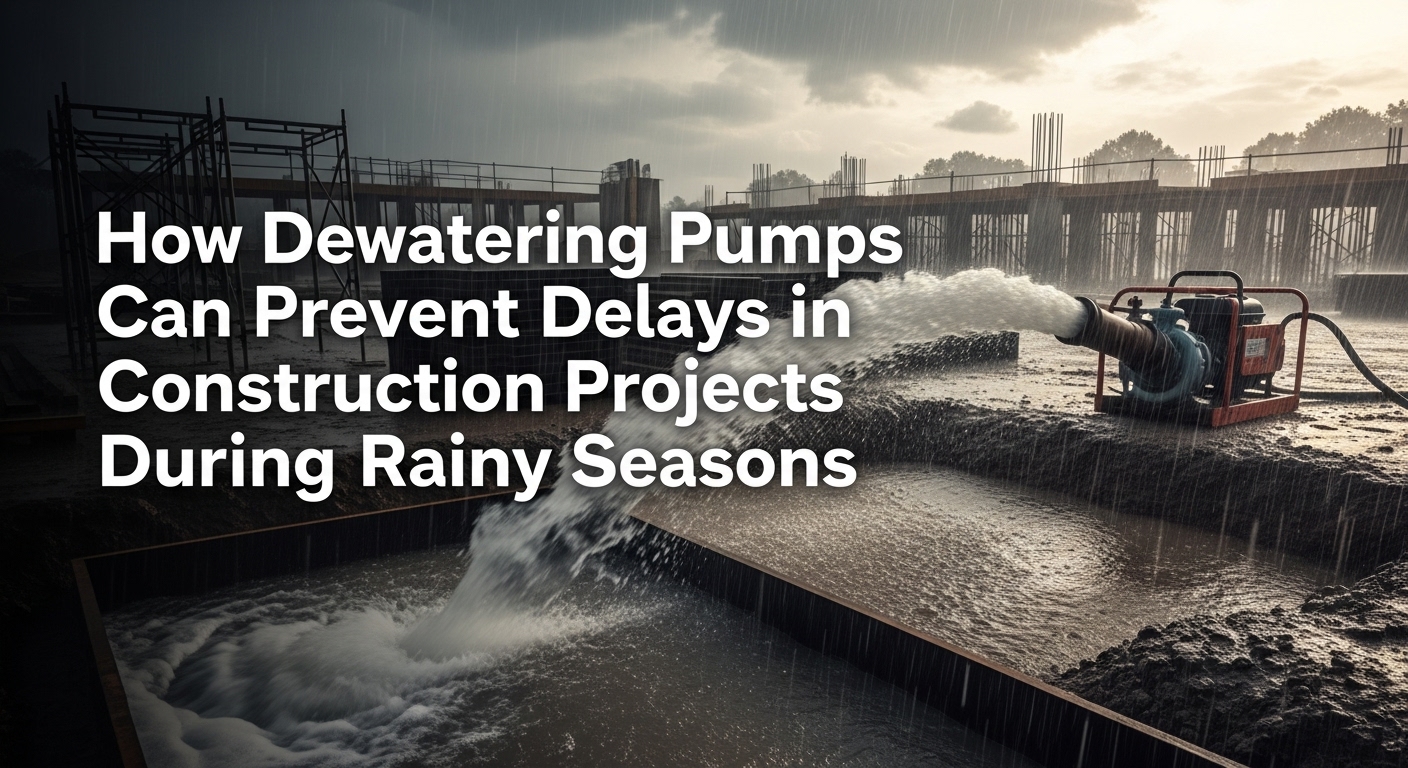
Rainy seasons pose significant challenges for construction projects, primarily due to water accumulation that can cause delays and increase costs. An effective solution to manage this issue is the implementation of dewatering pumps, specialized equipment designed to remove excess water swiftly and efficiently from construction sites.
Construction projects are complex endeavors that require careful planning and execution. One of the major challenges that can impede progress is the management of water, especially during rainy seasons. Excess water can cause delays, increase costs, and compromise safety on construction sites. This comprehensive guide explores the role of dewatering pumps in maintaining project timelines and ensuring safety by efficiently managing water on construction sites.
The Importance of Dewatering in Construction
Effective water management through dewatering is crucial for maintaining the structural integrity and safety of a construction site. Without proper dewatering, projects can face numerous issues:
- Foundation instability caused by waterlogged soil reducing bearing capacity and structural support
- Excavation site flooding that prevents safe access and equipment operation
- Soil erosion and slope failures that compromise site safety and project boundaries
- Delayed project timelines as wet conditions prevent concrete curing and equipment operation
- Increased project costs from extended schedules, equipment damage, and emergency remediation
- Worker safety hazards from standing water, slippery surfaces, and electrical risks
- Equipment damage and corrosion from prolonged water exposure
- Environmental compliance violations from uncontrolled water discharge and sediment pollution
The Significance of Dewatering in Construction
Dewatering is a critical process in construction that involves the removal of water from the soil or foundation area. This process is particularly important in areas with high water tables or during periods of heavy rainfall. Effective dewatering can prevent problems such as soil erosion, waterlogged digging sites, and unstable foundations.
Strategic dewatering serves multiple purposes in construction operations: it maintains safe working conditions by preventing water accumulation; preserves soil stability and bearing capacity essential for structural support; protects excavation and foundation work from water intrusion; enables equipment operation and material handling; and supports project schedules by maintaining workable conditions regardless of weather.
Understanding Water's Impact on Construction Sites
Water accumulation on construction sites creates immediate and long-term challenges affecting project success. Groundwater seeping into excavations raises water tables, flooding work areas and creating hazardous conditions. Surface water from rainfall accumulates in low areas and trenches, preventing equipment access and work progression.
Standing water destabilizes soil surrounding excavations, increasing collapse risks and requiring expensive stabilization measures. Water penetrating foundation areas compromises structural integrity and creates future moisture problems. Delayed evaporation and drainage during wet seasons extends project timelines and increases overhead costs. Proper dewatering prevents these complications, enabling consistent project progress and maintaining structural quality.
Comprehensive Overview of Dewatering Pumps
Dewatering pumps are specialized devices designed to remove excess water efficiently. These pumps are essential for maintaining dry conditions in various construction scenarios. Here's a closer look at the types of dewatering pumps used:
Types of Dewatering Pumps and Their Applications
Submersible Pumps
These pumps operate completely underwater and are perfect for areas with significant water accumulation. They are robust, reliable, and can handle large volumes of water, making them ideal for deep excavation sites, foundation work, and applications with sustained high water inflow. Submersible pumps eliminate suction limitations and operate efficiently even in deep water conditions where surface-mounted pumps would fail.
Submersible pumps feature sealed motor designs protecting electrical components from water exposure and contamination. Their ability to handle partially contaminated water makes them suitable for construction site applications where groundwater may contain sediment and debris. Typical flow rates range from 40 to 300+ gallons per minute depending on model and power rating.
Centrifugal Pumps
Often used on construction sites for pumping out water with lower solids content, centrifugal pumps are effective for surface-level water and are easier to install and move around compared to submersible alternatives. These pumps operate on the principle of converting rotational energy into kinetic energy, ideal for high-flow applications with clean or slightly contaminated water.
Centrifugal pumps deliver excellent flow rates for moderate head applications, making them economical choices for dewatering surface water accumulation. However, they require proper priming and are less effective than submersible or positive displacement pumps when handling abrasive or sediment-laden water.
Trash Pumps
Specifically designed to handle large debris and heavily contaminated water, trash pumps are essential in construction and demolition scenarios where water contains concrete particles, soil, gravel, and other solid materials. These pumps feature larger passages and oversized impellers compared to standard centrifugal pumps, enabling them to move debris that would clog conventional equipment.
Trash pumps typically handle solids up to 3 inches in diameter, though larger models can manage even bigger particles. Their robust construction and sealed bearing systems withstand abrasive material wear, maintaining reliability throughout extended dewatering operations. Typical applications include demolition site cleanup, aggregate washing water, and excavation dewatering with high debris loads.
Diaphragm Pumps
These positive displacement pumps are used for more viscous fluids or when the water contains significant sediment, sludge, or thick mud. Their design uses reciprocating diaphragms to move fluid without requiring large passages, allowing effective handling of thick materials that would clog centrifugal pumps.
Diaphragm pumps provide consistent flow regardless of back-pressure variations, making them excellent for systems with variable discharge conditions. Their ability to handle priming problems and self-priming capabilities enable quick startup even when suction lines contain air. Applications include dewatering with high silt and sediment content, sludge removal, and systems requiring gentle fluid handling.
Positive Displacement Pumps
Best suited for moving thick fluids or fluids containing larger solids, these pumps maintain consistent flow by physically displacing a fixed volume of fluid with each cycle. They excel when the water contains significant amounts of mud, sludge, or debris that standard centrifugal pumps cannot handle.
Positive displacement pumps generate higher pressures than centrifugal alternatives, enabling operation against substantial back-pressure. This capability proves valuable when discharge requires long distance conveyance or significant elevation gain. However, their lower flow rates compared to centrifugal pumps make them less suitable for high-volume, low-pressure applications.
High-Pressure Pumps
Utilized for applications requiring significant head or long-distance water conveyance, high-pressure pumps are crucial when water needs to be moved over extended distances or to higher elevations. These specialized pumps maintain sufficient pressure to overcome friction losses in discharge piping and gravitational head requirements.
High-pressure models enable dewatering operations on sloping sites, hillside construction, or scenarios where discharge points are significantly elevated above collection points. While offering impressive pressure capabilities, these pumps typically deliver lower flow rates than standard centrifugal alternatives.
Deploying Dewatering Pumps: Strategic Considerations
Selecting the right dewatering pump depends on several critical factors requiring careful evaluation:
- Water Volume and Flow Rate: Assess average and peak water inflow rates to determine required pump capacity. Undersized pumps cannot keep up with water accumulation, while oversized equipment wastes energy and capital
- Water Quality and Contamination: Determine sediment levels, debris size, and fluid viscosity to select appropriate pump types. Clean water systems suit centrifugal pumps, while debris-laden or thick fluids require trash pumps or positive displacement alternatives
- Head Requirements: Calculate discharge elevation above collection point and piping friction losses to determine required pump pressure rating. Underestimating head requirements results in inadequate flow, while excessive capacity increases costs
- Site Conditions: Consider available space for pump installation, power supply limitations, noise restrictions, and accessibility for maintenance. Confined spaces may require submersible units, while remote locations might benefit from portable centrifugal alternatives
- Operating Duration: Projects requiring continuous operation may justify larger capacity or redundant systems, while short-term dewatering suits rental equipment and portable solutions
- Environmental Regulations: Verify discharge requirements including sediment settling, permit requirements, and environmental impact assessments. Some jurisdictions mandate sediment filtration or treatment before discharge
- Cost Considerations: Evaluate capital costs, rental rates, fuel or electrical consumption, and maintenance requirements. Life-cycle cost analysis often reveals that higher-capacity equipment reduces total project costs through faster completion and reduced overhead
- Redundancy and Backup: Consider system reliability importance and potential consequences of pump failure. Critical applications often justify redundant systems ensuring continuous dewatering capability
Dewatering Strategies and Best Practices
Effective dewatering requires more than selecting appropriate pumps; strategic implementation ensures optimal results:
Site Preparation and Collection Points
Establish collection sumps or collection areas strategically positioned to gather water from high-point areas. Slope site grades to guide surface water toward collection points, minimizing scattered water and concentrating flows for efficient pumping. Install perimeter berms or grading to prevent water from escaping the collection area.
Pump Placement and Configuration
Position pumps to minimize suction line length and friction losses. Install intake screens to prevent debris from entering pumps and causing damage. Provide adequate submersion depth to prevent vortexing and air entrainment into pump suction. Use check valves on discharge lines to prevent backflow when pumps shut down.
Discharge Management
Direct pump discharge to appropriate disposal areas, following environmental regulations regarding sediment control and water quality. Install sediment settling basins or filtration systems when regulations require treated discharge. Ensure discharge piping routes water away from site boundaries and neighboring properties.
Monitoring and Maintenance
Establish regular monitoring routines to track water levels and system performance. Check pump intake screens frequently, cleaning as needed to prevent clogging. Monitor discharge lines for leaks or obstructions. Document system operation including run times and water volumes removed, providing data for project planning and troubleshooting.
Maintenance and Sustainability in Dewatering Operations
Proper maintenance of dewatering pumps is essential for their longevity and efficiency. Regular checks and servicing can prevent breakdowns and ensure consistent performance:
- Daily visual inspection of pump condition, intake screens, and discharge piping for damage or leaks
- Weekly cleaning of intake screens and strainers to maintain flow efficiency
- Monthly verification of electrical connections, grounding, and motor operation
- Quarterly oil changes and fluid level checks for gas-powered equipment
- Seasonal maintenance before and after periods of intensive use
- Professional servicing at manufacturer-recommended intervals for mechanical inspection and component replacement
As environmental sustainability becomes increasingly important, the construction industry is focusing on dewatering practices that minimize ecological impact. This includes selecting energy-efficient pumps, properly treating water before discharge to remove sediment and contaminants, managing discharge volumes to prevent environmental stress, and utilizing treated water for dust suppression and other beneficial site uses rather than discharging all volumes to storm systems.
Future Trends in Dewatering Technology
Advancements in dewatering technology continue to improve the efficiency and environmental impact of these systems:
Automated Monitoring Systems
Integration of automated sensors monitoring water levels, flow rates, and pump performance enables intelligent system operation. These systems automatically adjust pump speed and operation in response to changing conditions, optimizing energy consumption and reducing manual intervention requirements.
Energy Efficiency Improvements
Variable frequency drive technology enables pumps to operate at speeds matching actual flow requirements, reducing energy consumption by 20-50% compared to fixed-speed operation. Modern pump designs feature optimized hydraulics and high-efficiency motors delivering superior performance with reduced power requirements.
Water Treatment Integration
On-site water treatment systems enable discharge of filtered water meeting environmental standards, supporting water recycling for site dust control and other beneficial uses. Advanced filtration and settling technologies reduce environmental impact while recovering valuable water resources.
Smart Equipment Management
IoT connectivity enables remote monitoring and control of dewatering systems, providing site managers with real-time performance data accessible from anywhere. Predictive maintenance algorithms analyze equipment data to identify upcoming maintenance needs before failures occur.
Modular and Scalable Systems
Modern dewatering solutions feature modular designs enabling rapid reconfiguration as site conditions change. Scalable systems start with minimal capacity and expand as needs evolve, optimizing capital investment and equipment utilization.
Conclusion
Dewatering pumps are essential tools in modern construction, enabling projects to proceed on schedule regardless of weather conditions and site water challenges. The variety of available pump types ensures appropriate solutions exist for every construction scenario, from clean water surface dewatering to heavy-sediment and debris-laden applications.
By selecting appropriate pump types based on site-specific requirements, ensuring proper installation following manufacturer guidelines, and conducting regular maintenance throughout operation, construction managers can effectively mitigate water management challenges. This proactive approach prevents delays, protects worker safety, preserves structural quality, and ensures projects maintain budgets and schedules despite environmental challenges.
Investing in high-quality dewatering solutions, whether through equipment purchase or strategic rental programs, represents a wise project management decision. Modern dewatering technology, combined with strategic site planning and maintenance practices, ensures reliable water management supporting successful project completion. As construction sites face increasingly intense rainfall events and challenging environmental conditions, effective dewatering capabilities become ever more critical to achieving project success.