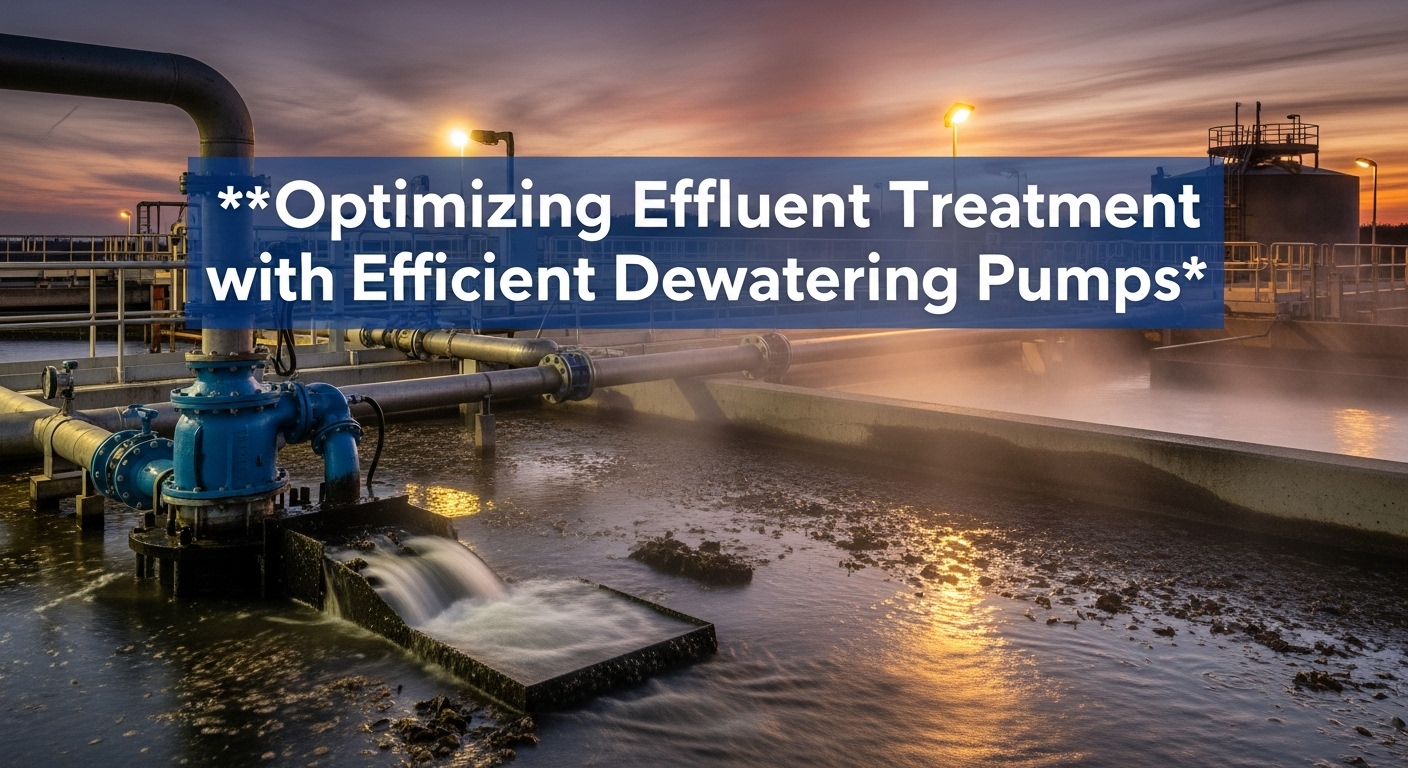
In the realm of industrial wastewater management, optimizing effluent treatment with efficient dewatering pumps is critical for maintaining environmental compliance, operational efficiency, and sustainable business practices. A cornerstone of effective wastewater management is the strategic use of dewatering pumps, which are specifically designed to handle the complex challenges posed by high volumes of wastewater containing solids, sludge, and various contaminants. This comprehensive blog delves deep into the types of dewatering pumps, their industrial applications, technological advancements, selection criteria, and best practices to optimize their use in effluent treatment systems.
Effluent treatment plants (ETPs) play a crucial role in industrial operations by treating wastewater before discharge, ensuring compliance with increasingly stringent environmental regulations. The efficiency of these treatment systems heavily depends on the performance of dewatering pumps, which must reliably handle varying flow rates, solid concentrations, and chemical compositions while minimizing energy consumption and maintenance requirements. Selecting the right dewatering pump configuration can reduce operational costs by 30-40% while significantly improving treatment efficiency and environmental outcomes.
Understanding Dewatering in Effluent Treatment
Dewatering is a critical process in wastewater treatment that involves removing water from solid materials or slurries to reduce volume, facilitate disposal, and enable resource recovery. This process is essential across multiple stages of effluent treatment, from preliminary solid separation to final sludge disposal. Effective dewatering reduces transportation costs, improves downstream processing efficiency, and enables valuable material recovery from industrial waste streams.
The Dewatering Process in ETPs
- Primary Treatment: Initial separation of suspended solids using settling tanks and clarifiers, where dewatering pumps transfer settled sludge to thickening processes
- Secondary Treatment: Biological treatment processes generating activated sludge requiring efficient pumping to dewatering equipment
- Tertiary Treatment: Advanced treatment creating concentrated waste streams needing specialized pump handling
- Sludge Thickening: Reducing sludge volume by removing free water before further processing
- Mechanical Dewatering: Using centrifuges, belt presses, or filter presses to achieve 15-35% dry solids content
- Sludge Disposal: Transporting dewatered cake to landfills, incinerators, or beneficial reuse applications
Key Performance Indicators for Dewatering Systems
- Solids Capture Rate: Percentage of solids retained versus lost to filtrate (target: 90-98%)
- Cake Dryness: Dry solids content in dewatered cake (typical range: 15-35% depending on process)
- Throughput Capacity: Volume of sludge processed per hour meeting treatment requirements
- Energy Efficiency: Kilowatt-hours per cubic meter of sludge processed
- Polymer Consumption: Chemical conditioning requirements affecting operational costs
- Filtrate Quality: Contaminant levels in separated water returned to treatment processes
- Equipment Availability: Uptime percentage ensuring continuous treatment operations
- Maintenance Requirements: Frequency and cost of preventive and corrective maintenance
Types of Dewatering Pumps and Their Applications
Submersible pumps are engineered to operate while fully submerged, making them ideal for pumping liquids with heavy solid content in challenging environments. They are widely used in mining, wastewater treatment, flood control, and industrial processes where handling large volumes of water and slurry is necessary. Their submersible design provides self-priming capability, natural cooling, and protection from environmental elements, making them the preferred choice for demanding dewatering applications.
Comprehensive Pump Classification for Effluent Treatment
1. Submersible Pump 1 HP
This variant is perfect for small to medium-scale effluent treatment applications. Its 1 HP motor provides an optimal balance between power and energy efficiency, ideal for residential wastewater treatment, small industrial facilities, or light commercial operations where water extraction needs are moderate.
Technical Specifications:
- Power Output: 0.75 kW (1 HP) typically consuming 3-4 amps at 230V single-phase
- Flow Rate: 50-100 liters per minute (3-6 m³/hour) depending on head pressure
- Maximum Head: 20-30 meters providing adequate pressure for most applications
- Solid Handling: Particles up to 15-20mm diameter without clogging
- Construction: Cast iron or stainless steel housing with corrosion-resistant components
- Operating Depth: Suitable for installations 5-30 meters deep
Ideal Applications:
- Small-scale ETP installations serving single facilities or small industrial parks
- Residential sewage treatment plants handling 50-100 households
- Agricultural wastewater treatment from dairy farms or food processing
- Commercial building wastewater management including restaurants and hotels
- Groundwater control in small construction or excavation projects
- Emergency backup pumping for critical process areas
2. Drainage Pumps
Primarily used in construction, agriculture, municipal settings, and industrial facilities, these pumps handle both clean and moderately dirty water, efficiently expelling it from flooded areas, drainage systems, or collection sumps. Their versatile design makes them essential for managing surface water, rainwater runoff, and light industrial effluents.
Key Features:
- High flow rates (100-500 liters per minute) with moderate head capacity optimized for surface water
- Automatic float switch operation enabling unattended operation during variable flow conditions
- Corrosion-resistant construction suitable for long-term outdoor installation
- Compact designs fitting standard drainage sumps and collection pits
- Pass solids up to 25-35mm preventing clogging from debris and sediment
- Energy-efficient motors reducing operational costs during frequent operation
- Portable configurations with carrying handles for temporary installations
Industrial Applications:
- ETP preliminary treatment removing floating debris and surface water
- Stormwater management preventing flooding of treatment facilities
- Equalization basin drainage transferring water between treatment stages
- Construction site dewatering during ETP installation or expansion
- Agricultural runoff collection from livestock operations and crop processing
- Industrial floor drainage from production areas and wash-down operations
- Cooling tower drainage and condensate management systems
3. Sludge Pumps and Sewage Sludge Pumps
These robust pumps are specifically designed to handle thick, viscous materials and slurries found in sewage and industrial wastewater treatment. Their powerful mechanisms, specialized impellers, and hardened components prevent clogging while efficiently moving high-solids content fluids, making them essential in municipal sewage treatment plants and industrial ETPs.
Advanced Design Features:
- Agitator functionality preventing solid settlement in sumps and maintaining pumpability
- Wide suction inlets (100-200mm) accommodating high-viscosity sludge and chunky materials
- Low-speed, high-torque operation (600-1200 RPM) reducing wear while maintaining efficiency
- Hardened chromium alloy impellers resisting abrasion from grit and debris
- Special sealing arrangements with silicon carbide mechanical seals protecting motors
- Handles sludge with dry solid content up to 8-12% depending on configuration
- Recessed or vortex impellers minimizing contact with solids
- Heavy-duty construction with replaceable wear plates extending service life
Critical ETP Applications:
- Primary Sludge Handling: Pumping settled solids from primary clarifiers to thickeners (2-6% solids content)
- Waste Activated Sludge (WAS): Transferring biological sludge from secondary treatment (0.8-1.2% solids)
- Thickened Sludge Transfer: Moving concentrated sludge to dewatering equipment (4-8% solids)
- Digested Sludge Pumping: Handling stabilized sludge from anaerobic or aerobic digesters
- Chemical Sludge Management: Processing metal hydroxide sludges from chemical precipitation
- Filter Press Feed: Supplying dewatering equipment with conditioned sludge
- Centrifuge Feed Systems: Providing steady flow to mechanical dewatering centrifuges
- Sludge Recirculation: Returning activated sludge to aeration basins for biological treatment
4. Submersible Sewage Pumps
These specialized pumps are equipped to handle raw sewage containing significant solid content including organic matter, fibrous materials, and debris. They are typically installed in municipal and industrial wastewater treatment plants where they transport untreated sewage from collection systems to preliminary treatment facilities, operating continuously under demanding conditions.
Technical Capabilities:
- Non-clog impeller designs (vortex, channel, or semi-open) passing solids 50-80mm diameter
- Flow capacities ranging from 100 to 2000+ liters per minute for various facility sizes
- Head pressures up to 30-50 meters enabling long-distance sewage transfer
- Double mechanical seals with oil bath lubrication protecting motor integrity
- Thermal overload protection preventing damage from excessive temperatures or overload
- Corrosion-resistant materials including cast iron, stainless steel 304/316, or duplex alloys
- Automatic operation with level sensors or float switches for hands-free management
- Grinder or macerator options for challenging solid compositions
Industrial Wastewater Applications:
- Raw Sewage Lift Stations: Pumping untreated wastewater from collection sewers to ETPs
- Industrial Effluent Collection: Managing process wastewater from manufacturing operations
- Food Processing Waste: Handling high-strength organic wastewater with food particles
- Textile Industry Effluent: Pumping dye-laden wastewater with fiber content
- Pharmaceutical Wastewater: Managing chemical-laden process water and cleaning effluents
- Brewery and Beverage: Transferring high-BOD wastewater with yeast and organic solids
- Slaughterhouse Effluent: Handling blood, grease, and organic waste streams
- Chemical Manufacturing: Pumping contaminated wastewater requiring careful material selection
5. Cutter Pumps
Featuring integrated cutting mechanisms to shred fibrous materials, rags, plastics, and other debris, these pumps are suitable for processing waste with heavy solids that might block other types of pumps. The cutting action reduces particle size before pumping, enabling the use of smaller diameter discharge pipes and preventing downstream equipment clogging.
Cutting System Technology:
- Hardened steel cutting blades rotating at 2000-3000 RPM creating shearing action
- Stationary cutter bar working with rotating blades like scissors
- Reduces solid particle size to 6-10mm enabling pumping through 50-75mm pipes
- Replaceable blade cartridges allowing maintenance without complete pump removal
- High-power motors (3-15 HP) providing torque needed for cutting action
- Prevents clogging from textiles, sanitary products, plastic bags, and fibrous materials
- Allows 50-70% reduction in discharge pipe diameter compared to conventional sewage pumps
- Enables longer pumping distances due to reduced friction losses
ETP and Industrial Applications:
- Textile Mill Effluent: Processing wastewater containing fiber, thread, and fabric waste
- Hospital Wastewater: Handling medical waste including bandages, gauze, and sanitary items
- Food Processing Plants: Managing waste with vegetable peels, packaging, and organic fibers
- Pulp and Paper Mills: Pumping wastewater laden with pulp fibers and paper waste
- Municipal Pumping Stations: Serving combined sewer areas with high rag content
- Residential Developments: Managing sewage from large residential complexes
- Shopping Malls: Processing wastewater from multiple sources with varied solid content
- Industrial Parks: Centralized sewage collection from diverse industries
6. Submersible Dewatering Pumps
Often used in mining, tunneling, construction, and industrial applications, these pumps are designed to remove large volumes of water from deep surfaces, sumps, and excavations, ensuring site stability, preventing flooding, and enabling continuous operations. Their high flow capacity and robust construction make them essential for challenging dewatering scenarios.
Performance Characteristics:
- Ultra-high flow rates (500-3000+ liters per minute) for rapid water removal
- Handles dirty water with particles up to 35-50mm without clogging
- Abrasion-resistant materials extending life in harsh, grit-laden environments
- Automatic float switches enabling unattended 24/7 operation
- Thermal overload and dry-run protection preventing motor damage
- Portable designs with lifting eyes and carrying handles for easy deployment
- Low suction capability draining to 5-10mm residual depth
- Dual-voltage options (230V/415V) for flexible power configurations
Industrial and ETP Applications:
- ETP Construction: Dewatering excavations during treatment plant installation or expansion
- Sump Management: Removing infiltration and process water from collection sumps
- Emergency Flooding: Rapid response to equipment failures, pipe breaks, or extreme weather
- Tank Draining: Emptying clarifiers, reactors, and storage tanks for maintenance
- Groundwater Control: Managing water table during underground construction
- Mining Operations: Continuous dewatering of pits, shafts, and underground workings
- Tunnel Construction: Removing water ingress during boring and excavation
- Industrial Sumps: Managing process water, cooling water, and condensate accumulation
Pump Selection Decision Matrix
The selection of a dewatering pump depends on multiple application-specific factors that must be carefully evaluated to ensure optimal performance, reliability, and cost-effectiveness:
- Liquid Characteristics: Type of effluent (sewage, industrial waste, chemical process water), pH level (acidic/neutral/alkaline), temperature range, viscosity, and specific gravity
- Solids Content: Concentration (percentage by weight), maximum particle size, type (organic vs inorganic, fibrous vs granular), abrasiveness, and settlement characteristics
- Hydraulic Requirements: Required flow rate (LPM or m³/hr), total dynamic head (vertical lift plus friction losses), system pressure requirements, and variation in operating conditions
- Installation Constraints: Available sump or pit dimensions, installation depth, access for maintenance, electrical power availability (single/three-phase), and environmental conditions
- Operating Profile: Duty cycle (continuous vs intermittent), seasonal variations, peak demand periods, redundancy requirements, and automation needs
- Regulatory Compliance: Discharge standards, noise regulations, energy efficiency mandates, and safety requirements
- Economic Factors: Capital budget, operating cost targets, maintenance resource availability, and lifecycle cost objectives
Each pump type offers different features including high durability, energy efficiency, anti-clog capability, and low maintenance costs, which are critical for optimizing ETP operations and extending service life. A systematic evaluation using these criteria ensures selection of the most appropriate pump configuration for each specific application.
Technological Enhancements in Modern Dewatering Pumps
Modern dewatering systems incorporate advanced technology to improve efficiency, reliability, and adaptability, transforming traditional pumping operations into intelligent, self-optimizing systems that reduce energy consumption, predict maintenance needs, and maximize treatment plant uptime.
1. Automated Controls and Smart Monitoring
Smart sensors and automated control systems enable pumps to adjust operation based on varying conditions without manual intervention, enhancing efficiency, preventing failures, and optimizing energy consumption throughout changing operational conditions.
Advanced Automation Features:
- Variable Frequency Drives (VFD): Adjusting motor speed to match actual flow demand, reducing energy consumption by 30-50% compared to fixed-speed operation
- Level Control Systems: Ultrasonic, pressure, or capacitance sensors maintaining optimal sump levels preventing overflow or dry running
- Multi-Pump Sequencing: Intelligent control alternating pump operation distributing wear evenly and providing automatic backup
- Pressure Management: Maintaining constant discharge pressure regardless of flow variations or head changes
- Flow Monitoring: Electromagnetic or ultrasonic flowmeters tracking instantaneous and cumulative flow for process optimization
- Remote SCADA Integration: Connection to supervisory control systems enabling facility-wide monitoring and control
- Predictive Algorithms: Machine learning analyzing operational patterns to predict maintenance needs and optimize performance
- Alarm Management: Multi-level alerts (warning, critical, emergency) notifying operators of abnormal conditions via SMS, email, or control room displays
Real-Time Monitoring Capabilities:
- Performance Tracking: Continuous monitoring of flow rate, pressure, power consumption, and efficiency metrics
- Vibration Analysis: Detecting bearing wear, imbalance, and mechanical problems before failure
- Temperature Monitoring: Motor winding and bearing temperature tracking preventing overheating damage
- Current Monitoring: Detecting motor overload, single-phasing, or electrical anomalies
- Seal Condition: Moisture detection in seal chambers providing early warning of seal degradation
- Runtime Tracking: Recording operating hours for maintenance scheduling and equipment lifecycle management
- Historical Data: Long-term trend analysis identifying performance degradation and optimization opportunities
2. Energy-Efficient Designs
New pump models focus intensively on reducing energy consumption, which is crucial in minimizing operational costs and environmental impact. Given that pumping can represent 40-60% of an ETP's energy consumption, efficiency improvements deliver substantial economic and environmental benefits.
Energy Optimization Technologies:
- High-Efficiency Motors: IE3 and IE4 rated motors achieving 92-95% efficiency compared to 85-88% for standard motors
- Optimized Hydraulics: Computational fluid dynamics (CFD) designed impellers minimizing turbulence and maximizing hydraulic efficiency to 80-85%
- Low-Friction Materials: Polished impeller surfaces and advanced coatings reducing friction losses by 5-10%
- Magnetic Bearings: Eliminating mechanical friction and lubrication requirements in large pumps
- Soft-Start Technology: Reducing starting current surge by 50-70% minimizing electrical infrastructure requirements
- Power Factor Correction: Automatic capacitor banks improving power factor from 0.75-0.80 to 0.95+ reducing utility charges
- Energy Recovery: Regenerative VFD systems recovering energy during pump deceleration
- Right-Sizing: Proper pump selection ensuring operation at best efficiency point (BEP) maximizing energy efficiency
Energy Management Systems:
- Real-Time Energy Monitoring: kWh meters tracking energy consumption per cubic meter of effluent processed
- Efficiency Trending: Comparing current performance against baseline identifying degradation
- Benchmarking: Comparing facility energy intensity against industry standards and best practices
- Optimization Recommendations: AI-powered analysis suggesting operational improvements reducing energy consumption
- Demand Response: Shifting non-critical pumping to off-peak hours reducing electricity costs by 20-30%
- Carbon Footprint Tracking: Calculating CO₂ emissions from pumping operations supporting sustainability reporting
3. Anti-Clog Features and Enhanced Solids Handling
Innovations such as advanced impellers and cutter systems are designed to handle large debris, fibrous materials, and high solids concentrations, reducing downtime due to clogs, minimizing maintenance requirements, and ensuring continuous ETP operation.
Advanced Anti-Clog Technologies:
- Self-Cleaning Impellers: Hydraulic designs creating vortices that prevent solid buildup on impeller surfaces, maintaining efficiency over time
- Large Flow Passages: 80-120mm clearances allowing passage of bulky solids without blockage
- Vortex Impellers: Recessed designs where solids never contact the impeller, eliminating clogging in high-solids applications
- Channel Impellers: Single or dual-channel designs providing large, unobstructed flow paths for sewage and sludge
- Integrated Maceration: Built-in cutting systems reducing all solids to 6-10mm before pumping
- Back-Flushing Systems: Periodic flow reversal clearing inlet screens and preventing debris accumulation
- Ultrasonic Cleaning: High-frequency vibrations preventing biofilm and scale formation on critical surfaces
- Agitator Integration: Submersible agitators keeping solids suspended in sumps preventing settlement and clogging
Material Selection for Abrasion Resistance:
- Hardened Impellers: Heat-treated stainless steel or chromium alloy (hardness 55-65 HRC) resisting wear from abrasive particles
- Ceramic Coatings: Alumina or tungsten carbide thermal spray coatings on wear surfaces extending life 300-500%
- Replaceable Wear Plates: Easily changed wear components protecting pump casing and extending service life
- Elastomer Linings: Rubber or polyurethane liners absorbing impact in slurry applications
- Duplex Stainless Steel: Superior corrosion and abrasion resistance for demanding chemical environments
4. Digital Twin Technology
Creating virtual replicas of physical pump systems enabling simulation, optimization, and predictive maintenance without disrupting actual operations:
- Virtual Commissioning: Testing control strategies and operational scenarios before physical implementation
- Performance Simulation: Modeling system behavior under various conditions optimizing pump selection and sizing
- Predictive Maintenance: Simulating component wear predicting remaining useful life with 85-95% accuracy
- Training Platform: Operators practice procedures and emergency response in risk-free virtual environment
- Design Optimization: Testing modifications virtually before physical changes reducing implementation risk
- Lifecycle Management: Tracking asset performance from installation through retirement optimizing replacement timing
5. IoT and Industry 4.0 Integration
- Cloud Connectivity: Real-time data transmission to cloud platforms enabling remote monitoring from anywhere globally
- Mobile Applications: Smartphone and tablet apps providing pump status, alerts, and control capabilities
- Artificial Intelligence: Machine learning algorithms optimizing pump operation and predicting failures
- Blockchain Integration: Immutable maintenance records ensuring authenticity and supporting asset valuation
- 5G Connectivity: Ultra-low latency communication enabling real-time control and augmented reality maintenance support
- Cybersecurity: Multi-layer protection preventing unauthorized access and ensuring operational integrity
Operational Best Practices for Dewatering Systems
Effective management and maintenance of dewatering pumps are vital for ensuring their longevity, reliability, and optimal efficiency. Implementation of systematic best practices reduces unplanned downtime by 60-70%, extends equipment life by 30-50%, and ensures consistent ETP performance meeting discharge standards.
1. Regular Maintenance Programs
Scheduled inspections and maintenance prevent unexpected failures and extend the pump's lifespan significantly. A comprehensive preventive maintenance program is far more cost-effective than reactive repairs, typically costing 30-40% less while improving reliability.
Daily Maintenance Tasks:
- Visual Inspection: Check for unusual noise, vibration, or heating during operation indicating developing problems
- Performance Monitoring: Review flow rate, pressure, and power consumption comparing against baseline values
- Alarm Review: Investigate and document any alarm conditions or unusual events
- Level Verification: Ensure sump levels cycling normally without excessive high or low level alarms
- Control System Check: Verify automatic controls functioning properly and pumps alternating as programmed
- Leak Detection: Inspect seals, flanges, and connections for signs of leakage
Weekly Maintenance Tasks:
- Sump Cleaning: Remove floating debris, scum, and trash from pump sumps preventing intake blockage
- Screen Inspection: Clean inlet screens, gratings, and bar screens removing accumulated debris
- Grease Level Check: Verify lubrication levels in mechanical seal systems
- Float Switch Test: Manually test automatic level controls ensuring proper operation
- Electrical Inspection: Check control panel for overheating, loose connections, or signs of moisture
- Backup System Test: Verify standby pumps activate properly during simulated failures
Monthly Maintenance Tasks:
- Vibration Analysis: Measure vibration levels at key points detecting bearing wear or imbalance
- Insulation Resistance: Megger test motor windings ensuring electrical integrity (minimum 5 megohms)
- Current Measurement: Verify running current within rated range indicating proper loading
- Pressure Testing: Check discharge pressure at known flow rates validating pump performance
- Seal Inspection: Examine mechanical seal condition, lubrication, and temperature
- Cable Inspection: Inspect power and control cables for damage, chafing, or deterioration
- Control Calibration: Verify level sensors, pressure transducers, and flowmeters reading accurately
Quarterly Maintenance Tasks:
- Deep Cleaning: Thoroughly clean pump sumps, wet wells, and collection areas removing sediment
- Impeller Inspection: Pull pump for visual inspection of impeller condition, wear, and damage
- Seal Examination: Detailed inspection of mechanical seal faces, springs, and O-rings
- Bearing Assessment: Check bearing condition, clearances, and lubrication quality
- Alignment Check: Verify motor-pump alignment within specifications
- Fastener Torque: Check and retighten all bolts and fasteners to specified torque
- Performance Testing: Conduct full-load performance test recording flow, head, and power consumption
- Spare Parts Inventory: Review and replenish spare parts stock based on consumption rates
Annual Maintenance Tasks:
- Complete Overhaul: Remove pump for comprehensive inspection and reconditioning
- Component Replacement: Replace wear items including seals, bearings, O-rings, and wear rings based on condition
- Motor Testing: Complete electrical testing including insulation resistance, winding resistance, and load testing
- Coating Inspection: Check protective coatings and repaint/recoat as needed
- System Calibration: Recalibrate all instruments, sensors, and control systems
- Documentation Update: Update maintenance records, performance baselines, and equipment history
- Training Refresh: Conduct operator training on procedures, troubleshooting, and emergency response
2. Proper Installation Practices
Correct installation is critical for optimal operation, equipment longevity, and preventing premature failures. Poor installation is responsible for 40-50% of early pump failures, making proper commissioning essential for reliable long-term performance.
Pre-Installation Planning:
- Site Assessment: Evaluate sump dimensions, depth, access for maintenance, and environmental conditions
- Foundation Design: Ensure adequate structural support for pump weight and dynamic loads
- Piping Design: Optimize discharge piping for minimal friction losses and proper flow velocity (1.5-3 m/s)
- Electrical Planning: Verify adequate power capacity, proper circuit protection, and grounding systems
- Safety Considerations: Plan confined space entry procedures, lifting equipment, and fall protection
- Permits and Approvals: Obtain necessary electrical, plumbing, and safety permits before starting work
Installation Procedures:
- Proper Depth: Install pump at correct depth ensuring adequate submergence (minimum 1 meter above pump) for cooling and preventing vortex formation
- Level Installation: Ensure pump sits level preventing bearing loading and seal damage
- Guide Rail System: Install guide rails allowing easy pump removal without disconnecting piping
- Discharge Piping: Use proper size piping (never smaller than pump discharge), minimize elbows, install check valves preventing backflow, and provide isolation valves for maintenance
- Cable Management: Secure cables to discharge pipe at 1-2 meter intervals preventing sagging, stress, or damage. Provide drip loops preventing water entry into connections
- Electrical Connections: Follow manufacturer wiring diagrams exactly, verify phase rotation for three-phase motors, install proper overload protection, and ensure excellent grounding (resistance < 5 ohms)
- Control Installation: Mount control panels above flood levels, protect from moisture and extreme temperatures, install proper circuit protection
- Float Switches: Position float switches at correct levels for automatic operation, verify clearances preventing interference
Commissioning Checklist:
- Pre-Start Checks: Verify all connections tight, rotation direction correct (for three-phase), sump filled with liquid
- Initial Startup: Monitor for unusual noise, vibration, or heating during first operation
- Performance Verification: Measure flow rate, pressure, and power consumption comparing against specifications
- Control Testing: Verify automatic controls, alarms, and interlocks functioning properly
- Documentation: Record baseline performance data, as-built drawings, and commissioning test results
- Training: Train operators and maintenance staff on proper operation and troubleshooting procedures
3. Monitoring and Adjustments
Continuously monitoring pump performance helps detect issues early, enabling proactive interventions before minor problems escalate into major failures. Adjustments might be needed to deal with changes in water table, sludge viscosity, solid content, or seasonal variations.
Performance Monitoring Systems:
- Flow Measurement: Electromagnetic or ultrasonic flowmeters providing real-time and totalizing flow data
- Pressure Monitoring: Discharge pressure gauges or transducers indicating system resistance and pump condition
- Power Monitoring: Current and voltage measurement revealing electrical problems or mechanical loading changes
- Vibration Monitoring: Accelerometers detecting developing mechanical problems before failure
- Temperature Tracking: Motor winding, bearing, and seal chamber temperature indicating cooling adequacy
- Level Monitoring: Continuous sump level recording revealing influent patterns and pump capacity adequacy
Key Performance Indicators (KPIs):
- Specific Energy: kWh per cubic meter pumped compared against baseline (typical: 0.15-0.35 kWh/m³)
- Mean Time Between Failures (MTBF): Average operating hours between failures (target: > 10,000 hours)
- Availability: Percentage of time pump available for operation (target: > 95%)
- Pump Efficiency: Wire-to-water efficiency monitoring degradation over time
- Maintenance Costs: Annual maintenance expense as percentage of replacement cost (target: < 10%)
- Alarm Frequency: Number of alarm events per month indicating operational issues
Operational Adjustments:
- VFD Optimization: Adjust speed setpoints matching actual demand reducing energy consumption
- Sequencing Modification: Change pump rotation schedules balancing runtime and optimizing efficiency
- Level Setpoint Adjustment: Modify start/stop levels optimizing cycle frequency and motor life
- Alarm Threshold Tuning: Adjust alarm levels reducing nuisance alarms while catching real problems
- Chemical Dosing Optimization: Coordinate polymer addition with sludge pumping for optimal dewatering
- Sump Configuration: Modify inlet locations or install baffles improving flow patterns and reducing turbulence
4. Operator Training and Competency
- Operational Procedures: Standard operating procedures (SOPs) for startup, shutdown, and normal operation
- Troubleshooting Skills: Systematic problem diagnosis techniques identifying root causes
- Emergency Response: Procedures for equipment failures, power outages, and environmental releases
- Preventive Maintenance: Hands-on training in routine maintenance tasks and inspection techniques
- Safety Training: Electrical safety, confined space entry, lockout/tagout, and personal protective equipment
- System Understanding: How pumps integrate with overall ETP processes and impact treatment performance
- Documentation: Proper recording of maintenance activities, performance data, and incident reports
Troubleshooting Common Dewatering Pump Problems
Problem 1: Pump Won't Start
Possible Causes and Solutions:
- Power Supply Failure: Check circuit breakers, fuses, and electrical connections. Verify voltage at motor terminals
- Control System Fault: Inspect control panel, verify float switches functioning, check for error codes
- Motor Failure: Test motor winding resistance and insulation. Check thermal overload hasn't tripped
- Mechanical Seizure: Attempt manual rotation. If seized, pump requires removal and overhaul
- Low Level: Verify sufficient liquid level for float switch activation or level sensor reading
Problem 2: Reduced Flow or Pressure
Possible Causes and Solutions:
- Clogged Impeller: Remove pump, disassemble, and clean impeller and volute. Install inlet screening to prevent recurrence
- Worn Impeller: Measure impeller clearances and diameter. Replace if worn beyond specifications
- Air Entrainment: Check for vortexing indicating insufficient submergence. Lower pump or increase sump level
- Discharge Obstruction: Inspect piping for blockages, closed valves, or fouling. Clean or repair as needed
- Wrong Rotation: Verify three-phase motor rotation direction. Swap two phases if incorrect
- System Changes: Higher discharge head due to downstream modifications. Verify pump still properly sized for application
Problem 3: Excessive Power Consumption
Possible Causes and Solutions:
- Pump Overload: Pumping against higher head than designed. Verify system hasn't changed increasing resistance
- Voltage Imbalance: Check three-phase voltage balance. More than 2% imbalance causes inefficiency and overheating
- Mechanical Binding: Bearing wear or shaft misalignment increasing friction. Remove and inspect pump
- Viscosity Increase: Thicker sludge than designed requiring more power. Consider different pump or dilution
- Motor Degradation: Winding damage or bearing wear reducing motor efficiency. Test and repair or replace motor
Problem 4: Frequent Cycling
Possible Causes and Solutions:
- Undersized Sump: Insufficient volume between start and stop levels. Modify sump or adjust level setpoints
- Check Valve Failure: Leaking check valve allowing backflow. Replace check valve
- Float Switch Malfunction: Adjust float switch positions or replace defective switches
- Oversized Pump: Pump capacity too high for influent flow. Install VFD or replace with smaller pump
- Level Control Problems: Verify level sensors calibrated correctly and functioning properly
Regulatory Compliance and Environmental Considerations
Discharge Standards and Monitoring
- BOD Limits: Biological Oxygen Demand requirements (typically 30-100 mg/L depending on jurisdiction)
- TSS Limits: Total Suspended Solids regulations (typically 50-200 mg/L)
- pH Requirements: Acceptable range usually 6.0-9.0 requiring proper neutralization
- Heavy Metals: Strict limits on chromium, lead, mercury, cadmium, and other toxic metals
- Nutrient Removal: Nitrogen and phosphorus limits in environmentally sensitive areas
- Flow Monitoring: Continuous or periodic flow measurement for discharge permit compliance
- Sampling Protocols: Proper sample collection, preservation, and analysis procedures
- Reporting Requirements: Regular discharge monitoring reports (DMRs) to regulatory agencies
Energy Efficiency Regulations
- Minimum Efficiency Standards: MEPS (Minimum Energy Performance Standards) requiring high-efficiency motors
- IE Classification: International efficiency classes (IE2, IE3, IE4) mandating progressively better efficiency
- Energy Audits: Periodic assessment of energy consumption and optimization opportunities
- Carbon Reporting: Greenhouse gas emissions tracking and reduction targets
- Incentive Programs: Government rebates and incentives for energy-efficient equipment upgrades
Safety Regulations
- Electrical Safety: NEC/IEC compliance for electrical installations and protection
- Confined Space: Proper procedures for entry into pump sumps and wet wells
- Lockout/Tagout: Energy isolation procedures during maintenance activities
- Hazardous Area: ATEX/IECEx certification for pumps in potentially explosive atmospheres
- Personal Protective Equipment: Requirements for chemical resistance, electrical protection, fall protection
Cost-Benefit Analysis and ROI
Total Cost of Ownership Calculation
Example: Industrial ETP with 10 HP Sludge Pump
- Capital Costs: Pump ($15,000) + Installation ($5,000) + Controls ($3,000) = $23,000
- Annual Energy: 7.5 kW × 12 hrs/day × 300 days × $0.12/kWh = $3,240
- Annual Maintenance: Preventive ($2,000) + Repairs ($1,500) + Spare Parts ($1,000) = $4,500
- 10-Year Total: $23,000 + ($3,240 × 10) + ($4,500 × 10) = $100,400
Value of High-Efficiency Pumps
Comparing Standard vs High-Efficiency Pump (10 HP Application):
| Factor | Standard Pump | High-Efficiency Pump |
|---|---|---|
| Initial Cost | $23,000 | $28,000 |
| Motor Efficiency | 87% (IE2) | 93% (IE4) |
| Annual Energy Cost | $3,240 | $3,030 |
| Annual Maintenance | $4,500 | $3,800 |
| 10-Year Total Cost | $100,400 | $96,300 |
| Savings | $4,100 (4.1%) | |
| Payback Period | 5.6 years | |
Downtime Cost Analysis
- ETP Shutdown: Plant unable to discharge effluent, production halted (cost: $10,000-$50,000 per day)
- Regulatory Penalties: Discharge violations (fines: $5,000-$100,000 per incident)
- Emergency Repairs: After-hours service, expedited parts (premium: 200-300% of normal cost)
- Temporary Solutions: Rental pumps, tankering services (cost: $2,000-$10,000 per day)
- Environmental Damage: Cleanup costs, remediation, legal liability (cost: $50,000-$1,000,000+)
Even single prevented failure often justifies investment in quality pumps, redundancy, and preventive maintenance programs.
Future Trends in Dewatering and Effluent Treatment
Emerging Technologies
- Solid-State Pumps: Electromagnetic pumps with no moving parts eliminating wear and maintenance
- Nano-Materials: Self-cleaning surfaces preventing biofilm and scale formation
- Energy Harvesting: Recovering energy from pressure drops or flow for self-powered sensors
- Quantum Sensors: Ultra-precise sensing enabling atomic-level process control
- Biological Enhancement: Enzyme-embedded materials accelerating sludge breakdown
Sustainability Initiatives
- Circular Economy: Recovering valuable materials (phosphorus, metals, biosolids) from wastewater
- Energy Neutrality: ETPs generating as much energy as consumed through biogas and solar
- Water Reuse: Ultra-efficient treatment enabling industrial water recycling approaching 90-95%
- Zero Sludge: Advanced treatment eliminating sludge disposal through complete mineralization
- Carbon Sequestration: Capturing CO₂ from treatment processes for industrial use or storage
Conclusion
Efficiently managing wastewater through the use of dewatering pump submersible systems and other related technologies is vital for sustaining industrial operations, protecting environmental resources, and ensuring regulatory compliance. By selecting the right type of pump based on comprehensive application analysis, employing advanced technologies including automation and energy optimization, and adhering to rigorous maintenance best practices, industries can optimize their effluent treatment processes achieving superior performance and reliability.
This strategic approach not only helps in reducing operational costs by 25-40% through improved efficiency and reduced downtime, but also ensures consistent compliance with environmental standards, thereby contributing to sustainable industrial practices and corporate environmental responsibility. The integration of modern technologies—including IoT connectivity, predictive maintenance, VFD control, and advanced materials—transforms traditional dewatering systems into intelligent, self-optimizing components of Industry 4.0 manufacturing ecosystems.
As environmental regulations become increasingly stringent and energy costs continue rising, investment in high-quality dewatering pumps and comprehensive management systems delivers compounding returns through reduced energy consumption, extended equipment life, minimized downtime, and avoided regulatory penalties. The total cost of ownership perspective clearly demonstrates that premium-quality pumps with advanced features provide superior long-term value compared to budget alternatives, with payback periods typically under 3-5 years for most industrial applications.
Looking forward, the dewatering and effluent treatment industry stands at the threshold of revolutionary advances driven by digitalization, artificial intelligence, and sustainability imperatives. Facilities investing in modern pumping infrastructure today position themselves advantageously for tomorrow's operational and environmental challenges. The convergence of energy efficiency, predictive maintenance, resource recovery, and environmental stewardship creates unprecedented opportunities for industrial facilities to achieve operational excellence while advancing global sustainability goals.
By partnering with reliable manufacturers, implementing systematic maintenance programs, training competent operators, and embracing technological innovation, industrial facilities can transform wastewater management from a compliance burden into a competitive advantage. The right dewatering pump selection and management approach ensures decades of reliable, cost-effective, and environmentally responsible effluent treatment, supporting industrial growth while safeguarding precious water resources for future generations. Ultimately, excellence in dewatering and effluent treatment is not just about moving water—it's about operational intelligence, environmental stewardship, and sustainable industrial leadership in an increasingly resource-constrained world.