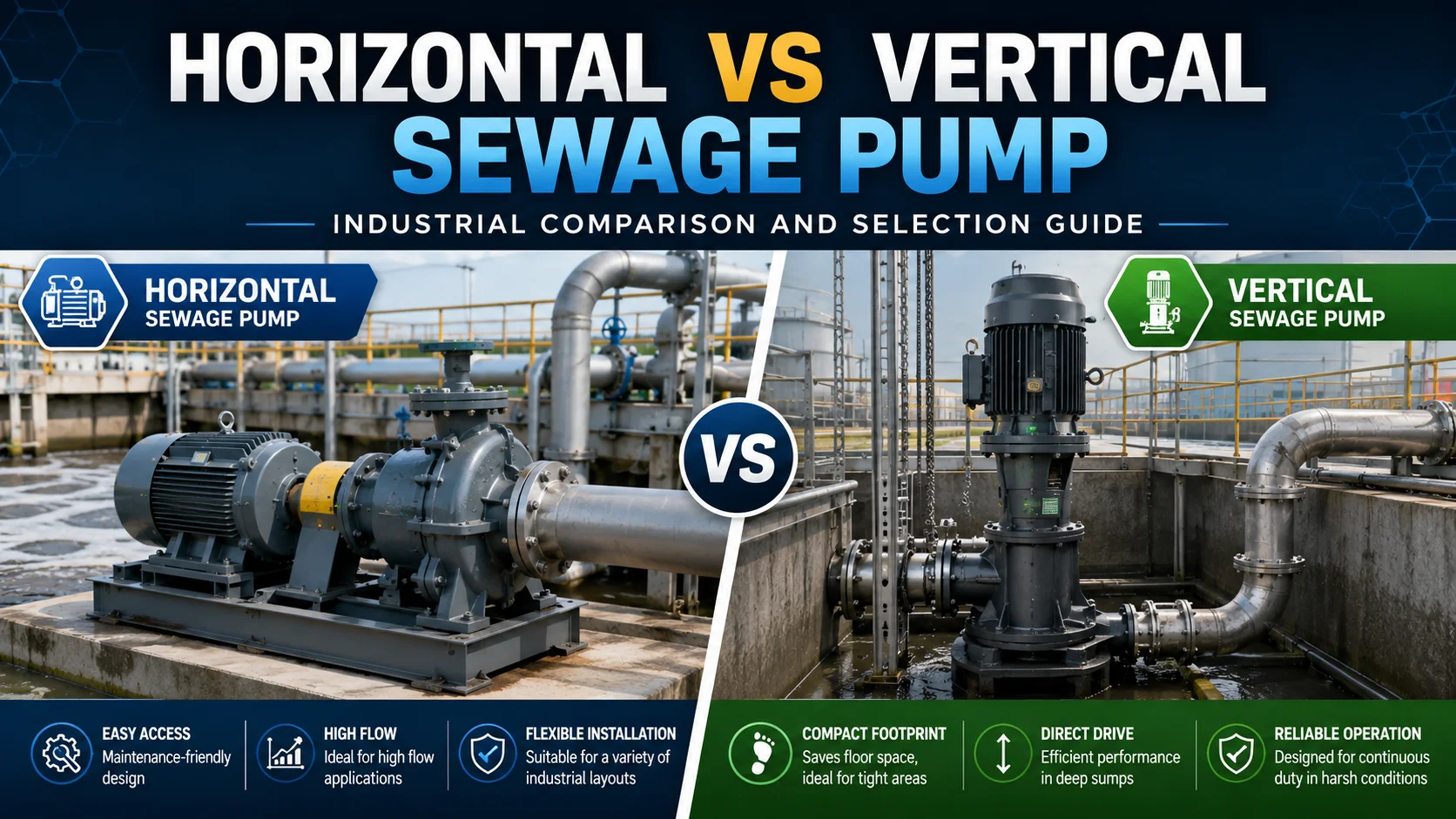
Compare horizontal vs vertical sewage pumps for industrial sites. Learn footprint, maintenance, civil cost, solids handling, flood risk and lifecycle trade
Horizontal and vertical sewage pumps solve the same wastewater transfer problem in different physical layouts.
A horizontal sewage pump is usually installed in a dry pit or pump room with the pump shaft arranged horizontally and the unit serviced above the wet well or suction source.
A vertical sewage pump is usually installed with the hydraulic end and motor arranged in a vertical package, often as a submersible unit in a wet well or sump.
For industrial sites, the right choice is rarely about which orientation is "better" in isolation.
It is about which layout matches the site’s civil constraints, operating team, flood exposure, solids behavior and maintenance philosophy.
If the station needs easy above-grade access, stable equipment space and a service-friendly room, the horizontal arrangement often becomes attractive.
If the project needs a smaller footprint, simpler wet-well integration and lower civil effort, a vertical submersible arrangement often wins.
The buyer should compare the whole station, not only the pump curve.
That means looking at footprint, lifting arrangements, access panels, cable routing, suction conditions, controls and the cost of keeping the station reliable over time.
What horizontal and vertical mean in sewage pumping
In sewage pumping, the terms horizontal and vertical describe the general installation orientation and service arrangement, not just the shape of the casing.
A horizontal sewage pump typically sits on a baseplate or structure in a dry chamber.
The motor and pump train are mounted so the shaft line is horizontal, which often makes inspection, alignment and bearing service more straightforward.
A vertical sewage pump typically has the motor above or integrated into a vertical package, with the wet end positioned down into the sump or wet well.
In many industrial projects, a vertical sewage pump is also a submersible sewage pump.
That means the motor is sealed for operation in liquid, and the unit is removed vertically for service.
The distinction matters because many buyers use the words "vertical" and "submersible" interchangeably, even though not every vertical pump is a fully submersible sewage unit.
For selection, think in three layers.
First, identify the hydraulic duty: flow, head, solids, ragging tendency and duty cycle.
Second, identify the installation type: dry pit, wet well, sump, packaged station or retrofit chamber.
Third, identify the service model: how often the pump is lifted, who services it, and how much downtime the site can tolerate.
That three-layer view prevents the common mistake of choosing a layout only because it looks familiar.
A horizontal sewage pump can still be wrong for a site with no room for piping and alignment access.
A vertical sewage pump can still be wrong for a facility that needs frequent hands-on maintenance without lifting equipment.
Advantages of horizontal dry-pit sewage pumps
Horizontal dry-pit sewage pumps are often selected when the station must behave like an accessible piece of plant equipment rather than a buried utility item.
The most obvious advantage is service access.
Technicians can usually inspect motors, couplings, bearings, valves and instrumentation without entering the wet well.
That can shorten outage time and make planned maintenance easier to schedule during plant shutdown windows.
A second advantage is equipment separation.
Because the motor and much of the rotating assembly sit in a dry area, the installation can be easier to protect from direct immersion and debris accumulation.
That is useful in facilities with strong maintenance standards or in buildings where the pump room is part of a larger mechanical service area.
A third advantage is alignment control.
Horizontal systems can be configured with a baseplate, pipe supports and structured maintenance access that help the team keep alignment under control.
When the station is designed properly, that can improve repeatability during overhaul and make spare-part replacement more predictable.
Horizontal dry-pit systems can also make it easier to integrate monitoring equipment.
Sensors, vibration monitoring, pressure taps, temperature probes and local isolation devices are often simpler to access above grade.
That can improve troubleshooting when the plant values diagnostics and fast fault isolation.
From a lifecycle perspective, some operators prefer horizontal layouts because they feel more visible and more controllable.
The equipment is in the room, the room is inspectable, and the maintenance team can understand the system at a glance.
That visibility can reduce operator hesitation when the team is unfamiliar with fully submerged equipment.
Horizontal sewage pump layouts are also useful in some larger industrial stations where redundancy and maintainability are more important than minimum footprint.
If the project has room for a dedicated pump chamber, the added civil area can be justified by lower service friction over many years.
Still, the horizontal layout is not automatically superior.
It can require more civil structure, tighter suction design, careful flood protection and more disciplined room planning.
If those elements are weak, the apparent advantage can disappear quickly.
Advantages of vertical submersible sewage pumps
Vertical submersible sewage pumps are popular because they reduce the amount of visible infrastructure required above the wet well.
The most immediate advantage is footprint.
A vertical submersible station can usually fit into a smaller plan area than a dry-pit horizontal arrangement.
That matters on congested industrial campuses, utility corridors and retrofits where civil space is limited.
A second advantage is civil simplicity.
When the pump sits inside the sump or wet well, there is often less need for a separate dry chamber, elaborate shafting or a larger equipment room.
That can reduce structural complexity and shorten project schedules, especially for packaged wastewater stations.
A third advantage is flooded intake suitability.
Because the pump is operating in or near the liquid, the station avoids many suction-lift and priming problems that surface-mounted layouts must manage.
That makes the vertical submersible option strong for sewage and wastewater duties where liquid level changes through the day.
Vertical submersible sewage pumps also work well in dirty or variable-flow environments when the wet end is sized correctly.
If the solids profile and passage design are matched to the duty, the system can run reliably with less operator intervention.
For many buyers, the removal process is also straightforward.
Guide rails, lifting chains and disconnect arrangements can make it easy to extract the unit vertically for inspection and replacement.
That is especially useful when the plant wants to avoid entering a confined dry pit for routine service.
Vertical submersible layouts can also improve resilience in some flood-prone locations.
If the equipment is designed for submerged duty and the controls are properly protected, the station can be easier to isolate from surface-level water issues than a room-based dry installation.
The limitation is that the service model changes.
The team may need lifting gear, cable handling discipline and a clear maintenance procedure for every removal.
If the staff does not have that workflow, the convenience of the layout can be overstated.
Key selection factors
The right orientation depends on how the station will operate, not just on a preference for one pump type.
Use the following factors as a practical selection checklist.
| Selection factor | Horizontal dry-pit sewage pump | Vertical submersible sewage pump | |---|---|---| | Footprint | Needs more room | Usually more compact | | Civil complexity | Often higher | Often lower | | Maintenance access | Strong above-grade access | Requires lifting and removal | | Flood exposure | Dry room must be protected | Better suited to wet environments | | Suction conditions | Must be engineered carefully | Less exposed to suction-lift issues | | Solids handling | Depends on pump design | Depends on submersible hydraulic design | | Service workflow | Familiar for many plants | Needs vertical lift procedures | | Retrofit fit | Good where room exists | Good where space is limited | | Initial civil cost | May be higher | Often lower | | Lifecycle convenience | Can be excellent if room is well designed | Can be excellent if retrieval is well planned |
Beyond the table, consider duty cycle.
A station running continuously or near-continuously may justify a service-friendly dry-pit arrangement if the plant wants fast access and stable monitoring.
A station that sees intermittent inflow, variable levels or storm-driven peaks may be better served by a vertical submersible layout with compact wet-well integration.
Also consider solids behavior.
If the sewage stream carries rags, stringy matter or sludge-like material, the impeller passage and cutter arrangement matter more than orientation alone.
The pump should be selected for the actual wastewater profile.
Do not assume a horizontal pump is automatically less clog-prone or that a vertical pump is automatically more forgiving.
The wet well design, inlet hydraulics and control logic can be just as important.
Finally, consider the operating team.
If the site has a strong mechanical maintenance crew and a strict planned-shutdown routine, a horizontal layout may be very comfortable.
If the site depends on compact utility stations with outsourced service, a vertical submersible station may reduce operational friction.
Installation footprint and civil cost differences
Footprint is often the deciding factor before the pump curve is even reviewed.
Horizontal dry-pit sewage pumps usually require more floor space, more equipment clearances and more structured access around the pump, motor and piping.
That extra space is valuable because it creates serviceability, but it comes with civil cost.
The station may need a larger room, stronger structural design and more detailed drainage and ventilation provisions.
A vertical submersible sewage pump often reduces those demands.
Because the wet end sits in the sump and the service is done vertically, the above-grade package can be more compact.
This can reduce excavation, concrete volume and superstructure requirements in many projects.
However, lower civil cost does not always mean lower total cost.
If the vertical station needs frequent lifting, more corrosion-resistant hardware or additional control redundancy, some of the civil savings are offset by mechanical and operational requirements.
The better question is not "Which is cheaper?" but "Which cost is being shifted?"
A horizontal layout may shift cost into concrete, room size and access planning.
A vertical layout may shift cost into submerged equipment, lifting practice and retrieval hardware.
For a new industrial site, this is a design choice.
For a retrofit, it is often a constraint management exercise.
If the existing station has room for a proper dry pit, the horizontal option may be viable.
If the station is boxed in by adjacent structures or utilities, the vertical option may be the only practical way to upgrade capacity without major reconstruction.
Common mistakes in configuration selection
The most common mistake is choosing by habit.
A team may specify the layout they used on the last project, even if the new sewage stream, available space or maintenance model is completely different.
A second mistake is confusing installation orientation with solids performance.
A vertical submersible sewage pump is not automatically better at moving rag-heavy sewage.
A horizontal dry-pit pump is not automatically better at handling sludge.
The hydraulic design still has to match the duty.
A third mistake is ignoring access logistics.
If the site has no clear lifting path, no removal zone or no safe way to isolate and pull the equipment, the apparently compact layout can become a long-term headache.
A fourth mistake is underestimating flood risk in dry-pit rooms.
Horizontal installations are only as good as the room that protects them.
If drainage fails, seals fail or the chamber floods, the maintenance benefit can vanish.
A fifth mistake is forgetting that controls and alarms are part of the configuration.
The pump may be excellent, but if the control panel, level sensors and fault strategy do not match the layout, the station still becomes unreliable.
A sixth mistake is buying for the initial CAPEX alone.
The cheaper civil option can become expensive if the site struggles with maintenance access, operator training or spare-part handling.
Sources
- Flow Chem Pumps product pages and industrial sewage pump categories.
- Manufacturer technical guidance for sewage, wastewater, sludge and submersible pump layouts.
- Standard industrial pump selection principles for access, flood protection, solids handling and maintainability.
Frequently asked questions
Is a horizontal sewage pump the same as a dry-pit sewage pump?
In most industrial usage, yes, the terms are closely related. A horizontal sewage pump is commonly installed in a dry pit or pump room, where the unit is accessible above the wet well. However, the exact mechanical arrangement can vary, so the buyer should confirm the installation drawing rather than rely only on the label.
Is a vertical sewage pump always submersible?
Not always, but in wastewater work the term often points to a submersible or wet-well-installed configuration. The key issue is whether the motor and wet end are designed for submerged or vertical wet-well operation. Always check the manufacturer’s arrangement and service method before specifying the unit.
Which configuration is easier to maintain?
A horizontal dry-pit sewage pump is often easier to inspect without lifting equipment because the service area is above grade. A vertical submersible sewage pump can still be easy to maintain if the station has good guide rails, lifting gear and a disciplined retrieval process. The easier option depends on the plant’s maintenance workflow, not just the pump orientation.
Which one is better for limited space?
A vertical submersible sewage pump usually fits better where space is tight. It can reduce the need for a separate pump room and lower the civil footprint of the station. That is why it is common in compact lift stations, retrofit pits and packaged wastewater installations.
Which one is better for flood-prone locations?
A vertical submersible arrangement is often better suited to wet environments because the pump is designed to work in the liquid zone. A horizontal dry-pit arrangement can still work well, but only if the room, drainage and flood protection are designed carefully. Flood resilience should be evaluated at the station level, not only at the pump level.
What should buyers compare besides orientation?
Buyers should compare solids handling, duty point, power, efficiency, service access, lifting method, controls, cable routing and spare-part availability. Orientation is important, but it is only one part of a complete sewage pump selection.
Need help selecting the right pump?
Share your flow, head, liquid type, solids, site layout and duty cycle with Flow Chem Pumps. Our team can help you shortlist the right pump.