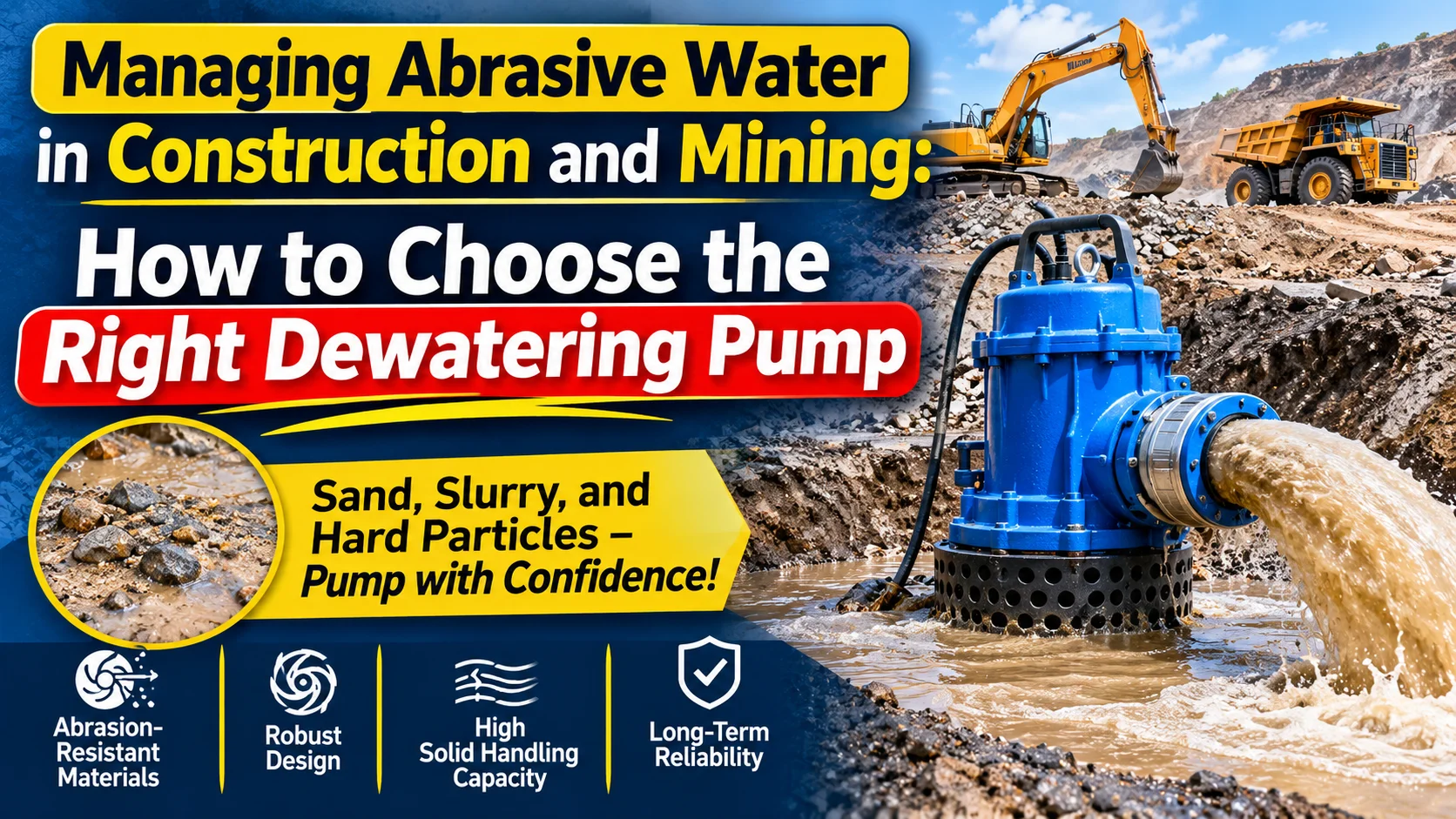
Construction sites and mining operations frequently deal with water containing sand, silt, soil, fine gravel, and other suspended particles. Removing this water is not simply a matter of installing a high-capacity pump. The nature of the water, particle concentration, pumping depth, and operating conditions all influence pump performance.
Choosing an unsuitable dewatering pump can result in excessive component wear, reduced pumping efficiency, frequent maintenance, and increased operating costs.
This guide explains the challenges of pumping abrasive water and the factors businesses should consider when selecting an industrial dewatering pump.
1. Why Abrasive Water Creates Pumping Challenges
Unlike relatively clean water, abrasive water contains suspended particles that continuously interact with internal pump components.
Common sources include:
- Construction excavation and foundation work
- Underground mining operations
- Open-pit mining and quarrying
- Tunnel construction
- Industrial drainage systems
- Rainwater accumulation at infrastructure sites
When abrasive particles pass through a pump, they can gradually wear the impeller, casing, and other wetted components.
The rate of wear depends on several factors, including particle size, hardness, concentration, velocity, and operating duration.
2. How Abrasive Particles Affect Pump Performance
Understanding the impact of abrasive materials helps operators identify the right pump configuration.
Impeller Wear
Sand and mineral particles can gradually erode impeller surfaces. As the impeller wears, the pump may experience reduced hydraulic performance.
Casing Erosion
Continuous exposure to abrasive water can wear internal casing surfaces, potentially affecting pump efficiency and service life.
Reduced Pumping Capacity
As internal components deteriorate, the pump may struggle to maintain its expected flow and head.
Increased Maintenance Requirements
Applications involving high concentrations of abrasive particles may require more frequent inspections and component replacement.
3. Important Factors When Selecting a Dewatering Pump
Selecting a suitable pump requires more than comparing motor horsepower.
A. Required Flow Rate
Determine how much water needs to be removed within a specific period.
For example, a construction site managing continuous groundwater seepage will have different pumping requirements from a mining operation dealing with heavy rainfall accumulation.
The required flow rate should account for:
- Water entering the excavation
- Expected rainfall or groundwater inflow
- Required drainage time
- Number of operating pumps
- Discharge arrangements
B. Total Dynamic Head
Total Dynamic Head (TDH) represents the overall resistance the pump must overcome to move water.
It includes:
- Static head: Vertical elevation difference between the water level and discharge point.
- Friction head: Resistance created by pipes, bends, valves, and fittings.
- Pressure head: Additional pressure requirements, where applicable.
A pump should be selected based on its operating point, where the required flow rate and total dynamic head intersect its performance curve.
C. Particle Size and Concentration
The type and concentration of suspended solids directly influence pump selection.
A pump designed for relatively clean drainage water may not be suitable for applications containing significant quantities of sand or abrasive particles.
Operators should evaluate the particle size, concentration, and characteristics of the liquid before finalising a pump.
D. Construction Material
Material selection becomes particularly important in abrasive environments.
The pump casing, impeller, and other wetted components should be suitable for the liquid being handled.
For applications involving chemically aggressive wastewater in addition to abrasive solids, corrosion compatibility must also be considered.
4. Why Pump Design Matters in Heavy-Duty Dewatering
Industrial dewatering applications often require pumps capable of operating under demanding site conditions.
Important design considerations include:
- Robust casing and impeller construction
- Suitable solids-handling capability
- Appropriate motor protection
- Reliable mechanical sealing
- Continuous-duty suitability
- Ease of installation and maintenance
Submersible dewatering pumps are particularly useful where water accumulates in excavations, sumps, underground areas, and locations where conventional surface pumping arrangements may be difficult to install.
5. Common Mistakes to Avoid
Even a technically capable pump can underperform when incorrectly selected or operated.
Avoid these common mistakes:
Choosing a Pump Based Only on Horsepower: Motor power alone does not establish whether a pump can deliver the required flow at the necessary head.
Ignoring Abrasive Content: Particle characteristics must be evaluated before selecting the pump.
Undersizing Discharge Pipelines: Excessive pipe friction can reduce the actual flow delivered by the pump.
Overlooking Operating Conditions: Continuous-duty requirements, water levels, installation depth, and maintenance accessibility should be considered.
Ignoring Pump Performance Curves: Always evaluate the manufacturer's performance data against actual site requirements.
6. Applications of Industrial Dewatering Pumps
Industrial submersible dewatering pumps are used across several sectors.
- Construction: Removing groundwater from foundations, basements, trenches, and excavation areas.
- Mining: Managing accumulated water in mining pits and underground operations.
- Infrastructure: Supporting drainage requirements in tunnels, bridges, and large civil engineering projects.
- Industrial Facilities: Removing accumulated water from production areas, sumps, and drainage systems.
Each application requires an appropriate combination of flow, head, solids-handling capability, and construction.
7. Choosing the Right Dewatering Pump for Your Project
A reliable dewatering solution starts with understanding the actual operating conditions.
Before finalising a pump, establish:
- Required flow rate in m³/hr.
- Total dynamic head in metres.
- Type and concentration of suspended solids.
- Discharge pipe diameter and length.
- Operating hours and duty requirements.
- Chemical characteristics of the water, where relevant.
Working with an experienced pump manufacturer can help ensure the selected equipment matches the application's hydraulic and operating requirements.
Conclusion
Managing abrasive water is a significant challenge in construction, mining, and industrial dewatering applications. Sand, silt, and mineral particles can accelerate component wear and affect pumping performance when the equipment is not appropriately selected.
Evaluating flow rate, total dynamic head, solids characteristics, materials, and operating conditions helps businesses make more informed pump selection decisions.
Flow Chem Pumps Pvt. Ltd. manufactures industrial submersible dewatering pumps for demanding construction, mining, and industrial applications. With manufacturing experience since 2002, the company offers pump solutions designed for challenging water and wastewater handling requirements.
Looking for a suitable dewatering pump for your application?
Visit Flow Chem Pumps to explore its industrial pump range and connect with the team for pump selection assistance.