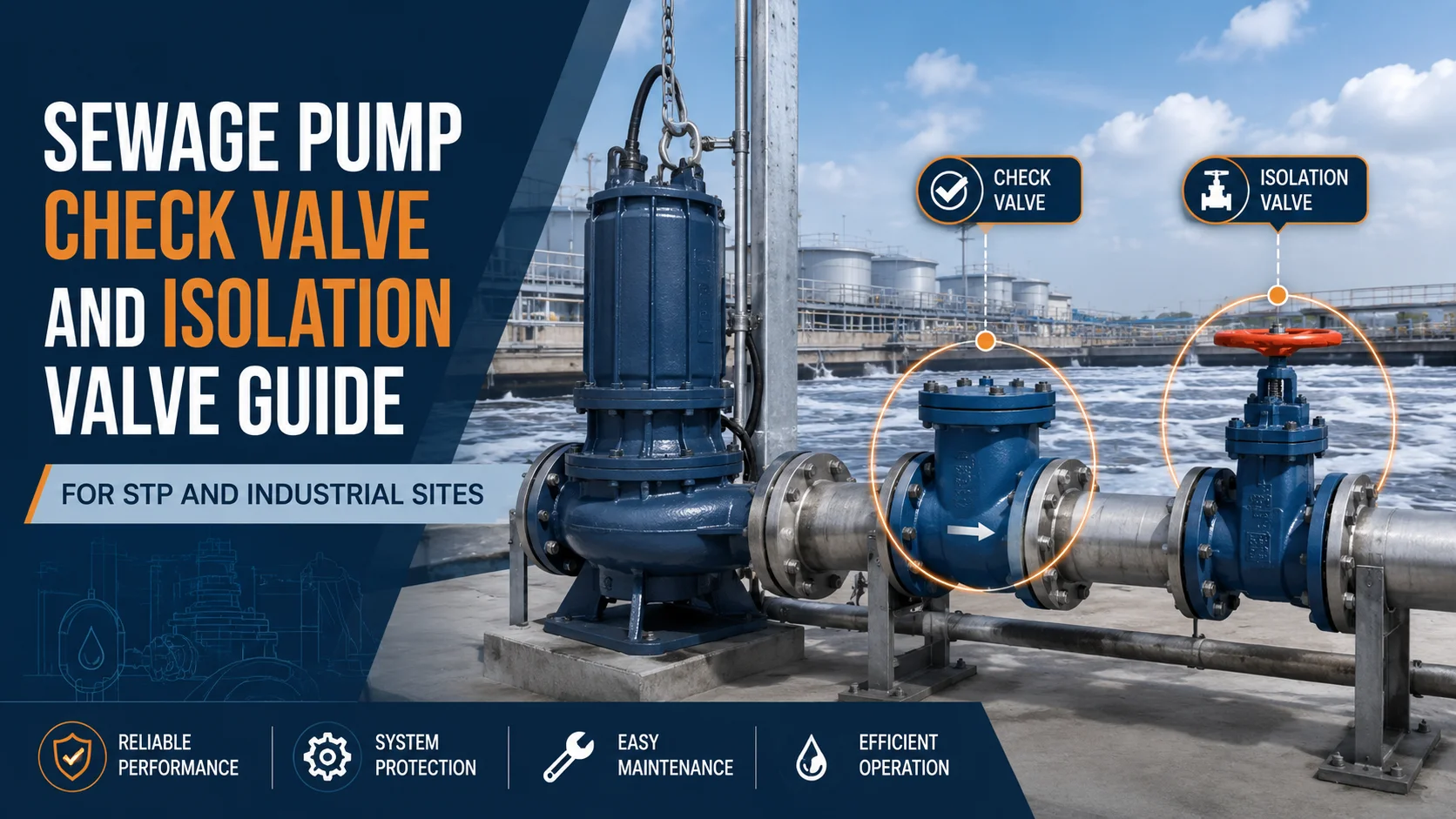
Learn how check valves, non-return valves and isolation valves should be selected and arranged in sewage pump discharge lines for reliable STP and industrial wastewater operation
A sewage pump discharge line normally needs a non-return valve, also called a check valve, to prevent wastewater from flowing backward when the pump stops, along with an isolation valve that allows the pump or pipeline section to be safely isolated for maintenance.
Valve selection should not be based only on pipe diameter.
The wastewater solids profile, flow velocity, operating pressure, head loss, valve opening characteristics, material compatibility, accessibility and maintenance requirements should all be reviewed.
In duty/standby sewage pumping systems, each pump branch will normally need its own suitable valve arrangement before connecting to the common discharge header.
Incorrect valve selection can cause:
- Backflow into the wet well
- Frequent pump restarting
- Water hammer
- Valve blockage
- Reduced discharge flow
- Higher pump head
- Increased electricity consumption
- Difficult maintenance
- Reverse flow through a standby pump
- Unexpected plant downtime
The valve system therefore needs to be considered as part of the complete sewage pumping system—not as an accessory selected after the pump.
Why Valves Matter in a Sewage Pumping System
When a sewage pump operates, wastewater is pushed from the wet well or sump through the discharge pipeline toward the next treatment stage, sewer network or collection tank.
When the pump stops, wastewater remaining in an elevated discharge pipe may try to flow backward.
Without effective backflow protection, part of the pumped wastewater may return to the sump.
The pump may then have to move the same liquid again.
This can create:
- Additional pump starts
- Increased motor wear
- Higher energy consumption
- Rising wet-well levels
- Increased overflow risk
- Unstable duty/standby operation
A correctly selected check valve helps stop this reverse flow.
The isolation valve serves a different purpose. It allows operators to isolate the pump from the discharge system when maintenance, inspection or replacement is required.
Both valves are therefore important, but they perform different jobs.
What Is a Check Valve in a Sewage Pump System?
A check valve or non-return valve (NRV) allows wastewater to flow in one direction while preventing it from flowing backward.
During pump operation, the pressure created by the pump opens the valve.
When the pump stops and the flow begins reversing, the valve closes.
In a sewage pumping station, this helps prevent wastewater inside the discharge pipeline from returning through the pump.
A check valve can also help prevent wastewater from one operating pump flowing backward through another pump installed on the same discharge header.
What Is an Isolation Valve?
An isolation valve allows operators to shut off a section of the discharge pipeline.
Its main purpose is maintenance.
For example, suppose an STP operates two sewage pumps in a duty/standby arrangement.
If Pump 1 needs to be removed for inspection, operators should be able to isolate its discharge branch while Pump 2 continues operating where the overall system has been designed for that operating condition.
Without proper isolation, servicing one pump may require shutting down a much larger portion of the pumping system.
Good valve planning therefore improves both:
- Pump reliability
- Maintainability of the plant
Check Valve vs Isolation Valve
Although both are installed in the discharge system, they should not be confused.
| Component | Main Purpose |
|---|---|
| Check valve / NRV | Prevent reverse flow automatically |
| Isolation valve | Manually or actuated shut-off for maintenance |
| Pump | Creates the required wastewater flow and head |
| Control system | Starts, stops and protects the pump |
A check valve should not normally be treated as the maintenance isolation device.
Likewise, an isolation valve should not be relied upon as the automatic protection against backflow during every pump stop.
Each component has a separate function.
Common Check Valve Types for Wastewater Applications
The correct valve type depends on the wastewater characteristics, pipe layout, pressure and project design.
1. Swing Check Valve
A swing check valve uses a hinged disc that opens with forward flow and closes when flow reverses.
It is widely used in water and wastewater systems because of its relatively simple construction.
Advantages can include:
- Simple operation
- Relatively low resistance when fully open
- Availability in large pipeline sizes
- Straightforward inspection on accessible installations
However, wastewater containing rags, fibres or solids can affect some valve designs.
Closure speed also matters because a rapidly reversing column of water can cause valve slam and pressure shock.
The exact valve configuration should therefore be selected for the pumping duty rather than simply using a general-purpose water valve.
2. Ball Check Valve
A ball check valve uses a movable ball that lifts away from the seat during forward flow and returns to the seat when the flow stops or reverses.
Ball-type non-return valves are commonly considered in wastewater duties because suitable designs can provide a relatively open passage.
They can be useful where wastewater contains suspended solids.
Important selection points include:
- Free passage
- Valve orientation
- Minimum velocity needed for reliable opening
- Pressure rating
- Ball and seat material
- Access for inspection
Not every ball check valve is suitable for every sewage application.
The actual solids profile and duty point should be reviewed before selection.
3. Other Non-Return Valve Designs
Depending on system size and engineering requirements, projects may also use other check-valve designs.
The important question is not simply:
Which check valve is best?
The better question is:
Which valve can reliably open, pass the wastewater, close without damaging pressure surges and remain maintainable under this operating condition?
That answer depends on the complete system.
Choosing an Isolation Valve for Sewage Pump Discharge
Isolation valves should provide effective shut-off while creating as little unnecessary restriction as practical during normal operation.
Common wastewater applications may use appropriate gate-type or other full-opening isolation valves depending on the project specification.
Important considerations include:
- Pipe diameter
- Pressure class
- Wastewater solids
- Corrosion risk
- Valve bore
- Sealing arrangement
- Installation orientation
- Operating mechanism
- Accessibility
- Maintenance frequency
A valve that becomes difficult to operate after months of sewage service is not useful simply because it looked suitable during installation.
Accessibility should therefore be considered during the design stage.
Where Should Check and Isolation Valves Be Installed?
For many submersible sewage pumping systems, the discharge arrangement includes:
Pump → discharge riser → check valve / NRV → isolation valve → common discharge header
However, exact arrangement, valve orientation and spacing should follow the approved piping design and valve manufacturer's requirements.
For multiple pumps, each branch usually needs individual backflow protection and isolation before joining a common header.
For example:
Pump 1 → NRV → Isolation Valve → Common Header
Pump 2 → NRV → Isolation Valve → Common Header
This helps prevent discharge from the running pump from travelling backward through the idle pump branch.
Valve chambers should also provide sufficient access for inspection and replacement.
Why the Check Valve Should Be Accessible
Installing the valve is only the first step.
Wastewater systems operate with:
- Sewage solids
- Sludge
- Rags
- Fibres
- Plastic material
- Grit
- Scale
- Grease
- Other process contamination
These materials can interfere with valve operation.
A check valve hidden in an inaccessible section of piping may become a major maintenance problem.
Design the installation so operators can safely inspect the valve without unnecessary civil work or complete plant shutdown.
Do Not Select a Valve Only by Pipe Diameter
A common procurement mistake is:
100 mm pipe = order 100 mm valve.
Nominal diameter is only one part of selection.
Engineers should also review:
Flow Rate
The valve must operate properly at the expected wastewater flow.
Flow Velocity
Very low velocity may prevent some valve types from opening correctly or may contribute to solids settlement.
Excessive velocity can increase head loss, wear and hydraulic shock.
Pump Head
Every valve introduces some resistance.
The pressure loss across the valve should be considered in the total dynamic head calculation.
Solids Profile
A valve suitable for treated effluent may not be suitable for raw sewage containing fibres and debris.
Pressure Rating
The valve and pipeline should be selected for the pressure conditions expected during operation and possible transient events.
Material Compatibility
Industrial wastewater can contain aggressive chemicals, chlorides or other corrosive constituents.
Valve body, trim, seat and elastomer materials should be compatible with the liquid.
Valve Head Loss Can Affect Pump Performance
Every fitting in the discharge line adds resistance.
That includes:
- Bends
- Tees
- Reducers
- Check valves
- Isolation valves
- Flow meters
- Other fittings
The sewage pump therefore does not only overcome vertical elevation.
It must overcome the complete total dynamic head of the system.
If valve losses are ignored during pump selection, the actual flow may be lower than expected.
This is especially important for:
- Long discharge lines
- High-flow pumping stations
- Multiple fittings
- Smaller pipe diameters
- High-head installations
The pump curve and the complete system resistance should therefore be reviewed together.
For further pump selection guidance, see Flow Chem's Submersible Sewage and Sludge Pump range.
Check Valve Slam and Water Hammer
One problem that can occur in pumping systems is check valve slam.
When a pump stops, the moving water column begins slowing and may reverse direction.
If the check valve closes after significant reverse velocity has developed, the sudden closure can create a pressure surge.
Possible symptoms include:
- Loud banging in the pipeline
- Pipe movement
- Valve vibration
- Damaged supports
- Flange leakage
- Repeated valve failure
Do not assume that simply installing a heavier valve will solve the issue.
The pumping system may require review of:
- Valve closing characteristics
- Pipeline length
- Flow velocity
- Pump stopping behaviour
- Static head
- Control strategy
- Pipe supports
- Surge protection
Severe hydraulic surge problems should be reviewed as a complete system.
Why Sewage Check Valves Become Blocked
Wastewater valves can fail even when the pump itself is operating correctly.
Common causes include:
- Rags trapped around the valve
- Fibrous waste
- Grease deposits
- Scale
- Sludge buildup
- Abrasive grit
- Damaged valve seats
- Corrosion
- Incorrect valve orientation
- Insufficient flow to fully open the valve
If blockage happens repeatedly, operators should investigate the wastewater entering the system.
Repeated ragging may also indicate that the pumping application needs better screening or a pump designed for fibrous material.
Where fibrous sewage repeatedly creates clogging problems, Flow Chem's Submersible Cutter Pump range may be relevant to the application.
What Happens When a Check Valve Leaks?
A leaking check valve may allow some wastewater to return to the wet well after every pump cycle.
Operators may notice:
- Wet-well level rising shortly after the pump stops
- Pump starting more frequently than before
- Longer cumulative pump running hours
- Backflow noise
- Reverse movement inside the discharge line
- Standby pump branch behaving abnormally
Frequent starts increase stress on motors, contactors and other electrical components.
Therefore, unexplained increases in pump cycling should include a valve inspection—not only a pump inspection.
Valve Planning for Duty/Standby Sewage Pumps
Many STPs use at least two pumps so one unit can remain available if the other pump is unavailable.
A typical arrangement may include:
- Pump A
- Pump B
- Individual discharge branches
- Individual check valves
- Individual isolation valves
- Common discharge header
- Automatic level control
- Duty/standby alternation
The valve arrangement becomes especially important here.
If one branch cannot prevent reverse flow, the running pump may push wastewater into the inactive branch instead of sending all available flow toward the intended discharge point.
If one pump cannot be isolated, maintenance flexibility is also reduced.
Valve design should therefore be included in redundancy planning.
Valve Chamber Design Matters
A good valve can still create maintenance problems if the valve chamber is poorly designed.
Review:
- Access opening size
- Working space
- Drainage inside the chamber
- Safe access
- Valve operating clearance
- Flange accessibility
- Pipe supports
- Lighting where applicable
- Flooding risk
- Space for future replacement
Do not position valves where routine inspection requires dismantling unrelated piping.
Maintenance access should be designed before construction is completed.
Common Sewage Pump Valve Mistakes
1. Installing a Generic Water Valve
Clean-water valve selection does not automatically translate to sewage service.
Wastewater solids and fibrous material must be considered.
2. Ignoring Valve Head Loss
Valve resistance forms part of the system head.
Ignoring it can reduce actual pump flow.
3. No Isolation Valve
Without suitable isolation, even a small pump repair can become a larger shutdown.
4. Poor Accessibility
Valves eventually require inspection.
An inaccessible valve increases maintenance time and cost.
5. Using One Common Check Valve for Multiple Pump Branches Without Proper Engineering
Individual pumps may require independent backflow protection.
6. Ignoring Water Hammer
Repeated valve slam should never simply be accepted as normal.
7. Oversizing Without Checking Operating Behaviour
A larger valve is not automatically better.
The actual flow and opening behaviour must be reviewed.
8. No Commissioning Test
Valve operation should be checked while the complete pumping system is running.
Commissioning Checks for Sewage Pump Valves
Before handing over a sewage pumping system, check:
- Correct direction of valve installation
- Valve size and pressure class
- Flange alignment
- Accessible isolation valve operation
- Check valve opening during pumping
- Proper closing after pump stop
- Reverse-flow behaviour
- Leakage at flanges
- Abnormal valve noise
- Pipe vibration
- Water-hammer symptoms
- Duty pump operation
- Standby pump operation
- Pump alternation
- Common-header behaviour
Testing both pumps individually and under the intended control sequence helps identify problems before normal plant operation begins.
Maintenance Signs That Need Valve Inspection
Valve inspection should be considered if operators notice:
- Pump cycles becoming more frequent
- Wet-well level rising immediately after shutdown
- Reduced discharge flow
- Unexpected motor current changes
- Loud pipe banging
- Valve chamber vibration
- Reverse flow
- Standby pump branch filling unexpectedly
- Increasing discharge pressure
- Difficult isolation-valve operation
- Leakage around valve flanges
Do not assume every wastewater pumping problem originates inside the pump.
Sometimes the pump is working correctly while the discharge system is restricting it.
Sewage Pump Valve Selection Checklist
Before finalising the valve arrangement, confirm:
- Pump design flow
- Pump operating head
- Discharge pipe diameter
- Expected flow velocity
- Wastewater type
- Maximum solids
- Fibrous-material risk
- Sludge concentration
- Abrasive grit
- Wastewater chemistry
- Operating pressure
- Valve pressure rating
- Valve material
- Seat and elastomer compatibility
- Head loss
- Valve opening characteristics
- Valve closing characteristics
- Water-hammer risk
- Installation orientation
- Number of pumps
- Duty/standby arrangement
- Common-header design
- Maintenance access
- Valve chamber dimensions
- Safe isolation procedure
- Commissioning requirements
Valve selection should be reviewed together with the pump, pipeline and control philosophy.
Frequently Asked Questions
Why is a check valve used on a sewage pump?
A check valve prevents wastewater in the discharge pipeline from flowing backward through the pump after it stops. This helps reduce backflow, unnecessary pump cycling and problems in multi-pump systems.
Is a check valve the same as an isolation valve?
No. A check valve automatically prevents reverse flow. An isolation valve is used to shut off a section of piping so equipment can be safely isolated for maintenance.
Which check valve is best for sewage?
There is no single valve that is best for every sewage application. Selection depends on flow, pipe diameter, solids, fibres, pressure, valve orientation, head loss, closing behaviour and maintenance requirements.
Should every sewage pump have its own check valve?
In many duty/standby and multi-pump systems, each pump discharge branch requires independent backflow protection before joining a common header. The exact arrangement should follow the approved system design.
Can a check valve cause low sewage pump flow?
Yes. A restricted, partially blocked, incorrectly selected or undersized valve can add excessive resistance to the discharge line and reduce flow.
Why does a sewage pump start again shortly after stopping?
One possible cause is wastewater flowing backward through a leaking or malfunctioning check valve. Wet-well size, float settings, incoming flow and control logic should also be checked.
What causes a sewage check valve to slam?
Rapid reversal of the water column combined with the valve's closing behaviour can create valve slam and hydraulic shock. Flow velocity, system head, pipeline length and valve type may all contribute.
Where should an isolation valve be installed?
It should be positioned so the pump or discharge branch can be safely isolated for maintenance while remaining accessible to operators. Final positioning depends on the pumping-station piping design.
How often should sewage pump valves be checked?
Inspection frequency depends on wastewater characteristics, operating hours and site criticality. Sites with rags, grease, sludge, abrasive solids or frequent cycling generally require closer monitoring.
Need Help Selecting the Right Sewage Pump?
Reliable sewage pumping depends on more than the pump alone.
Flow, total dynamic head, wastewater solids, pipe layout, valves, wet-well design, controls and maintenance access should work together as one system.
For sewage, sludge and industrial wastewater applications, share your:
- Required flow rate
- Total head
- Pipe diameter and length
- Wastewater type
- Solids profile
- Wet-well dimensions
- Duty cycle
- Number of pumps
- Site layout
with Flow Chem Pumps for application-based pump selection support.
Explore the Flow Chem Submersible Sewage and Sludge Pump range or contact the Flow Chem engineering team for project requirements.
Related Tags:#sewage-pump #check-valve #non-return-valve #stp #wastewater-pump