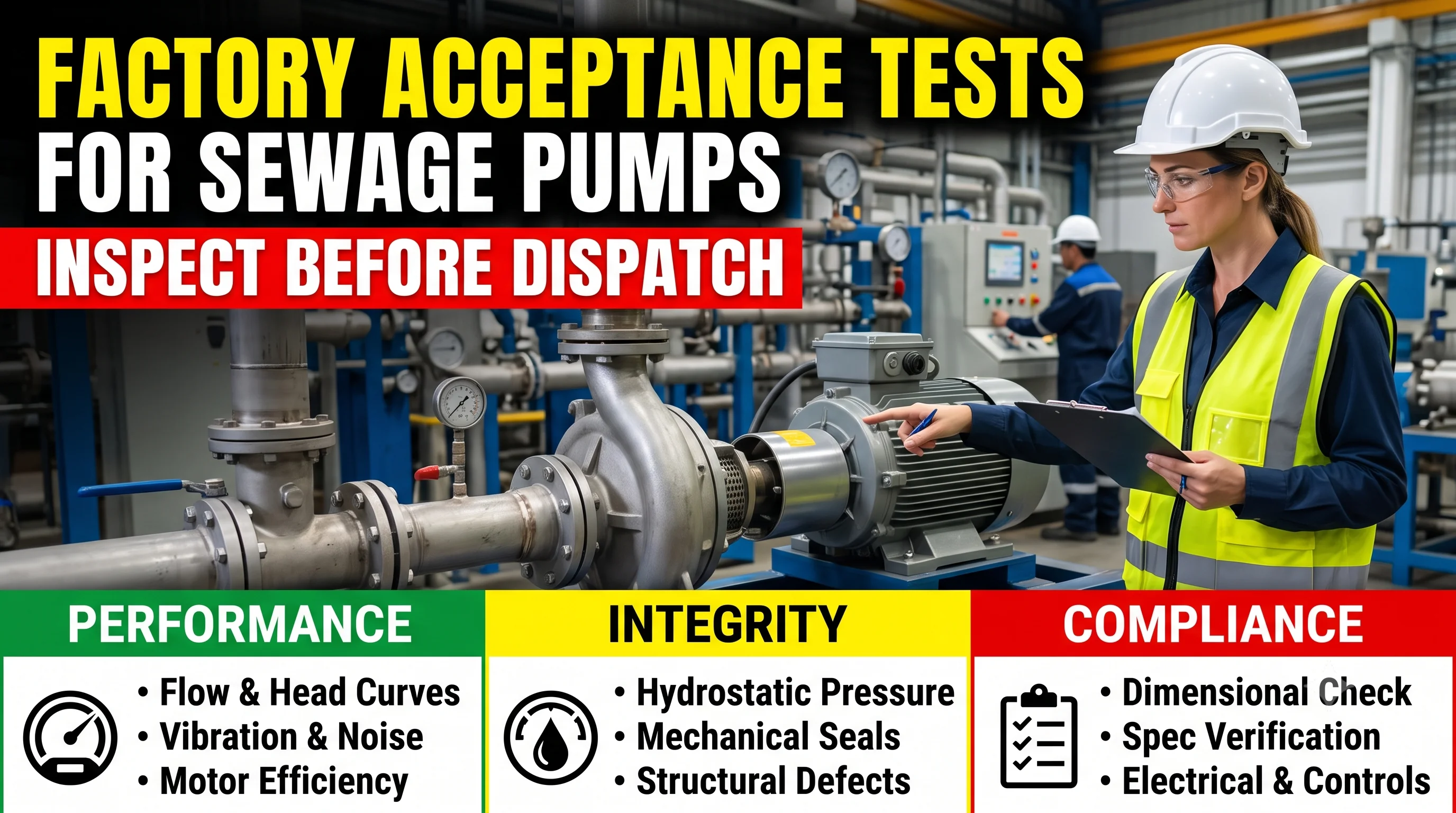
What a sewage pump factory acceptance test should cover - performance testing to ISO 9906, insulation and motor checks, material verification, documentatio
The FAT is the buyer's last point of leverage. Once a pump is dispatched and installed, every deficiency becomes a negotiation under schedule pressure. A proper factory acceptance test verifies three things: the pump performs as specified (ISO 9906 performance test with certified curves and stated tolerances), the pump is built as specified (materials, seals, cable entry, protections verified against the datasheet), and the paperwork proves it (test certificates, material certificates, calibrated instrument records). For standard small pumps, review certificates; for larger or critical pumps, witness the test in person with this checklist.
This guide complements the tender specification guide - the tender defines what to test, and the FAT verifies it was delivered.
What a FAT must verify
A factory acceptance test is not a formality or a photo opportunity. It verifies the three promises a specification makes:
1. Performance: the pump delivers the specified flow and head at the specified efficiency and power, within the tolerance band the tender defined. 2. Construction: the materials, impeller, seals, cable entry, and protection devices match what the tender required, not merely what the manufacturer's standard catalogue contains. 3. Documentation: certificates and records exist, are traceable to this specific pump (serial number), and are signed by competent, identifiable people.
Each promise needs its own verification method. A single "tested and passed" stamp verifies none of them, which is why FAT failures and disputes usually trace back to acceptance based on paperwork alone - or worse, on delivery alone.
Performance testing: what the test actually shows
The heart of the FAT is the performance test on a test bed with calibrated instruments. What buyers should require:
- Test standard and grade: ISO 9906 defines acceptance grades (for example, Grade 1B or 2B) with tolerances on flow, head, and power. The tender should state the grade; the FAT report should reference it. A "test" without a stated grade has no defined pass/fail boundary.
- Test points across the curve: minimum five points spanning closed valve to beyond duty, not a single duty-point reading. The curve shape reveals problems a single point hides: an unstable saddle, a drooping curve, or a trimmed impeller compensating for a wrong hydraulic design.
- Duty point verification: flow, head, power, and computed efficiency at the specified duty, each within the stated tolerance. Efficiency is computed from measured values - ask how it was computed and check the arithmetic on the certificate.
- Instrument calibration: test-bed pressure, flow, and power instruments must have valid calibration certificates traceable to national standards, with calibration dates covering the test date. An uncalibrated test bed produces impressive, meaningless curves.
- NPSH testing where specified: required NPSH at duty measured or guaranteed per the standard's provisions, relevant for hot effluent or high-altitude or low-flooded installations.
- Motor during pumping: current and power factor at duty tell whether the motor runs within its rating with the actual hydraulic load.
For submersibles, the pump is tested in a sump tank in its true submerged configuration. Beware alternative setups that test only the hydraulic end with a separate motor, which hide coupling losses and real motor performance.
Witnessing the test: a practical checklist
When the tender requires witnessed testing (standard for larger pumps), the witness's job is structured observation, not ceremony:
- Before the test: verify the pump nameplate against the order (serial number, duty, motor rating), confirm the impeller size and material against the datasheet, and check instrument calibration certificates for the test bed in use.
- During the test: confirm the test starts from closed valve and progresses across the curve; watch that the flow measurement method matches the certificate (magnetic flowmeter, venturi - and its calibration); note power measurement at the motor control panel; and observe the pump running steady at duty for the stated duration without abnormal noise, vibration, or visible leakage.
- Seal and leakage checks: verify zero visible leakage at the seal chamber and cable entry during and after the run.
- Protection devices: where the test includes them, see thermal and moisture sensors actually demonstrated (tripped and reset), not merely stated as fitted.
- After the test: collect the raw test data, not only the final formatted curve; sign or annotate the certificate against the serial number; and confirm any deviation (for example, impeller trimmed to meet duty) is recorded with its justification.
A witness who signs untested certificates becomes the buyer's liability. Where travel to the works is impractical, third-party inspection agencies perform the same checklist for a fraction of the cost of a wrong pump.
Electrical and insulation tests
Motor failures in submersible sewage pumps most often begin at the insulation and the cable entry, so electrical verification is not optional:
- Insulation resistance (IR): measured winding-to-earth with a megohmmeter at the specified test voltage; healthy submersible motors read in the hundreds of megohms or higher. Record the value and the megohmmeter's calibration.
- High-voltage (hipot) test where specified: a controlled overvoltage test proving insulation margin, applied per standard practice with proper safety procedures.
- Phase continuity and balance: winding resistance balanced across phases catches manufacturing defects before dispatch.
- No-load and locked-rotor data where applicable, confirming motor characteristics match the starter design in the control panel specification.
- Cable entry integrity: potted or glanded entries verified; on larger pumps, a pressure or water-immersion test of the motor housing with the cable fitted proves the entry system as an assembly - this is the exact failure location the cable failure guide documents from field experience.
Request that IR values be recorded on the certificate with the megohmmeter reading - not a checkmark. Field crews commissioning the pump later will compare their site IR against the factory value; that comparison is what catches transport damage or moisture ingress during storage.
Material and construction verification
The FAT (or the associated pre-dispatch inspection) should confirm the pump matches the specification's construction requirements:
- Material certificates: for castings and key wetted parts, material test certificates traceable to heat numbers, matching the specified grades. For standard duties, a certificate of conformity may suffice; for aggressive effluent, demand the full certificates.
- Impeller verification: type, size (diameter and free passage), and material against the datasheet. This is where substitutions hide - a vortex impeller supplied where a channel was specified, or an undersized free passage that will rag-block in service.
- Seal verification: seal face materials (for example, silicon carbide versus carbon) against the specification, and seal type where the tender demanded a specific arrangement.
- Fasteners and hardware: stainless or coated as specified - a small line item that predicts the pump's condition at its first lifting.
- Paint and coating: thickness measurements where a coating system was specified, with the gauge readings recorded.
- Nameplate and markings: duty, serial number, motor data, weight, and manufacture date legible and correct; the serial number ties every certificate to this physical pump.
Documentation package
A complete FAT closes with a document package the buyer keeps with the pump's asset file:
- Certified performance test report with raw data and the stated ISO 9906 grade.
- Insulation resistance and electrical test records with instrument details.
- Material test certificates for wetted parts (or certificate of conformity for standard duty).
- Calibration certificates for test-bed instruments covering the test date.
- Warranty certificate with clear terms - duration, coverage, exclusions (seals explicitly addressed), and claim procedure.
- Clearance of any tender-specific requirements: third-party inspection release notes, statutory markings, or export documentation.
Require this package before dispatch payment milestone. A pump dispatched ahead of its paperwork arrives with zero accountability, and the paperwork's absence is discovered exactly when a warranty claim needs it.
Common FAT failures and red flags
Experienced inspectors see the same failures repeatedly. Watch for:
- Curve that meets duty only at one lucky point: the rest of the curve deviates wildly, suggesting a trimmed or substituted impeller. Acceptable within grade tolerances; suspicious when combined with other flags.
- Efficiency notably below specification, "accepted" via tolerance: a pump can pass a 2B grade and still be several efficiency points below the tender's intent, quietly costing energy for a decade. Where the tender set an efficiency floor, check it explicitly - the energy guide shows what each point costs.
- No raw data, only final curves: formatted certificates without raw readings resist scrutiny. Genuine test beds record raw data; ask for it.
- Calibration certificates expired or missing: the single most common genuine failure. No valid calibration, no valid test.
- Serial number mismatches: certificates referencing a different serial than the nameplate break the traceability chain; every document must reference the same pump.
- Moisture or thermal sensors "fitted" but never demonstrated: a two-minute demonstration proves the devices work; a datasheet line does not.
- Test performed with a different motor than supplied: occasionally the test bed uses a superior motor while the delivered assembly carries a cheaper one. Verify motor serial on the test record.
Any one flag justifies a question; several together justify rejection or retest before dispatch. Buyers who enforce this calmly - the contract's acceptance clauses already authorize it - train their supply base to test honestly.
Frequently asked questions
What is a factory acceptance test for a sewage pump?
A FAT is the pre-dispatch verification, at the manufacturer's works, that the pump meets its specification: a performance test to a stated standard (typically ISO 9906) with certified curves, electrical and insulation tests, construction verification against the datasheet, and a documentation package tied to the pump's serial number. It is the buyer's last practical point of leverage - deficiencies found at the works cost a rectification; the same deficiencies found after installation cost a commissioning delay and a dispute.
Is witnessing the FAT necessary for every pump?
No. For standard small pumps bought in quantity, reviewing the certified test reports against a stated acceptance grade is proportionate. Witness testing earns its cost for larger pumps, critical installations (a single-pump station with no standby), aggressive duties, or new suppliers without purchase history. A practical middle path many Indian buyers use: witness the first pump of a lot and review certificates for the remainder, with the right to random retest retained in the contract.
What tolerance applies to pump performance test results?
ISO 9906 acceptance grades define the tolerances. Grade 2B (a common commercial grade) allows roughly ±8% on flow at the guaranteed point and ±4% on head within a defined convergence zone; Grade 1B tightens these to roughly ±4.5% and ±3%. The essential point for buyers: the tender must state the grade, because a pump can "pass" a looser grade while missing the buyer's real intent. State the grade in the tender, then check the certificate's computed values against both the grade and any stricter duty/efficiency floors the tender added.
What documents should come with a tested sewage pump?
At minimum: the certified performance test report (with raw data and stated grade), insulation resistance and electrical test records with instrument calibration references, material certificates or certificate of conformity for wetted parts, test-bed instrument calibration certificates covering the test date, the warranty certificate with explicit terms, and any third-party inspection release notes - all referencing the pump's serial number. File the package with the asset register; field teams comparing commissioning IR readings against factory values rely on it.
Can a pump pass FAT but still fail on site?
Yes - FAT verifies manufacture, not installation. A tested pump can still fail from site-side causes: wrong sump geometry causing recirculation or air entrainment, pipework strains on the discharge, control settings causing short-cycling or dry running, or a duty that changed from the tender's assumptions. FAT's value is that it removes the factory from the suspect list: when a FAT-certified pump misbehaves on site, the investigation starts - correctly - at installation and system conditions rather than at the manufacturer.
Who should witness a factory acceptance test?
Ideally someone who understands both pumps and the contract: the buyer's mechanical engineer, the design consultant for the pumping station, or a third-party inspection agency acting for the buyer. The witness needs the tender's technical specification, the approved datasheet, and this checklist; their job is structured verification against documents, not impressions. For public-sector buyers in India, third-party inspection is standard practice on higher-value contracts and provides documented, dispute-resistant acceptance records.
Need help selecting the right pump?
Share your flow, head, liquid type, solids, site layout and duty cycle with Flow Chem Pumps. Our team can help you shortlist the right pump.