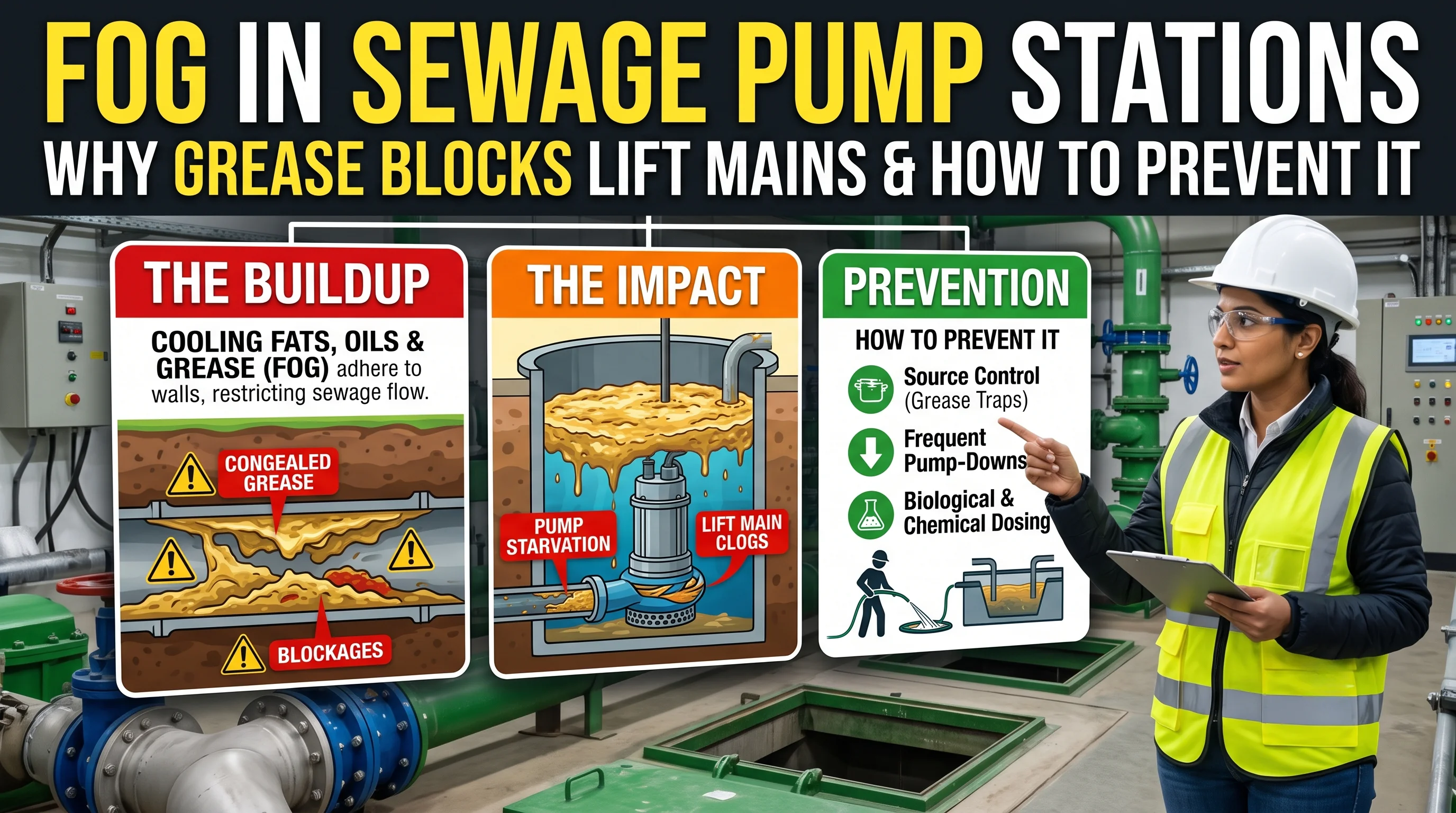
How fats, oils and grease clog sewage pump stations and rising mains, and the pump, wet well and operating practices that keep a grease-loaded line flowing
Grease does not clog pumps the way rags do; it builds. Cooling sewage lets FOG congeal on walls and float as a thickening mat that eventually reaches the pump intake, sticks to impellers, and narrows rising mains. Control it at three levels: source control (grease traps in the catchment), pump and station selection (non-clog impellers, adequate clearances, sloped walls, inlet positioning), and operations (frequent pump-downs, mat-breaking cycles, and line cleaning before the restriction becomes a blockage).
Stations serving hotels, marriage halls, food courts, and food processing units need this discipline from day one, because grease complaints rarely give advance warning - the line flows for months, then restricts suddenly.
Where FOG comes from and why it accumulates
FOG enters the sewer as liquid cooking oil, fried-food residues, dairy fats, and emulsified fats from washing-up water. Warm from the kitchen, it travels easily. Inside the sewer and the wet well, the sewage cools and the chemistry changes:
- Free fats and oils cool below their melting point and begin to congeal on any surface they touch.
- Calcium in hard water reacts with fatty acids to form calcium-based grease deposits - literally soap scum at industrial scale - which form hard, adherent layers that pure hot water flushing struggles to remove.
- Floating mats form as congealed globules collect at the water surface, binding with food particles, hair, and tissue paper into a coherent, buoyant layer.
The mat grows from the edges inward and downward. In a wet well with 1.5-2 m between high and low levels, a mat left undisturbed for weeks can thicken enough to survive pump-down, floating on the minimum level and slowly descending toward the intake bell.
Certain catchments are notorious: hotel clusters, marriage-hall belts, areas of dense food stalls, dairy and ice-cream plants, palm-oil handling units, and commercial complexes where grease traps are undersized or never serviced. In industrial estates, the common utility station often receives FOG from dozens of canteens with no individual accountability.
How grease actually fails a pump station
Grease failures develop in four recognizable stages, and knowing them helps target the intervention:
1. Mat accumulation: a floating layer forms but nothing visibly fails. Pump cycles may look normal. This is the stage where intervention is cheapest. 2. Intake starvation: the descending mat reaches the pump intake bell, restricting inflow. The pump begins to cavitate, lose prime, or run at reduced flow. Operators often misread this as pump wear and overhaul a healthy pump. 3. Impeller fouling: sticky grease and stringy waste bind on the impeller vanes and in the floatswitch and fittings, unbalancing the impeller (vibration rises), reducing flow, and increasing load on the mechanical seal. Repeated start-stop under starved conditions damages the seal faces. 4. Rising main restriction: inside the force main, grease deposits harden on the pipe wall, raising friction losses. The pump's duty point slides up the curve to lower flow. Eventually the combined intake-and-main restriction chokes the station and sewage surcharges into the street or upstream manholes.
Each stage is mistaken for something else. Stage 2 gets blamed on the intake design, Stage 3 on the pump brand, and Stage 4 on "bad pipes." A flow test against the pump curve identifies the real pattern quickly: grease loss shows as a gradual right-to-left drift on the curve that cleaning temporarily restores.
Pump selection for grease-loaded sewage
Not every sewage pump handles grease equally. When specifying for a FOG-heavy catchment, prioritize:
- Impeller type and clearance: an anti-clog or vortex-design impeller with generous walk-away clearance passes stringy material and resists grease binding. Precision-clearance impellers that deliver peak efficiency on clean water lose it fastest in grease service. Accept slightly lower efficiency in exchange for sustained performance between cleanings. The non-clog submersible pump selection guide covers these trade-offs.
- Seal protection: grease that reaches the seal chamber can stiffen and cause seal face hang-up. A well-flushed seal chamber design and quality mechanical seals buy time between services. The mechanical seal failure guide explains the failure chain.
- Motor cooling suitability: in a chamber where the mat insulates the surface, jacket-cooled motors near the mat may see elevated temperatures. Verify the cooling method suits shallow, high-mat chambers.
- Ease of lifting and cleaning: guide-rail systems that let crews lift the pump without confined-space entry make the frequent cleaning cycle realistic. A pump that is easy to lift gets maintained; one that needs a crane permit does not.
- Cutting capability - with caution: cutter pumps shred stringy solids, but grease-rich mat can bind cutters and is better prevented than cut. Cutters suit rags and fibrous waste more than floating fat; match the pump to the dominant solids type.
Where the station must also handle grit or sludge, review the selection against the submersible sewage sludge pump guide, since combined FOG-and-solids duty is the most punishing case for clearances and seals.
Wet well geometry and grease behavior
Station design determines whether grease can ever reach the pump:
- Sloped, hopper-bottom walls leave fewer horizontal surfaces for mats to anchor and direct floating debris toward the intake during pump-down.
- Fillet walls at corners eliminate the quiet triangles where grease rafts accumulate untouched.
- Inflow positioning opposite or tangential to the intake stirs the contents at each pump start, breaking fresh mats before they cohere.
- Minimize the surface area between levels: a narrow, deep chamber concentrates the mat where pump-down can remove it, while a wide, shallow chamber spreads it beyond the intake's reach.
- A dedicated wash-down connection lets crews hose walls and break the mat during scheduled pump-downs without confined-space entry for scrubbing.
Retrofit challenge: older stations with flat floors and wide chambers cannot easily change geometry. There, operations must compensate - more frequent pump-downs, seasonal cleaning, and mat-breaking level strategies described below.
Operating routines that keep grease moving
Grease control is a routine, not a project. Stations that stay clear follow a rhythm:
- Pump down to minimum level frequently. Each full pump-down drags floating mat toward the intake and out. A station cycled deeply several times daily stays ahead of accumulation far better than one holding a constant high level.
- Break the mat deliberately. Periodically disable the duty pump's automatic start and let the level rise until the mat contacts the rising column, then pump down. Hosing from the access hatch during pump-down accelerates this. The goal is to send the mat downstream in small doses the main can carry, not in one slug that blocks it.
- Clean before summer and before monsoon. Grease stiffens less in hot months but combined monsoon load and reduced station access make pre-monsoon cleaning the anchor point of the annual calendar.
- Enforce grease trap servicing in the catchment. A station's grease load is a catchment management problem. Municipal operators should couple pump-station maintenance with inspection rounds of major contributors; industrial estate operators should make trap servicing a lease condition.
- Watch the trend, not the alarm. Track pump run-hours per day and flow per cycle. Rising run-hours at constant inflow is the earliest quantitative signal of a main restriction forming, appearing weeks before any blockage. This trend-watching discipline is the same one used for short-cycling diagnosis and it catches grease problems early.
Rising main and pipeline considerations
The main is where grease does its most expensive damage, because pipe cleaning is far costlier than wet well cleaning:
- Velocity matters: self-cleansing velocity in the main keeps grease and solids moving. A grossly oversized main laid for future flow runs below cleansing velocity for years, depositing grease steadily. Where future capacity is far away, consider a smaller initial main.
- Air valves and high points collect congealed grease and gas pockets, creating local restrictions. Include them in cleaning routines.
- Access points: cleanouts and pigging launchers installed during construction determine whether later cleaning is a routine job or an excavation. For existing mains without access, schedule cutting-in points during the first serious cleaning so future cleanings become routine.
- Cleaning methods: jetting suits fresh deposits; hardened calcium-grease layers may need mechanical scraping or chemical softening. Test a section before committing to a full-main contract so the method matches the deposit.
Downstream impact deserves a note: heavy FOG arriving at the treatment plant overloads screens and primary treatment. Source control protects the whole chain, which is why municipal FOG programs target the catchment rather than individual stations.
Common mistakes in FOG management
- Treating the pump, not the station. Overhauling a grease-fouled pump and returning it to the same chamber guarantees a repeat in weeks. The chamber and catchment are the system.
- Emulsifying chemicals as the first resort. Hot water and emulsifiers move grease downstream, where it re-solidifies at the next cooling point - often the rising main or the treatment inlet. Use them surgically, not routinely.
- Ignoring the floating mat because "the pump still runs." By the time the pump fails, intake starvation has already damaged the seal and possibly the impeller. The mat at Stage 1 is the cheapest possible moment to act.
- Sizing grease traps by rule-of-thumb and never inspecting them. An undersized or full grease trap is a grease injector, not a grease interceptor. Trap effectiveness decays silently.
- One-time line cleaning with no trend monitoring. Without run-hour tracking, the regrowth curve is invisible and the next blockage is a surprise. Trends convert cleaning from emergency response to scheduled maintenance.
- Blaming detergent-only dischargers while ignoring dairy and oil handlers. The largest single contributor usually dwarfs all diffuse sources. Find it with a catchment survey before spreading effort evenly.
Frequently asked questions
What is FOG in a sewage pump station?
FOG stands for fats, oils, and grease - animal fats, vegetable oils, dairy fats, and food residues that enter the sewer from kitchens, food processing, and related trades. In a pump station they cool, congeal, and form floating mats in the wet well and adherent layers in rising mains. They are among the most common causes of sewage pump blockages in commercial catchments, and unlike rags, they accumulate gradually, which makes them easy to ignore until the station is close to failure.
How often should a grease-prone wet well be cleaned?
For stations serving hotel or food-heavy catchments in warm climates, plan on pump-down cleaning weekly to monthly, with a thorough hosed cleaning before summer and before monsoon. The right interval comes from observation: after cleaning, photograph the chamber and track how fast the mat reforms. Stations vary enormously by catchment strength and temperature, so a fixed annual cleaning schedule that suits a domestic catchment will fail in a commercial one.
Which impeller type handles grease best?
Vortex or anti-clog impellers with generous, walk-away clearances tolerate grease and stringy solids far better than tight-clearance channel impellers, at some cost in peak efficiency. The right question is sustained performance between cleanings, not laboratory efficiency on clean water. For combined grease and fibrous loads, discuss the specific catchment with the pump manufacturer, because impeller geometry, clearances, and seal arrangement should be matched to the dominant solids.
Can chemicals dissolve grease blockages in rising mains?
Some can, but with caution. Caustic or emulsifying treatments soften fresh grease, and biological dosing can reduce long-term accumulation, but hardened calcium-grease deposits resist simple chemical dosing, and emulsified grease can re-solidify downstream, moving the problem toward the treatment plant. Chemicals work best as part of a program - mechanical cleaning first to restore capacity, then dosing and source control to slow regrowth - rather than as a standalone fix.
Does a grease problem affect the pump warranty or seal life?
Manufacturers warranty pumps against defects, not against duty-mismatch damage. Grease that starves the intake causes dry-running and cavitation, both of which destroy mechanical seals quickly, and seal damage from fouled duty is generally not warrantable. This is a commercial reason to fix the station-side conditions first: keeping the intake clear protects both the pump investment and the warranty position. The dry-running protection guide covers the protection devices that catch these conditions early.
How do we find who is discharging the grease?
Combine data with inspection. Start with the catchment map: list hotels, marriage halls, food courts, dairies, and oil handlers above the station. Sample the incoming sewer at manholes during different times of day - a strong grease and BOD signature at a specific time window usually traces to a specific discharger's cleaning schedule. Follow with trap inspections at the identified premises. Municipal corporations have survey powers for this; industrial estates can achieve the same through lease and trade-effluent conditions.
Need help selecting the right pump?
Share your flow, head, liquid type, solids, site layout and duty cycle with Flow Chem Pumps. Our team can help you shortlist the right pump.