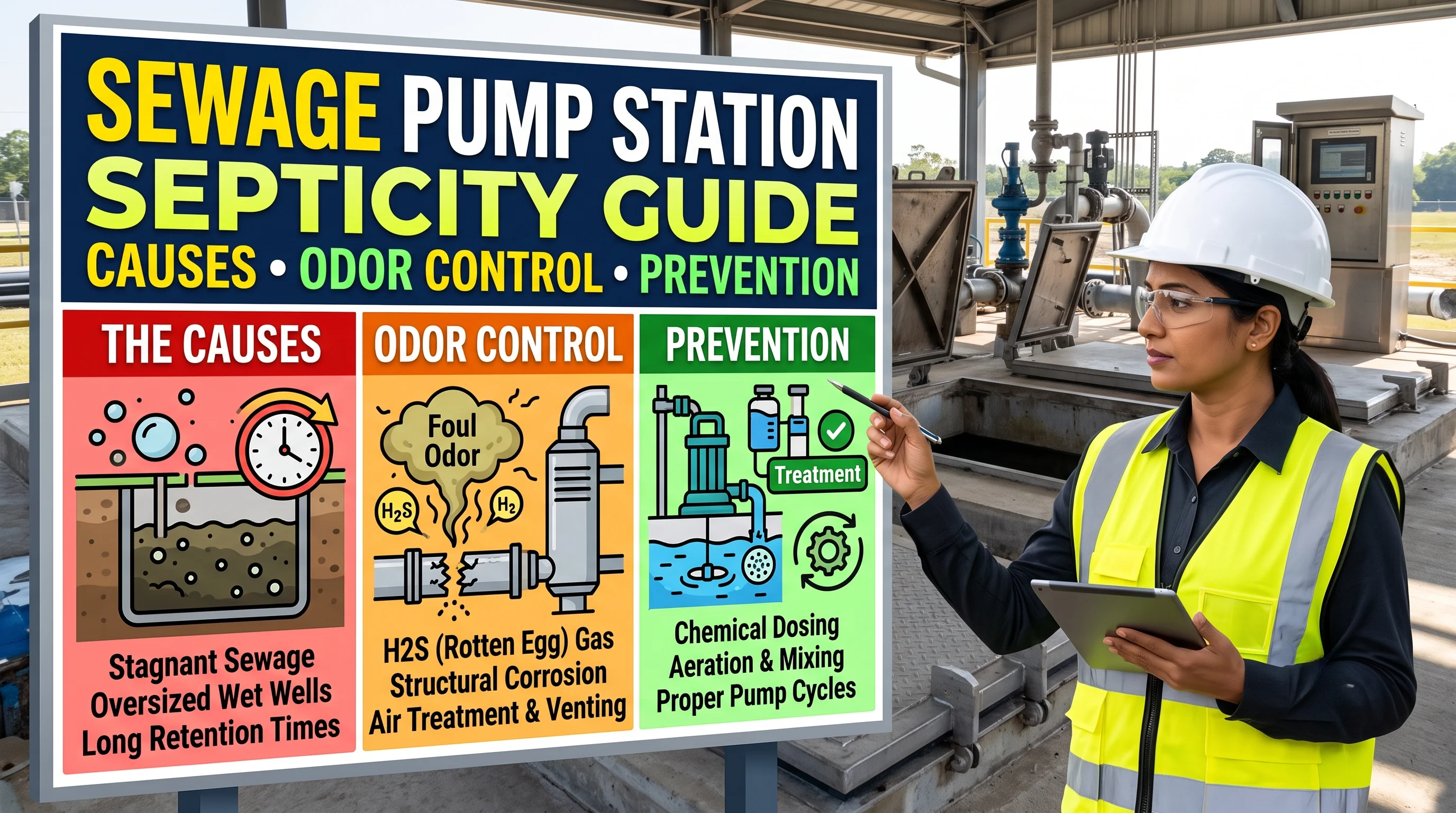
Understand why sewage pump stations turn septic, how septicity causes odor and corrosion, and which design and operating practices keep wet wells fresh and
Septicity is not a pump fault; it is a detention-time problem. When sewage rests in a wet well longer than roughly one to two hours in warm conditions, anaerobic bacteria begin generating hydrogen sulphide, mercaptans, and other foul-smelling compounds. Control it by sizing and operating the station so sewage moves through quickly, keeping wet well walls washed and sloped, venting properly, and dosing chemicals only where source-side and hydraulic fixes cannot do the job.
For the structural side of the problem, pair this guide with the wet well design guide for sewage pump stations and the float switch level control guide, since level settings decide how long sewage actually stays in the chamber.
What septicity means in a sewage pump station
Fresh sewage arriving at a pump station still carries dissolved oxygen from the collection network and is relatively inoffensive. As it sits in the wet well, that oxygen is consumed by biological activity. Once the free oxygen is gone, bacteria shift to nitrate, then sulphate, as oxygen sources. Sulphate reduction produces hydrogen sulphide gas, which is the main compound behind both the rotten-egg smell and the corrosion that damages station infrastructure.
A septic sewage pump station is therefore one where detention time, temperature, and organic load have combined to push the wet well contents anaerobic. The sewage may look black, carry a strong sulfurous odor, and release gas bubbles when agitated by the pumps starting.
Three factors dominate how fast this happens:
- Detention time: the single biggest factor. Sewage that pumps out every 20-30 minutes rarely turns septic; sewage that sits for hours often does.
- Temperature: southern and coastal Indian sites in summer can see septicity develop in half the time it takes in winter conditions.
- Strength of the sewage: high BOD loads from industrial discharges or food processing effluent accelerate oxygen depletion.
Septicity can also develop in the rising main (force main) itself on long, flat pipelines. When the main discharges at a downstream manhole or treatment inlet, the septic sewage releases its stored hydrogen sulphide at that point, which is why odor complaints sometimes concentrate far from the pump station.
Why wet wells turn septic
Most septicity problems trace back to one of a handful of hydraulic and design causes. If you diagnose a septic wet well, check these first before reaching for chemicals.
- Oversized wet well volume: chambers built for future peak flows hold too much sewage at current flows. The extra volume is exactly the detention time that bacteria need.
- Pump cycles too long or too short: paradoxically, both extremes can worsen conditions. Very infrequent pumping lets sewage stagnate between starts, while rapid short-cycling agitates septic sewage and strips hydrogen sulphide into the air without fixing the root cause.
- Flat inflow periods: night-time low flows at a municipal station, or weekend shutdowns at an industrial unit, extend residence time dramatically.
- Dead zones and poor geometry: corners, ledges, and flat chamber floors accumulate sludge that digests in place, generating gas continuously even when the main volume turns over quickly.
- Long rising mains: sewage traveling 3-5 km or more in a force main has hours of additional detention time it cannot avoid.
- High ambient temperatures: wet wells in hot plant rooms or shallow chambers exposed to sun lose their margin quickly in May and June.
Industrial estates present a special case: a common utility pump station receiving effluent from dozens of units sees load swings that municipal stations never experience. When a large discharger runs a batch dump at 2 AM, the station may receive a slug of high-strength, warm, rapidly-digesting sewage with almost no dilution.
Warning signs of a septic wet well
Operators usually get several warnings before odor complaints arrive from neighbors. Train site staff to spot them:
- Black sewage with visible gas bubbling when the pump starts and the surface agitates.
- Rotten-egg odor noticeable at the chamber access hatch, stronger in summer afternoons.
- Slime and corrosion patterns on the walls just above normal water level, and rust staining or thinning on steel brackets, guide rails, and covers.
- Level sensor fouling: septic slime coats float switches and pressure sensors, causing erratic level readings and abnormal pump cycling.
- Increased maintenance frequency on check valves and pump lifting chains, which corrode faster in gas-heavy chambers.
- Concrete spalling or crown corrosion in the upstream and downstream manholes, where sulphuric acid formed from hydrogen sulphide attacks the concrete above the water line.
If your station shows several of these together, treat it as a septicity problem, not a series of unrelated maintenance issues. Fixing each symptom separately - replacing a corroded chain, cleaning a fouled float, patching concrete - will consume budget without slowing the underlying process.
Odor and corrosion: the hidden costs
The smell is what triggers complaints, but corrosion is what actually costs money. Hydrogen sulphide gas in the humid air above the wet well is oxidized by bacteria on surfaces into sulphuric acid. That acid attacks:
- Concrete walls, roof slabs, and manhole crowns, causing progressive spalling and structural loss that is expensive to rehabilitate.
- Steel guide rails, brackets, chains, and covers, which thin and seize.
- Cable trays and electrical fittings in poorly ventilated valve chambers.
- Downstream manholes and the treatment plant inlet works, where the gas is finally released from the rising main.
Odor complaints carry their own regulatory and reputational weight for municipalities and industrial parks. A station that generates repeated complaints invites inspections, and a septic discharge reaching the treatment inlet can upset biological treatment processes that were never designed for sulphide-loaded sewage.
Budgeting reality: corrosion damage in a septic station over five years typically dwarfs the cost of the septicity controls that would have prevented it. This is why experienced consultants treat detention-time management as an asset-protection measure, not a comfort measure.
Design measures that reduce septicity
When designing a new station or rehabilitating an old one, attack detention time and dead zones directly:
- Size the wet well between pump start and stop levels, not to total chamber volume. The working volume between the lead pump start and stop levels should give acceptable cycle times at the actual current inflow, with the inflow you expect in the first years of operation, not the ultimate design horizon.
- Use a sloped, hopper-bottom chamber so solids and sludge move toward the pump intake instead of settling on ledges. Aim for wall slopes steep enough that accumulated sludge slides to the sump during pump-down.
- Position the inflow to promote mixing. Inlet pipes that discharge tangentially or opposite the pump intake help stir the contents at each pump start instead of letting a quiet corner stagnate.
- Provide freshwater backflow or a flushing connection where permitted, so operators can agitate and dilute the chamber during low-flow periods.
- Vent the chamber properly. Ventilation does not prevent septicity, but it removes hydrogen sulphide from the chamber headspace before it concentrates and attacks surfaces, and it protects maintenance crews.
- Specify corrosion-tolerant materials in gas-heavy stations: duplex or coated guide rails, stainless fasteners, and sealed cable entries. Where septicity is unavoidable, materials become the fallback defense.
- Avoid unnecessary future capacity. It is cheaper to add a pump in ten years than to fight septicity for ten years in an oversized chamber.
On long rising mains, design options narrow: consider intermediate lifting points, main flushing provisions, or chemical injection at the station as the main alternatives. The geometry of the main itself is usually fixed by the route.
Operating practices that keep sewage fresh
Many septic stations can be brought back under control with operating changes that cost almost nothing:
- Review pump start and stop levels. Raising the stop level and lowering the start level modestly reduces working volume and detention time, as long as pump cycle frequency stays within the motor's starting limits. The float switch and level control guide covers this balancing act in detail.
- Alternate pumps on time, not only on demand. Equalizing wear also ensures both pumps see the chamber contents and no pump sits in a stagnant sump indefinitely.
- Schedule periodic pump-down cleaning. Running the station down to its lowest practical level - or temporarily pumping to a standby arrangement - allows walls and the hopper to be hosed down, removing the digesting sludge layer that seeds gas production.
- Fix inflow infiltration where extraneous groundwater or stormwater is diluting flows so low that detention time balloons. Ironically, too much clean infiltration can create a septicity problem at a station designed for stronger sewage.
- Log odor observations. A simple daily note of odor strength at the hatch, season, and time builds the data needed to justify corrective spending later.
Industrial operators should also coordinate with member units on discharge schedules. If one plant's batch discharge is known to load the station at night, shifting part of that discharge to coincide with higher daytime inflow reduces peak stagnation.
When chemical dosing is justified
Chemicals are the third line of defense, applied when detention time and housekeeping cannot be fixed, typically on long rising mains or in dense urban locations where odor tolerance is low:
- Iron salts (ferrous or ferric chloride) bind sulphide chemically, reducing both gaseous hydrogen sulphide release and downstream corrosion. Dosing is typically controlled against flow and sulfide measurements.
- Magnesium hydroxide raises pH and suppresses sulphide formation biologically while adding alkalinity, which also protects downstream treatment biology.
- Oxygen-releasing or nitrate-based products give the bacteria a preferred oxygen source so sulphate reduction never starts. These are common on force mains where upstream control is impossible.
- Odor scrubbing or biofiltration at the vent point treats the symptom at the discharge location where complaints concentrate.
Dosing systems need reliable dosing pumps, storage suited to the chemical, and a monitoring loop - otherwise they drift out of calibration and money is spent without effect. Any chemical program should start with sulfide profiling along the system so the dose point and dose rate are chosen from measurements, not estimates.
Chemicals should never become a substitute for fixing an oversized chamber or a housekeeping failure. The annual chemical bill for a badly operated station can exceed the capital cost of the physical correction within a few years.
Common mistakes in septicity management
These errors recur across municipal and industrial stations:
- Treating odor with ventilation alone. Fans move gas out; they do nothing about the biological process producing it. Neighbors downwind may notice the problem gets worse.
- Enlarging the wet well to "give sewage room." More volume means more detention time and faster septicity at low flows. Chamber sizing must balance cycle time, storage, and freshness - bigger is not safer.
- Setting pump levels once and never revisiting. Seasonal flow changes and network extensions alter detention time. Levels and alternation settings deserve an annual review.
- Ignoring the rising main. A station that pumps frequently can still deliver septic sewage if the main adds hours of travel time. Diagnose the whole system, not the chamber alone.
- Chemical dosing without monitoring. Fixed-dose systems that ignore flow and sulfide variations either undershoot (complaints continue) or overshoot (budget wasted, downstream chemistry disturbed).
- Leaving dead-zone sludge untouched between annual desludging. A monthly pump-down and hose-down cycle in the hot months prevents most of the gas generation a yearly cleaning must then undo.
- Blaming the pumps. Pumps agitate and release the gas; they rarely cause the underlying biology. Replacing pumps in a septic station with an oversized chamber produces fresh pumps in the same septic conditions.
Frequently asked questions
How long can sewage sit in a wet well before it turns septic?
There is no single number, but as a working rule, sewage held for more than one to two hours in warm conditions starts producing noticeable sulfide, while sewage held for several hours in summer can become strongly septic. Retention under roughly 30 minutes is generally fresh. Sites should judge by their own observations - odor at the hatch, black color, and gas bubbling - rather than by textbook values, because temperature and sewage strength shift the timing significantly.
Does running the pumps more often fix septicity?
More frequent pumping reduces detention time, which helps, but only if the cycle frequency stays within the motor's safe starting limits and the wet well level settings are adjusted properly. Pumping alone cannot fix an oversized chamber at low inflow, and aggressive agitation of already-septic sewage can strip hydrogen sulphide into the air and worsen immediate odor. Pumping changes should be combined with chamber cleaning and, where needed, chemical support.
What is crown corrosion and why does it matter for pump stations?
Crown corrosion occurs when hydrogen sulphide gas from septic sewage is absorbed by moisture on surfaces above the water line - especially the crown of pipes and manholes - where bacteria convert it into sulphuric acid. The acid slowly dissolves concrete, causing loss of structural section that can eventually collapse the asset. In pump station systems, it attacks the wet well roof, vent structures, downstream manholes, and the force main discharge point, which is why septicity is an asset-integrity issue and not just a nuisance.
Are septicity problems worse in summer?
Yes. Higher temperatures accelerate bacterial metabolism dramatically, so sulfide production that takes several hours in winter can occur in a fraction of that time in May and June across most of India. Many stations that operate without complaints from November to February develop odor problems at the start of summer. The practical response is a pre-summer cleaning program, a review of level settings before the hot months, and chemical support scaled for the seasonal change.
Can septicity damage the pumps themselves?
The pumps see indirect damage rather than direct biological attack. Hydrogen sulphide corrodes lift chains, guide rails, cables, and motor housings above the waterline, and septic slime fouls float switches and cooling jackets. Septic sewage can also be corrosive to cast iron components over long exposures. Selecting pumps with sealed cable entries, appropriate coatings, and proven mechanical seals - and maintaining the station so gas concentrations stay low - protects the investment.
When should a station move from operational fixes to chemical dosing?
Consider chemicals when measurements or observations show septicity persisting after level settings, alternation, and cleaning have been addressed - typically on long rising mains, oversized chambers that cannot be rebuilt, or stations near sensitive receptors. Start with a sulfide survey to identify where gas is being released, choose the dose point from that data, and control dosing against flow. If operational measures alone would take years or major capital to implement, chemicals provide relief while the permanent fix is planned.
Need help selecting the right pump?
Share your flow, head, liquid type, solids, site layout and duty cycle with Flow Chem Pumps. Our team can help you shortlist the right pump.