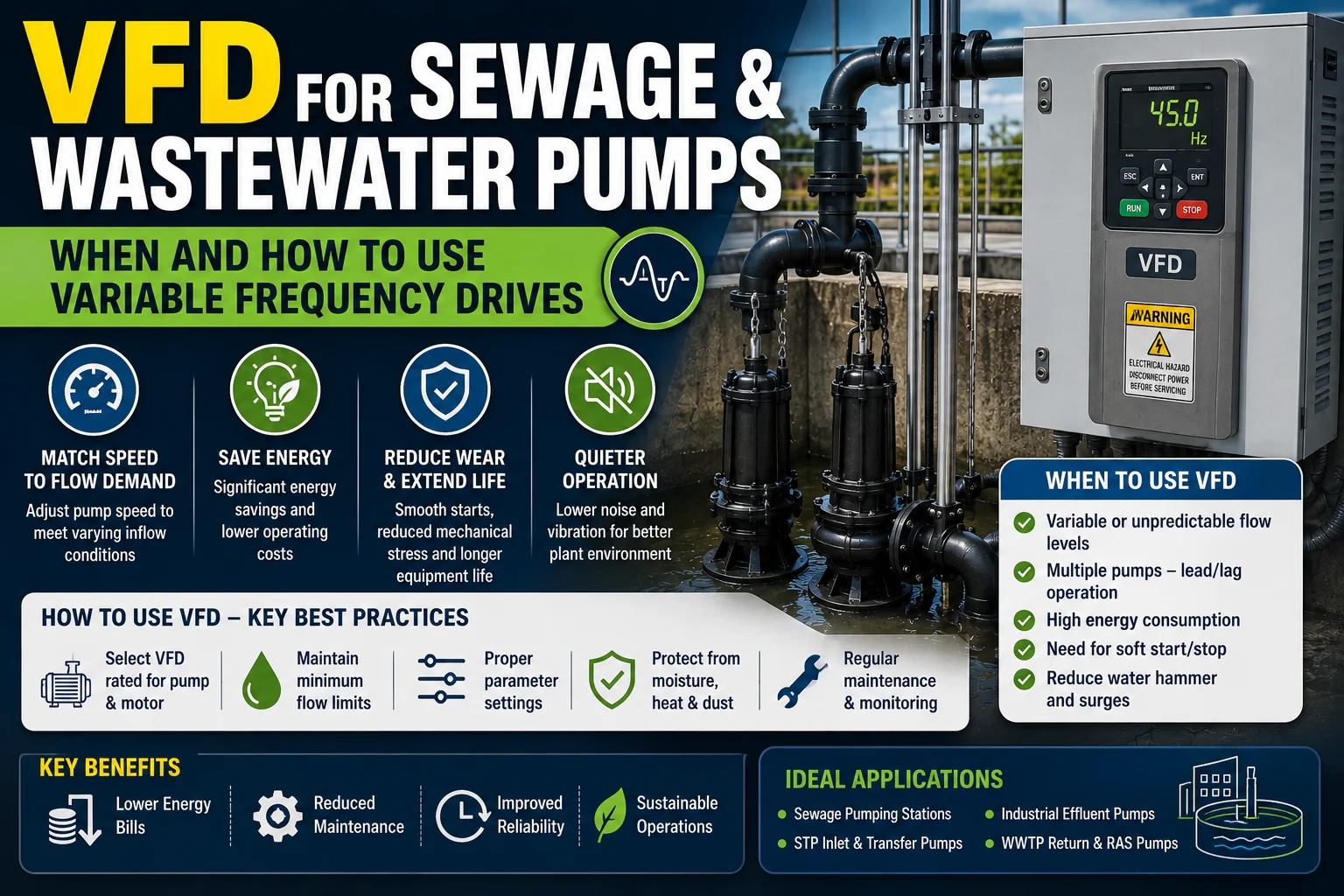
Learn when a VFD helps sewage and wastewater pumps, how to size one, and where speed control saves energy without creating solids-handling problems.
A VFD makes sense when the pump load changes through the day and the system can benefit from speed control instead of throttling.
It is most useful in lift stations, equalization tanks, treatment plants, and municipal or industrial pumping systems with variable inflow.
It is less useful when the pump mostly runs at full speed, when solids handling depends on a minimum scouring velocity, or when the site cannot support proper electrical protection.
For a sewage pump, the big question is not only energy savings.
You also need to check torque at low speed, minimum motor cooling, cable length, insulation stress, and whether the wet well or pipeline needs a certain velocity to stay clear.
A well selected VFD can reduce starting current, cut mechanical shock, and help operators match flow to demand.
A poorly selected one can create heat, harmonics, tripping, and maintenance headaches.
The right answer is usually site specific.
If the duty curve stays flat and the pump is either on or off, the payback may be weak.
If the flow changes often and the pump runs many hours each day, the case for variable speed becomes much stronger.
What a VFD does for sewage pumps
A variable frequency drive changes the electrical frequency and voltage sent to the motor.
That changes motor speed, which changes pump speed.
For centrifugal pumps, even small speed changes can have a large effect on flow, head, and power.
That is why VFDs can save energy in systems with variable demand.
In sewage service, the practical benefits are usually these:
- soft starting instead of a hard across-the-line start
- lower inrush current
- flow matching instead of relying only on valves or repeated start-stop cycling
- better control in wet wells and lift stations
- less mechanical shock on couplings, bearings, pipes, and check valves
- easier process control in treatment plants
The energy story matters, but it is not the whole story.
A sewage pump often faces ragging, solids, air pockets, and changing liquid levels.
That means the VFD must be part of a system design, not just a box added to the wall.
The control logic should match the pump's duty.
If the site uses level control, the VFD can maintain a target wet well level.
If the system uses pressure control, it can hold discharge pressure at a setpoint.
If the process uses flow control, it can follow a flow signal from the plant.
For submersible sewage pumps, the drive also needs to respect motor cooling.
A submersible motor often depends on the surrounding liquid for cooling.
At low speed, the motor may not shed heat as well.
That is one reason minimum speed limits matter.
Another point is insulation stress.
Long cable runs between the VFD and submersible motor can create voltage spikes.
That is why output reactors, dv/dt filters, or sine filters may be needed on some installations.
When VFD makes sense for sewage duty
A VFD sewage pump installation usually makes sense when the duty cycle changes enough to create real savings or operational gain.
The strongest cases are below.
1. Variable inflow during the day
Lift stations and wastewater plants rarely see the same flow all day.
Morning and evening peaks can be very different from overnight flow.
If a VFD lets the pump slow down during low demand and speed up only when needed, the site may reduce energy use and reduce short cycling.
2. Long operating hours
A pump that runs for many hours each day has more room to recover the cost of a drive.
A unit that runs only a few minutes at a time usually has a weaker payback.
The more runtime, the more value you get from smoother control and lower power draw.
3. Systems that currently use throttling
If operators control flow by partially closing valves, the pump is wasting energy.
A VFD usually does the same job with less waste.
That is especially true where the system curve shifts often or the discharge head is not fixed.
4. Wet well level control
Many sewage stations benefit from maintaining a narrower wet well band.
That reduces overflow risk, limits odor and septicity issues, and helps manage pump starts.
A VFD can keep the pump running longer at lower speed instead of bouncing between on and off.
5. Reduced water hammer and mechanical stress
Sewage systems can have long headers, check valves, and fragile fittings.
Soft starting and soft stopping can reduce pressure shock.
That is useful where pipe breaks or check valve slam are recurring problems.
6. Process plants with mixed loading
Industrial effluent plants often see batch discharge.
When a process line dumps variable flow into a sump, a VFD can help the pump follow that pattern more smoothly than fixed speed control.
7. Sites with generator or weak power supply issues
A soft starter or VFD can reduce starting current and help when electrical supply is limited.
That does not remove the need for proper sizing, but it can reduce nuisance voltage dip problems.
8. Energy audits show throttling loss
If the site already has an energy audit or pump curve data, the case becomes clearer.
When the pump runs far away from its best efficiency point for long periods, variable speed may improve both energy use and operating stability.
The best sign is simple.
If the process truly needs variable flow, the VFD is doing useful work.
If the pump just needs to move one fixed duty point, the case weakens.
When VFD is not worth the investment
A VFD is not automatically the right answer for every sewage pump.
There are cases where the added cost and complexity do not justify the result.
1. Mostly constant duty
If the pump runs near one point all the time, speed control may not deliver much value.
The simplest, most reliable setup may be a fixed speed pump with a proper starter and controls.
2. Very short run times
A pump that runs briefly and rarely may not save enough energy to justify the drive.
In those cases, the savings from soft starting may not offset the extra equipment.
3. Solids handling depends on minimum velocity
Some sewage lines need enough velocity to keep solids moving.
If the pump slows too much, solids can settle in the wet well or pipeline.
That can create ragging, clogging, and odor problems.
4. Poor electrical environment
A weak earthing system, high harmonic sensitivity, unstable supply, or lack of surge protection can make VFD operation unreliable.
If those issues are not fixed first, the drive may create more trouble than value.
5. No maintenance support on site
A VFD is not hard to use, but it does need someone who understands alarms, parameter settings, and fault logs.
If the site has little electrical support, a simpler solution may be better.
6. Motor or cable limitations
Older motors, damaged insulation, and long submersible cable runs may not tolerate inverter duty well.
If the motor is not suitable, the project can turn into a repair cycle instead of an energy project.
7. The project is being sold only on savings claims
Energy savings matter.
But if the vendor ignores process stability, solids behavior, and electrical quality, the recommendation is incomplete.
The right question is not "Can a VFD reduce power?"
The right question is "Will the whole system run better and pay back in this duty cycle?"
Sizing a VFD for submersible sewage pumps
Sizing a VFD for a submersible sewage pump is more than matching kilowatts.
You need to match current, overload duty, thermal behavior, and the actual load profile.
1. Start with motor nameplate data
Check the motor voltage, full-load current, frequency, power factor, efficiency, and service factor.
Do not size only from horsepower.
Nameplate current matters because sewage pumps can draw more current during start or under heavy solids load.
2. Choose the drive voltage correctly
The VFD output voltage must match the motor rating.
For example, a 415 V motor needs a compatible 3-phase drive and suitable supply.
If the site uses a transformer or generator, check the full electrical chain, not just the motor.
3. Leave room for overload
A sewage pump may face transient overload when ragging increases torque demand.
That means the drive should have enough overload margin for the duty class.
Do not operate right at the edge.
4. Account for low-speed cooling
Submersible motors cooled by surrounding liquid may need a minimum speed setting.
At low speed, the pump may still move enough liquid for process control, but the motor might not cool adequately.
If the pump spends long periods at low speed, check the motor manufacturer guidance.
5. Check minimum frequency
The minimum frequency should not be chosen only for flow control.
It also needs to preserve solids transport and motor cooling.
In many sewage applications, the operator sets a lower limit to avoid settling and overheating.
6. Consider the pump curve
Speed reduction changes the pump curve.
If the system head is high, the expected savings may be modest.
If the system head is variable, savings can be larger.
Use the actual pump curve and system curve when estimating performance.
7. Add protection for the output side
Long cables, high dv/dt, and submersible motor insulation can be a problem.
Depending on the installation, you may need:
- output reactor
- dv/dt filter
- sine filter
- proper shielded cable
- correct grounding
8. Plan the control mode
Common modes include:
- level control
- pressure control
- flow control
- PID control with feedback
Pick the mode that matches the site.
Do not force pressure control onto a wet well problem if level control is the real need.
9. Select the enclosure and cooling
A VFD mounted in a dusty, humid, or corrosive sewage environment needs proper protection.
The panel should be rated for the site conditions, with ventilation or cooling as required.
10. Include bypass only if it makes sense
Some sites need a bypass so the pump can run fixed speed during a VFD fault.
That can improve uptime.
But bypass adds complexity, so it should be designed, not guessed.
A simple rule helps here.
If the pump is critical, the electrical design should assume a fault will happen one day.
Installation and commissioning considerations
Installation quality matters as much as the drive itself.
Many VFD problems in sewage service come from wiring, grounding, or bad parameter setup rather than the drive hardware.
Electrical installation
Use proper cable sizing, grounding, isolation, and short output runs where possible.
Keep the drive wiring separate from signal cables.
If the site has lightning or surge exposure, add the right protection.
Motor compatibility
Confirm that the motor can operate with inverter supply.
Some older motors may need insulation checks before VFD use.
If the motor is already stressed, the drive may expose the weakness faster.
Sensor placement
If the system uses level or pressure feedback, install the sensor where the reading represents the real process state.
Bad sensor location leads to hunting, overspeeding, and erratic operation.
Parameter setup
Commissioning should include ramp times, minimum frequency, maximum frequency, current limits, and PID tuning.
Start with conservative settings.
Then tune carefully.
Too aggressive a ramp can cause surge.
Too slow a ramp can make the process sluggish.
Minimum speed trial
Test the pump at several speeds while watching current, temperature, vibration, and solids movement.
A speed that looks fine on paper may still be too low in practice.
Wet well behavior
Watch for vortexing, air entrainment, and rag build-up.
Low speed operation can change wet well hydraulics.
If the wet well starts to collect solids, the control band may need adjustment.
Operator training
Operators should know how to read alarms, reset faults, and understand what the drive is protecting.
A VFD is only helpful if the team knows when not to override it.
Spares and service
Keep critical spare parts or at least a service contact.
That may include a replacement fan, keypad, control board, or complete drive for larger stations.
If the site is remote, this matters more than the brochure claims.
Common VFD application mistakes
These are the errors that show up again and again in sewage and wastewater sites.
1. Overselling energy savings
The pump may save energy, but the exact number depends on the system curve and duty cycle.
Do not promise savings without checking the actual load pattern.
2. Ignoring minimum solids velocity
If the pump slows too much, solids settle.
That creates clogs, bad smells, and poor station cleanliness.
3. Using the same settings everywhere
A lift station and a treatment plant sump are not the same.
A good parameter set for one may be wrong for the other.
4. Skipping output protection
Long submersible cable runs can create electrical stress.
If the installation needs a filter or reactor, skipping it can shorten motor life.
5. Forgetting cooling at low speed
Low speed may solve flow control but create motor heat.
Always confirm the thermal limits.
6. Not checking harmonics
A VFD can affect upstream power quality.
If the site has sensitive loads or a weak supply, harmonics may matter.
7. No bypass or no fallback plan
A critical sewage station should not depend on a single untested failure mode.
If the drive fails, what happens next?
That question needs a real answer.
8. Wrong control objective
Many sites want level stability but are configured for pressure control.
That mismatch causes cycling and operator frustration.
9. Poor commissioning records
If nobody records the settings, a later fault can become a guessing game.
Save the parameters, notes, and baseline readings.
10. Treating the VFD as a cure-all
A VFD does not fix a damaged impeller, blocked suction, bad piping, or undersized pump selection.
It only helps when the underlying hydraulic and electrical design are sound.
Frequently asked questions
What is the main benefit of a VFD on a sewage pump?
The main benefit is control. A VFD lets the pump match speed to demand, which can reduce energy use, soften starts, and improve wet well management. In many stations, that control also reduces wear because the pump does not slam on and off as often.
Can a VFD damage a submersible sewage pump motor?
It can if the setup is wrong. Problems usually come from poor grounding, long cable runs without protection, bad parameter settings, or low-speed overheating. With the right motor, cable, and commissioning, VFD operation is common and practical.
How do I know if a sewage pump can run at low speed?
Check the pump and motor manufacturer limits. Then confirm that the lower speed still moves solids, keeps the wet well clean, and cools the motor properly. If any of those fail, set a higher minimum speed.
Is a VFD better than a soft starter for sewage pumps?
They solve different problems. A soft starter reduces starting stress, but it does not provide continuous speed control. A VFD does both soft starting and speed control, so it is better when variable operation matters. If the site only needs reduced start current, a soft starter may be enough.
Do VFDs save a lot of electricity on every sewage pump?
No. Savings depend on how much the flow changes, how long the pump runs, and how the system head behaves. A pump that runs near full speed most of the time may save very little.
What should I check before buying a VFD for a wastewater pump?
Check motor nameplate data, cable length, motor insulation suitability, overload requirement, cooling at low speed, site power quality, and the control objective. Also check whether the system needs a bypass, output filter, or special enclosure rating.
Need help selecting the right pump?
Share your flow, head, liquid type, solids, site layout and duty cycle with Flow Chem Pumps. Our team can help you shortlist the right pump.