Learn how to select an effluent pump for industrial wastewater applications. Compare flow, head, liquid chemistry, solids, materials, seals and service sup
The correct effluent pump is selected by matching the pump to the liquid, not just by horsepower or pipe size. For industrial wastewater applications, start with the effluent chemistry, required flow rate, total dynamic head, solids content, abrasiveness, temperature, operating hours and installation layout. Then shortlist the pump construction, material, impeller, seal arrangement and service plan.
If the liquid is treated effluent, ETP discharge or industrial wastewater transfer, review Flow Chem’s effluent pumps and submersible waste water pump options. If the application involves raw sewage, heavy sludge or high solids, compare the duty with a submersible sewage sludge pump instead.
This guide is written for plant engineers, ETP teams, consultants, EPC contractors and purchase teams that need a practical selection process before sending an enquiry or finalizing a pump.
What is an effluent pump used for?
An effluent pump is used to transfer wastewater, treated effluent or process discharge from one stage of an industrial or wastewater treatment system to another. In factories, ETPs and wastewater handling systems, effluent pumps may move liquid from collection tanks, equalization tanks, treatment units, filter outlets, storage tanks or discharge points.
Effluent is not always clean water. It can contain suspended solids, chemicals, oil traces, process residues, heat, corrosive components or abrasive particles depending on the industry. Because of this, selecting an effluent pump requires more application detail than selecting a basic water-transfer pump.
The pump must deliver the required flow and head while tolerating the liquid properties. If material compatibility or seal protection is ignored, the pump may suffer corrosion, leakage, reduced performance or premature failure.
Effluent pump vs sewage pump vs wastewater pump
Many buyers use the terms effluent pump, sewage pump and wastewater pump interchangeably, but the applications are different.
An effluent pump is usually selected for treated effluent, ETP liquid transfer, process wastewater and industrial discharge where liquid chemistry and corrosion risk matter.
A sewage pump is selected for raw sewage, sludge and solids-handling duties. If the liquid has heavy sludge or large solids, a sewage/sludge pump is usually more relevant than a standard effluent pump.
A wastewater pump is a broader category. It can include treated wastewater, industrial wastewater or general dirty-water transfer depending on solids, chemistry and duty conditions.
Step 1: define the effluent chemistry
Effluent chemistry is the first selection input because it affects pump material, seals and expected service life. Before asking for a quote, collect details about the liquid.
Important inputs include:
- pH range.
- Temperature.
- Chemicals or solvents present.
- Oil, grease or process residues.
- Chlorides or corrosive elements.
- Abrasive particles or grit.
- Suspended solids level.
- Whether the liquid is treated, partially treated or untreated.
If the liquid is corrosive, the pump may need specific material, coatings or seal choices. If the liquid has abrasive particles, wear resistance becomes important. If the effluent is near clean treated water, the selection may be simpler, but the hydraulic duty still needs to be checked.
Step 2: calculate flow rate and total dynamic head
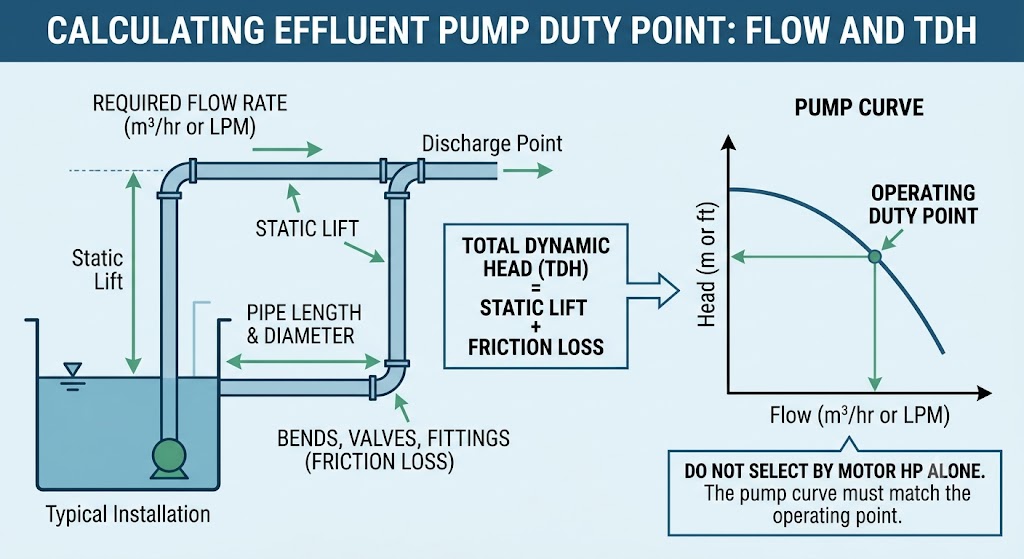
Flow and head determine whether the pump can meet the required operating point. Flow rate tells how much liquid must be moved. Total dynamic head tells how much resistance the pump must overcome.
Document:
- Required flow rate in m³/hr or LPM.
- Static lift from tank level to discharge point.
- Pipe length and pipe diameter.
- Bends, valves and fittings.
- Friction loss at operating flow.
- Final discharge pressure or destination.
- Whether the pump runs continuously or intermittently.
Do not select an effluent pump only by motor HP. A pump with the same HP can perform very differently depending on the curve, impeller and duty point. The pump curve should match the calculated flow and total dynamic head.
Step 3: check suspended solids and abrasion risk
Industrial effluent may contain suspended solids even after treatment. Some applications also include fine grit, process residue or abrasive particles. These conditions influence impeller type, wear components and pump construction.
Ask these questions:
- What is the expected solids percentage?
- Are particles soft, hard, abrasive or fibrous?
- Is there any risk of clogging?
- Is upstream screening or filtration available?
- Has the site previously faced impeller wear or blockage?
If solids are heavy or sludge-like, do not force the application into a standard effluent pump. Compare it with a submersible sewage sludge pump or other solids-handling pump options.
Step 4: select material and seal arrangement
Material selection is critical in industrial wastewater. Standard construction may work for neutral treated effluent, but corrosive or chemically aggressive liquid may need upgraded material, coating or seal protection.
Review:
- Pump body material.
- Impeller material.
- Shaft and fastener material.
- Mechanical seal material.
- Cable entry and motor protection.
- Coating requirement.
- Compatibility with pH and chemical exposure.
For aggressive wastewater, the cheapest pump is rarely the lowest-cost solution. Corrosion-related downtime can cost more than the initial saving.
Step 5: match the pump to installation conditions
Effluent pumps may be installed in collection tanks, sumps, ETP chambers, equalization tanks or discharge pits. The installation environment affects serviceability and safe operation.
Check:
- Tank depth and pump submergence.
- Available space for pump installation.
- Lifting and removal access.
- Pipe routing and valve access.
- Electrical cable protection.
- Control panel and dry-run protection requirements.
- Standby pump requirement for critical processes.
For critical industrial sites, plan duty/standby arrangement so that one pump can continue operation while the other is under maintenance.
Step 6: evaluate duty cycle and reliability
Industrial wastewater transfer can be continuous, batch-based or peak-load driven. The pump should be selected for actual operating conditions.
Consider:
- Operating hours per day.
- Number of starts and stops.
- Peak discharge periods.
- Liquid level variation.
- Thermal protection needs.
- Dry-run risk.
- Spare parts availability.
- Local service support.
A pump that works for occasional transfer may not be suitable for continuous ETP operation. Reliability depends on matching motor rating, hydraulics, material and protection systems to the real duty.
Effluent pump selection checklist
Use this checklist before procurement:
- Application: ETP transfer, treated effluent, process wastewater or discharge pumping.
- Liquid chemistry: pH, chemicals, temperature and corrosion risk.
- Solids: suspended solids, abrasive particles and clogging risk.
- Flow rate: average and peak requirement.
- Total dynamic head: static lift plus friction loss.
- Pump type: effluent, wastewater, sewage/sludge or other special-duty pump.
- Material: body, impeller, shaft, seals and coating.
- Installation: tank, sump, chamber or discharge layout.
- Duty cycle: continuous, intermittent or batch transfer.
- Service: access, spares, warranty and manufacturer support.
Common selection mistakes
Avoid these mistakes when selecting an effluent pump:
- Choosing by HP without checking the pump curve.
- Treating chemical effluent like normal water.
- Ignoring pH, temperature or corrosion risk.
- Underestimating pipe friction loss.
- Using an effluent pump for sludge-heavy sewage duty.
- Not checking seal compatibility.
- Selecting without standby planning for critical ETP operation.
- Buying without spare and service support.
When to ask Flow Chem for selection support
If the effluent chemistry is unclear, the site has corrosion issues, or the duty involves mixed wastewater, share the application data before final selection. Flow Chem can review the liquid type, flow, head, installation and material requirements to recommend a suitable pump.
For selection support, send duty details through the Flow Chem contact page. Include liquid type, pH, temperature, flow rate, head, solids content, tank depth, pipe route and operating hours.
Frequently asked questions
What is the difference between an effluent pump and a sewage pump?
An effluent pump is generally used for treated or industrial wastewater transfer where liquid chemistry and material compatibility matter. A sewage pump is used for raw sewage, sludge and heavier solids-handling applications.
Can an effluent pump handle industrial wastewater?
Yes, if the pump material, seal arrangement, flow, head and solids-handling capability match the wastewater. Industrial wastewater should always be checked for pH, corrosion, temperature and suspended solids before selection.
How do I size an effluent pump?
Calculate the required flow rate and total dynamic head, then match the duty point to the pump curve. Also check liquid chemistry, solids, duty cycle, installation depth and service requirements.
Which material is best for effluent pumps?
The best material depends on the effluent chemistry. Neutral treated effluent may work with standard construction, while corrosive or chemical wastewater may need upgraded materials, coatings or seal options.
What details should I send for an effluent pump quote?
Send flow rate, total head, liquid type, pH, temperature, solids content, tank depth, pipe length, operating hours, material concerns and project location.
Need help selecting the right pump?
Share your flow, head, liquid type, solids, site layout and duty cycle with Flow Chem Pumps. Our team can help you shortlist the right pump.