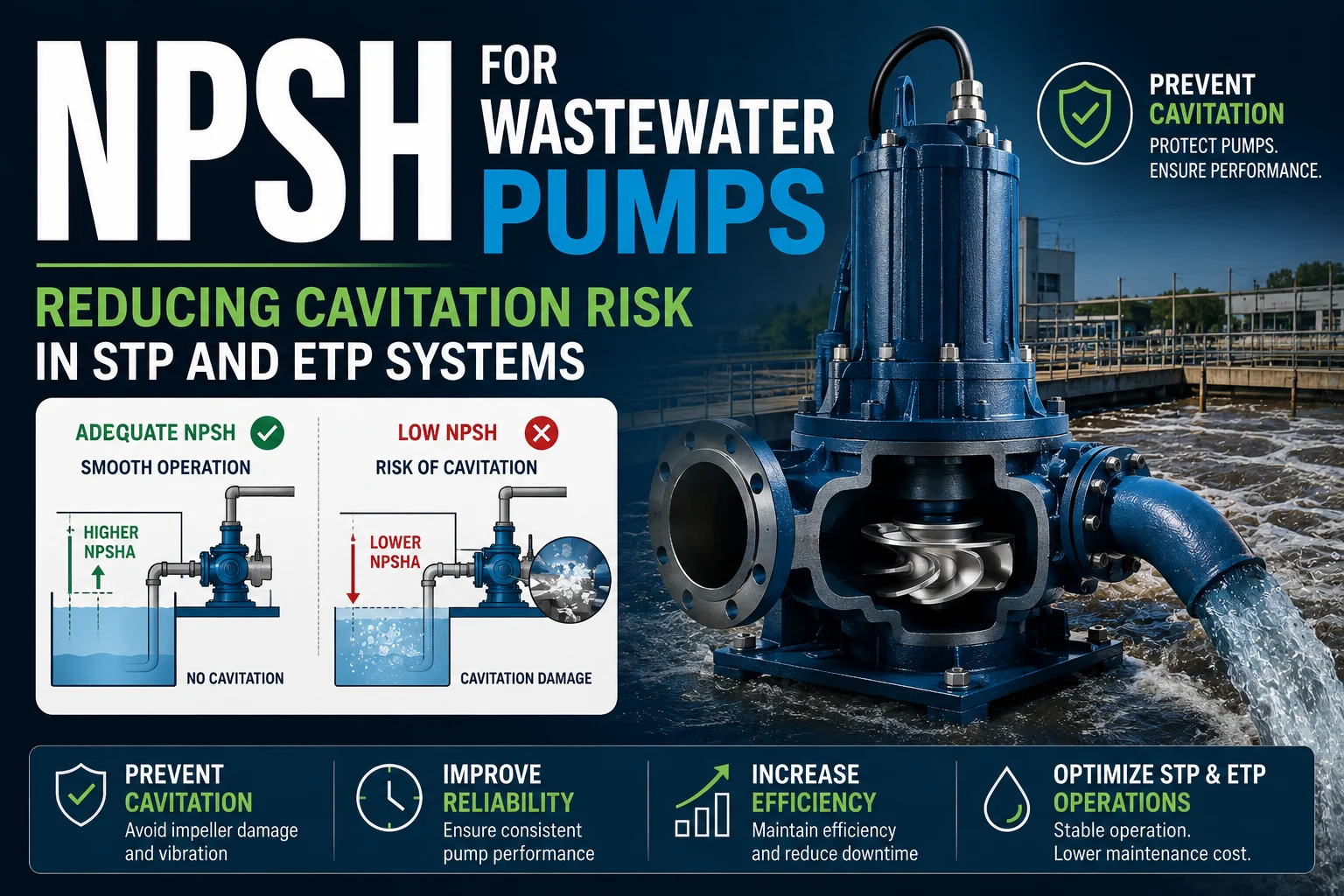
Understand NPSH for wastewater pumps and how to reduce cavitation risk in STP and ETP systems. Learn the suction-side checks that protect uptime and pump l
NPSH matters in wastewater pumps because poor suction conditions can trigger cavitation, noise, vibration, reduced capacity and premature wear. Plants should review liquid level, suction losses, sump behavior, pipe routing and duty changes instead of treating cavitation as a purely mechanical fault.
Why NPSH matters in wastewater service
Wastewater stations often experience variable liquid level, entrained air, changing temperatures and solids movement. Those factors make suction reliability especially important.
- Cavitation reduces hydraulic performance.
- Repeated cavitation accelerates wear on impellers and casings.
- Noise and vibration rise when suction conditions become unstable.
- Mechanical seals and bearings may fail earlier when the pump operates in distress.
NPSH available versus NPSH required
The practical goal is simple: NPSH available at the site should remain safely above the pump's NPSH required across the operating range.
- NPSH available depends on liquid level, suction geometry, friction loss and fluid conditions.
- NPSH required comes from the pump design and changes with operating point.
If available suction head gets too close to the pump requirement, cavitation risk rises quickly.
Where wastewater systems lose suction margin
- Falling wet-well level or unstable inlet conditions.
- Undersized suction lines or excessive fittings.
- Partially blocked strainers or upstream restrictions.
- Air ingress from poor sealing or vortex formation.
- Operating the pump away from the intended duty point.
These problems can affect a submersible waste water pump, submersible sewage sludge pump or effluent pump alike if suction conditions are weak.
Signs of cavitation in a wastewater pump station
- Crackling or gravel-like sound.
- Unstable discharge performance.
- Rising vibration or temperature.
- Repeated seal or impeller wear.
- Reduced flow even when the motor seems healthy.
These symptoms should trigger a suction-side review before the team orders replacement hardware.
How wet-well design influences NPSH performance
In wastewater systems, the sump or wet well can destroy suction conditions even when the pump itself is correctly chosen.
- Poor inlet location can create turbulence.
- Vortex formation can pull air into the pump.
- Dead zones may allow solids settlement that changes suction behavior.
- Inadequate submergence can increase risk during low-level operation.
Practical ways to reduce cavitation risk
- Maintain adequate liquid level and level-control settings.
- Review suction pipe diameter, length and fittings.
- Eliminate avoidable restrictions or clogged strainers.
- Check for air ingress and vortexing.
- Confirm the pump is operating near the intended duty point.
- Reassess whether the selected pump is appropriate for the application.
When the root cause is not the pump alone
Plants often replace a pump after cavitation damage without fixing the conditions that caused it. That creates a repeat failure cycle.
- The control logic may allow levels to fall too low.
- The suction arrangement may have changed after retrofit.
- Process variation may now exceed the original design assumptions.
- Solids accumulation may be altering sump hydraulics.
Checklist for engineers and maintenance teams
- Compare NPSH available with the pump requirement over real duty conditions.
- Review low-level operating scenarios, not just ideal conditions.
- Inspect wet-well hydraulics and air-entry risk.
- Check suction-line friction losses and restrictions.
- Investigate process changes that may have shifted the duty.
Frequently asked questions
What does NPSH mean in a wastewater pump application?
It refers to the suction energy margin available to the pump. If that margin is too low, the liquid can vaporise locally and cause cavitation.
Can a submersible wastewater pump still cavitate?
Yes. Even submersible pumps can cavitate if the station conditions, liquid level, suction hydraulics or operating point are poor.
Is cavitation always caused by low liquid level?
No. Low level is one cause, but suction restrictions, vortexing, air ingress, temperature effects and duty mismatch can also reduce suction margin.
Should I replace the pump immediately if I hear cavitation noise?
Not before checking the suction-side conditions. Replacing the pump without fixing the root cause can repeat the same failure.
Can solids handling issues worsen cavitation risk?
Yes. Solids buildup, partial blockages or unstable inlet conditions can change the suction environment and reduce effective NPSH available.
Can Flow Chem confirm NPSH margin without site data?
No. Final NPSH review needs the actual liquid level, suction layout, line losses and operating duty.
Need help selecting the right pump?
Share your flow, head, liquid type, solids, site layout and duty cycle with Flow Chem Pumps. Our team can help you shortlist the right pump.