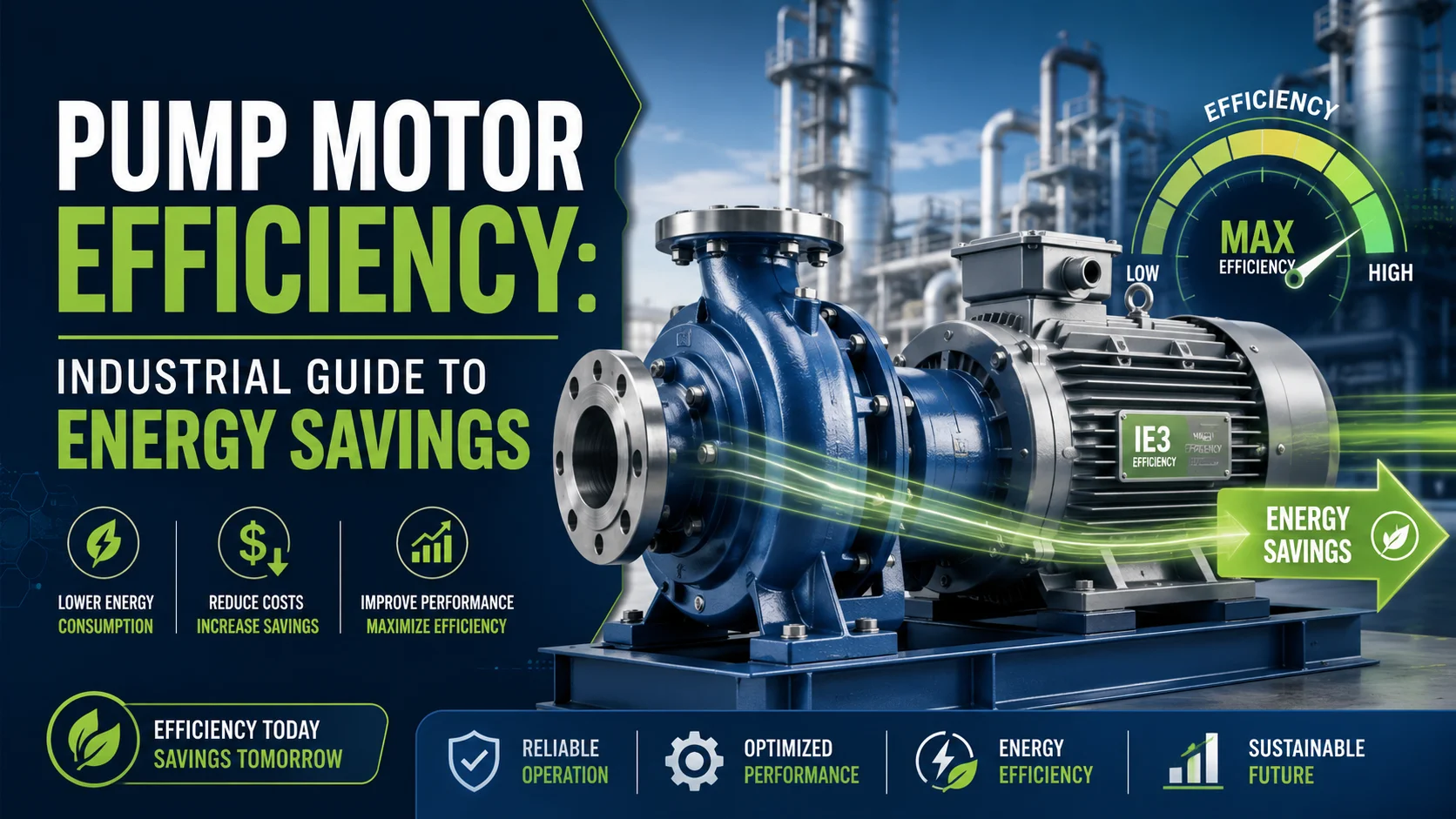
Learn how to improve pump motor efficiency and reduce energy cost in industrial systems. Review motor selection, pump sizing, controls, maintenance and lif
Industrial plants improve pump motor efficiency by matching the pump and motor to the real duty point, reducing throttling and friction losses, using efficient motors and controls where appropriate, maintaining bearings and seals, and monitoring actual power consumption over time. The biggest savings usually come from system-level optimization, not from buying a more efficient motor alone.
If the plant uses wastewater or sewage systems, compare the duty with submersible sewage sludge pump, submersible waste water pump and submersible pump manufacturer in India pages when reviewing equipment options.
Why pump motor efficiency matters
Pump energy is one of the most persistent operating costs in industrial plants. A pump may run for thousands of hours per year, which means even a small drop in efficiency can translate into a meaningful increase in electricity consumption.
For many facilities, pump systems are among the top electrical loads. The reason is simple:
- Pumps often run continuously or for long duty periods.
- They are frequently oversized during design.
- Flow demand changes over time.
- Operators throttle valves to control flow instead of optimizing the whole system.
- Maintenance wear slowly increases power demand.
- Motors and controls may be selected without enough attention to real duty conditions.
That is why pump motor efficiency should be treated as a system-performance issue, not just an equipment specification.
Step 1: understand that the motor is only one part of the system
The phrase “pump motor efficiency” is useful, but it can be misleading if it is treated as only a motor problem. In practice, the total electrical demand depends on the pump, motor, piping, valves, controls and operating schedule.
A high-efficiency motor can still waste energy if:
- The pump is oversized.
- The duty point is far from the best efficiency point.
- Discharge is throttled heavily.
- The pipeline has unnecessary bends or friction loss.
- The suction conditions are poor.
- The pump operates outside its preferred range.
- Cavitation or air entrainment causes unstable performance.
The correct question is not only “which motor is efficient?” but also “is the entire pumping system designed and operated efficiently?”
Step 2: start with the real duty point
The most common energy mistake in industrial pumping is selecting equipment based on a guessed duty instead of the actual duty point. If the pump operates too far from its best efficiency point, the plant pays for wasted electricity every hour the system runs.
Review these duty inputs:
- Required flow rate.
- Static head.
- Total dynamic head.
- Pipe length and diameter.
- Number of fittings, valves and bends.
- Liquid type and density.
- Solids or slurry content.
- Duty cycle and run hours.
- Minimum and maximum flow needs.
A pump selected for the right duty point will usually consume less power than a pump that is forced to operate by throttling or bypassing.
Step 3: check motor sizing carefully
Motor sizing affects both efficiency and reliability. An oversized motor may run below its optimal load range, while an undersized motor may overheat or trip.
A good sizing approach should consider:
- Pump shaft power requirement at the duty point.
- Starting torque and starting current.
- Service factor and margin.
- Ambient temperature.
- Frequency of starts and stops.
- Continuous or intermittent duty.
- Load variation over time.
A motor should not be selected only by matching the nearest higher horsepower rating. The plant should verify that the motor fits the actual load profile.
Step 4: use efficient motors where the load profile justifies them
Efficient motors can reduce energy use, but they should be chosen based on the operating profile and total economics. In many industrial contexts, an efficient motor is justified when the pump runs long hours.
Consider:
- Motor efficiency class.
- Part-load behavior.
- Temperature rise.
- Harmonic compatibility if using drives.
- Repairability and spare availability.
- Total lifecycle cost, not only purchase cost.
For long-run applications, a more efficient motor can pay back through lower operating electricity use. But if the system is poorly designed, the motor upgrade alone may not deliver the expected savings.
Step 5: reduce throttling losses
A throttling valve is one of the most common hidden energy drains in pumping systems. Operators often reduce flow by partially closing a valve instead of adjusting pump speed or redesigning the system.
That creates wasted pressure and wasted power.
Plant teams should ask:
- Is the pump being throttled for normal operation?
- Could a different impeller diameter or pump selection remove the need for throttling?
- Could a variable frequency drive help match flow demand?
- Is bypass flow sending energy straight back to the tank?
- Is the control strategy based on real demand or old habits?
Reducing throttling losses is often one of the fastest paths to pump energy savings.
Step 6: review friction losses in piping and fittings
Even a highly efficient pump will waste energy if the piping system is poorly designed. Excessive friction loss forces the pump to work harder to achieve the same output.
Check:
- Pipe diameter adequacy.
- Unnecessary elbows and bends.
- Long routed pipelines.
- Partially blocked strainers.
- Fouling or scaling inside pipes.
- Wrong valve type.
- Sudden diameter changes.
- Inlet restrictions.
Small design improvements in the pipe network can produce meaningful efficiency gains, especially in large or continuous-duty systems.
Step 7: consider variable speed control carefully
A variable frequency drive, or VFD, can improve pump motor efficiency when the process demand changes. But it should be applied with a proper engineering review.
A VFD can help when:
- Flow demand varies over time.
- Pressure requirements change.
- The process benefits from fine control.
- The pump would otherwise be throttled a lot.
- Soft starting reduces electrical stress.
A VFD may not help as much when:
- The pump already runs at stable full load.
- The system is badly oversized and needs redesign.
- The motor/pump are not suitable for variable-speed duty.
- The liquid or solids profile creates operating constraints.
A VFD is a control tool, not a substitute for correct hydraulic selection.
Step 8: keep suction conditions healthy
Poor suction conditions reduce efficiency and can damage the pump. When suction losses rise, the pump may cavitate or run with unstable output, which wastes energy and shortens equipment life.
Check:
- Adequate liquid level.
- Suction line size.
- Short, direct suction routing.
- Filter or strainer condition.
- Air ingress points.
- Vortex formation in the sump.
- Proper priming where relevant.
- NPSH margin.
If the suction side is unstable, the pump will not operate efficiently even if the motor itself is efficient.
Step 9: maintain bearings, seals and alignment
Mechanical condition has a direct impact on power consumption. Friction, misalignment and internal wear increase the load on the motor.
Maintenance checks should include:
- Bearing noise and temperature.
- Vibration monitoring.
- Shaft alignment.
- Seal condition.
- Impeller wear.
- Coupling condition.
- Lubrication intervals.
- Foreign material build-up.
A worn pump often draws more power to deliver less useful output. That is wasted energy and a reliability risk at the same time.
Step 10: measure actual energy use, not just nameplate data
One of the best ways to improve pump motor efficiency is to measure what the system is actually consuming. Nameplate horsepower and theoretical calculations do not tell the full story.
Track:
- Motor current.
- Power factor.
- Real kW.
- Daily runtime.
- Flow rate during operation.
- Pressure or head.
- Pump vibration and temperature.
- Downtime and maintenance cost.
A simple monitoring plan can reveal whether the pump is operating inefficiently due to wear, throttling, fouling or poor control settings.
Step 11: optimize duty scheduling
Sometimes the best energy improvement does not involve hardware. It involves scheduling.
Examples:
- Running pumps only when process demand exists.
- Alternating duty and standby units to reduce wear.
- Matching pumping to off-peak production windows where practical.
- Avoiding unnecessary recirculation.
- Cleaning tanks or strainers at the right interval.
Smarter scheduling reduces runtime and can extend equipment life.
Step 12: review the economics of upgrades
Not every upgrade is worth doing. Plant teams should compare the cost of improvement against expected energy savings.
When evaluating an upgrade, compare:
- Capital cost.
- Installation cost.
- Expected kWh reduction.
- Maintenance impact.
- Reliability improvement.
- Spare parts implications.
- Payback period.
- Process risk.
Sometimes the best payback comes from fixing the pump selection, not from replacing the motor. In other cases, the pump is fine but the control system is outdated. The economic case should be based on measurements and actual operating hours.
Pump efficiency improvement checklist
Use this checklist before approving an energy project:
- Real duty point measured.
- Oversizing reviewed.
- Throttling losses identified.
- Pipe friction losses reviewed.
- Suction conditions checked.
- Motor load and sizing confirmed.
- Maintenance condition inspected.
- VFD suitability assessed.
- Runtime and scheduling reviewed.
- Energy baseline captured.
- Payback calculated.
- Reliability risks documented.
For wastewater or sewage systems, compare your application against submersible sewage sludge pump and submersible waste water pump options where relevant.
Common mistakes to avoid
Avoid these efficiency mistakes:
- Buying a more efficient motor without checking the pump selection.
- Ignoring real duty changes after installation.
- Using throttling as the default control method.
- Accepting oversized pumps because they seem safer.
- Ignoring suction losses and cavitation risk.
- Skipping vibration and alignment checks.
- Comparing only nameplate efficiency instead of system efficiency.
- Running pumps continuously when demand is intermittent.
- Treating maintenance as a reactive cost instead of an efficiency tool.
- Assuming the cheapest electrical fix is the best energy solution.
These mistakes can lock in high energy costs for years.
SEO strategy fit
This article strengthens the operational efficiency and pump lifecycle cluster. It supports industrial buyers who are trying to reduce electricity cost, improve reliability and make smarter pump procurement decisions.
The article also connects naturally to Flow Chem product and authority pages such as submersible pump manufacturer in India, submersible sewage sludge pump and submersible waste water pump without making unsupported claims about exact savings, guaranteed payback or product performance.
Reference URL: https://theflowchempumps.com/submersible-pump-manufacturer-in-india/
Frequently asked questions
Does a high-efficiency motor always save energy?
No. A high-efficiency motor only delivers meaningful savings when the whole pumping system is correctly selected and operated. Oversizing, throttling and poor piping can waste more energy than the motor upgrade saves.
What is the fastest way to reduce pump power consumption?
The fastest gains often come from eliminating throttling, correcting oversizing, fixing poor suction conditions and adjusting control strategy. Measuring actual kW and flow is the best starting point.
Should I add a VFD to every pump?
No. A VFD helps when demand varies or when a pump is being throttled frequently. For constant-duty systems with stable flow demand, a VFD may not create enough savings to justify the cost.
How do I know if a pump is oversized?
Signs include heavy throttling, operation far from the expected duty point, low discharge demand compared with installed capacity and unusually poor energy performance. Measuring flow, pressure and power is the proper way to confirm it.
Why does maintenance affect efficiency?
Wear, misalignment, seal friction, bearing issues and fouled impellers increase power draw. A pump can consume more electricity while delivering less useful flow if maintenance is neglected.
Can Flow Chem promise energy savings numbers?
No. Energy savings depend on the site duty point, system losses, runtime, controls and maintenance condition. Any savings estimate should be based on measured plant data and approved engineering review.
Need help selecting the right pump?
Share your flow, head, liquid type, solids, site layout and duty cycle with Flow Chem Pumps. Our team can help you shortlist the right pump.