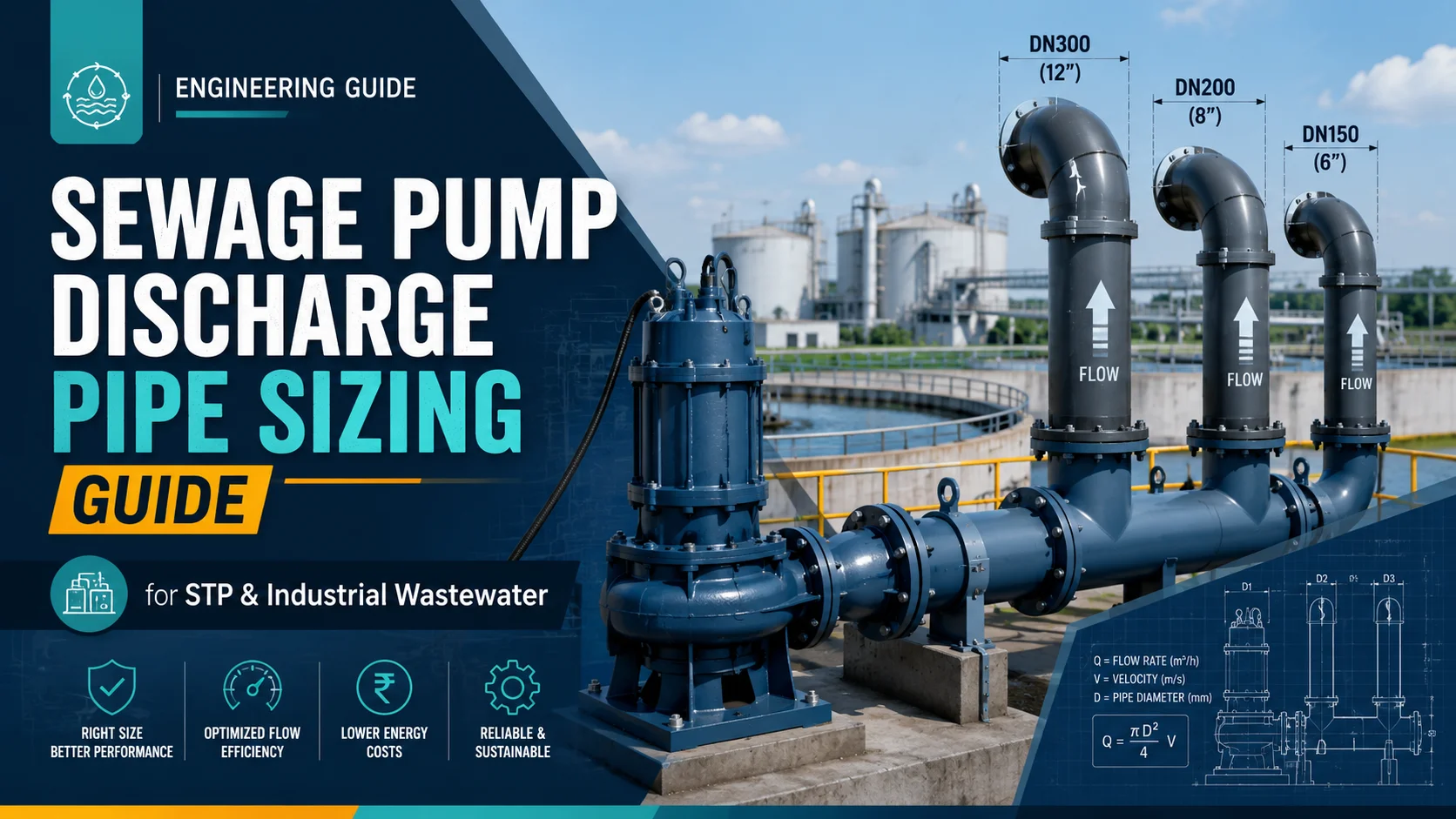
A sewage pump discharge pipe should be sized according to the required flow rate, wastewater solids, acceptable flow velocity, pipe length, friction loss, fittings and total dynamic head.
The discharge pipe should not automatically be selected simply because its diameter matches the pump outlet.
A pipe that is too small can create:
- High friction loss
- Excessive flow velocity
- Higher pump head
- Increased electricity consumption
- Reduced pump flow
- Water hammer
- Faster pipe and valve wear
A pipe that is too large can create:
- Low wastewater velocity
- Solids settlement
- Sludge accumulation
- Blockage risk
- Higher installation cost
- Poor flushing of the discharge line
The correct pipe size is therefore the diameter that allows the sewage pump to deliver its required flow while keeping the complete pumping system hydraulically stable and maintainable.
Why Sewage Pump Discharge Pipe Size Matters
The pump and discharge pipeline operate as one hydraulic system.
A sewage pump does not simply lift wastewater vertically.
It must also overcome resistance created by:
- Straight pipe length
- Pipe diameter
- Bends
- Tees
- Reducers
- Check valves
- Isolation valves
- Flow meters
- Other fittings
- Downstream pressure
All of these losses contribute to the total dynamic head seen by the pump.
Changing the discharge pipe diameter changes this resistance.
That means a correctly selected pump can still perform poorly if the discharge pipeline is incorrectly sized.
Do Not Select Pipe Size Only from the Pump Outlet
One of the most common mistakes during STP installation is:
Pump outlet is 80 mm, therefore the complete discharge pipe must also be 80 mm.
That is not always correct.
The pump discharge connection tells you the connection size of the pump.
It does not automatically define the most suitable diameter for a long discharge pipeline.
For example, the system may have:
- A long horizontal discharge distance
- Several bends
- A high required flow
- Multiple pumps connected to one common header
- Significant valve losses
In these conditions, maintaining the same small pipe diameter for the entire line can create excessive friction.
The final pipe diameter should therefore be checked hydraulically.
Start with the Required Flow Rate
Pipe sizing starts with the amount of wastewater the system must move.
Typical design information may include:
- Flow in litres per second
- Flow in litres per minute
- Flow in cubic metres per hour
- Average wastewater inflow
- Peak wastewater inflow
- Required pumping time
- Number of operating pumps
For an STP, the pumping system may need to handle varying inflow throughout the day.
Industrial wastewater systems may have even greater variation depending on production cycles.
The discharge pipe should therefore be sized around the actual pump operating flow, not simply the average wastewater generation figure.
Understand Flow Velocity
Flow velocity is the speed at which wastewater moves through the discharge pipe.
It is directly affected by:
- Flow rate
- Internal pipe diameter
For the same flow rate:
Smaller pipe = higher velocity
Larger pipe = lower velocity
Neither extreme is desirable.
What Happens If Velocity Is Too Low?
Sewage can contain:
- Organic solids
- Sludge
- Sand
- Grit
- Fibres
- Rags
- Suspended particles
If wastewater moves too slowly through the discharge line, heavier material can begin settling.
Over time this can create deposits inside the pipeline.
Possible results include:
- Reduced internal pipe diameter
- Increasing friction loss
- Reduced pump flow
- Higher discharge pressure
- Repeated blockage
- More frequent pipeline cleaning
This is why sewage pipe sizing is different from sizing a clean-water pipeline.
The pipe must help keep the wastewater moving.
What Happens If Velocity Is Too High?
Selecting a very small pipe may prevent settlement, but it creates another set of problems.
High velocity can increase:
- Friction loss
- Pump operating head
- Electricity consumption
- Pipe vibration
- Noise
- Valve wear
- Hydraulic shock
In abrasive wastewater containing sand or grit, excessive velocity can also accelerate wear.
The objective is therefore not to create the highest possible velocity.
The objective is to create a suitable operating velocity for the wastewater and system design.
Pipe Diameter and Friction Loss
Friction loss is the resistance wastewater experiences while moving through the pipeline.
As pipe diameter becomes smaller, friction loss normally increases significantly for the same flow.
Consider two systems carrying the same wastewater flow.
System A
- Larger discharge pipe
- Lower velocity
- Lower friction loss
System B
- Smaller discharge pipe
- Higher velocity
- Higher friction loss
System B requires the pump to overcome more resistance.
That additional resistance increases total dynamic head.
If the pump was originally selected without considering this additional head, the actual discharge flow may be lower than expected.
Calculate Total Dynamic Head, Not Just Vertical Lift
A common pump-sizing mistake is considering only the vertical height.
Suppose wastewater must be pumped 8 metres upward.
It would be incorrect to automatically say:
Required pump head = 8 metres
The pump must also overcome pipe and fitting losses.
A simplified system concept is:
Total Dynamic Head = Static Head + Pipe Friction Loss + Fitting Losses + Downstream Pressure Requirement
The exact hydraulic calculation depends on the project.
Important inputs include:
- Vertical lift
- Total pipe length
- Pipe diameter
- Pipe material
- Wastewater flow
- Number of bends
- Check valve
- Isolation valve
- Reducers
- Tees
- Final discharge condition
Flow Chem's broader Sewage Pump Sizing Guide for STP and Industrial Wastewater can be used together with the discharge-pipe calculation.
Pipe Length Can Change the Best Diameter
A pipe size that works for a short discharge line may perform poorly when the same pump has to discharge hundreds of metres away.
Consider:
Short Installation
Pump → short riser → nearby treatment tank
Pipe friction may represent a relatively small portion of total head.
Long Installation
Pump → long underground pipeline → remote collection point
Here, pipe friction can become a major part of total dynamic head.
Increasing the pipeline diameter may reduce friction enough to lower the pump's required operating head.
This can improve system efficiency even if the larger pipe has a higher initial purchase cost.
Include Bends and Fittings
Every fitting creates additional resistance.
Examples include:
- 90-degree bends
- 45-degree bends
- Tees
- Reducers
- Check valves
- Gate valves
- Other isolation valves
- Flow meters
A discharge line containing several bends can have significantly more resistance than a straight pipe of the same length.
Where possible, piping layouts should avoid unnecessary changes in direction.
A clean discharge layout can provide:
- Lower friction
- Easier maintenance
- Lower hydraulic shock
- Better pump efficiency
Check Valve Losses Also Matter
Most sewage pump discharge systems require a suitable non-return valve to prevent wastewater flowing backward when the pump stops.
The valve adds resistance to the pipeline.
The amount depends on:
- Valve type
- Valve diameter
- Valve opening characteristics
- Flow velocity
- Actual operating condition
Ignoring the valve when calculating discharge losses can cause the real operating point to differ from the design.
Pipe Sizing for Multiple Sewage Pumps
Many pumping stations use:
- One duty pump
- One standby pump
Larger installations may use multiple duty pumps.
When several pumps discharge into a common header, the header must be sized for the maximum expected combined operating flow.
For example:
Pump A → Individual Branch → Common Header
Pump B → Individual Branch → Common Header
The individual branch sees the flow from its own pump.
The common header may see flow from more than one pump.
Using the same diameter for every section without checking the actual flow can create high velocity and excessive friction in the common header.
Duty/Standby Systems Need a Different Check
If two pumps are installed as pure duty/standby units and only one operates at a time, the common header may only need to carry one pump's flow during normal operation.
If the control philosophy allows both pumps to run together during peak inflow, the header must also be checked for the combined flow.
This should be confirmed before finalising the piping.
Pipe Material Also Affects Hydraulic Performance
Common discharge piping materials may include:
- DI
- GI
- MS
- HDPE
- PVC or other suitable engineered piping systems
The correct material depends on:
- Pressure
- Wastewater chemistry
- Installation location
- Corrosion risk
- Temperature
- Mechanical loading
- Project specification
The internal condition of the pipe also matters.
Corrosion, scale or accumulated deposits can increase resistance as the system ages.
Sewage Solids Must Be Considered
Pipe sizing cannot be separated from the actual sewage characteristics.
Ask:
- Is the wastewater screened?
- Does it contain rags?
- Are wipes present?
- Is sludge being pumped?
- Is grit present?
- Are there plastics or fibres?
- Is the wastewater highly viscous?
- Is industrial waste mixed with sewage?
For general sewage and sludge applications, an appropriate Submersible Sewage and Sludge Pump may be suitable.
Where the wastewater contains significant rags or fibrous material, the application may need to be reviewed against a Submersible Cutter Pump.
Why Oversizing the Pipe Is Not Always Better
It may seem logical that a larger pipeline is always better because it reduces friction.
But an excessively large sewage pipeline can reduce flow velocity too much.
This can encourage:
- Grit settlement
- Sludge deposition
- Organic solids accumulation
It also increases:
- Pipe cost
- Valve cost
- Fitting cost
- Civil installation cost
- Required space
The goal is optimisation, not simply choosing the largest possible pipe.
Why Undersizing the Pipe Creates Long-Term Problems
An undersized pipeline may initially appear cheaper.
But additional operating cost can continue for the entire life of the pumping system.
Possible consequences include:
- Higher electricity consumption
- Lower delivered flow
- Pump operating away from its intended duty point
- Higher internal pressure
- More hydraulic noise
- More severe water hammer
- Increased wear
- Requirement for a larger pump
A small saving in pipe cost can therefore create a much larger lifecycle cost.
Watch the Pump Operating Point
The pump does not deliver one fixed flow under every condition.
Its actual operating flow depends on where the pump curve intersects the system curve.
If discharge pipe resistance increases, the system curve changes.
The pump may then operate at:
- Lower flow
- Higher head
If the pipe becomes less restrictive, the pump may operate at:
- Higher flow
- Lower head
This is why the pipe and pump must be selected together.
Example of a Poor Discharge Pipe Design
Consider an STP where a sewage pump is selected correctly based on the required flow.
But during installation:
- A smaller discharge pipe is used
- Several additional bends are added
- A restrictive valve is installed
- The actual pipe run is longer than the original design
The system resistance becomes higher than expected.
Operators then notice:
- Low discharge flow
- Long pump running time
- Rising wet-well level
- Higher motor loading
- Poor performance during peak inflow
The immediate assumption may be:
The pump is undersized.
But the real problem may be the discharge system.
Signs Your Sewage Pump Discharge Pipe May Be Incorrectly Sized
Investigate the piping if you notice:
- Pump runs but flow is lower than expected
- Discharge pressure is unusually high
- Pump takes too long to empty the sump
- Wet-well level rises during peak inflow
- Pipeline produces excessive noise
- Water hammer occurs frequently
- Motor current differs significantly from commissioning data
- Solids repeatedly collect inside the line
- Pipeline requires frequent flushing
The complete system should be reviewed before replacing the pump.
Discharge Pipe Sizing Checklist
Before finalising the sewage pump discharge line, confirm:
- Required pump flow
- Peak flow
- Number of simultaneously operating pumps
- Pump discharge size
- Proposed pipe diameter
- Pipe internal diameter
- Total pipe length
- Vertical lift
- Pipe material
- Wastewater characteristics
- Solids size
- Sludge concentration
- Number of bends
- Number of tees
- Check valve type
- Isolation valve type
- Other fittings
- Friction loss
- Flow velocity
- Total dynamic head
- Pump operating point
- Common header flow
- Water hammer risk
- Maintenance access
- Future expansion requirements
Common Discharge Pipe Sizing Mistakes
1. Matching the Entire Pipeline to the Pump Outlet
The pump outlet is not a complete hydraulic design.
2. Considering Only Vertical Height
Pipe friction and fittings also contribute to pump head.
3. Using a Very Small Pipe to Save Cost
This can significantly increase friction and energy consumption.
4. Oversizing Without Checking Velocity
Very low velocity can encourage solids settlement.
5. Ignoring Multiple Pump Operation
Common headers must be checked for the actual combined flow.
6. Ignoring Valves
Check valves and isolation valves introduce resistance.
7. Changing Site Piping Without Rechecking the Pump
Additional pipe length or bends change system resistance.
8. Looking Only at Horsepower
HP alone does not tell you whether the pump and pipeline will deliver the required duty point.
Frequently Asked Questions
Should the sewage pump pipe be the same size as the pump outlet?
Not necessarily. The pump outlet provides the connection size, but the complete discharge pipeline should be sized according to flow, velocity, friction loss, length, solids and total dynamic head.
Can I increase the pipe diameter after the pump outlet?
Yes, where hydraulic design requires it. Appropriate reducers or transitions should be incorporated correctly into the piping design.
Does a larger discharge pipe increase sewage pump flow?
Reducing pipeline resistance can change the pump operating point and may increase flow, but the final result depends on the pump curve and complete system.
Why does a small pipe reduce pump performance?
A smaller pipe generally creates higher velocity and greater friction loss at the same flow. The pump must overcome this additional resistance.
Can a discharge pipe be too large?
Yes. Excessively large sewage pipelines can create low velocities that encourage solids and sludge to settle.
Do bends affect sewage pump head?
Yes. Bends and fittings create additional hydraulic losses and should be included when calculating total dynamic head.
Should the common header be larger than individual pump branches?
It may need to be, especially when multiple pumps can operate simultaneously. The common header should be checked for the maximum expected combined flow.
Need Help Selecting a Sewage Pump for Your Actual Pipe Layout?
Correct pump selection requires more than knowing the required horsepower.
The pump should be selected against the actual flow, total dynamic head, discharge pipeline, solids profile and operating pattern.
When requesting pump selection support from Flow Chem Pumps, share:
- Required flow rate
- Vertical lift
- Total discharge pipe length
- Proposed pipe diameter
- Number of bends
- Valve details
- Wastewater type
- Solids profile
- Number of pumps
- Duty pattern
This allows the pumping requirement to be reviewed against the real system instead of selecting a pump from HP alone.
Explore Flow Chem's Submersible Sewage and Sludge Pump range for STP, sewage and industrial wastewater applications.