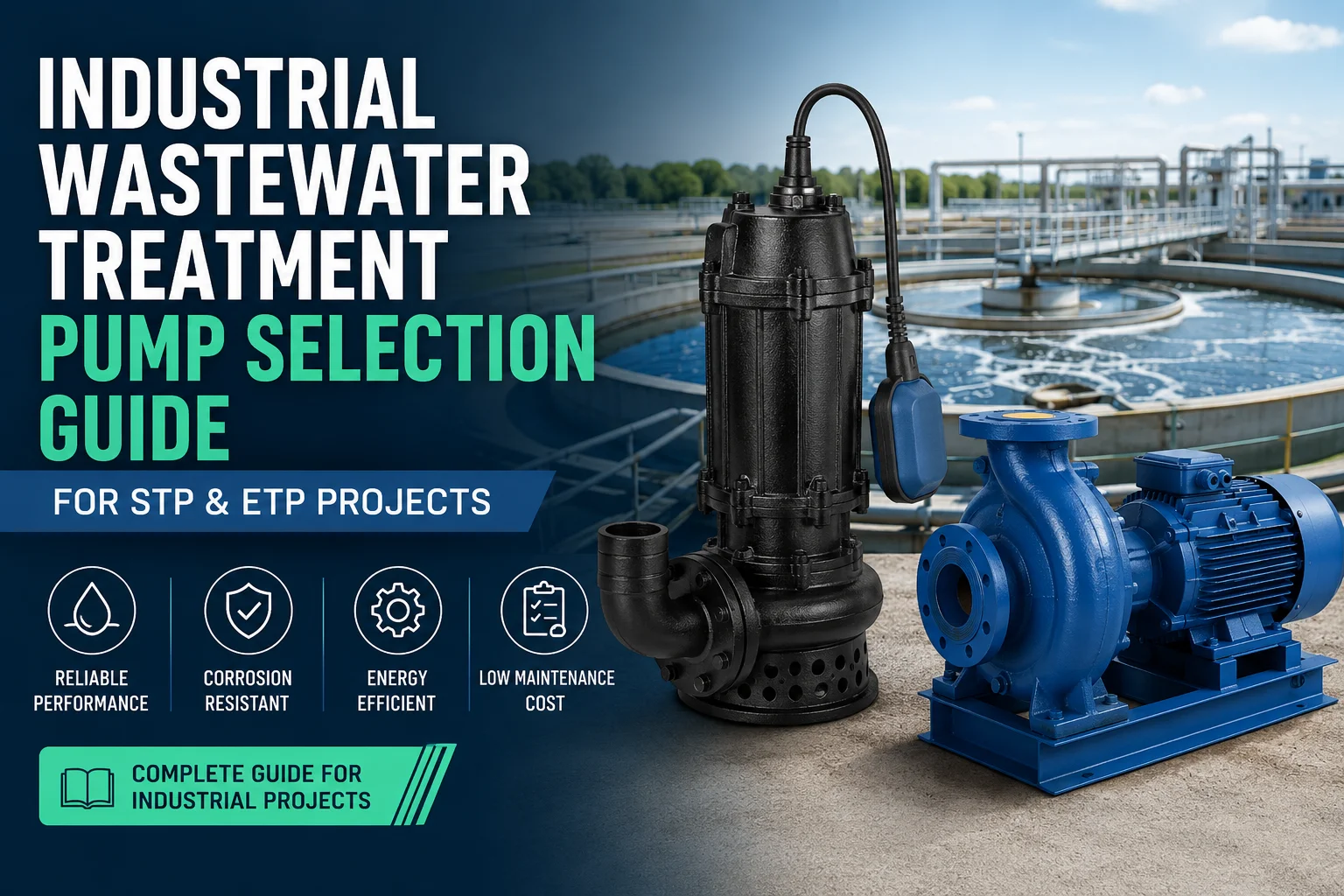
Learn how to size a sewage pump for STP and industrial wastewater duties using flow, head, solids handling, pipe losses, power supply and duty cycle.
A sewage pump is sized by matching the pump curve to the real duty point, not by guessing from HP, pipe size or vendor catalogue headline numbers. Start with the flow requirement, then calculate total dynamic head, then confirm the wastewater profile, solids handling requirement, electrical supply and operating pattern. The pump should deliver the required flow at the actual head while handling sewage solids without clogging or overload.
For many STP and industrial wastewater duties, the first shortlist is a submersible sewage sludge pump. If the sewage contains rags, wipes, plastics or fibrous solids, also review a submersible cutter pump. If the duty is treated wastewater, industrial discharge or less aggressive effluent, compare the application with a submersible waste water pump.
The safest rule is simple: size the pump from site data, not from a fixed HP assumption.
Why sewage pump sizing matters
Sewage pumping is not the same as pumping clean water. Sewage and industrial wastewater can include sludge, grit, soft solids, rags, fibrous waste, chemical carryover, variable inflow and long operating hours. A pump that looks right on paper can still fail in the field if it is selected only by motor power or nominal discharge size.
Poor sizing can cause:
- Low discharge flow even when the pump is running.
- Frequent choking from solids or fibrous waste.
- Motor overload, overheating or tripping.
- Excessive wear on seal, bearings and hydraulic parts.
- Wet well overflow or process backup.
- Higher maintenance cost and more shutdowns.
- Shorter service life because the pump runs far from its efficient operating range.
Correct sizing protects uptime. It also reduces the chance that the buyer will overbuy a larger pump that is more expensive, harder to control and less efficient than necessary.
Step 1: define the actual application
Before calculating head or selecting HP, define where the pump will work and what it will move. The same sewage pump size may be wrong for two different sites with the same nominal flow.
Common applications include:
- STP inlet or transfer sump.
- STP sludge transfer.
- Municipal sewage lift or pumping station.
- Industrial wastewater pit or collection tank.
- Commercial building sewage transfer.
- Basements or underground collection chambers connected to sewage systems.
- Emergency bypass or temporary sewage handling.
Ask these questions first:
- Is the liquid raw sewage, screened sewage, sludge, mixed wastewater, treated wastewater or industrial effluent?
- Are solids soft, fibrous, abrasive or stringy?
- Is the duty continuous, intermittent or peak-load based?
- Is the pump fixed, submerged, portable or guide-rail mounted?
- Is the site mostly sewage duty or mostly drainage/water transfer duty?
If the liquid is mostly sewage or sludge, sewage-duty construction is usually the right starting point. If clogging is the main issue, a cutter pump may need to be reviewed early. If the liquid is cleaner and less aggressive, a wastewater or drainage pump may be enough.
Step 2: calculate required flow rate
Flow rate is the amount of liquid the pump must move in a given time, usually in m³/hr or LPM. This is the first sizing input because it tells you the pump capacity required for the job.
For sewage systems, do not rely only on average flow. A pump must often handle peak inflow, not just daily average inflow. Peak load may occur during specific operating hours, process discharge cycles, monsoon ingress, occupancy surges or batch emptying.
Document:
- Average flow.
- Peak flow.
- Minimum flow.
- Required pump-out time.
- Duty pump count.
- Standby pump count.
- Expected operating hours per day.
A pump sized for average flow but not peak flow may overflow the wet well or keep cycling too often. A pump sized only for peak flow may be oversized and inefficient during normal operation. The right answer is the one that fits the actual duty profile.
Step 3: calculate total dynamic head
Total dynamic head, or TDH, is the total resistance the pump must overcome. This includes more than the vertical lift. It also includes friction losses, fittings, valves and discharge pressure requirements.
Include these items in the calculation:
- Static lift from the liquid level to the discharge point.
- Pipe length.
- Pipe diameter.
- Number of bends and fittings.
- Non-return valve loss.
- Isolation valve loss.
- Friction loss at the design flow.
- Final discharge condition or downstream pressure.
- Variation in liquid level between start and stop points.
If head is underestimated, the pump may not deliver the expected flow. If head is overestimated, the pump may operate away from its best efficiency point and waste energy or cause instability.
The goal is to identify the true duty point and then confirm that the pump curve covers that point with a sensible margin.
Step 4: identify solids handling requirement
Sewage pump sizing is not only about flow and head. The solids profile can change the pump type entirely.
Check the following:
- Maximum solid size.
- Whether the solids are soft or hard.
- Whether the waste contains rags, wipes, plastics or fibres.
- Whether the wastewater contains settled sludge or suspended sludge.
- Whether the inlet is screened.
- Whether the site has a history of choking.
- Whether the liquid is abrasive because of grit or sand.
General sewage and sludge transfer duties often suit a sewage/sludge pump. High-clogging-risk duties may require a cutter pump. If the liquid is more like treated wastewater or process effluent, solids handling may be less demanding but material compatibility may become more important.
If the solids profile is unclear, ask for a site sample or recent process data before finalising the pump size.
Step 5: choose the pump type before finalizing HP
HP should be the result of the sizing exercise, not the starting assumption. The pump type determines what kind of hydraulic and motor package is suitable.
Submersible sewage sludge pump
A submersible sewage sludge pump is often the first option for STP transfer, sewage pits, collection sumps and general wastewater duties with solids. It is typically evaluated when the duty needs robust sewage handling rather than cutting action.
Submersible cutter pump
A submersible cutter pump is the better route when the main risk is clogging from rags, wipes, plastics or fibrous waste. The cutting mechanism helps reduce blockage before pumping.
Submersible wastewater pump
A submersible wastewater pump or effluent pump is often more appropriate for treated wastewater, process transfer or less solids-heavy liquid where corrosion resistance and liquid chemistry matter more than raw sewage passage.
Drainage or dewatering pump
If the duty is rainwater, site drainage, clean water removal or temporary flood control rather than sewage, a dewatering or drainage pump may be the better answer.
Choosing the wrong type can lead to over-sizing, under-sizing or a pump that technically runs but fails in actual use.
Step 6: confirm pipe size and friction losses
Many buyers ask for pump sizing after the piping layout is already fixed. That is fine, but the pump must then be checked against the real line losses created by that piping.
Pipe sizing affects pump performance because a narrow pipe increases friction losses. A long discharge line, too many bends or poorly planned routing can add significant head. That means the same flow may require a very different pump than the one first estimated from vertical lift alone.
Review:
- Pipe diameter.
- Pipe length.
- Number of elbows, tees and reducers.
- Whether the line has rising sections or loops.
- Discharge elevation.
- Whether the pipe material creates higher friction.
- Whether the line can trap air or solids.
If the line is long or complex, the pump curve should be checked carefully so the selected unit does not run outside its useful operating zone.
Step 7: review duty cycle and operating hours
A sewage pump used for occasional emptying does not need the same duty profile as a pump that runs all day in a plant or municipal system.
Important duty questions:
- Is the pump intermittent or continuous duty?
- How many starts per hour are expected?
- Will the pump run in a duty/standby arrangement?
- Is there a risk of dry running?
- Does the site need automatic alternation?
- Are high-level alarms and pump trip logic required?
A pump that is correctly sized for flow and head can still be wrong if it is not built for the actual duty cycle. Continuous industrial wastewater service, for example, demands more attention to motor loading, thermal protection and service access than a short-duration sump emptying duty.
Step 8: check electrical supply and motor configuration
Pump size is not only hydraulic size. The motor and electrical supply must also fit the site.
Check:
- Available supply voltage.
- Single-phase or three-phase availability.
- Start method.
- Motor protection.
- Control panel compatibility.
- Cable length and cable routing.
- Phase monitoring and overload protection.
- Any site restrictions on starting current.
Do not choose a larger motor just to be safe without checking whether the site can support it. The correct motor is the one that matches the hydraulic duty and electrical conditions together.
If the buyer only knows the motor HP and not the actual head, flow and solids profile, the quote should be treated as incomplete.
Step 9: match materials to wastewater chemistry
Material selection affects durability. In sewage pumping, cast iron may be suitable for many standard duties. In industrial wastewater, aggressive effluent or chemically active liquid, the material choice becomes more important.
Review:
- pH range.
- Chlorides or corrosive content.
- Abrasive grit or sand.
- Temperature.
- Seal material.
- Coating requirement.
- Need for stainless steel or special wetted parts.
If the wastewater is corrosive or abrasive, confirm the construction with the manufacturer before final sizing. A pump that is hydraulically correct but chemically wrong can still fail early.
Step 10: plan maintenance access and installation
A correct pump size can still become a bad project if maintenance access is poor. Sewage pumps operate in environments where removal, cleaning and inspection matter.
Check:
- Wet well or sump dimensions.
- Guide rail or coupling arrangement.
- Lifting chain or removal method.
- Access for inspection and cleaning.
- Cable protection.
- Valve access.
- Space for service work.
- Whether the installation supports fast pump removal.
If maintenance is difficult, the effective cost of the pump rises because each service event takes longer and costs more.
Practical sewage pump sizing checklist
Use this checklist before requesting a quote:
- Required flow rate.
- Peak flow and average flow.
- Total dynamic head.
- Wet well depth and liquid levels.
- Pipe length and diameter.
- Number of bends and valves.
- Solids size and solids type.
- Presence of rags, wipes or fibres.
- Wastewater chemistry.
- Duty cycle and operating hours.
- Single-phase or three-phase supply.
- Duty/standby requirement.
- Maintenance access and installation type.
If you can provide all of the above, the pump selection conversation becomes much faster and much more accurate.
Common sewage pump sizing mistakes
1. Sizing only by HP
HP is useful, but it is not the complete answer. Two 2 HP pumps can have very different flow, head and solids handling.
2. Ignoring friction loss
Vertical lift is only part of head. Long discharge lines and fittings can change the duty point substantially.
3. Ignoring peak flow
Average flow alone is not enough for STP and industrial systems with variable inflow.
4. Overlooking solids profile
A pump may be hydraulically fine but still choke because the impeller or passage is not suited to the solids.
5. Using a drainage pump for sewage duty
A pump meant for clean water or light drainage may not survive sewage solids or sludge.
6. Forgetting the electrical setup
A pump that is right on paper but wrong for the available power supply can create delays and extra cost.
How Flow Chem’s product pages fit this sizing process
This sizing article is a support page, not the money page. The commercial route should still send the buyer to the most relevant product page after the duty is understood.
Use the following page mapping:
- submersible sewage sludge pump — for general sewage, sludge and solids-handling duties.
- submersible cutter pump — for fibrous, rag-heavy or clog-prone sewage.
- submersible waste water pump — for treated wastewater, industrial discharge or less raw sewage-oriented duties.
- contact us — for project-specific sizing help, quote requests and application review.
This article should help the buyer define the duty before they ask for a model recommendation.
What information should I send for a sewage pump quote?
When requesting a quotation, send:
- Application type.
- Required flow rate.
- Peak flow requirement.
- Total dynamic head.
- Pipe length and diameter.
- Wet well depth or liquid levels.
- Solids description.
- Clogging history.
- Operating hours.
- Duty/standby requirement.
- Power supply details.
- Material preference.
- Any special installation constraints.
The more complete the data, the better the sizing result.
Frequently asked questions
How do you size a sewage pump correctly?
Size it by matching the pump curve to the real duty point. Define flow, total dynamic head, wastewater type, solids load, pipe losses, duty cycle and electrical supply before selecting HP.
Is HP enough to size a sewage pump?
No. HP alone is not enough because flow, head, solids handling and duty cycle can change the correct pump size completely.
What is the most important factor in sewage pump sizing?
Flow and total dynamic head are the primary hydraulic inputs, but solids handling is often the factor that decides whether the pump will actually work on site.
When should I choose a cutter pump instead of a sewage sludge pump?
Choose a cutter pump when the sewage contains rags, wipes, plastics or other fibrous waste that creates repeated clogging risk.
Can I use a drainage pump for sewage?
Only if the duty is actually light drainage or clean water transfer. For real sewage or sludge, a sewage-duty pump is usually the safer choice.
Why does sewage pump sizing often need a standby pump?
A standby pump reduces the risk of overflow or process backup if the duty pump fails or if inflow rises above expected levels.
What should I send to get a sizing recommendation?
Send flow, head, pipe data, waste type, solids description, duty cycle, power supply and installation details.
Need help selecting the right pump?
Share your flow, head, liquid type, solids, site layout and duty cycle with Flow Chem Pumps. Our team can help you shortlist the right pump.