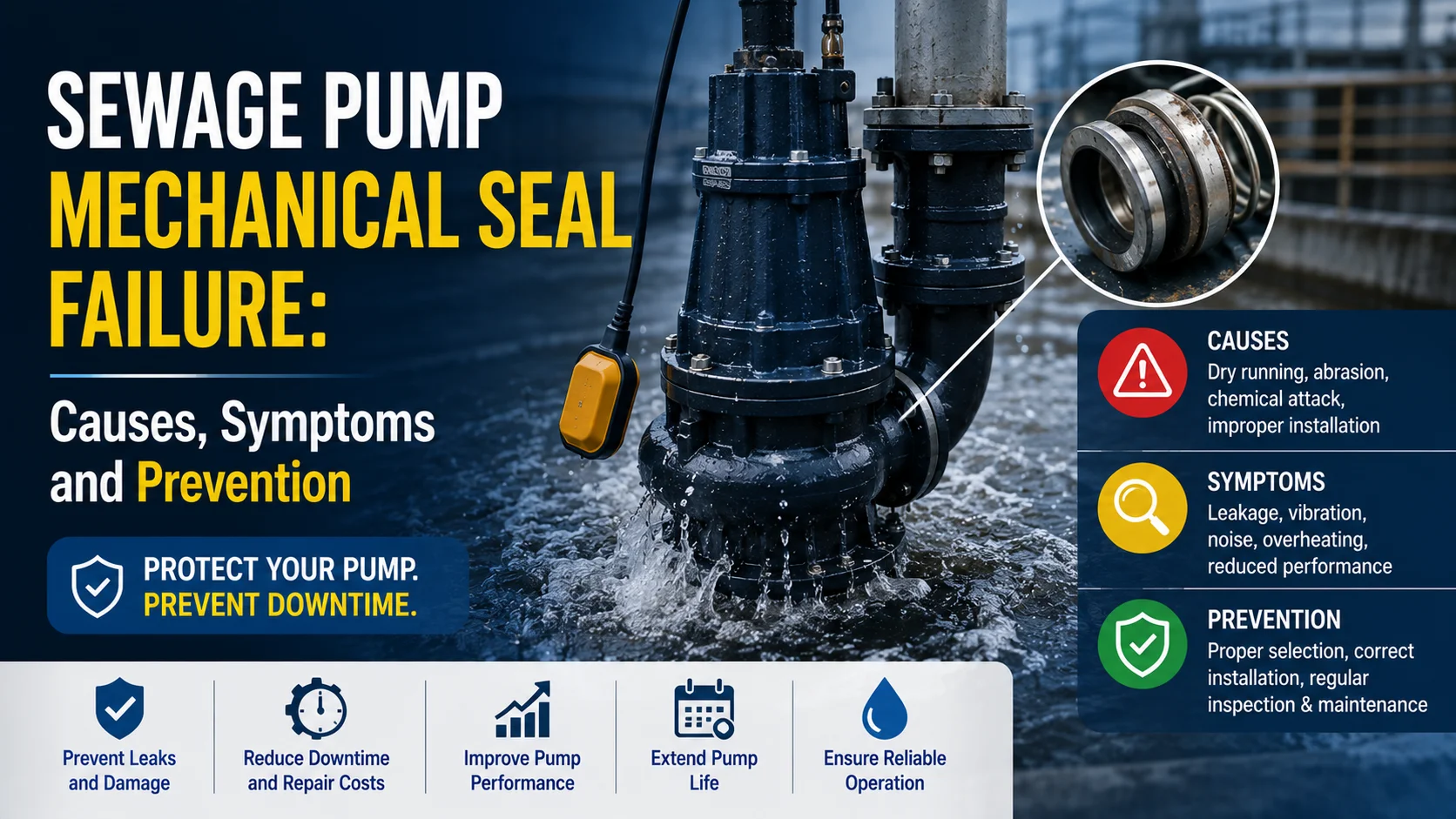
A mechanical seal prevents wastewater from travelling along the rotating pump shaft toward the motor.
Mechanical seal failure in a sewage pump may be caused by:
- Dry running
- Abrasive grit
- Incorrect pump operation
- Excessive vibration
- Shaft or bearing wear
- Corrosive wastewater
- Damaged seal faces
- Contaminated oil chamber
- Excessive temperature
- Poor installation
- Repeated clogging
- Normal long-term wear
Early warning signs can include:
- Moisture entering the pump
- Oil contamination
- Seal leakage
- Repeated motor trips
- Falling insulation resistance
- Unusual vibration
- Bearing noise
- Pump overheating
- Reduced reliability
A failed seal should not be ignored because wastewater eventually reaching the motor can result in winding damage and complete pump failure.
The best approach is to detect seal deterioration before water reaches the motor.
What Is a Mechanical Seal in a Sewage Pump?
A sewage pump contains a rotating shaft that transfers power from the electric motor to the impeller.
The shaft must rotate while the pump casing contains wastewater.
This creates an engineering challenge.
There must be enough clearance for the shaft to rotate, but wastewater must not be allowed to travel through that clearance into the motor.
This is where the mechanical seal is used.
The seal creates a controlled sealing interface between:
- The rotating shaft
- The stationary pump components
In submersible sewage pumps, the sealing system is especially important because the complete pump operates inside wastewater.
Why Mechanical Seals Are Critical in Submersible Pumps
A surface-mounted pump may provide visible warning if a seal starts leaking.
A submersible sewage pump is different.
The pump may be operating:
- Several metres below the wastewater surface
- Inside a wet well
- Inside an underground pumping station
- In a difficult-to-access sump
Operators cannot simply look at the pump every day.
Seal deterioration may therefore continue unnoticed until another symptom appears.
For this reason, sewage pump sealing should be treated as a critical reliability component, not a small consumable item.
How a Double Mechanical Seal System Works
Many industrial submersible sewage pumps use a double mechanical seal arrangement.
A simplified arrangement can be thought of as:
Wastewater → Lower Mechanical Seal → Oil Chamber → Upper Mechanical Seal → Motor
The first seal provides protection against the pumped wastewater.
The second seal provides another barrier before the motor.
The oil chamber between the seals can provide:
- Lubrication
- Cooling
- Separation between wastewater and motor
- An inspection point for identifying seal deterioration
Flow Chem's submersible sewage and sludge pump range uses a double mechanical seal with an oil chamber for wastewater applications.
What Happens When the Lower Mechanical Seal Fails?
Consider the arrangement:
Wastewater → Seal 1 → Oil Chamber → Seal 2 → Motor
If the wastewater-side seal begins leaking, wastewater may enter the oil chamber.
At this stage, the motor may still remain protected by the second seal.
However, this should be treated as an early warning.
If the first seal is not repaired and the second seal subsequently deteriorates, wastewater can eventually enter the motor housing.
This is why inspecting the oil chamber can provide valuable information about seal condition.
What Happens When Both Seals Fail?
When the final sealing barrier fails, wastewater may reach:
- Bearings
- Motor housing
- Electrical winding area
Possible consequences include:
- Insulation breakdown
- Electrical leakage
- Earth fault
- Motor trip
- Bearing corrosion
- Winding damage
- Complete pump failure
A relatively small sealing problem can therefore become an expensive motor repair if it is not detected early.
1. Dry Running Can Damage Mechanical Seals
Dry running is one of the most important operating conditions to investigate when seal life is unusually short.
The seal faces operate against each other while the shaft rotates.
Correct pump operating conditions help control heat around the sealing area.
If the pump runs without adequate liquid, temperature around the mechanical seal can increase.
Repeated overheating can damage:
- Seal faces
- Elastomers
- O-rings
- Springs
- Secondary sealing components
Possible results include leakage after the pump returns to normal service.
Why Dry Running Happens
Common causes include:
- Float switch stuck ON
- Pump OFF level set too low
- Level sensor fault
- Control-panel malfunction
- Pump left in manual mode
- Low wastewater inflow
- Incorrect wet-well level settings
If repeated seal problems occur together with low-level operation, the level-control system should be investigated before another seal is installed.
2. Abrasive Grit Can Wear Seal Faces
Sewage and industrial wastewater may contain:
- Sand
- Grit
- Fine mineral particles
- Metal particles
- Process solids
These particles can be highly abrasive.
When abrasive material reaches the sealing area, it can contribute to wear of the seal faces.
Over time, a sealing surface that was originally extremely flat can develop:
- Scratches
- Grooves
- Surface wear
- Pitting
Even a small amount of damage can allow liquid to migrate across the seal.
Applications with Higher Abrasive Risk
Seal wear deserves closer monitoring in:
- Industrial wastewater
- Construction drainage mixed with sewage
- Sand-heavy sewage
- CETPs
- ETPs
- Sludge transfer
- Wastewater containing mineral particles
If the liquid contains heavy abrasive solids, pump selection should consider not only flow and head but also the materials used in the hydraulic and sealing components.
3. Fibres and Rags Can Affect the Seal Area
Raw sewage frequently contains:
- Cloth
- Wipes
- Hair
- Plastic strips
- Fibres
- Threads
- Packaging material
These materials may wrap around the impeller or shaft area.
This is commonly called ragging.
Material wrapped around the shaft can interfere with the sealing system and create:
- Additional friction
- Heat
- Shaft loading
- Vibration
Repeated seal failure combined with repeated ragging may indicate that the existing pump design is not well matched to the waste stream.
For severe fibrous wastewater, a cutter-type pump may need to be considered.
4. Excessive Pump Vibration Can Damage the Seal
Mechanical seals depend on stable shaft rotation.
Excessive vibration can disturb the seal faces and increase wear.
Possible causes of vibration include:
- Impeller blockage
- Damaged impeller
- Unbalanced impeller
- Worn bearings
- Bent shaft
- Cavitation
- Loose pump mounting
- Poor guide-rail seating
- Operating far from the intended duty point
If a new mechanical seal fails shortly after replacement, simply installing another seal may not solve the problem.
The cause of vibration should be identified.
5. Worn Bearings Can Cause Repeated Seal Failure
Bearings support the rotating shaft.
When bearings wear, shaft movement can increase.
The shaft may develop:
- Radial movement
- Axial movement
- Vibration
- Misalignment
The mechanical seal must then operate against an unstable rotating surface.
Seal life can decrease rapidly.
This creates an important troubleshooting rule:
Repeated seal failure may actually be a bearing or shaft problem.
Before installing another seal, check:
- Bearing condition
- Shaft play
- Shaft surface
- Alignment
- Vibration
6. Shaft Damage Can Prevent Proper Sealing
The seal is installed around the rotating shaft or shaft sleeve.
If this surface is damaged, proper sealing may become difficult.
Look for:
- Grooves
- Corrosion
- Pitting
- Wear
- Incorrect dimensions
- Burrs
- Scratches
A new seal installed over a damaged shaft surface may begin leaking prematurely.
The shaft condition should therefore be inspected whenever the pump is dismantled for seal replacement.
7. Corrosive Wastewater Can Attack Seal Components
Industrial wastewater chemistry can be very different from domestic sewage.
The liquid may contain:
- Acids
- Alkalis
- Chlorides
- Cleaning chemicals
- Process chemicals
- Solvents
- Salts
These chemicals may attack:
- Elastomers
- Springs
- Metallic components
- Seal faces
- Pump casing materials
A mechanical seal suitable for normal sewage may not necessarily be suitable for aggressive industrial effluent.
Share Wastewater Chemistry During Pump Selection
For industrial applications, provide information such as:
- pH
- Temperature
- Chemical composition
- Chloride concentration
- Solids
- Abrasiveness
Material compatibility should be reviewed before selecting the pump and seal arrangement.
8. Excessive Wastewater Temperature Can Reduce Seal Life
Standard sewage pumps are normally designed for a specified liquid-temperature range.
Higher liquid temperatures increase the thermal load on:
- Motor
- Bearings
- Mechanical seals
- Elastomers
Industrial plants sometimes discharge hot process water into an ETP or collection sump.
If the liquid temperature exceeds the pump's intended operating range, seal life can be reduced.
Always verify:
- Normal temperature
- Maximum temperature
- Duration of high-temperature discharge
Do not specify the pump only around room-temperature conditions if hot batches regularly enter the sump.
9. Incorrect Pump Operating Point Can Increase Mechanical Stress
A centrifugal sewage pump should operate within an appropriate region of its performance curve.
Operating too far from the intended duty point may increase:
- Hydraulic instability
- Vibration
- Shaft loading
- Recirculation
- Motor loading
These conditions can indirectly shorten seal and bearing life.
Pump selection should therefore be based on:
Required flow @ actual total dynamic head
rather than only:
- HP
- Maximum flow
- Maximum head
- Discharge diameter
10. Repeated Clogging Can Lead to Seal Problems
A pump that repeatedly becomes clogged experiences abnormal mechanical loading.
When rags or solids jam the impeller:
- Motor current may increase
- Shaft loading changes
- Vibration may rise
- Temperature may increase
Even after the blockage is removed, repeated events can reduce the life of bearings and seals.
If clogging occurs frequently, investigate:
- Wastewater solids
- Impeller type
- Screening
- Wet-well cleanliness
- Pump selection
Do not treat repeated unclogging as normal maintenance.
11. Incorrect Seal Installation Can Cause Early Failure
Mechanical seals contain precision surfaces.
Poor handling during installation can damage them before the pump even starts.
Problems may result from:
- Dirty seal faces
- Scratched surfaces
- Incorrect assembly
- Wrong spring compression
- Damaged O-rings
- Incorrect seal size
- Improper lubrication during assembly
- Forcing components into position
Seal replacement should therefore be carried out by trained personnel using the correct components and procedure.
12. Normal Wear Eventually Occurs
Mechanical seals are wear components.
Even in a correctly designed and operated sewage pump, seal surfaces can deteriorate over time.
Seal life depends on:
- Operating hours
- Starts per hour
- Wastewater abrasiveness
- Temperature
- Chemical exposure
- Vibration
- Pump operating point
- Maintenance quality
There is therefore no universal replacement interval that is correct for every sewage pump.
Maintenance should consider actual site conditions and manufacturer recommendations.
Early Signs of Mechanical Seal Failure
Detecting problems early can prevent motor damage.
Watch for the following signs.
1. Contaminated Oil Chamber
In pumps with an oil chamber between mechanical seals, oil condition can provide useful information.
Healthy oil should generally resemble the expected lubricant condition for that pump.
Warning signs can include:
- Milky oil
- Water mixed with oil
- Unusual colour
- Reduced oil level
- Contamination
- Metal particles
Milky-looking oil can indicate moisture contamination.
If water is found in the seal chamber, investigate the sealing system before returning the pump to continuous duty.
2. Falling Insulation Resistance
Insulation resistance testing can help identify moisture entering electrical areas.
If test readings trend downward compared with previous maintenance records, possible causes may include:
- Moisture ingress
- Cable damage
- Motor insulation deterioration
- Seal failure
The important point is the trend.
Keeping historical electrical test records can help identify deterioration before complete motor failure.
3. Repeated Earth Leakage or Electrical Trips
If a submersible sewage pump repeatedly trips on electrical protection, do not automatically increase the protection setting.
Possible causes can include:
- Water ingress
- Cable damage
- Winding insulation problems
- Motor overload
The pump should be electrically tested before repeated restarting.
4. Unusual Bearing Noise
Seal leakage can eventually allow contamination into areas affecting the bearings.
Operators may hear:
- Grinding
- Rumbling
- Scraping
- Metallic noise
Bearing noise should be investigated promptly.
A failing bearing can create shaft movement that further damages the seal.
5. Increased Vibration
Compare pump vibration with its normal operating condition.
Increasing vibration may indicate:
- Bearing wear
- Impeller blockage
- Mechanical imbalance
- Shaft problems
All of these conditions can affect mechanical seal reliability.
6. Pump Overheating
Unusual temperature rise can indicate:
- Dry running
- Motor overload
- Blockage
- Bearing problem
- Incorrect operating point
If seal problems appear together with overheating, investigate the cause rather than treating the seal as an isolated failure.
Why Seal Failure Can Cause Motor Burnout
The failure sequence can develop gradually.
Stage 1
Lower seal begins to wear.
Stage 2
Wastewater enters or contaminates the oil chamber.
Stage 3
Secondary seal deteriorates or cannot contain the contamination.
Stage 4
Moisture reaches the motor area.
Stage 5
Electrical insulation deteriorates.
Stage 6
Motor develops leakage, short circuit or winding failure.
At the beginning, the problem may only require seal maintenance.
At the end, the pump may require:
- Mechanical seal replacement
- Bearing replacement
- Motor rewinding
- Cable replacement
- Complete overhaul
Early detection is therefore important.
Mechanical Seal Failure vs Cable Leakage
Water inside a submersible motor does not always mean the mechanical seal failed.
Another possible entry point is the power cable.
Water can enter through:
- Damaged cable insulation
- Poor cable gland
- Incorrect cable joint
- Damaged terminal sealing
- Cable pulled excessively during lifting
The technician should inspect both:
Mechanical sealing system
and
Electrical cable entry
before determining the root cause.
Mechanical Seal Failure vs Bearing Failure
These two failures can also influence each other.
Seal Failure Can Lead to Bearing Damage
Water contamination can eventually reach the bearings.
Bearing Failure Can Lead to Seal Damage
Worn bearings can allow excessive shaft movement.
This movement damages the mechanical seal.
Therefore, when either component fails, inspect the other.
How to Inspect a Sewage Pump Mechanical Seal
Before removing a submersible pump:
- Isolate electrical power.
- Follow the site's lockout and safety procedure.
- Isolate the discharge system where required.
- Use the approved lifting arrangement.
- Never lift the pump using its electrical cable.
Once the pump is safely removed, inspection may include:
- External pump condition
- Cable condition
- Shaft movement
- Impeller condition
- Oil chamber
- Mechanical seal
- Bearings
- Motor insulation
Detailed disassembly should follow the manufacturer's service instructions.
What to Check in the Oil Chamber
Where the pump has an oil chamber, inspect:
- Oil quantity
- Oil colour
- Water contamination
- Metal contamination
- Burnt smell
- Seal leakage
If oil repeatedly becomes contaminated shortly after replacement, investigate:
- Seal installation
- Shaft condition
- Bearing movement
- Pump vibration
- Wastewater abrasiveness
Changing only the oil will not correct an active seal leak.
Should You Replace Only the Mechanical Seal?
It depends on the condition of the pump.
If the seal has failed, also inspect:
- Bearings
- Shaft
- Shaft sleeve
- Oil
- Impeller
- Cable
- Motor insulation
Installing a new seal without correcting worn bearings or a damaged shaft can result in another early failure.
The objective should be to identify the root cause, not simply replace the failed component.
When Should the Pump Be Removed for Inspection?
Consider removing the pump if you observe:
- Repeated moisture alarm
- Contaminated seal oil
- Falling insulation resistance
- Abnormal vibration
- Repeated electrical trip
- Bearing noise
- Significant overheating
- Repeated seal problems
- Reduced pump reliability
A planned inspection is usually better than waiting until the pump fails during peak wastewater inflow.
Mechanical Seal Maintenance for Duty/Standby Pumps
Many STPs use:
- Pump A – Duty
- Pump B – Standby
Alternating the pumps helps distribute operating hours.
However, the standby pump should still be tested regularly.
A standby pump that remains unused for long periods can develop problems that remain unnoticed until the duty pump fails.
Routine tests should confirm:
- Pump starts
- Pump develops flow
- Motor current is normal
- Float/control system changes duty correctly
- No abnormal vibration
- No fault alarms
Maintenance planning should include both pumps.
Mechanical Seal Maintenance for 24/7 Treatment Plants
Continuous-duty installations deserve closer condition monitoring.
Examples include:
- CETPs
- Large STPs
- Municipal pumping stations
- Industrial ETPs
- Process wastewater systems
Useful records include:
- Running hours
- Starts
- Motor current
- Insulation resistance
- Oil condition
- Vibration
- Seal alarms
- Maintenance history
These records can help identify trends rather than waiting for sudden failure.
How to Prevent Mechanical Seal Failure
Seal life can be improved by addressing the complete pump system.
Maintain Correct Minimum Liquid Level
Prevent prolonged dry running.
Keep the Wet Well Clean
Remove debris that can cause impeller blockage and vibration.
Select the Correct Pump
Match:
- Flow
- Head
- Solids
- Fibres
- Abrasion
- Chemistry
Monitor Pump Vibration
Unexpected vibration should be investigated early.
Inspect Bearings
Worn bearings can quickly damage new seals.
Inspect Oil Condition
Where applicable, seal-chamber oil can provide early warning.
Protect the Power Cable
Cable damage can cause water ingress that resembles seal failure.
Maintain Level Controls
Reliable float switches prevent abnormal dry-running conditions.
Record Electrical Measurements
Trend motor current and insulation resistance.
Mechanical Seal Failure Troubleshooting Table
| Symptom | Possible Cause | What to Check |
|---|---|---|
| Milky oil | Water entering seal chamber | Lower mechanical seal |
| Falling insulation resistance | Moisture ingress | Seal and cable |
| Repeated seal replacement | Bearing or shaft movement | Bearings, shaft and vibration |
| Seal fails after dry run | Excessive heat | Float and level-control system |
| Seal fails in gritty sewage | Abrasive wear | Seal material and wastewater solids |
| High vibration | Impeller or bearing problem | Impeller, bearings and operating point |
| Electrical leakage | Water entering motor | Mechanical seal and cable gland |
| Hot pump | Dry running or overload | Liquid level and motor current |
| Repeated clogging with seal damage | Fibrous material | Impeller and pump type |
| New seal leaks immediately | Installation problem | Seal assembly and shaft condition |
Common Mechanical Seal Maintenance Mistakes
1. Replacing Only the Seal Every Time
Repeated seal failure usually means another underlying condition needs correction.
2. Ignoring Bearing Play
A new seal cannot perform reliably on an unstable shaft.
3. Reusing Contaminated Oil
Seal-chamber oil should be handled according to the manufacturer's maintenance procedure.
4. Operating the Pump Dry After Repair
Running a pump without proper liquid conditions during testing can damage the new seal.
5. Ignoring Wastewater Chemistry
Industrial effluent can attack seal materials that perform well in normal domestic sewage.
6. Ignoring Vibration
Vibration is often an early sign of another mechanical problem.
7. Treating Electrical Trips as Only an Electrical Problem
Water ingress can cause electrical protection to operate.
Both mechanical and electrical systems should be inspected.
8. Waiting Until the Motor Fails
Condition monitoring can identify many problems before the motor winding is damaged.
Sewage Pump Seal Inspection Checklist
During planned maintenance, review:
- Pump operating hours
- Number of starts
- Motor current
- Insulation resistance
- Cable condition
- Cable gland
- Oil level
- Oil condition
- Water contamination
- Seal faces
- Shaft surface
- Shaft play
- Bearing condition
- Impeller condition
- Pump vibration
- Abnormal noise
- Motor temperature
- Wet-well level settings
- Dry-running history
- Wastewater solids
- Wastewater chemistry
- Previous seal replacement history
Maintaining these records makes recurring problems easier to identify.
Questions to Ask When Mechanical Seals Keep Failing
If the same pump repeatedly develops seal problems, ask:
- Is the pump running dry?
- Are bearings worn?
- Is the shaft damaged?
- Is the impeller blocked or unbalanced?
- Does the wastewater contain abrasive grit?
- Are fibrous materials wrapping around the shaft?
- Is the wastewater chemically aggressive?
- Is the liquid too hot?
- Is the pump operating at the correct duty point?
- Is the correct seal being installed?
- Is the installation procedure correct?
- Is the power cable actually the source of water ingress?
Repeated failure should trigger root-cause analysis.
When Is Pump Overhaul Better Than Seal Replacement?
Replacing only the seal may be suitable when:
- Bearings remain healthy
- Shaft condition is good
- Motor insulation is healthy
- Impeller is in good condition
- No major corrosion exists
A more complete overhaul may be appropriate when there is:
- Bearing wear
- Shaft damage
- Significant water ingress
- Poor insulation resistance
- Impeller damage
- Severe corrosion
- Repeated failure history
The decision should consider the condition of the complete pump.
Frequently Asked Questions
What causes a sewage pump mechanical seal to fail?
Common causes include dry running, abrasive solids, excessive vibration, worn bearings, shaft damage, corrosive wastewater, high temperature, repeated clogging and normal wear.
What happens if a sewage pump seal fails?
Wastewater can enter the seal chamber and may eventually reach the motor if the sealing system deteriorates further. This can cause insulation damage, electrical trips and motor failure.
How do I know if a submersible pump seal is leaking?
Possible indicators include contaminated oil, moisture alarms, falling insulation resistance, repeated electrical trips, abnormal vibration or signs of water inside the pump.
What does milky oil in a sewage pump mean?
Milky oil can indicate that water has mixed with the seal-chamber lubricant. The mechanical seal and other possible entry points should be inspected.
Can dry running damage a mechanical seal?
Yes. Inadequate liquid conditions can increase heat around the seal and contribute to premature seal damage.
Can worn bearings cause mechanical seal failure?
Yes. Worn bearings can allow excessive shaft movement, preventing the seal faces from operating correctly.
Why does my sewage pump seal keep failing?
Repeated seal failure may indicate an underlying problem such as bearing wear, vibration, shaft damage, abrasive sewage, dry running, incorrect pump selection or improper seal installation.
Can grit damage a sewage pump seal?
Yes. Sand and abrasive particles can wear or scratch mechanical seal faces.
Should the bearings be checked when replacing a seal?
Yes. Bearing condition and shaft movement should be checked because excessive play can quickly damage the replacement seal.
Is a double mechanical seal better for sewage pumps?
Double mechanical seal arrangements provide an additional sealing barrier between wastewater and the motor and are commonly used in submersible sewage-pump designs.
Can water enter the motor through the cable instead of the seal?
Yes. Damaged cables, cable glands or joints can provide another path for water ingress. Both the seal and cable entry should be inspected.
Should a sewage pump seal be replaced at fixed intervals?
Maintenance requirements depend on operating hours, wastewater characteristics, pump design and manufacturer recommendations. Condition monitoring and maintenance history should also guide inspection and replacement planning.
Need Help Selecting a Reliable Sewage Pump for Your STP or ETP?
Mechanical seal reliability depends on more than the seal itself.
The complete pump should be matched with:
- Required flow
- Total dynamic head
- Wastewater solids
- Fibrous material
- Abrasiveness
- Liquid chemistry
- Temperature
- Operating hours
- Wet-well design
- Level controls
For sewage, sludge, STP, ETP and industrial wastewater applications, share these operating details with Flow Chem Pumps for application-based pump selection.
Flow Chem's Submersible Sewage and Sludge Pump range is available with double mechanical seal and oil-chamber configurations for demanding sewage and wastewater duties.