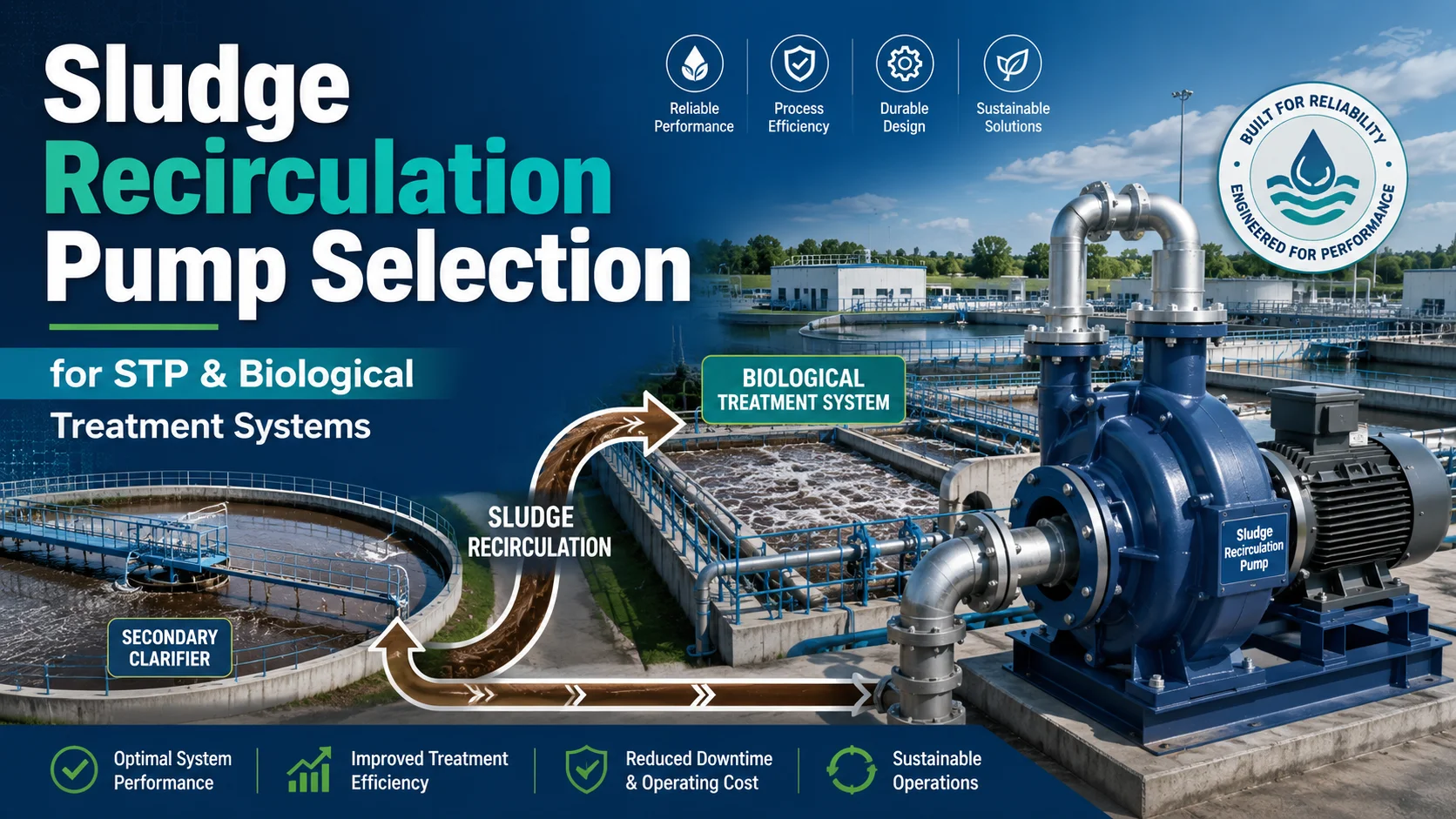
Select the right sludge recirculation pump for STP and biological treatment systems. Review solids profile, duty stability, wear risk and standby planning.
A sludge recirculation pump should be matched to the real sludge consistency, flow range, head requirement and process stability needs. Buyers should review solids behavior, wear potential, standby planning and control logic before choosing a pump for return or recycle duty.
Why recirculation duty is not the same as generic wastewater transfer
Sludge recirculation and return-sludge duties sit closer to process stability than ordinary transfer pumping. Pump problems can affect clarifier balance, biological health and solids control.
- The liquid is usually thicker than light wastewater.
- Solids concentration can change with process upsets.
- Shear, wear and settling behavior matter more than many buyers expect.
Step 1: define the sludge behavior accurately
Before choosing the pump, review the actual sludge conditions rather than using a generic “sludge” label.
- Expected solids concentration range.
- Viscosity or flowability at operating temperature.
- Presence of grit, fibres or abrasive carryover.
- Whether the duty is continuous recirculation or intermittent transfer.
These checks help determine whether a submersible sewage sludge pump style configuration is appropriate or whether another approach is safer.
Step 2: match the pump to the real recirculation duty
Recirculation pumping is often steady but process-sensitive. The pump should be selected for the true operating window, not only the peak emergency case.
- Required flow and head under normal operation.
- Whether the process needs tight repeatability.
- The effect of throttling or oversizing on solids handling.
- How standby units will behave during switchover.
Step 3: review wear and solids handling risk
Even when the sludge is not extremely abrasive, long run hours can magnify wear issues.
- Impeller and casing wear over time.
- Seal protection in solids-laden service.
- Bearing load and temperature during continuous operation.
- Settling risk during frequent stop-start cycles.
Step 4: controls and standby planning for process stability
Because return or recirculation duty touches treatment performance directly, control logic matters.
- Duty-standby planning should support continuous process operation.
- Alarm handling should not wait until clarifier performance is already unstable.
- Variable control may be useful where process flow changes materially.
- Maintenance access should support fast recovery.
Checklist for comparing sludge recirculation pump options
- Sludge concentration range defined.
- Duty point and run hours confirmed.
- Wear environment reviewed.
- Standby philosophy checked.
- Panel and alarm logic considered.
- Recommended spares and service support reviewed.
Common mistakes in recirculation pump selection
- Treating return sludge like clear wastewater.
- Selecting purely on flow and head without solids review.
- Ignoring process consequences of standby failure.
- Underestimating wear from long operating hours.
- Using unstable control logic that creates unnecessary starts.
Frequently asked questions
What is the main difference between a sludge recirculation pump and a normal wastewater transfer pump?
A sludge recirculation pump usually handles thicker solids-bearing liquid and often operates in a process-sensitive loop where stability matters as much as mechanical reliability.
Should recirculation pumps run continuously?
Many do, but the correct operating mode depends on the process design, sludge balance and control philosophy of the plant.
Why is oversizing risky in sludge recirculation?
Oversizing can create unstable control, poor operating efficiency and unnecessary stress on the sludge-handling system.
Does standby planning matter more for recirculation duty?
Often yes, because a pump failure can affect process continuity and solids balance faster than in some lower-risk transfer duties.
Can I use a standard sewage pump for sludge recirculation?
Sometimes, but only if the actual solids profile, duty and wear environment support that choice. The application should decide the final pump type.
Can Flow Chem recommend a sludge recirculation pump without solids data?
No. Final recommendation should follow the sludge characteristics, duty point, control philosophy and maintenance requirements of the site.
Need help selecting the right pump?
Share your flow, head, liquid type, solids, site layout and duty cycle with Flow Chem Pumps. Our team can help you shortlist the right pump.