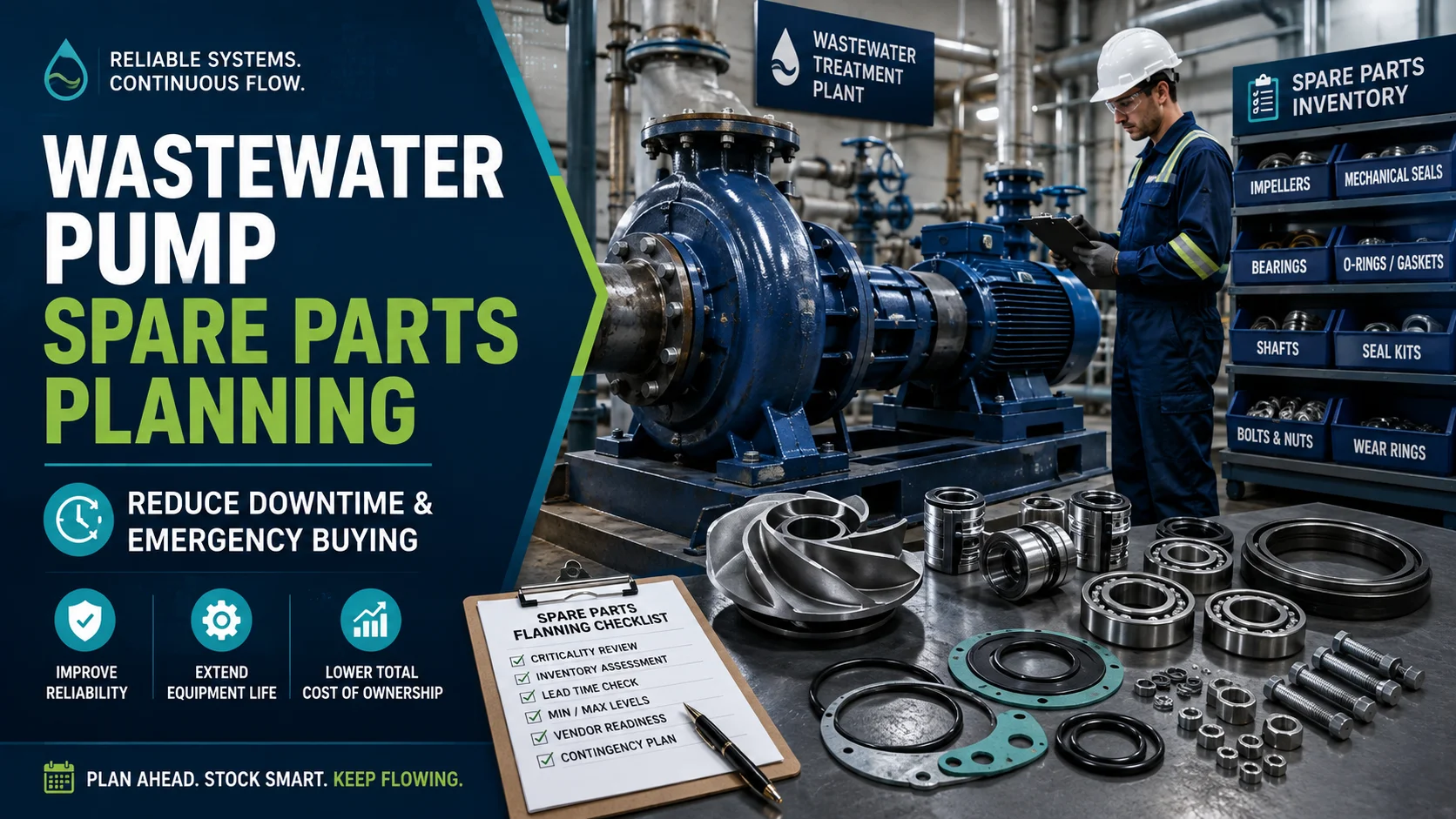
Reduce wastewater pump downtime with better spare parts planning. Learn which critical spares, lead times and failure patterns matter for STP and industria
Plants reduce wastewater pump downtime when they identify critical failure parts, understand vendor lead times, align spares with station criticality and review actual breakdown history. Spare strategy should follow risk, not guesswork or panic buying.
Why spare planning matters in wastewater operations
Wastewater systems often run in critical transfer or treatment loops. When a pump fails, the cost is not just the component; it can also include overflow risk, process disruption and emergency logistics.
- Lead times may be longer than expected for some components.
- Repeated urgent buying usually costs more than planned stocking.
- Sites with remote location or limited vendor response need stronger spare discipline.
Start with failure history and criticality
The best spare strategy begins with what actually fails and how much that failure hurts operations.
- Which pumps are process-critical?
- Which components fail most often?
- How long can the plant operate on standby capacity?
- Which failures can be repaired locally and which need factory support?
Common critical spares wastewater plants review
- Mechanical seals and seal kits.
- Impellers or wear components where solids or abrasion are significant.
- Bearings and O-rings where service kits are standardised.
- Power and control accessories linked to pump protection.
- Cables, sensors or moisture-related items for submersible units.
The exact list depends on whether the station uses a submersible sewage sludge pump, submersible waste water pump or other configuration.
Lead time matters more than many teams expect
Some components fail rarely but deserve stocking because delivery takes too long. Others fail often but can be sourced quickly.
- Check standard delivery versus emergency dispatch reality.
- Confirm whether parts are common across multiple installed pumps.
- Review whether the supplier keeps regional stock or builds to order.
Spare planning should reflect both failure frequency and replacement delay.
How standby philosophy changes the spare strategy
Plants with strong duty-standby redundancy may accept slightly leaner spare stocking than plants with limited backup. But redundancy is not a substitute for all spares.
- A failed duty pump still needs timely repair to restore resilience.
- Some stations cannot tolerate a second failure while waiting for parts.
- Process-critical loops may need both standby capacity and stocked spares.
Avoid two common spare-planning extremes
One mistake is stocking almost nothing and relying on emergency calls. The other is buying every possible part without a risk basis.
A better approach is tiered stocking:
- Critical fast-consumption or long-lead items in local stock.
- Moderate-risk items with confirmed vendor response.
- Rare or capital-heavy items handled through planned backup arrangements.
Spare planning checklist for maintenance teams
- Failure history reviewed by pump type.
- Criticality ranking agreed.
- Long-lead items identified.
- Interchangeability across pumps checked.
- Service-kit and overhaul strategy defined.
- Vendor escalation contacts documented.
Common mistakes that create emergency buying
- No record of what failed last year.
- Assuming all spares are easily available locally.
- Forgetting that standby pumps still require repair spares.
- Mixing incompatible parts across similar-looking pumps.
- Waiting for failure before confirming lead times.
Frequently asked questions
What spare parts are usually most important for wastewater pumps?
The answer varies by pump type and service, but seals, wear components, bearings, cables or pump-specific protection items are commonly reviewed first.
Should every plant stock a full spare pump?
Not always. The right strategy depends on criticality, standby capacity, delivery lead time and repair capability. Some sites need full spare units; others need only critical kits.
How do I decide which spare parts to stock locally?
Start with failure history, pump criticality and vendor lead time. Stock the items that combine meaningful failure risk with unacceptable replacement delay.
Can standby pumps replace a spare-parts strategy?
No. Standby pumps buy time, but they do not eliminate the need to repair failed units and restore full resilience.
Why do wastewater pump spare lists become too large?
Because some teams buy parts without ranking criticality or checking interchangeability. A structured risk-based review usually reduces waste.
Can Flow Chem define the exact spare list without installed-base details?
No. Final spare planning should follow the pump models, failure history, criticality and lead-time realities of the site.
Need help selecting the right pump?
Share your flow, head, liquid type, solids, site layout and duty cycle with Flow Chem Pumps. Our team can help you shortlist the right pump.