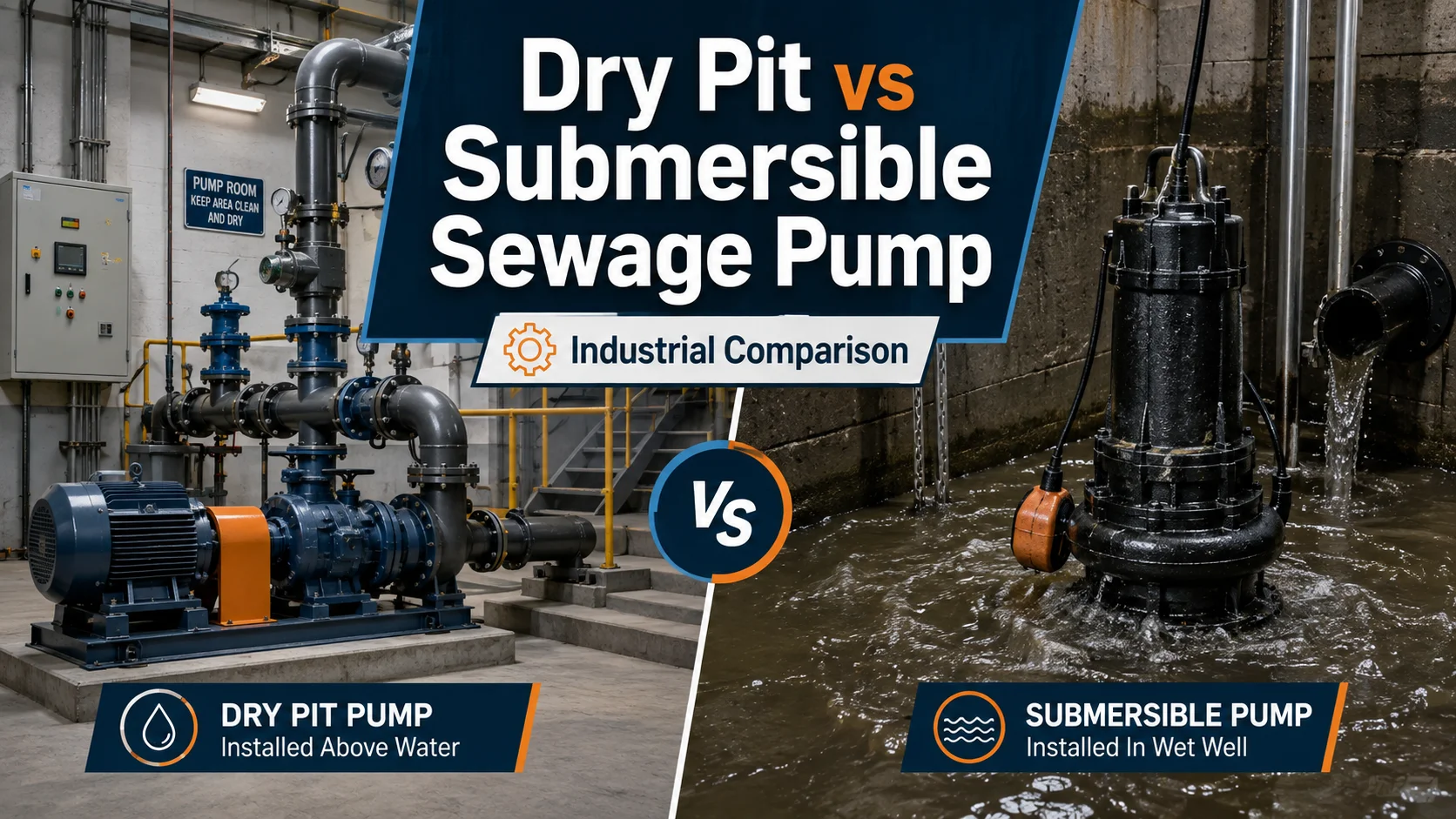
Compare dry pit vs submersible sewage pump layouts for industrial and municipal wastewater systems. Review maintenance access, flooding risk, footprint, co
A dry pit layout can improve maintenance access and keep motors out of the liquid, while a submersible sewage pump layout can reduce civil complexity and simplify wet-well installation. The better option depends on duty, site constraints, operator resources, solids profile and how the plant manages reliability risk.
Why this layout decision matters
Pump layout affects maintenance time, shutdown risk, civil cost and operator safety. Once the station is built, layout mistakes are expensive to reverse.
- Dry pit systems separate the pump or motor arrangement from the wet well.
- Submersible arrangements place the unit in the liquid zone with guide rails or similar installation support.
- Both approaches can work well when matched to the site and operating team.
When submersible sewage pumps make sense
A submersible sewage sludge pump style arrangement is often preferred when the project needs a compact layout and straightforward wet-well integration.
- Smaller civil footprint.
- Simpler installation for many packaged or compact stations.
- Less separate pump-room infrastructure.
- Straightforward guide-rail removal for service in many layouts.
Submersible pumps are common where the plant wants a proven, compact wastewater solution and accepts the maintenance workflow that comes with immersed equipment.
When a dry pit layout may be better
Dry pit layouts can be attractive when maintenance access and equipment segregation are top priorities.
- Easier inspection access in some installations.
- Reduced need to retrieve the full pump from the wet well for every inspection.
- Potentially better conditions for certain instrumentation and service routines.
- Useful where operators strongly prefer above-liquid mechanical access.
But the layout needs proper suction conditions, sealing discipline and room planning. A dry pit is not automatically lower risk.
Solids handling and clogging considerations
The solids profile should influence the layout decision because clogging behavior is not only a pump issue; it is also a station-design issue.
- Wet well shape and retention zones matter.
- Inlet placement affects ragging and turbulence.
- Pump passage geometry still has to match the solids load.
- Some duties may require a submersible cutter pump instead of a standard sewage pump.
Do not expect layout alone to solve repeated clogging if the hydraulic selection and wet-well design remain weak.
Maintenance and operator access
Dry pit systems often look easier for maintenance on paper, but the real answer depends on the station design and staffing model.
- Is there safe access space around the pump?
- Can the team isolate, remove and inspect equipment quickly?
- Are lifting arrangements planned?
- Does the site have the workforce and tools for the chosen configuration?
- How often will inspection be needed based on the liquid profile?
Flooding, environment and motor protection
In sewage infrastructure, water ingress risk and room conditions matter.
- Dry pit rooms need protection against flooding and drainage failure.
- Ventilation and humidity management may be needed.
- Submersible motors are built for immersed duty but still need correct cable sealing, overload protection and monitoring.
- Alarm philosophy should reflect the station risk profile.
Civil, footprint and installation tradeoffs
Layout decisions are often driven by more than pump performance.
- Available footprint and structural constraints.
- Accessibility for lifting and removal.
- Retrofit limitations in old stations.
- Budget split between mechanical scope and civil scope.
A submersible layout may reduce some civil complexity, while a dry pit layout may justify its footprint where serviceability is mission-critical.
Decision checklist for engineers and buyers
- Define the sewage stream and solids profile.
- Review maintenance staffing and lifting capability.
- Assess flooding and room-risk scenarios.
- Check footprint and retrofit constraints.
- Confirm standby philosophy and alarm handling.
- Compare lifecycle intervention effort, not only capital cost.
Common mistakes in layout selection
- Choosing dry pit only because it appears more industrial.
- Choosing submersible only because it appears simpler upfront.
- Ignoring wet-well hydraulics and inlet layout.
- Assuming either configuration eliminates clogging by itself.
- Overlooking lifting, ventilation and drainage planning.
Frequently asked questions
Is a dry pit pump always easier to maintain than a submersible sewage pump?
Not always. Dry pit layouts can improve mechanical access, but poor room design, flooding risk or difficult isolation can erase the advantage. Site design matters.
Are submersible sewage pumps only for small stations?
No. Submersible sewage pumps are widely used in industrial and municipal duties of many sizes. The key is whether the layout, solids profile and service philosophy suit the application.
Which layout is better for clogging problems?
Neither layout is automatically better unless the wet-well hydraulics, solids profile and pump geometry are also addressed. Chronic clogging usually needs a broader review.
Can a cutter pump be used in either layout?
Yes, depending on the manufacturer and configuration, but the need for a cutter arrangement should be based on the actual fibrous or rag-heavy solids load.
Should buyers decide the layout only by capital cost?
No. Capital cost is important, but maintenance effort, downtime risk, civil constraints and operator capability often decide the better long-term choice.
Can Flow Chem choose the layout without a station review?
No. Final layout should follow the duty, footprint, civil constraints, solids profile and maintenance philosophy of the site.
Need help selecting the right pump?
Share your flow, head, liquid type, solids, site layout and duty cycle with Flow Chem Pumps. Our team can help you shortlist the right pump.