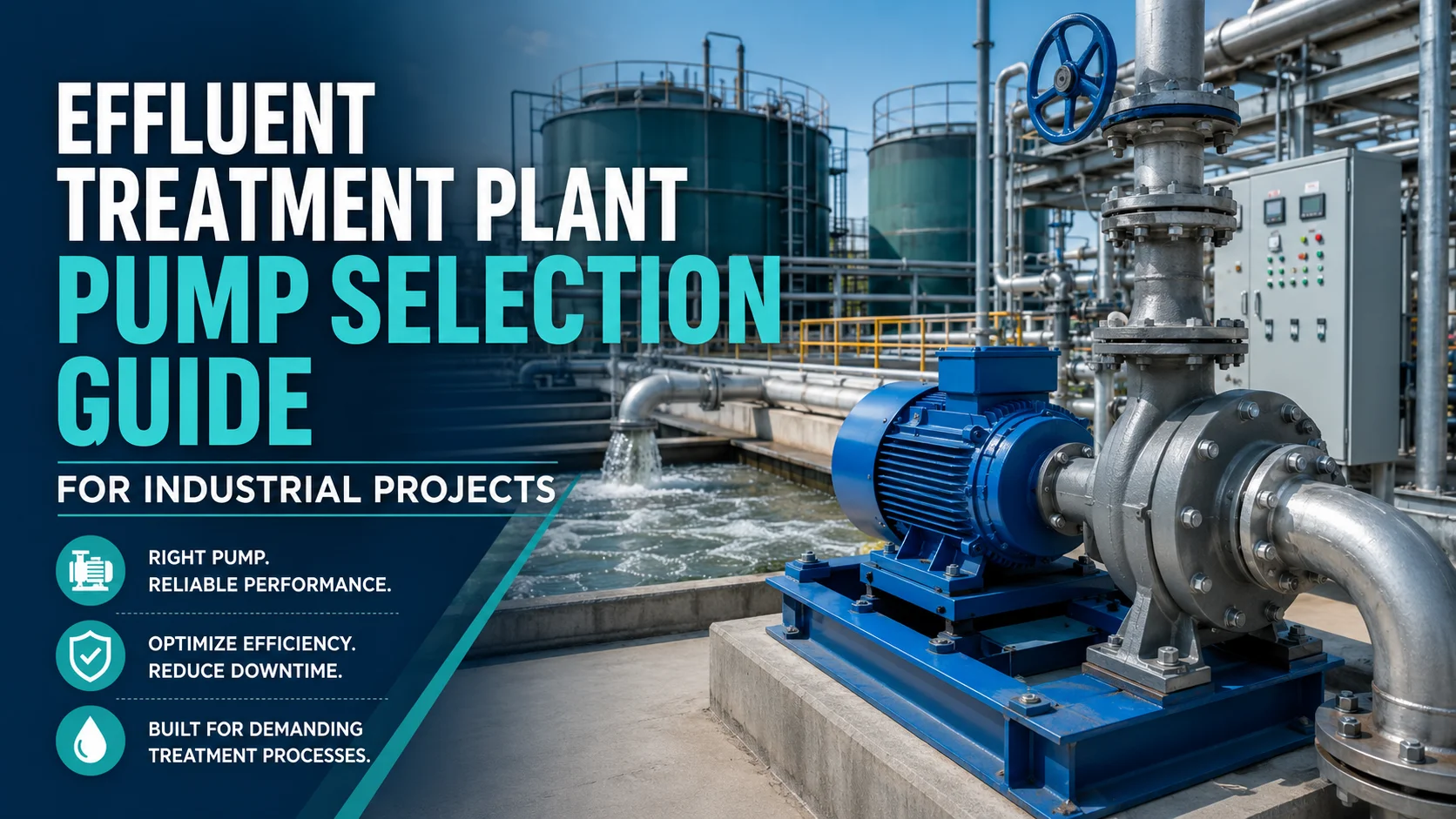
Select the right pumps for an effluent treatment plant with this industrial guide. Compare ETP stages, flow, head, chemical compatibility, materials, sludg
Effluent treatment plant pump selection starts with mapping every stage of the ETP process and identifying the liquid characteristics at each stage. An ETP is not a single pumping duty — it is a sequence of treatment steps where the liquid changes from raw industrial effluent to treated water, with sludge, chemical dosing and recirculation loops in between. Each stage needs its own pump selection logic.
For treated or semi-treated effluent transfer, Flow Chem's effluent pumps are the primary product route to review. For sludge handling within the ETP, review the submersible sewage sludge pump. For raw effluent or mixed wastewater intake with solids, review the submersible waste water pump.
Why ETP pump selection is different from standard wastewater pump selection
An effluent treatment plant processes industrial wastewater through multiple chemical, biological and physical treatment stages. The liquid at the inlet is fundamentally different from the liquid at the outlet. A pump selected for raw effluent intake may be completely unsuitable for chemical dosing, sludge recirculation or treated water discharge.
Key differences from standard wastewater pump selection:
- Chemical variation across stages: pH, dissolved solids, oil content and corrosive elements change as the effluent passes through treatment.
- Multiple pump duties in one plant: an ETP may need raw effluent transfer pumps, chemical dosing pumps, recirculation pumps, sludge pumps and treated water pumps — each with different selection criteria.
- Abrasive and corrosive exposure: chemical precipitation, coagulant dosing and biological sludge can create abrasive or corrosive conditions that standard pump materials may not withstand.
- Sludge generation: ETP processes produce sludge that must be pumped, thickened and handled separately from the main effluent stream.
- Variable flow and load: industrial effluent flow varies with production cycles, batch discharges and cleaning operations, so pumps must handle fluctuating inlet conditions.
Selecting all ETP pumps from a single product category without reviewing stage-specific requirements is a common cause of premature failure, frequent maintenance and treatment underperformance.
Step 1: map the ETP process stages
Before selecting any pump, document every stage of the effluent treatment plant and the liquid characteristics at each point. A typical industrial ETP includes:
- Raw effluent collection sump: receives untreated industrial wastewater from the factory. May contain oil, chemicals, suspended solids, temperature variation and variable pH.
- Screening and grit removal: removes large solids, rags and grit before further treatment.
- Equalization tank: balances flow and load variations. The liquid is mixed and may require aeration or mixing.
- pH correction and neutralization: acid or alkali is dosed to adjust pH. Chemical compatibility becomes critical.
- Coagulant and flocculant dosing: chemical dosing pumps add coagulants and flocculants for precipitation and settling.
- Biological treatment: aerobic or anaerobic processes treat dissolved organic matter. May involve aeration, mixed liquor recirculation and sludge return.
- Clarifier or settling tank: separates treated water from settled sludge. Requires sludge withdrawal pumps.
- Filtration: sand, carbon or membrane filtration polishes the treated water.
- Treated water tank and discharge: final treated effluent is stored and discharged or reused.
- Sludge handling: thickening, dewatering and sludge transfer from clarifiers and biological stages.
Each of these stages has a different liquid profile. Document the flow, head, chemical exposure, temperature and solids content for every stage before approaching a pump supplier.
Step 2: define flow and head for each ETP stage
Every pump in the ETP must be matched to the flow rate and total dynamic head required at its specific stage. Do not assume one flow and head figure covers the entire plant.
For each stage, document:
- Required flow rate at operating conditions, including peak and minimum flow.
- Static head between the source tank and discharge point.
- Pipe length, diameter and material for the discharge line.
- Number of bends, valves and fittings that add friction loss.
- Non-return valve and isolation valve losses.
- Discharge condition: gravity overflow, pressurized feed to the next stage or discharge to a storage tank.
- Duty cycle: continuous, intermittent or batch operation.
- Number of pumps: duty only, duty plus standby, or duty plus assist for peak flow.
If head is underestimated at any stage, the pump may not deliver the required flow, which can disrupt the entire treatment sequence. Pump curve review is essential for each selection.
Step 3: review chemical compatibility stage by stage
Chemical exposure is one of the most critical factors in ETP pump selection. The liquid chemistry changes significantly across treatment stages, and a pump material that works at the inlet may corrode at the neutralization or dosing stage.
Review:
- pH range at each stage — acidic, neutral or alkaline.
- Chemical type: acids, alkalis, coagulants (alum, PAC, ferric chloride), flocculants, disinfectants (chlorine, hypochlorite) or specialty process chemicals.
- Chloride content — high chlorides can cause pitting corrosion in stainless steel.
- Temperature — elevated temperatures can accelerate chemical attack and affect seal life.
- Oil and solvent content — can affect elastomer and seal compatibility.
- Dissolved solids and conductivity — influence corrosion potential.
For general treated effluent with near-neutral pH, cast iron construction may be adequate. For acidic, alkaline or high-chloride conditions, stainless steel, coated components or specialized alloys may be required. For chemical dosing, the pump wetted parts must be compatible with the specific chemical being dosed.
The supplier should explain material selection based on the actual chemical conditions at each ETP stage rather than offering a generic material for the entire plant.
Step 4: select the correct pump type for each ETP duty
Different ETP stages require different pump types. A single pump design cannot cover all duties. Review the following pump type mapping:
| ETP stage | Liquid profile | Pump type to review | |---|---|---| | Raw effluent collection | Untreated industrial wastewater, possible solids and oil | Submersible waste water pump or effluent pump | | Equalization tank | Mixed effluent, variable solids | Submersible waste water pump or effluent pump | | Chemical dosing | Acid, alkali, coagulant, flocculant | Chemical-compatible dosing pump | | Biological treatment recirculation | Mixed liquor, suspended biological solids | Recirculation pump with solids handling | | Clarifier sludge withdrawal | Settled sludge, variable density | Submersible sewage sludge pump | | Treated water transfer | Treated effluent, low solids | Effluent pump | | Sludge thickening and dewatering feed | Concentrated sludge | Sludge transfer pump | | Fibrous or rag-containing effluent | Rags, plastics, stringy waste | Submersible cutter pump |
For treated or semi-treated water transfer duties, the effluent pumps route is the primary product page. For sludge withdrawal and thickened sludge handling, review the submersible sewage sludge pump. If raw effluent contains fibrous solids that cause repeated clogging, review the submersible cutter pump.
Step 5: handle sludge within the ETP
Sludge is generated at multiple points in an effluent treatment plant — from chemical precipitation in the clarifier, from biological treatment excess sludge, and from filtration backwash. Sludge handling is one of the most demanding pump duties in an ETP.
For ETP sludge pumping, review:
- Sludge source: primary clarifier, secondary clarifier, biological reactor or filter backwash.
- Solids content percentage — primary sludge, secondary sludge and thickened sludge have different viscosities.
- Sludge density and flow behaviour.
- Abrasive content — chemical sludge may contain precipitated metal hydroxides, grit or mineral particles.
- Transfer distance and head to the sludge thickener, dewatering unit or sludge storage.
- Duty cycle — intermittent sludge withdrawal or continuous transfer.
- Standby requirement — sludge pumps are often critical to maintaining clarifier performance.
A standard effluent pump is not designed for sludge duty. Review the submersible sewage sludge pump for ETP sludge withdrawal and transfer applications. The pump must be sized for the actual sludge density and solids content, not just the liquid flow rate.
Step 6: plan duty and standby for critical ETP stages
An effluent treatment plant is a continuous process in most industrial facilities. A pump failure at a critical stage can halt the entire treatment sequence and lead to non-compliant discharge. Duty and standby planning should be considered for each stage.
Review:
- Raw effluent intake pumps — if the collection sump overflows, untreated effluent may bypass treatment. Consider duty plus standby.
- Chemical dosing pumps — dosing failure can disrupt pH correction or coagulation. Consider redundancy for critical dosing points.
- Biological recirculation pumps — interruption can affect biomass health and treatment efficiency.
- Clarifier sludge pumps — if sludge is not withdrawn, the clarifier blanket rises and treated water quality drops.
- Treated water discharge pumps — depending on the discharge method, standby may be needed.
For each stage, decide whether a single duty pump is acceptable or whether duty plus standby is required based on the consequence of failure and the plant's tolerance for downtime.
Step 7: review material construction for ETP conditions
Material selection in an ETP must account for the chemical, abrasive and temperature conditions at each stage. Do not apply one material specification across the entire plant.
Review:
- Cast iron for general effluent transfer at near-neutral pH where chemical exposure is low.
- Stainless steel (CF8M, 316 grade or equivalent) for acidic, alkaline or high-chloride conditions.
- Coated volute and impeller for additional chemical resistance where bare metal is insufficient.
- Hard-faced or wear-resistant impeller for abrasive sludge containing grit, metal hydroxides or mineral particles.
- Mechanical seal material compatible with the chemical and temperature conditions at each stage.
- Elastomer compatibility — O-rings and seals must suit the chemical environment.
- Cable and motor insulation for submersible pumps operating in chemically aggressive effluent.
The supplier should provide a material recommendation for each ETP stage based on the actual liquid analysis, not a generic material grade applied universally.
Step 8: review installation and maintenance access
ETP pumps operate in a plant environment where access for inspection, service and replacement must be planned at the design stage. Poor access turns routine maintenance into a prolonged shutdown.
Review:
- Pump lifting arrangement for submersible pumps in sumps and tanks.
- Guide rail system for pumps installed in deep or narrow sumps.
- Valve chamber access for isolation and non-return valves.
- Control panel location — accessible, protected from chemical splash and weather.
- Spare pump storage or quick-swap arrangement for critical stages.
- Space around the pump for impeller clearance checks and seal inspection.
- Safety procedures for working in confined spaces, chemical areas and biological treatment zones.
A pump that cannot be safely removed or serviced can turn a minor wear issue into a multi-day plant interruption.
Step 9: prepare a complete ETP pump enquiry brief
Before requesting pump recommendations from a supplier, prepare a stage-by-stage brief for the entire effluent treatment plant.
For each ETP stage, include:
1. Stage name and function in the treatment process. 2. Liquid description: raw effluent, equalized effluent, dosed chemical, biological mixed liquor, sludge or treated water. 3. Flow rate: average, peak and minimum. 4. Total dynamic head calculation. 5. Pipe length, diameter and material. 6. Chemical analysis: pH range, chloride content, chemical type, oil content. 7. Temperature range. 8. Solids content and type. 9. Sludge density and viscosity where applicable. 10. Duty cycle: continuous, intermittent or batch. 11. Duty and standby requirement. 12. Installation type: wet-well submersible, dry-installed, sump-mounted or inline. 13. Power supply available. 14. Material compatibility concerns. 15. Maintenance access constraints.
For Flow Chem application review, submit the ETP stage-by-stage details through the Flow Chem contact page.
ETP pump selection checklist
Use this checklist before finalizing pump selections for an effluent treatment plant:
- Every ETP stage is mapped with its liquid profile.
- Flow rate is documented for each stage.
- Total dynamic head is calculated for each stage.
- Chemical compatibility is reviewed stage by stage.
- pH range, chloride content and temperature are documented.
- Correct pump type is matched to each stage duty.
- Sludge handling pumps are selected separately from effluent transfer pumps.
- Material construction is specified per stage, not universally.
- Mechanical seal and elastomer compatibility is confirmed.
- Duty and standby is planned for critical stages.
- Abrasive sludge conditions are reviewed for wear-part selection.
- Installation and maintenance access is confirmed.
- Pump curves are reviewed for each selection.
- Complete enquiry brief is prepared with stage-by-stage data.
Common mistakes to avoid
Avoid these ETP pump selection mistakes:
- Selecting one pump type for the entire plant — each stage has different liquid and chemical conditions.
- Ignoring chemical compatibility — a pump that works at the inlet may corrode at the neutralization or dosing stage.
- Using an effluent pump for sludge — sludge density, viscosity and abrasive content require a different pump selection.
- Underestimating head at intermediate stages — pipe runs between tanks, bends and valve losses add up.
- Not planning standby for critical stages — a single pump failure can halt the entire ETP.
- Applying one material grade across all pumps — chemical conditions vary by stage.
- Ignoring fibrous solids in raw effluent — if rags or plastics enter the ETP, a cutter pump may be needed at the intake.
- Skipping sludge density data — sludge pump selection without density and solids percentage leads to underperformance.
- Selecting dosing pumps without chemical compatibility review — dosing chemicals can be highly corrosive.
- Not reviewing pump curves — duty point must be confirmed on the performance curve for each selection.
These mistakes create reliability, compliance and operational risks for industrial effluent treatment projects.
Frequently asked questions
What type of pump is used in an effluent treatment plant?
An ETP typically uses multiple pump types across its stages: submersible waste water pumps or effluent pumps for raw and treated effluent transfer, chemical-compatible dosing pumps for pH correction and coagulant dosing, submersible sewage sludge pumps for clarifier sludge withdrawal, and effluent pumps for final treated water discharge. Each stage needs stage-specific selection.
How do I select a pump for ETP treated water transfer?
For ETP treated water transfer, review effluent pump options based on required flow rate, total dynamic head, pipe layout, residual chemical content, temperature and solids level. If the treated water is near-neutral with low solids, an effluent pump with standard construction may be suitable. Confirm material compatibility before final selection.
Can I use the same pump for raw effluent and treated water in an ETP?
Not usually. Raw effluent may contain chemicals, oil, suspended solids and variable pH that require different material construction and solids handling compared to treated water. Each ETP stage should be reviewed separately for pump type, material and duty.
What pump is used for ETP sludge handling?
For ETP sludge from clarifiers, biological treatment or filter backwash, review submersible sewage sludge pump options. Sludge pump selection should account for solids content percentage, sludge density, abrasive content, transfer distance and duty cycle. A standard effluent pump is not designed for sludge duty.
How does chemical compatibility affect ETP pump selection?
Chemical compatibility determines the pump body, impeller, seal and elastomer materials. Acidic, alkaline or high-chloride conditions may require stainless steel, coated components or specialized alloys. Each ETP stage should be reviewed for its specific chemical exposure. Applying one material grade across all pumps can lead to corrosion and premature failure.
What information should I send for an ETP pump enquiry?
Send a stage-by-stage brief including stage name, liquid description, flow rate, total dynamic head, pipe details, chemical analysis, pH range, temperature, solids content, sludge density where applicable, duty cycle, duty and standby requirement, installation type, power supply and material compatibility concerns.
Need help selecting the right pump?
Share your flow, head, liquid type, solids, site layout and duty cycle with Flow Chem Pumps. Our team can help you shortlist the right pump.