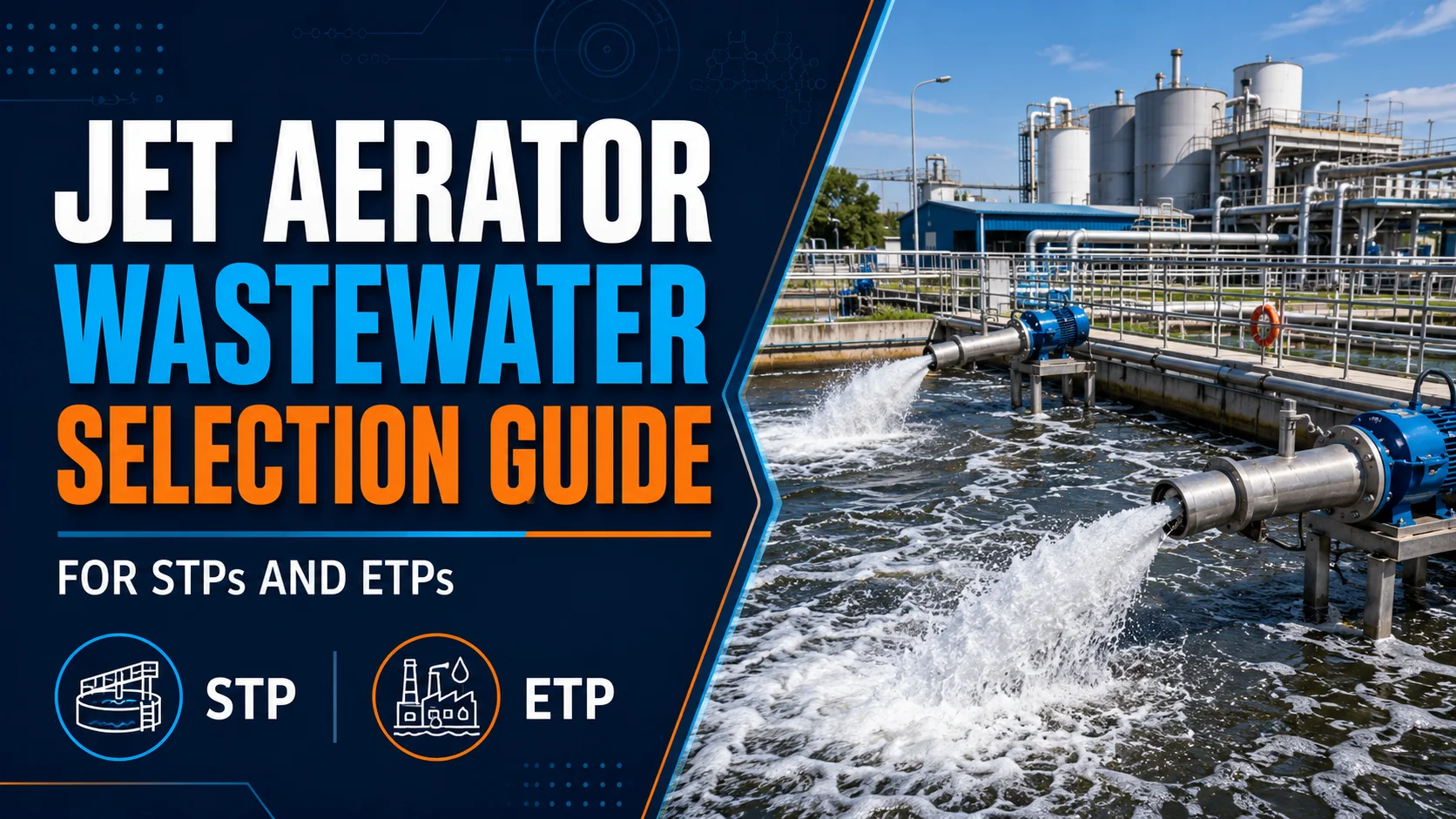
Learn how to select a jet aerator for wastewater treatment. Compare tank depth, oxygen demand, mixing, flow, power, installation and maintenance for STPs a
A jet aerator for wastewater should be selected by matching the aeration and mixing requirement to the treatment process. The buyer should define tank volume, tank depth, required oxygen transfer, wastewater load, mixing need, operating hours, installation constraints, power supply and maintenance access before procurement.
Jet aerator selection should be reviewed by the process consultant or manufacturer because aeration equipment affects biological treatment performance. If the site also requires sewage, sludge or wastewater pumping, the relevant Flow Chem routes include submersible sewage sludge pump, submersible waste water pump, effluent pumps and submersible cutter pump depending on the duty.
What a jet aerator does in wastewater treatment
A jet aerator is used to support oxygen transfer and mixing in wastewater treatment tanks. In many systems, aeration helps biological treatment by supplying oxygen and keeping contents mixed enough for the process requirement.
A jet aerator may be reviewed for:
- STP aeration tanks.
- ETP biological treatment tanks.
- Industrial wastewater treatment.
- Equalization or mixing support where suitable.
- Retrofit aeration review where existing equipment underperforms.
- Sites needing combined aeration and circulation review.
The correct use depends on the process design. Do not assume a jet aerator is suitable for every tank without process review.
Step 1: define the treatment process
Aeration selection starts with the wastewater treatment process. Different processes need different oxygen and mixing conditions.
Document:
- STP or ETP application.
- Biological treatment process.
- Tank role: aeration, equalization, mixing or polishing.
- Continuous or intermittent operation.
- Design organic load if available.
- Required dissolved oxygen target if specified.
- Existing aeration method.
- Reason for new selection or replacement.
A jet aerator should support the treatment process, not be selected as a generic pump accessory.
Step 2: confirm tank volume and geometry
Tank dimensions affect mixing and aeration distribution. A shallow tank, deep tank, long tank or irregular tank may need different equipment layout.
Review:
- Tank length, width and depth.
- Working water depth.
- Freeboard.
- Tank shape.
- Number of compartments.
- Inlet and outlet location.
- Sludge accumulation zones.
- Access platform or mounting arrangement.
Tank geometry should be shared before requesting a jet aerator recommendation.
Step 3: estimate oxygen demand
Aeration equipment must be selected for oxygen requirement. Motor HP alone does not confirm treatment suitability.
Check with the process consultant for:
- BOD/COD load.
- Flow rate into the treatment unit.
- MLSS or biomass condition where applicable.
- Required dissolved oxygen level.
- Operating hours.
- Peak load condition.
- Safety factor.
If oxygen demand is underestimated, treatment performance can suffer. If oversized blindly, energy cost may increase.
Step 4: review mixing requirement
Aeration and mixing are related but not identical. A tank may need oxygen transfer, mixing, suspension of solids or circulation.
Ask:
- Does the tank need complete mixing?
- Is sludge settling a problem?
- Are dead zones visible?
- Does the aerator need to support circulation?
- Are there multiple tanks or zones?
- Is existing mixing insufficient?
Jet aerator layout should consider how water moves in the tank, not only how much air enters.
Step 5: evaluate wastewater characteristics
Wastewater quality affects equipment selection, materials and maintenance.
Document:
- Domestic sewage or industrial wastewater.
- pH range.
- Temperature.
- Oil/grease presence.
- Chemical exposure.
- Solids and sludge level.
- Corrosive or abrasive components.
- Foaming tendency.
Material compatibility and process suitability should be verified from actual wastewater data. Avoid unsupported chemical-resistance claims.
Step 6: check power and operating cost
Aeration can be a major energy load in wastewater treatment. Selection should consider power availability and operating hours.
Review:
- Available voltage and phase.
- Motor rating.
- Continuous or intermittent operation.
- Control strategy.
- Existing panel capacity.
- Cable routing.
- Energy cost expectations.
Do not claim energy savings unless approved data is available. It is safer to compare selection basis and operating requirement.
Step 7: plan installation and maintenance access
Jet aerators should be installed so they can be inspected and maintained safely.
Review:
- Mounting arrangement.
- Access walkway or platform.
- Lifting/removal method.
- Pipe or air-line arrangement where applicable.
- Cable routing.
- Safe isolation.
- Tank emptying requirement for maintenance.
- Operator access during normal plant operation.
Installation access affects long-term reliability and maintenance cost.
Step 8: compare jet aerator with other aeration options
A jet aerator may be one option among several aeration technologies. The right choice depends on process design, tank layout, power cost, maintenance preference and site constraints.
Compare:
- Jet aerator.
- Diffused aeration.
- Surface aerator.
- Existing retrofit options.
- Mixing-only equipment where oxygen is not the issue.
The buyer should not choose by equipment name alone. The wastewater treatment requirement should decide the aeration route.
Step 9: prepare a complete enquiry
Before asking for a jet aerator recommendation, prepare a technical brief.
Include:
- STP/ETP/process type.
- Tank dimensions and working depth.
- Flow rate.
- BOD/COD or load data if available.
- Required DO level if specified.
- Wastewater characteristics.
- Existing aeration equipment.
- Current problem: low DO, odor, poor mixing, high energy, maintenance, retrofit.
- Power supply.
- Installation and access constraints.
- Photos or layout drawings if available.
For Flow Chem review, submit details through the Flow Chem contact page. Avoid assuming product fit without application review.
Jet aerator selection checklist
Use this checklist before procurement:
- Treatment process is defined.
- Tank dimensions are available.
- Working water depth is known.
- Oxygen demand is estimated by process design.
- Mixing requirement is defined.
- Wastewater characteristics are documented.
- Power supply and control needs are reviewed.
- Installation access is practical.
- Maintenance plan is clear.
- Manufacturer/process consultant review is requested.
- No unsupported performance or energy-saving claims are used.
Common mistakes to avoid
Avoid these mistakes:
- Selecting only by motor HP.
- Ignoring tank depth and geometry.
- Ignoring process oxygen demand.
- Treating aeration and mixing as the same requirement.
- Ignoring wastewater chemistry.
- Ignoring installation access.
- Assuming energy savings without data.
- Retrofitting without checking tank hydraulics.
- Publishing unsupported treatment-performance claims.
These mistakes can create poor treatment performance and unnecessary energy cost.
Frequently asked questions
What is a jet aerator used for in wastewater treatment?
A jet aerator is used to support aeration and mixing in wastewater treatment tanks such as STPs, ETPs and industrial wastewater systems. Final suitability depends on process design, tank geometry and oxygen demand.
How do I select a jet aerator for an STP?
Define the STP process, tank volume, working depth, oxygen demand, flow rate, wastewater load, mixing requirement, operating hours, power supply and maintenance access before requesting a recommendation.
Is motor HP enough to select a jet aerator?
No. Motor HP alone does not confirm oxygen transfer, mixing effectiveness or treatment suitability. Selection should be based on tank and process requirements.
Can a jet aerator replace diffused aeration?
It may be considered in some retrofit or process situations, but replacement should be reviewed by a wastewater process expert. Tank layout, oxygen demand, energy use and maintenance requirements must be evaluated.
What details should I share for a jet aerator quote?
Share tank dimensions, working depth, wastewater flow, BOD/COD load if available, required DO, wastewater type, existing aeration system, site problem, power supply and installation constraints.
Can Flow Chem claim exact oxygen-transfer or energy-saving performance?
Exact oxygen-transfer, energy-saving or treatment-performance claims should only be made when approved technical data is available for the specific application and equipment.
Need help selecting the right pump?
Share your flow, head, liquid type, solids, site layout and duty cycle with Flow Chem Pumps. Our team can help you shortlist the right pump.