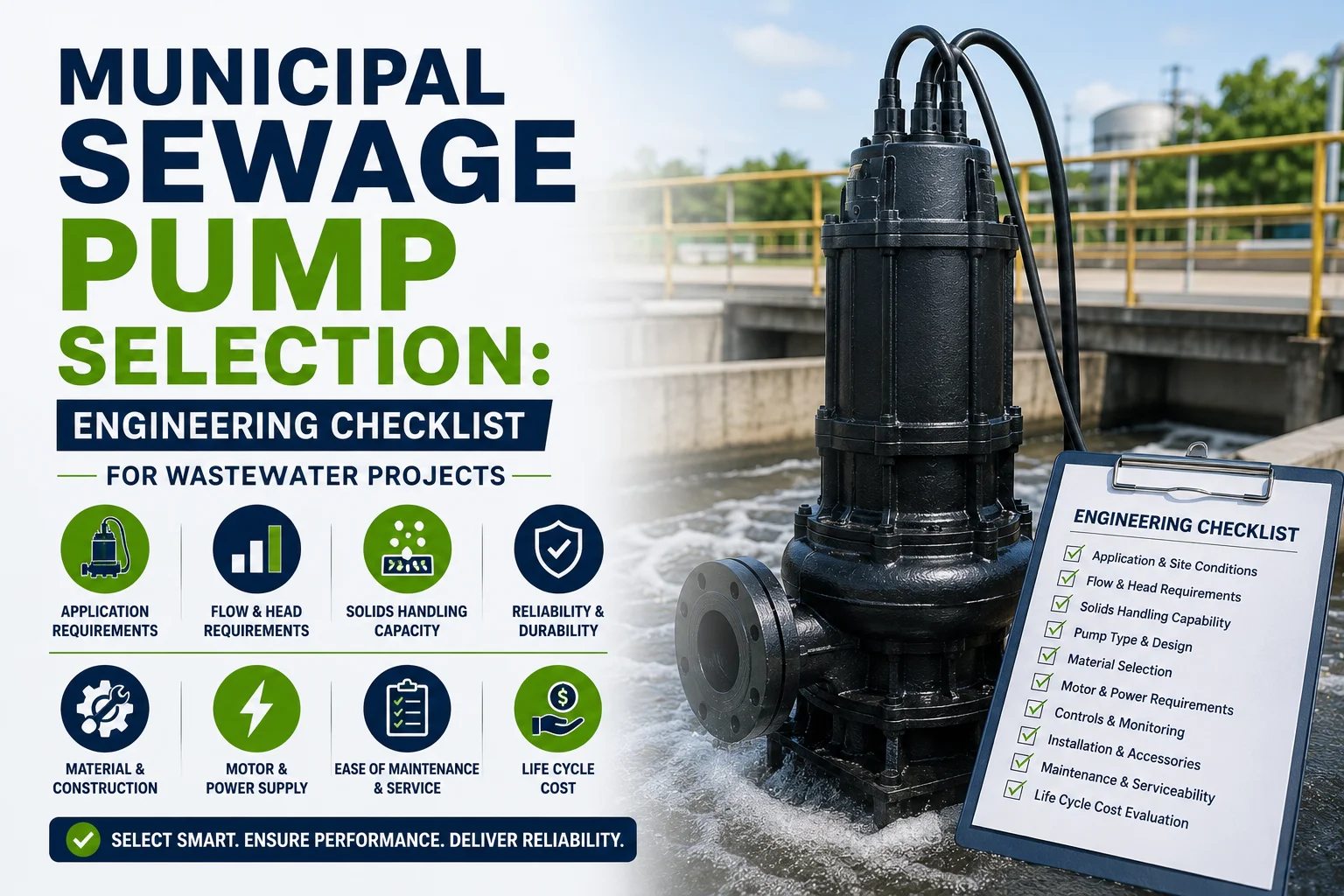
Use this municipal sewage pump selection checklist for wastewater projects. Compare flow, head, solids, clogging risk, duty cycle, installation and mainten
A municipal sewage pump is selected by matching the pump to the wastewater duty, not only to horsepower or discharge size. The buyer should define average flow, peak flow, total dynamic head, solids profile, clogging risk, wet-well layout, operating hours, standby requirement and maintenance access before procurement.
For many municipal sewage, STP and lift-station duties, the first product route to review is a submersible sewage sludge pump. If the sewage contains wipes, rags, plastics or fibrous material that causes repeated choking, a submersible cutter pump may be more suitable. For treated or semi-treated wastewater transfer, the duty may need comparison with a submersible waste water pump or effluent pumps.
The right selection should be supported by duty-point data and site conditions.
Why municipal sewage pump selection is high-risk
Municipal sewage pumps often work in difficult and variable conditions. Inflow can change by time of day, rainfall, population load, industrial discharge and upstream screening quality. The pump may face solids, sludge, grit, rags, plastics, wipes and long operating hours.
Wrong selection can create:
- Wet-well overflow risk.
- Pump choking.
- Low discharge.
- Motor overload.
- Seal failure.
- Repeated emergency cleaning.
- Public nuisance or sanitation issues.
- Higher maintenance and downtime.
- Procurement disputes because specifications were unclear.
The cost of failure is usually higher than the cost of proper selection.
Step 1: define the wastewater source
Municipal sewage can vary significantly from one project to another. Before choosing a pump, define what enters the wet well or sump.
Document:
- Raw sewage, screened sewage, sludge, treated wastewater or mixed wastewater.
- Domestic sewage vs commercial/industrial contribution.
- Whether grit, plastics, rags or wipes are present.
- Whether upstream screening exists and how reliable it is.
- Whether stormwater or monsoon inflow affects the system.
- Whether sludge transfer is part of the duty.
The pump type should follow the actual wastewater profile. General sewage may suit a sewage sludge pump. Fibrous high-clogging sewage may require cutter-pump review.
Step 2: calculate average and peak flow
Municipal systems should not be selected only for average flow. Peak inflow can occur during morning/evening loads, rainfall events, industrial discharge cycles or monsoon periods.
Review:
- Average daily flow.
- Peak hourly flow.
- Minimum flow condition.
- Emergency inflow scenario.
- Number of working pumps.
- Number of standby pumps.
- Whether duty/assist operation is required.
A pump that handles average flow but fails during peak load can cause wet-well overflow or unstable operation. Peak-flow review is critical for municipal applications.
Step 3: calculate total dynamic head
Total dynamic head includes more than vertical lift. It includes static lift, pipe friction, fittings, valves and discharge condition.
Include:
- Static head from wet-well level to discharge point.
- Pipe length and diameter.
- Bends, valves and fittings.
- Friction loss at peak flow.
- Non-return valve and isolation valve losses.
- Discharge pressure or terminal condition.
- Wet-well level variation.
If head is underestimated, discharge may be lower than expected. If head is overestimated, the pump may run outside its efficient range. Pump curve review is necessary.
Step 4: review solids and clogging risk
Municipal sewage often contains unpredictable solids. Clogging risk is one of the biggest causes of sewage pump maintenance.
Ask:
- What is the expected solids size?
- Are rags, wipes, plastics or fibrous solids present?
- Is screening reliable?
- Is there a history of pump choking?
- Does the pump need large free passage?
- Is cutting action required?
- Is grit or abrasive material present?
For general sewage and sludge, a submersible sewage sludge pump is usually reviewed first. If fibrous waste is the main failure mode, review the submersible cutter pump route.
Step 5: choose pump type based on failure mode
The pump should be selected around the most likely failure mode.
Use this logic:
- If the main duty is sewage/sludge transfer, review sewage sludge pump selection.
- If the main problem is rags, wipes, plastics and fibrous waste, review cutter pump selection.
- If the duty is treated wastewater or semi-treated effluent, review wastewater or effluent pump selection.
- If grit and abrasive solids are high, review wear and material requirements.
- If corrosion is likely, confirm material compatibility.
Do not force one pump type into every municipal duty. The right pump depends on the wastewater and site history.
Step 6: review wet-well design and installation access
A pump can be correctly selected hydraulically and still fail operationally if the wet well or installation design is poor.
Review:
- Wet-well depth and diameter.
- Pump placement.
- Minimum submergence.
- Guide rail or coupling arrangement.
- Lifting access for pump removal.
- Cable routing.
- Ventilation and electrical safety.
- Valve chamber access.
- Cleaning access.
- Ability to inspect and remove clogged material.
Municipal maintenance teams need safe and practical access. Serviceability should be planned before installation.
Step 7: check material, seal and motor protection
Municipal sewage can be corrosive, abrasive or variable. Reliability features matter.
Review:
- Pump construction material.
- Coating requirement where suitable.
- Seal arrangement.
- Cable-entry protection.
- Thermal protection where applicable.
- Motor rating and phase.
- Control-panel protection.
- Dry-run or overload protection where required.
Do not assume material compatibility without checking the wastewater characteristics. For industrial-mixed sewage, chemical exposure may need additional review.
Step 8: plan duty/standby operation
Municipal sewage systems should not depend on a single pump without failure planning. Standby and assist operation should be considered.
Review:
- Duty/standby arrangement.
- Duty/assist arrangement for peak flow.
- Alternating pump operation.
- Emergency pumping requirement.
- Maintenance downtime window.
- Alarm and control strategy.
- Availability of spare parts and service support.
Standby planning reduces the risk of overflow and emergency maintenance.
Step 9: prepare a clear municipal pump enquiry
Before asking for a quote, prepare a complete duty brief.
Include:
- Project type: municipal wet well, lift station, STP, sump or sludge transfer.
- Average and peak flow.
- Total dynamic head.
- Pipe length and diameter.
- Solids size and type.
- Clogging history.
- Screening details.
- Wet-well depth and dimensions.
- Duty/standby requirement.
- Electrical supply and controls.
- Maintenance access.
- Wastewater chemistry concerns.
Flow Chem can review sewage/sludge and cutter-pump requirements when buyers share duty details through the Flow Chem contact page.
Municipal sewage pump selection checklist
Use this checklist before finalizing procurement:
- Wastewater source is defined.
- Average and peak flow are calculated.
- Total dynamic head is calculated.
- Solids profile and clogging risk are reviewed.
- Pump type is selected based on failure mode.
- Wet-well design and installation access are checked.
- Material and seal requirements are reviewed.
- Duty/standby strategy is planned.
- Service and spares support are discussed.
- Pump curve and selection assumptions are documented.
This checklist helps municipal buyers compare pumps on engineering fit instead of only price.
Common mistakes to avoid
Avoid these mistakes in municipal sewage pump selection:
- Selecting only by horsepower.
- Ignoring peak flow.
- Ignoring friction loss.
- Ignoring rags, wipes and fibrous solids.
- Using a wastewater pump where a cutter pump is needed.
- Ignoring wet-well maintenance access.
- Skipping standby planning.
- Ignoring corrosion or industrial wastewater contribution.
- Not documenting pump selection assumptions.
These mistakes often create repeated service calls and lower system reliability.
Frequently asked questions
Which pump is best for municipal sewage applications?
For many municipal sewage and STP duties, a submersible sewage sludge pump is reviewed first. If rags, wipes, plastics or fibrous waste cause repeated choking, a cutter pump may be more suitable. Final selection depends on flow, head, solids and site conditions.
How do I size a municipal sewage pump?
Calculate average flow, peak flow and total dynamic head, then review solids size, clogging risk, wet-well conditions, duty/standby arrangement, material requirements and pump curve suitability. Do not size only by horsepower.
What is the role of a cutter pump in municipal sewage systems?
A cutter pump is useful when fibrous waste, wipes, rags or plastics cause repeated pump choking. It helps reduce clogging by cutting solids before pumping, but it should be selected only when the wastewater profile requires it.
Why is peak flow important in municipal sewage pump selection?
Municipal inflow varies by time of day, rainfall and upstream discharge. A pump selected only for average flow may fail during peak load, causing wet-well overflow or unstable operation.
What details should I send for a municipal sewage pump quote?
Send average flow, peak flow, total dynamic head, pipe length, wet-well dimensions, solids profile, clogging history, screening details, duty/standby requirement, electrical supply and wastewater chemistry concerns.
Can one pump handle sewage, sludge and treated wastewater?
One pump may handle overlapping duties if the flow, head, solids and material conditions match its design. However, raw sewage, sludge, fibrous wastewater and treated wastewater should be reviewed separately before final selection.
Need help selecting the right pump?
Share your flow, head, liquid type, solids, site layout and duty cycle with Flow Chem Pumps. Our team can help you shortlist the right pump.