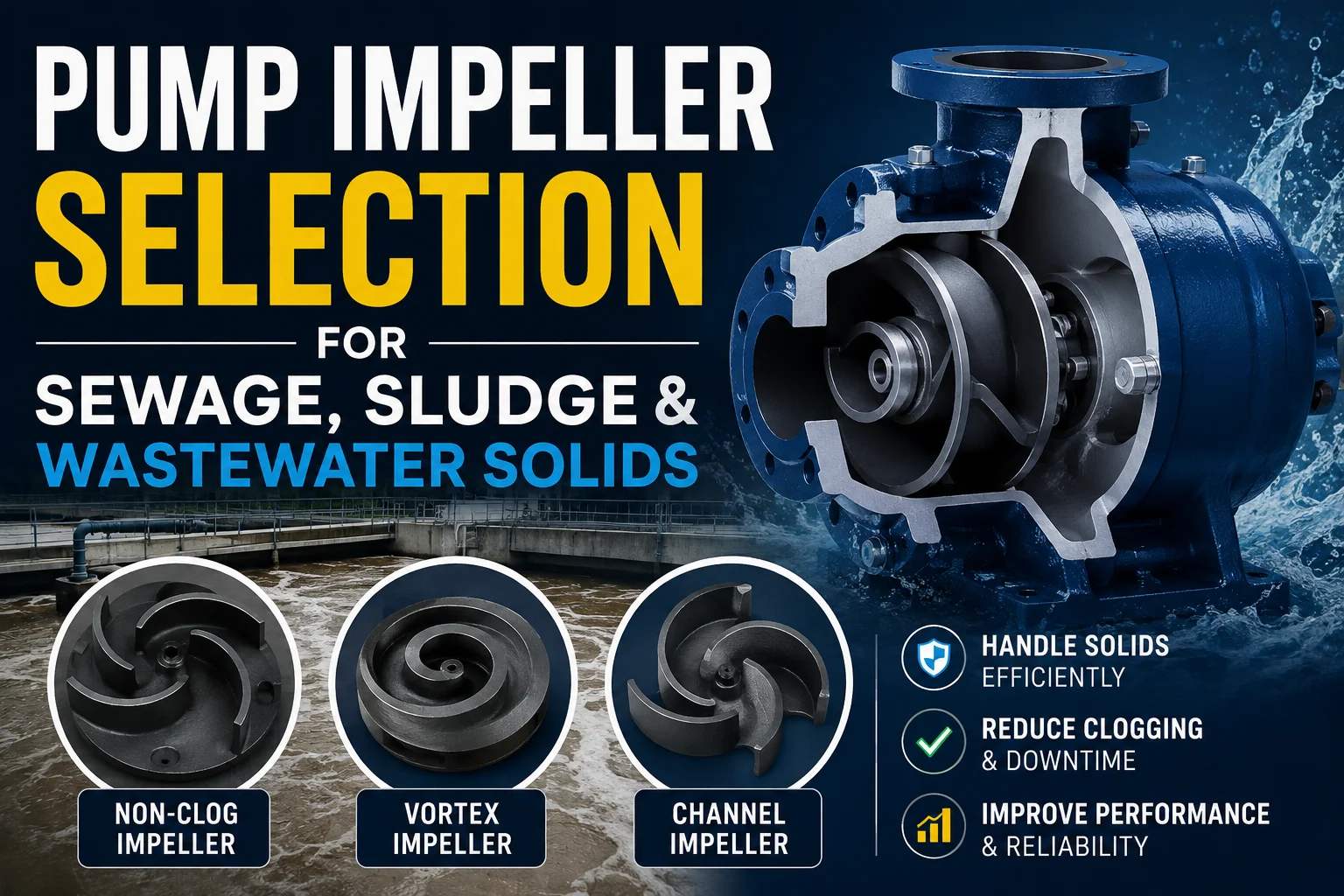
Learn how impeller selection affects clogging, solids handling and efficiency in sewage, sludge and wastewater pumps. Review non-clog, vortex, channel and
The right impeller for sewage or wastewater duty depends on the solids profile, fibrous content, head-flow duty and maintenance priorities. Non-clog, vortex, channel and cutter-style approaches each solve different operating problems, so impeller choice should follow the liquid behavior at the site.
Why impeller choice matters more than many buyers expect
When a pump clogs repeatedly, attention often goes first to motor size or panel protection. But the impeller geometry may be the real reason the pump and solids are fighting each other.
- Impeller design affects solids passage and ragging resistance.
- It also changes efficiency, head generation and wear pattern.
- The best impeller for one sewage stream may be the wrong choice for another.
Start with the liquid and solids profile
Impeller selection should begin with the actual stream, not a catalogue preference.
- Are solids soft, fibrous, abrasive or sticky?
- Is the flow mostly municipal sewage, mixed wastewater or sludge-laden transfer?
- Are wipes, threads or cloth common?
- Does the duty involve settled solids or intermittent upset loading?
These answers help decide whether a submersible sewage sludge pump style non-clog geometry, a vortex approach or a submersible cutter pump is safer.
Non-clog and channel-style impellers
Non-clog and channel designs are common in sewage and wastewater pumps because they balance head generation with solids passage.
- Useful where the duty needs meaningful hydraulic efficiency and moderate solids passage.
- Often selected for STP transfer, sewage lift and mixed wastewater duties.
- The exact passage and blade geometry matter more than a generic “non-clog” label.
They work best when the solids profile matches the passage design and the wet well is not creating unusual ragging conditions.
Vortex-style approaches
Vortex-style handling can be useful where soft solids or sensitive material should pass with lower direct impeller contact.
- Can reduce direct impeller interaction with certain solids.
- May suit some difficult, stringy or fragile streams.
- But the hydraulic tradeoff must still be understood because efficiency and head behavior can differ from channel-style designs.
When cutter-style geometry is worth considering
A cutter arrangement is not required for every sewage duty. It becomes more relevant when fibrous solids repeatedly defeat standard passage geometries.
- Wipes or fibrous debris in the wet well.
- Frequent ragging and manual cleaning events.
- Service interruptions caused by stringy waste.
- Duty where solids need size reduction before transfer.
That is where a submersible cutter pump may make more sense than simply upsizing a conventional sewage pump.
Impeller choice versus efficiency and power draw
The most clog-resistant impeller is not always the most energy efficient option. Buyers should compare the hydraulic tradeoff honestly.
- Required head and flow at the duty point.
- Expected solids behavior over time.
- Maintenance cost of repeated clogging versus power cost.
- Whether the process values reliability over peak hydraulic efficiency.
A slightly less efficient configuration may still be the better choice if it prevents chronic blockages and emergency shutdowns.
Wear, metallurgy and lifecycle planning
Impeller design cannot be separated from wear environment.
- Abrasive particles can attack edges and clearances.
- Corrosive streams may demand material upgrades.
- Repeated solids impact can change clearances and performance.
- Spare impeller access matters for uptime planning.
Checklist before finalising impeller selection
- Confirm the real solids profile.
- Match the impeller style to head-flow duty.
- Review clogging history if replacing an old pump.
- Check whether cutter geometry is genuinely needed.
- Compare wear risk and spare planning.
- Review sump and inlet conditions that may worsen ragging.
Common mistakes buyers should avoid
- Assuming all “non-clog” pumps behave the same.
- Choosing the highest-efficiency impeller without considering solids.
- Using cutter geometry where the liquid does not justify it.
- Ignoring wet-well design and upstream screening.
- Treating clogging as only an operator issue.
Frequently asked questions
What is the best impeller type for sewage pumps?
There is no universal best type. The right impeller depends on the solids profile, fibrous content, required head-flow duty and maintenance priorities at the site.
Is a cutter impeller better than a non-clog impeller?
Not always. Cutter-style geometry helps where fibrous solids or ragging are severe, but many sewage duties are better served by a properly selected non-clog geometry.
Why do pumps with the same motor size behave differently with solids?
Impeller geometry, passage size, hydraulic design and sump conditions all affect how the pump handles solids. Motor size alone does not explain clogging behavior.
Can impeller selection affect energy use?
Yes. Impeller style changes hydraulic efficiency and the way the pump develops head and passes solids, so it can affect power draw as well as reliability.
Should I replace repeated-clogging pumps with a bigger unit?
Not before reviewing the impeller geometry, solids profile, wet-well design and duty point. Upsizing alone can leave the real problem unsolved.
Can Flow Chem recommend an impeller without solids data?
No. Final impeller choice should follow the actual solids, flow, head and installation conditions.
Need help selecting the right pump?
Share your flow, head, liquid type, solids, site layout and duty cycle with Flow Chem Pumps. Our team can help you shortlist the right pump.