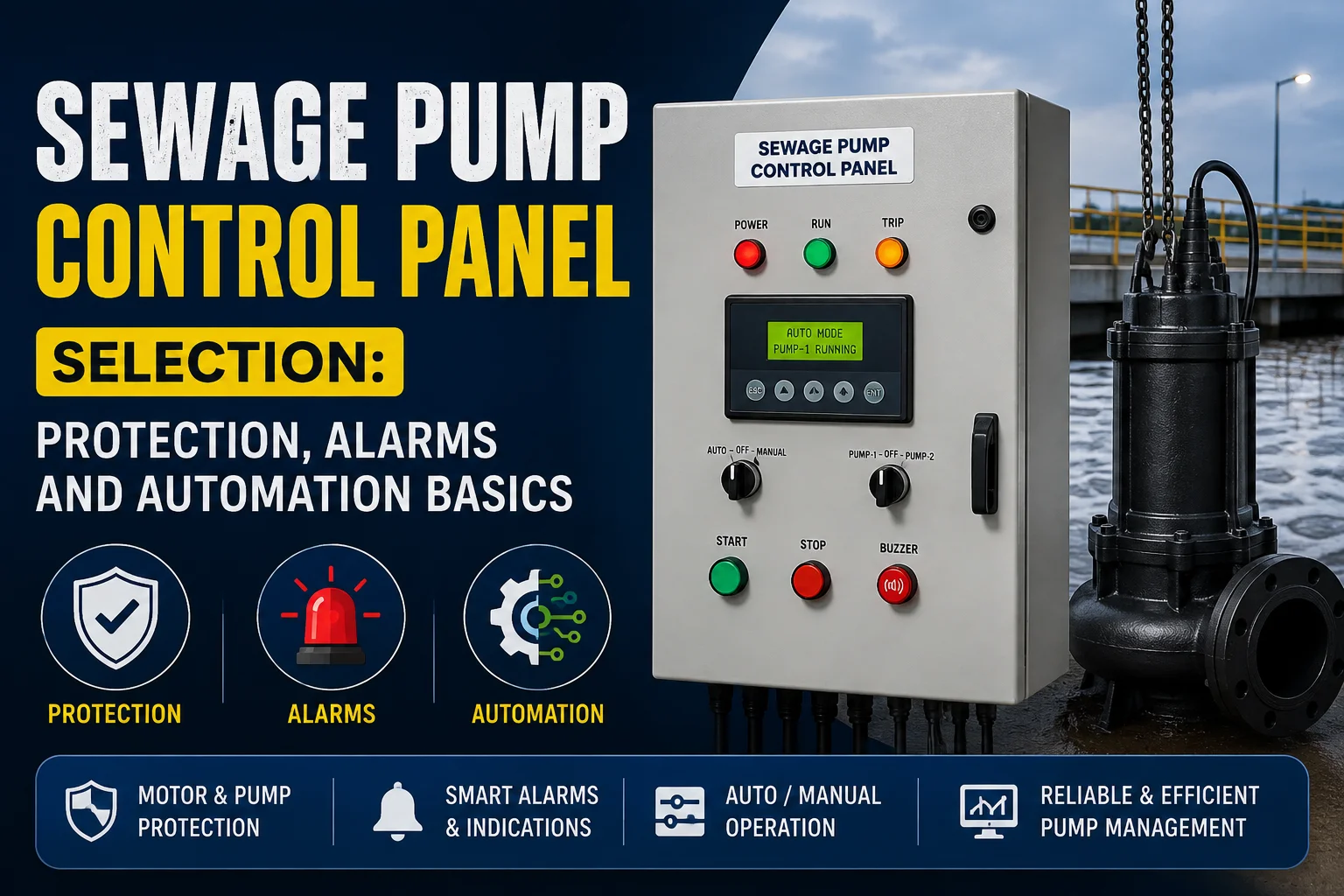
Choose a sewage pump control panel with the right protection, alarms and automation logic for STP and industrial wastewater duties. Avoid mismatch between
The right sewage pump control panel protects the motor, automates level-based operation, manages duty-standby sequencing and gives operators clear alarms before the station reaches a failure condition. Panel selection should follow the pump duty and station risk, not only the motor rating.
Why the panel matters as much as the pump
A properly selected pump can still perform badly if the control panel is weak, poorly configured or not aligned with the process.
- Level logic affects start-stop frequency and overflow risk.
- Protection settings affect nuisance trips and motor life.
- Duty-standby sequencing affects station resilience.
- Alarm visibility determines how quickly operators can intervene.
Start with the pump duty and motor data
Panel decisions should begin with the actual pumping duty and motor requirements.
- Power rating, phase and starting method.
- Expected frequency of starts.
- Continuous or intermittent operation.
- Need for automatic alternation.
- Whether a submersible sewage sludge pump or submersible cutter pump has additional monitoring needs such as moisture or thermal protection.
Protection functions that should be reviewed
- Overload protection matched to the motor.
- Phase failure and phase reversal protection.
- Dry-run or low-level interlock where relevant.
- Seal leak and overtemperature indication if the pump supports it.
- Short-circuit protection and proper isolation.
These functions are not optional extras on a serious wastewater station; they are part of risk control.
Level controls and automation logic
Level instrumentation decides when pumps start, stop and escalate alarms.
- Float-based logic may be acceptable for simple stations.
- Level transmitters may improve visibility and trend monitoring.
- Auto-start of standby should be linked to the right conditions.
- High-high level alarms should be impossible to miss.
Duty-standby sequencing basics
If the station has more than one pump, the panel should support sensible alternation and escalation.
- Alternate duty to balance wear.
- Bring standby online during duty failure or abnormal level rise.
- Provide manual override without confusing the operators.
- Keep the logic simple enough that the plant can maintain it confidently.
When VFDs make sense and when they do not
Variable-speed control can help where flow demand changes or throttling losses are large, but it is not mandatory for every sewage pump panel.
- Use VFDs where process demand truly varies.
- Confirm motor and pump suitability for the speed range.
- Review harmonics, cooling and maintenance competence.
- Avoid adding complexity where the duty is simple on-off transfer.
Alarm strategy and operator usability
A panel should help the operator act quickly, not hide problems in a crowded enclosure.
- High level and pump fail alarms should be obvious.
- Fault history helps troubleshooting recurring trips.
- Remote alerting may be justified for unattended stations.
- Labels and operating states should be clear for shift staff.
Panel selection checklist
- Pump and motor data confirmed.
- Protection functions matched to duty risk.
- Level-control philosophy defined.
- Duty-standby logic reviewed.
- Alarm priorities agreed.
- Site maintenance capability considered.
Frequently asked questions
What protections should a sewage pump control panel usually include?
At minimum, buyers usually review overload, short-circuit, phase protection and the correct pump-specific alarms such as thermal or moisture indication where supported.
Do all sewage pumps need a VFD panel?
No. A VFD helps where duty varies meaningfully, but many transfer duties work well with simpler control logic if the selection is correct.
Why do sewage pump panels trip even when the pump seems fine?
Trips can be caused by poor settings, low-level events, phase problems, high starts, moisture signals or real hydraulic issues such as clogging and overload.
Should level control use floats or transmitters?
Either can work. The better choice depends on station complexity, alarm needs, maintenance culture and how much visibility the operator needs.
Is panel design separate from pump selection?
It should not be. Panel logic and pump behavior need to be reviewed together so the station actually works under real operating conditions.
Can Flow Chem recommend a panel without motor and duty details?
No. Final panel selection should follow the motor data, duty cycle, level philosophy and site protection requirements.
Need help selecting the right pump?
Share your flow, head, liquid type, solids, site layout and duty cycle with Flow Chem Pumps. Our team can help you shortlist the right pump.