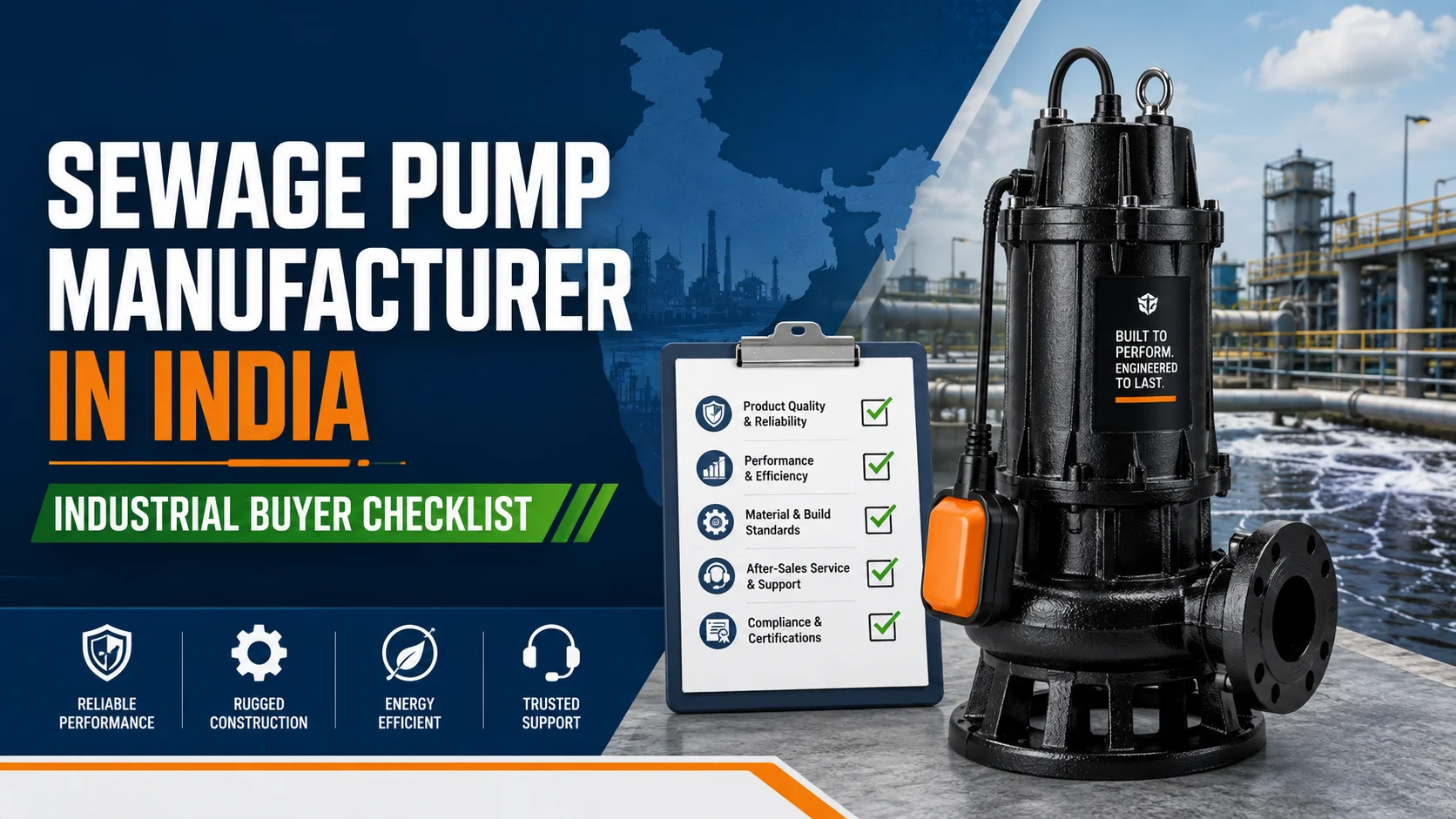
Compare sewage pump manufacturers in India using application fit, solids handling, testing, metallurgy, service support and lifecycle risk for STP and indu
Industrial buyers should shortlist a sewage pump manufacturer in India by checking application fit, solids-handling capability, test standards, material selection, seal and motor protection, spare support, lead time and service coverage. A supplier that helps size the duty correctly is usually safer than one that competes only on initial price.
Why manufacturer selection matters in sewage duties
Sewage pumping failures are rarely just a motor problem. In most plants, trouble begins with poor application fit, unstable solids handling, incorrect sizing or weak support after commissioning.
That is why choosing a sewage pump manufacturer should be treated as an engineering and lifecycle decision, not only a procurement exercise.
- Sewage duty can include fibrous solids, abrasive particles and variable inflow.
- Wet wells may create ragging, vortex formation or air entrainment.
- Municipal and industrial sites often need high uptime with limited maintenance windows.
- Wrong pump selection leads to blockages, overloads, seal failures and emergency replacement buying.
Step 1: define the actual sewage duty before comparing suppliers
A manufacturer comparison is meaningless if the plant has not defined the real duty. Start with the process conditions, not the catalogue.
- Required flow rate and static head.
- Total dynamic head including pipe friction and fittings.
- Type of sewage: domestic, municipal, mixed industrial or process wastewater.
- Solids size, fibre content and grease loading.
- Duty cycle, standby philosophy and expected run hours.
- Site constraints such as guide rails, sump depth and panel arrangement.
If needed, compare your application with submersible sewage sludge pump, submersible cutter pump and submersible waste water pump pages before you ask for quotations.
Step 2: review solids handling and anti-clog suitability
One sewage pump manufacturer may be strong in clear or lightly contaminated liquid but weak in solids-heavy wet-well duties. Ask how the pump geometry is matched to the liquid profile.
- Maximum free passage and non-clog design details.
- Impeller type and expected rag handling performance.
- Whether the duty needs a standard sewage impeller or a cutter arrangement.
- Real examples of similar STP or industrial installations.
For heavy ragging or fibrous loads, a submersible cutter pump may be more suitable than a conventional sewage pump. For mixed sludge-style service, compare against submersible sewage sludge pump.
Step 3: compare hydraulic selection discipline
Good manufacturers do more than share a catalogue curve. They ask for operating duty, recommend the right pump size and explain the preferred operating window.
- Duty point relative to the best efficiency range.
- Margin for changing inflow without chronic throttling.
- Motor load under maximum expected duty.
- Minimum submergence and sump conditions.
- Whether pump curves and power curves were reviewed with the buyer.
A supplier that simply quotes the cheapest higher-horsepower unit often creates long-term operating waste.
Step 4: check construction materials and seal arrangement
Sewage service can be corrosive and abrasive at the same time. Material and sealing decisions should match the application, not generic assumptions.
- Casing and impeller material for solids, corrosion and wear.
- Shaft material and surface protection.
- Seal configuration and oil chamber details.
- Cable entry sealing and moisture protection.
- Bearing quality and thermal protection logic.
When the process includes chemicals, oily waste or unusual contaminants, ask the manufacturer to state where standard cast iron is acceptable and where upgraded materials are safer.
Step 5: verify testing, documentation and quality control
Industrial buyers should ask what testing actually happens before dispatch.
- Hydraulic performance test or routine run test.
- Insulation and electrical checks.
- Leakage or seal checks where applicable.
- Serial-level traceability or dispatch documentation.
- GA drawing, curve sheet and operating data package.
Strong documentation reduces argument later during installation and performance review.
Step 6: evaluate service footprint and spare support
A competitive manufacturer still becomes a risky choice if the plant cannot get help quickly after startup.
- Nearby service response capability.
- Spare parts lead times for seals, impellers, cables and bearings.
- Troubleshooting support for panel, level control and overload issues.
- Onsite inspection support for commissioning or repeated failures.
- Willingness to review duty mismatch instead of only selling spare parts.
This is especially important when the buyer is outside a major metro or the system runs in a critical treatment loop.
Commercial comparison checklist for RFQs
Use the same checklist across all quotations so the comparison stays fair.
- Duty point and power clearly stated.
- Materials of construction declared.
- Solids handling statement included.
- Motor protection and cable details included.
- Test scope stated clearly.
- Delivery lead time confirmed.
- Recommended spares list attached.
- Warranty terms explained without ambiguity.
- Service contact and escalation process shared.
Common mistakes buyers should avoid
- Choosing only on price per horsepower.
- Assuming every sewage pump handles fibrous or rag-heavy loads equally well.
- Ignoring sump design and level-control issues.
- Accepting oversizing as a safety margin without checking energy impact.
- Buying without asking about seal arrangement, testing and spare support.
How Flow Chem should fit the conversation
This topic should support industrial buyers evaluating Indian pump suppliers for sewage, wastewater and solids-handling duties.
Use contextual internal links to submersible pump manufacturer in India, submersible sewage sludge pump and contact-us without making unsupported performance guarantees.
Frequently asked questions
What should I ask a sewage pump manufacturer before sending an order?
Ask for the exact duty point, pump curve, material details, solids handling capability, seal arrangement, test scope, lead time, spare support and service contact. Those answers reveal far more than a price sheet alone.
Is a sewage pump manufacturer the same as a sludge pump manufacturer?
Not always. Some suppliers are stronger in relatively free-flowing sewage duties, while others are better suited for thicker sludge or solids-heavy service. The application should decide the shortlist.
Should I compare manufacturers only by warranty length?
No. Warranty matters, but service response, spare access, sizing accuracy and application fit usually have a bigger effect on lifecycle risk than a longer but vague warranty statement.
When should I consider a cutter pump instead of a standard sewage pump?
Consider a cutter pump when the wet well contains fibrous solids, wipes, stringy waste or repeated clogging that a standard non-clog geometry may not handle reliably.
Can an Indian manufacturer support export or multi-site industrial projects?
Some can, but buyers should confirm documentation, dispatch support, spare strategy and after-sales escalation before assuming the service model will scale across multiple locations.
Can Flow Chem promise performance without reviewing the duty?
No. Final pump recommendation should depend on the actual flow, head, solids profile, installation layout and operating philosophy at the site.
Need help selecting the right pump?
Share your flow, head, liquid type, solids, site layout and duty cycle with Flow Chem Pumps. Our team can help you shortlist the right pump.