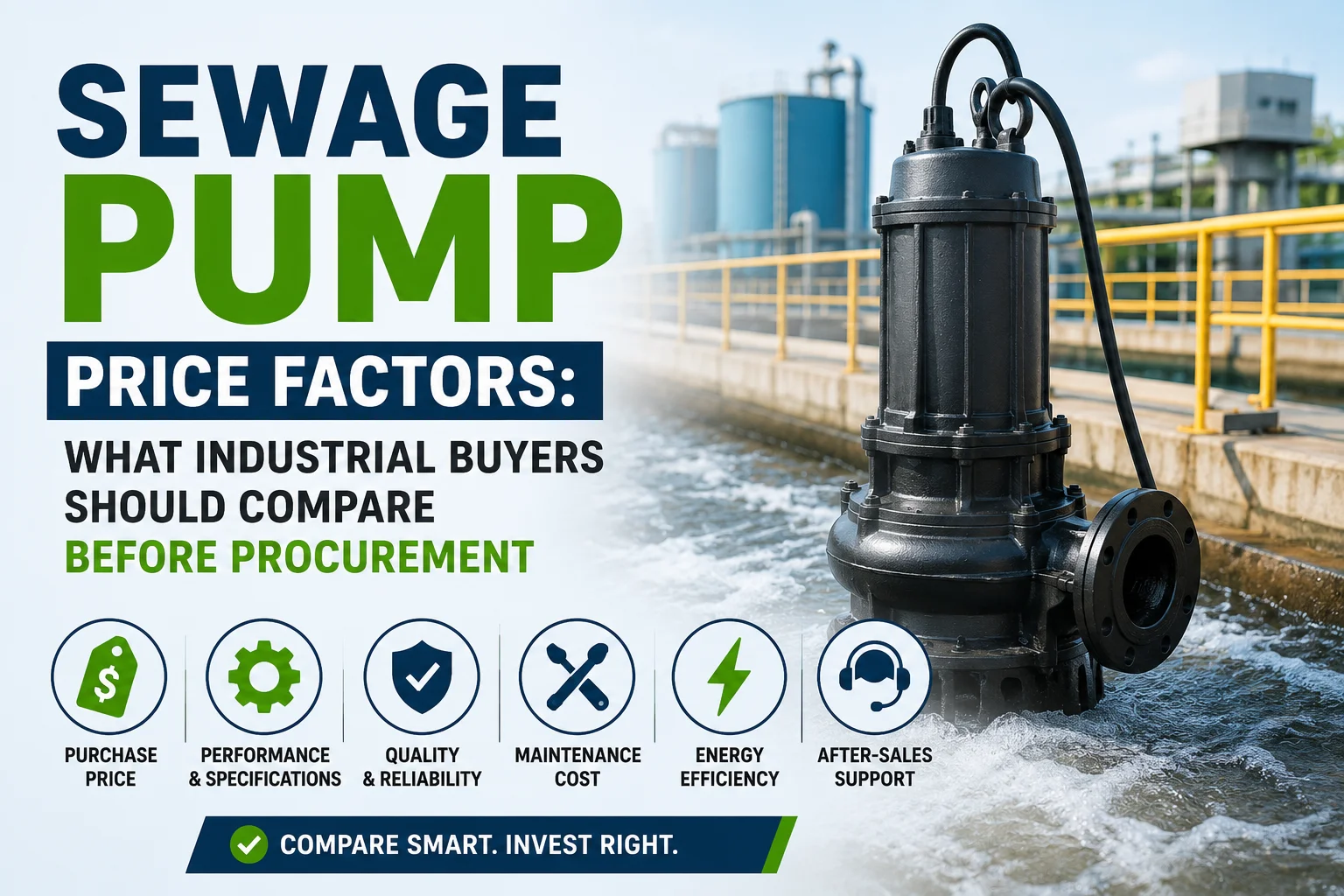
Learn what affects sewage pump price for STP, municipal and industrial wastewater duties. Compare flow, head, solids, materials, motor, installation and li
Sewage pump price is affected by the pump duty, not only by motor horsepower. The most important factors are required flow, total dynamic head, solids size, clogging risk, pump type, motor rating, material construction, seal protection, operating hours, installation conditions and service support.
For STP, municipal and industrial wastewater projects, buyers should first select the correct pump for the duty and then compare quotes. A low-cost pump that is not suitable for the wastewater can create repeated choking, poor discharge, downtime and higher maintenance cost.
For Flow Chem, the main commercial page for this topic is submersible sewage sludge pump. If fibrous solids, rags, wipes or plastics cause clogging, buyers should also review the submersible cutter pump route.
Why sewage pump price varies so much
Sewage pumps can look similar from the outside but differ significantly in construction, hydraulics, solids handling, motor protection and serviceability. Two pumps with the same horsepower may not deliver the same flow, handle the same solids or survive the same wastewater duty.
Price can vary because of:
- Flow and head requirement.
- Motor rating and phase.
- Pump type and impeller design.
- Solids-handling capability.
- Cutter mechanism requirement.
- Material and coating requirements.
- Seal and cable-entry protection.
- Control and protection needs.
- Installation and service conditions.
- Supplier support and documentation.
Industrial buyers should compare what the pump is selected to do, not just what it costs.
Factor 1: flow rate requirement
Flow rate decides how much sewage the pump must move within a specific time. Higher flow requirements can affect pump size, motor rating, impeller design and pipe selection.
Before comparing price, document:
- Required flow rate in m³/hr or LPM.
- Average and peak flow.
- Whether the pump must empty a sump within a fixed time.
- Number of working and standby pumps.
- Operating hours per day.
A pump that is cheap but undersized for peak flow can cause overflow, long run times and unstable operation.
Factor 2: total dynamic head
Total dynamic head is the resistance the pump must overcome. It includes static lift, pipe friction, bends, valves and discharge pressure.
Head affects price because the pump must be selected to deliver flow at the actual duty point. A higher head requirement may need a different pump model, motor rating or impeller selection.
Include:
- Static lift.
- Pipe length and diameter.
- Bends, valves and fittings.
- Friction loss.
- Discharge condition.
- Variation in wet-well or sump level.
Do not compare prices without confirming head. The cheaper pump may not deliver the required discharge.
Factor 3: solids size and clogging risk
Sewage pumps need to handle solids. If the wastewater contains rags, wipes, plastics, fibers or sludge, the pump design becomes more important.
Review:
- Expected solid size.
- Soft vs fibrous solids.
- Screening quality.
- Site history of choking.
- Whether cutter action is required.
- Whether grit or abrasive solids are present.
For general sewage/sludge, a submersible sewage sludge pump may be reviewed. For high-clogging sewage, a submersible cutter pump may cost more but reduce maintenance risk.
Factor 4: pump type and impeller design
Pump type affects both price and performance. A regular wastewater pump, sewage sludge pump and cutter pump may not be interchangeable.
Typical selection routes:
- Sewage sludge pump for sewage and sludge transfer.
- Cutter pump for fibrous or high-clogging sewage.
- Wastewater or effluent pump for treated/semi-treated liquid.
- Dewatering pump for site-water or drainage duties.
A lower-priced pump is not a saving if it is the wrong type. The buyer should compare pump type against the failure mode: clogging, low discharge, wear, corrosion or downtime.
Factor 5: motor rating, phase and protection
Motor rating affects price, but horsepower should not be the only selection input. A 2 HP sewage pump, for example, must still match flow, head, solids and duty cycle.
Review:
- HP or kW rating.
- Single-phase or three-phase requirement.
- Thermal protection.
- Overload protection.
- Start/stop frequency.
- Control-panel requirements.
- Cable length and cable-entry protection.
A motor that is not suitable for the duty may overheat or trip frequently.
Factor 6: material and corrosion risk
Sewage and industrial wastewater may contain corrosive or abrasive content. Material requirements can affect price.
Check:
- pH range.
- Chemical exposure.
- Chlorides or salts.
- Grit or abrasive solids.
- Temperature.
- Coating requirement.
- Seal material.
- Stainless steel or special construction needs.
For standard municipal/STP sewage, cast iron construction may be suitable in many duties. For aggressive industrial wastewater, material compatibility should be reviewed before finalizing the pump.
Factor 7: installation and maintenance access
Installation conditions affect both upfront cost and lifecycle cost. A pump that is difficult to remove, inspect or service may cost more over time.
Review:
- Sump depth.
- Wet-well dimensions.
- Guide rail or coupling requirement.
- Lifting access.
- Valve arrangement.
- Cable routing.
- Cleaning access.
- Site safety constraints.
For municipal and industrial sites, maintenance access should be planned before procurement.
Factor 8: documentation, warranty and service support
A sewage pump quote should not only show price. It should explain what the pump is selected for and what support is included.
Compare:
- Pump type and application basis.
- Flow/head assumptions.
- Motor and material details.
- Solids-handling assumptions.
- Scope of supply.
- Installation exclusions.
- Warranty/support terms where available.
- Service and spare support discussion.
A vague quote may look cheaper but create procurement and maintenance risk.
Lifecycle cost matters more than lowest quote
The lowest quote is not always the lowest cost. If the pump fails, chokes or underperforms, the site may face cleaning cost, downtime, emergency service, replacement parts and process disruption.
Industrial buyers should compare:
- Initial price.
- Suitability for duty.
- Expected maintenance effort.
- Clogging or wear risk.
- Serviceability.
- Spare support.
- Downtime risk.
A higher-quality pump selected correctly may be more economical over the life of the project.
Sewage pump price comparison checklist
Use this checklist before comparing quotes:
- Flow and head are defined.
- Solids size and clogging risk are documented.
- Pump type is matched to duty.
- Motor rating and phase are suitable.
- Material/corrosion requirements are reviewed.
- Installation and access requirements are known.
- Quote assumptions are visible.
- Service and spare support are discussed.
- No unsupported price, capacity or availability claims are used.
- Manufacturer has reviewed the application data.
For Flow Chem selection support, buyers can share duty details through the Flow Chem contact page.
Common mistakes to avoid
Avoid these sewage pump buying mistakes:
- Asking only for “2 HP sewage pump price” without flow/head data.
- Selecting the lowest quote without checking solids handling.
- Ignoring peak flow.
- Ignoring total dynamic head.
- Using a wastewater pump where a cutter pump is required.
- Ignoring material compatibility.
- Not planning maintenance access.
- Comparing quotes with different scope assumptions.
- Publishing exact prices without approval.
These mistakes can make a low-price purchase expensive later.
Frequently asked questions
What affects sewage pump price the most?
The biggest factors are required flow, total dynamic head, motor rating, solids-handling design, pump type, material construction, seal protection, installation conditions, duty cycle and service support.
Why do two sewage pumps with the same HP have different prices?
Two pumps with the same HP can have different flow, head, impeller design, solids passage, materials, seals, protection features and service support. HP alone does not define pump suitability.
Should I choose the lowest sewage pump quote?
Not without checking duty fit. A low quote can become expensive if the pump clogs, underperforms, overheats or needs frequent maintenance. Compare lifecycle cost and application suitability.
Is a cutter pump more expensive than a normal sewage pump?
A cutter pump may cost more because it includes cutting action for fibrous or ragging wastewater. It should be considered when clogging risk justifies the added functionality.
Can Flow Chem publish exact sewage pump prices?
Exact prices should only be published if approved by Flow Chem. For SEO content, it is safer to explain price factors and ask buyers to share duty data for an accurate quote.
What details should I send for a sewage pump quote?
Send flow rate, total dynamic head, sump depth, pipe length, liquid type, solids size, clogging history, material concerns, duty cycle, electrical supply and project location.
Need help selecting the right pump?
Share your flow, head, liquid type, solids, site layout and duty cycle with Flow Chem Pumps. Our team can help you shortlist the right pump.