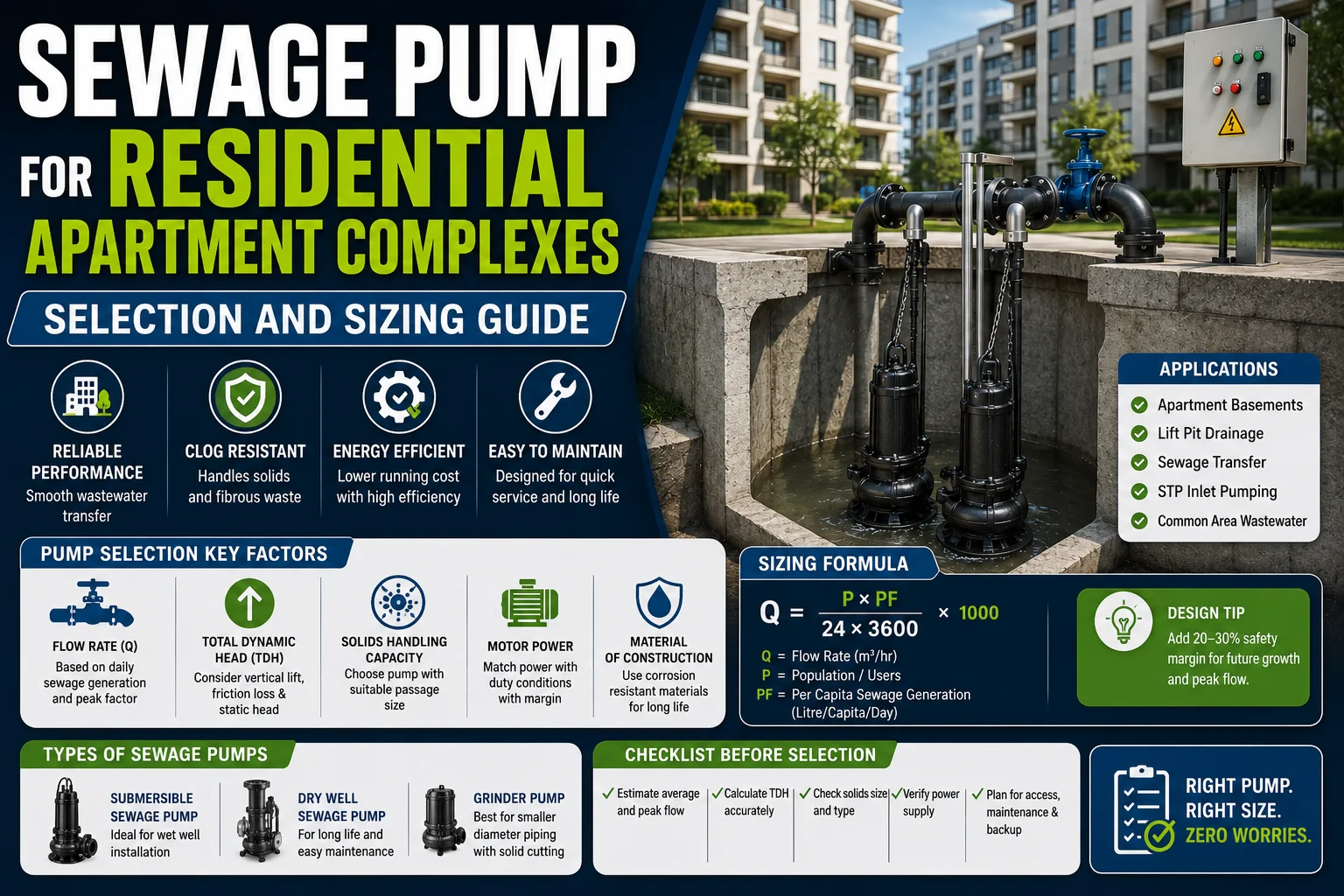
Choose the right sewage pump for apartment complexes with practical sizing tips on occupancy, peak flow, tank design, power, maintenance, and backups.
If you are sizing a sewage pump for an apartment complex, start with the number of residents, the number of sanitary fixtures, and the expected peak discharge during busy periods.
Then check the lift height, pipe friction, and discharge distance so the pump can overcome total dynamic head, not just vertical lift.
For most residential buildings, a duty standby arrangement is safer than a single pump because one pump can continue service when the other is under maintenance.
Choose a pump with a non-clog impeller or cutter arrangement if the system will receive wipes, hair, sanitary waste, or mixed wastewater from high-use common plumbing lines.
Prefer a sump and control panel that reduce short cycling, because frequent starts shorten motor life and increase service calls.
If the building has a dependable three-phase supply, three-phase pumps are usually more suitable for larger apartment blocks.
If the building is smaller, has limited electrical infrastructure, or needs simpler installation, a single-phase sewage pump may be enough for a low-rise setup.
The best selection is the one that matches occupancy, collection tank volume, and maintenance reality, not just the cheapest pump on paper.
For guidance on pump sizing logic in tougher wastewater applications, see the internal article on 2 hp sewage pump selection.
Why apartments need dedicated sewage pumps
Apartment buildings create a different sewage profile from independent homes.
A single household discharges intermittently, but a residential tower can send many simultaneous flushes into the collection chamber within a short time.
That peak demand matters because a pump that works fine during average hours may fail to keep up when several flats use bathrooms, kitchens, and utility lines together.
Basements and lower parking levels often sit below the municipal sewer line, which means gravity alone cannot move wastewater out of the building.
In those cases, the sewage pump becomes a critical piece of infrastructure rather than an optional accessory.
Common areas also add load.
Gym showers, clubhouses, basement wash areas, security toilets, and housekeeping discharge can all contribute to the same collection system.
A separate sewage ejector pump apartment setup helps isolate this wastewater from clean water systems and from stormwater drainage.
That separation improves hygiene and makes troubleshooting easier when a blockage or float failure occurs.
It also supports better odor control.
When wastewater is held in a properly vented chamber and discharged at controlled intervals, the building is less likely to suffer from sewer smell in parking spaces, shafts, or service rooms.
Dedicated pumping also helps with compliance and safety.
A controlled system with alarms, level switches, and access hatches is easier for facility teams to inspect than a makeshift arrangement.
For larger buildings, the system should be designed as part of the entire apartment building sewage pump system, not selected as a stand-alone machine.
That means reviewing inlet pipes, venting, chamber dimensions, control logic, backflow protection, and emergency overflow routing together.
If the building is still in design stage, this is the time to decide whether the pump room will need spare space for standby equipment, a control panel, and future capacity.
A small upfront design decision can prevent expensive civil rework later.
Sizing based on occupancy and peak flow
The starting point for sizing is occupancy.
Estimate how many people will use the building on a normal day, then consider peak occupancy during weekends, holidays, and tenant turnover periods.
For apartment complexes, the real peak often comes from combined morning and evening use.
At those times, multiple toilets, sinks, and shower outlets can discharge almost together.
Do not size only from motor kilowatts.
Motor size tells you very little without flow rate and head.
You need the target discharge in litres per minute or cubic metres per hour, plus the total dynamic head.
A practical sizing workflow looks like this:
1. Count apartments, shared facilities, and below-grade fixtures. 2. Estimate likely occupant load for each block or wing. 3. Apply a realistic simultaneity factor instead of assuming every fixture runs at once. 4. Add vertical lift from chamber to discharge point. 5. Add pipe friction losses, bends, valves, and fittings. 6. Select a pump curve that delivers the required flow at that head. 7. Check the duty cycle so the pump will not start too frequently.
A common mistake is to undersize because the building is “mostly residential.”
Residential does not mean low peak flow.
A large housing complex can create as much operational stress as a modest commercial building, especially where toilets, wash areas, and basement services feed the same chamber.
The sump volume matters just as much as the pump curve.
If the chamber is too small, even a correctly sized pump will start too often.
That increases wear on contactors, floats, bearings, and seals.
If the chamber is too large, wastewater may sit too long and create odor or sediment buildup.
The target is a balance between enough storage for safe cycling and enough turnover to keep the system fresh.
When consultants compare options, they should look at both duty point and collection volume together.
That is especially important for a residential complex sewage pump where the pump has to serve predictable daily demand and occasional surges.
For systems with mixed wastewater, it is useful to compare this selection process with the broader sizing logic in the sewage pump sizing guide for STP and industrial applications.
A simple capacity check
Use a practical check before finalizing the model.
Ask whether the pump can empty the chamber fast enough after peak discharge, but not so fast that it creates excessive starts.
Then confirm the selected flow at actual head, not catalogue head.
If the discharge line is long or includes multiple bends, friction losses can materially reduce performance.
That is why field drawings matter.
A good pump selection can still fail if the final routing differs from the design assumption.
When to consider redundancy
For mid-rise and high-rise buildings, a single pump is rarely the safest choice.
A duty and standby pair provides resilience during cleaning, servicing, or unexpected failure.
If the building cannot afford downtime, redundancy should be treated as essential, not optional.
Choosing between single-phase and three-phase
Electrical supply affects both cost and reliability.
Single-phase pumps are common in small residential buildings where the load is modest and the pump room is simple.
They are easier to install in locations with limited electrical infrastructure.
However, single-phase systems may not be ideal when the pump must start frequently or when discharge heads are higher.
Three-phase sewage pumps are usually preferred for larger apartment blocks.
They often offer smoother operation, better motor performance, and stronger suitability for continuous-duty environments.
They also integrate well with larger control panels and duty standby logic.
The choice should match both building scale and maintenance capability.
If a property team already manages lift motors, DG systems, and central water pumps, a three-phase sewage installation often fits the same operational model.
If the building is low-rise and the chamber is close to the discharge point, a single-phase model may be acceptable.
Still, the decision should never be based on electricity alone.
Match the power supply to flow, head, cycle frequency, and support availability.
Also review starting current.
If a building has sensitive backup power or shared electrical capacity, the starting characteristics may matter as much as the running load.
A soft-start arrangement, proper overload protection, and correctly rated cables help reduce nuisance trips.
For apartment projects, the best practical rule is simple.
Use single-phase only when the installation is genuinely small and stable.
Use three-phase when the load is larger, the lift is higher, or reliability matters more than initial simplicity.
Sump chamber and collection tank design
The chamber is not just a pit.
It is the operating environment for the pump.
Its depth, width, access, venting, and inlet arrangement all affect performance.
A well-designed chamber lets solids settle and keeps the pump intake clear enough to operate without blockage.
It should also provide enough free volume to prevent the pump from switching on and off too often.
The chamber floor should slope appropriately so settled debris does not collect in dead corners.
Where possible, provide easy access for cleaning and inspection.
A hidden chamber that is hard to open invites neglect.
Level controls should be mounted and tested so they are not exposed to unnecessary turbulence.
If floats or probes are placed too close to the inlet, false starts can occur.
If they are too low, the pump may run dry or leave too much stagnant wastewater behind.
Ventilation is critical for odor management.
Wastewater chambers can produce unpleasant gases, so the tank should be properly ventilated according to project requirements and local design practice.
Access covers should be robust, secure, and easy for maintenance teams to remove.
The pump discharge should include a non-return valve and isolation valve where the system design requires them.
Those components prevent reverse flow and allow service without draining the entire line.
Where the apartment complex serves multiple blocks, consider whether one shared chamber or multiple zone chambers will be easier to operate.
A single central chamber can reduce equipment duplication, but zone-based systems may improve service continuity and reduce long pipe runs.
For mixed-use complexes, separating residential and non-residential sewage streams is often wise.
The residential pumping arrangement can then be tuned for apartment use, while the other block can be sized for its own peak pattern.
Chamber design questions to ask
- Will maintenance staff be able to enter or inspect safely?
- Is there space for a standby pump and guide rails if needed?
- Can the chamber handle peak inflow without overflow?
- Will sediment accumulation be easy to remove?
- Are floats, sensors, and cabling protected from damage?
A note on solids handling
Apartment sewage often contains wipes, sanitary waste, hair, and other stringy debris.
That means the impeller choice matters.
A non-clog or cutter design can improve reliability when the system faces difficult waste.
If the building uses shared guest facilities or high-traffic amenities, solids handling should be given extra attention.
For more on pump families and rugged wastewater duty, review the submersible sewage sludge pump page.
Installation and maintenance for apartment buildings
Installation quality is just as important as pump selection.
Even a good pump can fail early if cables, rails, valves, or controls are installed badly.
The suction and discharge arrangement should follow the manufacturer’s recommended orientation.
The electrical installation should include proper earthing, overload protection, and clearly labelled isolation.
The control panel should be placed where staff can reach it without entering hazardous areas.
It should also provide clear alarms for high level, pump trip, and standby failure if those features are included.
Maintenance access is a design decision, not an afterthought.
Provide enough working room around the chamber and panel so technicians can remove the pump and service it without dismantling nearby plumbing.
Apartment managers should create a simple inspection routine.
That routine should cover float movement, discharge valve condition, visible leaks, alarms, and odor issues.
A monthly visual check is far better than waiting for overflow.
For larger housing societies, a service log helps track failures and recurring blockages.
Patterns in the log often reveal whether the problem is pump sizing, user behavior, or poor chamber cleaning.
If the building experiences repeated tripping, the cause may be electrical, mechanical, or hydraulic.
Do not assume the pump is faulty until the entire system has been reviewed.
Routine cleaning is essential.
Sludge and debris can reduce chamber capacity, interfere with floats, and increase odor.
Regular desilting keeps the system closer to its designed operating condition.
Maintenance schedule basics
- Check alarms and float operation routinely.
- Clean the chamber on a planned cycle.
- Inspect valves, couplings, and cable entries.
- Record any overflow or tripping incident immediately.
- Keep a spare part plan for seals, floats, and consumables.
A good sewage pump for apartment use should not create daily drama for the building team.
If the system is designed properly, most of the work is monitoring and planned cleaning, not emergency repair.
Common mistakes in apartment sewage pump selection
One of the biggest mistakes is choosing a pump by horsepower alone.
Horsepower is not the same as suitability.
Flow at head is what matters.
Another mistake is ignoring future occupancy.
A building that is only partly occupied today may be full in a year.
The pump should be sized for the realistic operating future, not only the first month after handover.
A third mistake is underestimating solids.
Residential sewage may look lighter than industrial wastewater, but apartments can still produce problematic waste.
If the pump cannot pass soft solids reliably, blockage risk rises quickly.
A fourth mistake is placing maintenance access too low or too close to parked vehicles, walls, or landscaping.
If technicians cannot reach the equipment safely, the system will be serviced late.
A fifth mistake is overlooking standby capacity.
When one pump fails and no backup exists, the whole building can face a sanitation emergency.
A sixth mistake is failing to coordinate civil, electrical, and plumbing drawings.
A pump that is selected correctly can still perform poorly if the chamber, piping, or control panel is built differently from the design.
The safest approach is to treat the sewage pump as part of a complete system.
That mindset leads to better results than selecting a model in isolation.
Sources
- https://theflowchempumps.com/2hp-sewage-pump-selection-guide-stp-industrial-wastewater
- https://theflowchempumps.com/sewage-pump-sizing-guide-for-stp-and-industrial
- https://theflowchempumps.com/submersible-sewage-sludge-pump/
Frequently asked questions
What is the best sewage pump for apartment complexes?
The best model is the one that matches the building’s peak flow, total dynamic head, solids load, and maintenance plan. For small buildings, a compact single-phase unit may be enough. For larger apartment blocks, a three-phase duty standby setup is usually more reliable.
How do I size a sewage pump for an apartment building?
Start with occupancy and fixture count, then estimate peak flow and add vertical lift plus pipe losses. After that, select a pump curve that meets the duty point and check that the sump volume prevents short cycling. If the chamber empties too quickly or too slowly, adjust the system design instead of guessing.
Is a sewage ejector pump apartment system the same as a wastewater pump?
Not exactly. A sewage ejector pump is typically used to move sewage or wastewater from a lower level to a higher discharge point. A wastewater pump may cover a broader range of clean or dirty water duties, so the exact selection depends on solids content and head.
Should a residential complex sewage pump always have a standby unit?
For small buildings, a standby unit may be optional. For mid-rise and high-rise apartments, standby capacity is strongly recommended because it improves continuity during service or failure. If the building cannot safely tolerate downtime, standby should be treated as part of the core design.
How often should apartment sewage pumps be inspected?
A simple visual check should be done regularly, and the chamber should be cleaned on a planned schedule. The exact interval depends on occupancy, sludge buildup, and how heavily the common areas are used. If the system starts tripping or smelling bad, inspection should happen immediately.
Can one pump serve multiple apartment blocks?
Yes, but only if the chamber, piping, and control logic are designed for the combined peak load. A shared system can save equipment cost, but it also creates a larger single point of failure. Many projects benefit from zone-wise pumping instead.
Need help selecting the right pump?
Share your flow, head, liquid type, solids, site layout and duty cycle with Flow Chem Pumps. Our team can help you shortlist the right pump.