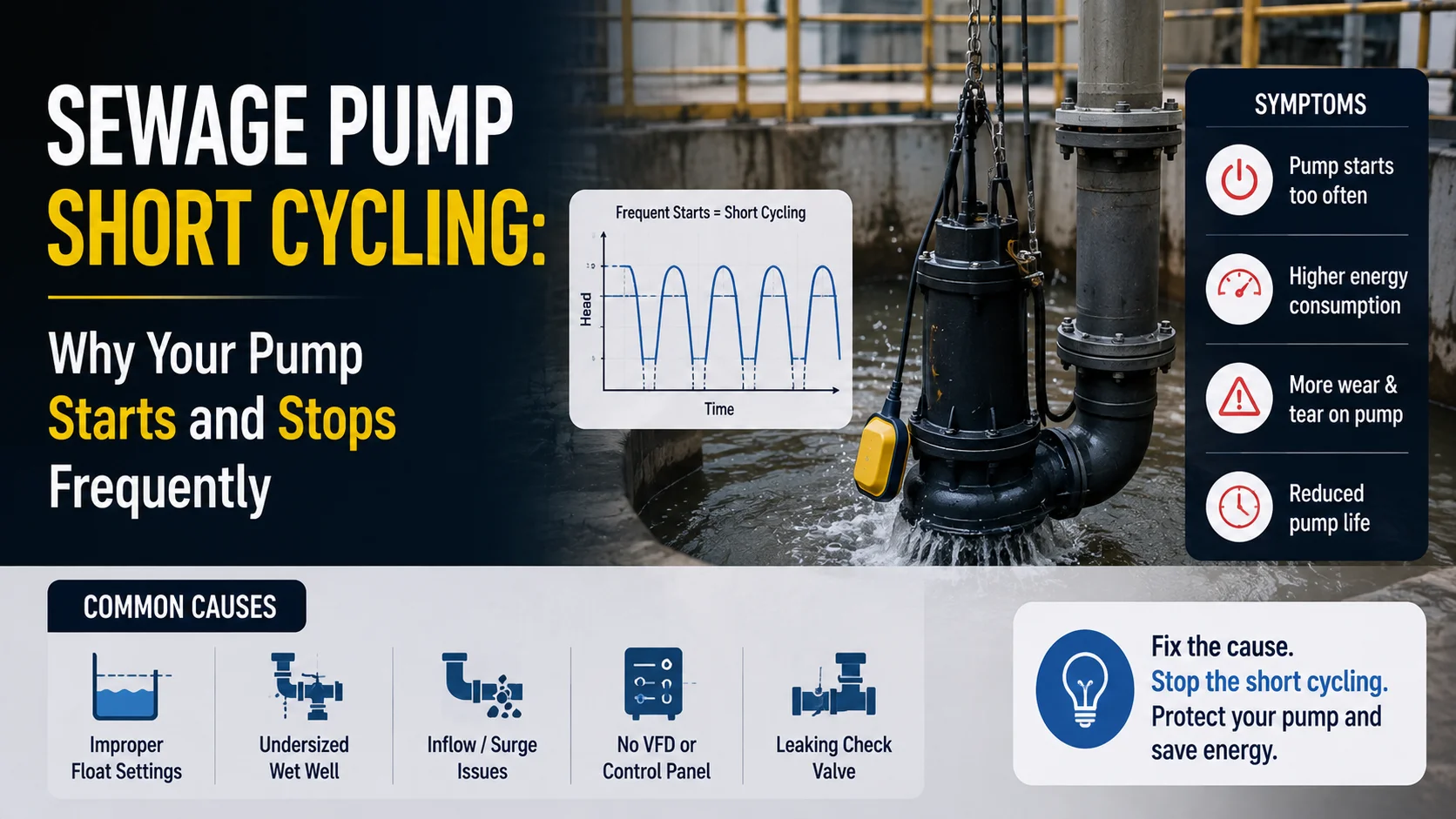
If a sewage pump starts and stops repeatedly within short intervals, the system may be experiencing short cycling.
Homeowners usually describe the same problem as a sewage pump that keeps turning on and off every few minutes — in a basement sump pit, septic tank or domestic pumping basin the causes and the fixes are identical.
Common causes include:
- Start and stop levels set too close together
- Undersized wet well
- Oversized sewage pump
- Faulty or incorrectly positioned float switches
- Leaking check valve
- Wastewater flowing back into the sump
- Excessive incoming flow
- Incorrect control-panel logic
- Multiple pumps interacting incorrectly
- Blocked or restricted discharge piping
Short cycling should not be ignored.
Frequent starts can increase wear on:
- Motors
- Contactors
- Starters
- Bearings
- Mechanical seals
- Electrical components
The correct solution is to identify why the wet-well level is reaching the start point again so quickly rather than simply replacing the pump.
What Is Sewage Pump Short Cycling?
Short cycling occurs when a sewage or wastewater pump switches on and off more frequently than intended.
A normal pumping cycle looks something like this:
- Wastewater enters the wet well.
- The liquid level rises.
- The pump reaches its start level.
- The pump starts.
- Wastewater is pumped out.
- The liquid reaches the stop level.
- The pump stops.
- The wet well gradually fills again.
There should normally be enough useful volume between the start level and stop level to give the pump a reasonable operating period.
If the pump turns on, runs briefly, stops and then starts again soon afterward, the pumping system needs investigation.
Why Frequent Pump Starts Matter
A sewage pump motor may be designed for repeated operation, but every motor has practical limits on the number of starts it should experience.
Starting creates additional electrical and mechanical stress.
Excessive cycling can lead to:
- Contactor wear
- Starter failure
- Motor heating
- Cable stress
- Bearing wear
- Seal wear
- Increased maintenance
- Reduced equipment life
A system that starts 20 times because of incorrect level settings may perform the same pumping work that could have been completed with far fewer, longer operating cycles.
Good pumping-station design therefore considers not only flow and head but also cycle time and starts per hour.
1. Start and Stop Levels Are Too Close Together
One of the first things to inspect is the distance between the pump ON and pump OFF levels.
Suppose the wet well has:
Pump ON level: 1.4 m
Pump OFF level: 1.3 m
There is only a small amount of wastewater between those two levels.
The pump may remove this volume very quickly.
The result can be:
Pump starts → runs briefly → stops → wet well refills → starts again
Increasing the usable drawdown volume can create longer and more stable pump cycles.
However, the stop level cannot simply be moved downward without checking minimum pump submergence and wet-well conditions.
Float Switch Positioning Matters
In many sewage pumping systems, level control is handled using float switches.
For spacing, wiring and troubleshooting details, see the sewage pump float switch level control guide.
Typical functions may include:
- Pump OFF
- Pump ON
- Lag pump ON
- High-level alarm
If the ON and OFF floats are installed too close together, short cycling can occur.
Float movement can also be affected by:
- Rags
- Cables
- Grease
- Sludge
- Turbulent inlet flow
- Wet-well walls
- Guide rails
The float must have enough clear space to operate reliably.
2. The Wet Well Is Too Small
Wet-well volume has a major influence on pump cycling.
A small wet well stores only a limited amount of wastewater between the pump start and stop levels.
If a large pump is installed in that small volume, it can empty the useful storage area very quickly.
The pump stops.
Incoming wastewater then refills the same volume.
The pump starts again.
This cycle may continue throughout the day.
Why Wet-Well Volume Matters
The usable storage volume is approximately the liquid volume between:
Pump start level
and
Pump stop level
Larger usable volume generally allows more wastewater to accumulate before another pump cycle is required.
However, making the wet well excessively large can create other problems such as:
- Long wastewater retention time
- Odour
- Solids settlement
- Septic conditions
- Sludge accumulation
Wet-well design therefore requires balance.
3. The Sewage Pump Is Oversized
Buying a bigger pump is not always safer.
An oversized sewage pump may remove wastewater much faster than the wet well receives it.
For example:
Wastewater inflow: 15 m³/hr
Pump discharge: 80 m³/hr
If the useful wet-well volume is small, the pump may empty it very quickly.
The pump then stops.
Wastewater continues entering.
A short time later the pump starts again.
This creates repeated short operating cycles.
Why Oversizing Happens
Pump oversizing can result from:
- Selecting only by motor HP
- Adding excessive safety margin
- Using maximum flow instead of required duty flow
- Incorrect TDH calculation
- Selecting from outlet diameter
- Ignoring the wet-well volume
- Assuming bigger pumps always improve reliability
The correct sewage pump should be selected using the required flow and total dynamic head.
The pump curve should then be reviewed to confirm the actual operating point.
Signs the Pump May Be Oversized
Possible signs include:
- Wet well empties extremely quickly
- Pump runtime is very short
- High number of starts per hour
- Strong turbulence when the pump starts
- Large difference between incoming and pumped flow
- Pump operates far from expected duty point
- High discharge velocity
Pump sizing should be checked before changing level controls to compensate for an oversized pump.
4. The Check Valve Is Leaking
This is one of the most easily overlooked causes of repeated sewage pump cycling.
When the pump stops, the check valve should prevent wastewater in the discharge pipeline from flowing backward.
If the valve leaks:
- Pump empties the wet well.
- Pump stops.
- Wastewater inside the discharge pipeline flows backward.
- Wet-well level rises.
- Start float activates again.
- Pump restarts.
The pump may effectively be pumping part of the same wastewater repeatedly.
Signs of Check Valve Backflow
Look for:
- Wet-well level rising immediately after pump shutdown
- Gurgling or backflow noise
- Pump restarting even when incoming flow is low
- Reverse movement in the discharge branch
- Abnormal valve noise
- Increased starts after valve deterioration
Possible causes include:
- Debris trapped in the valve
- Damaged seat
- Worn internal parts
- Ragging
- Corrosion
- Incorrect installation
- Valve unable to close completely
Inspect the valve before adjusting the control system.
5. Float Switch Is Faulty
A damaged or sticking float switch can make the pump behave unpredictably.
Possible symptoms include:
- Pump starts too early
- Pump stops too early
- Pump starts repeatedly
- Pump does not stop
- Pump does not start
- High-level alarm activates unexpectedly
The problem may not always be electrical.
Mechanical movement of the float can also be restricted.
Check for Physical Obstruction
Inspect whether the float is touching:
- Pump cable
- Guide rails
- Discharge pipe
- Wet-well wall
- Lifting chain
- Another float
Also look for:
- Rags
- Plastic
- Grease
- Sludge
- Fibrous material
A float that cannot move freely may send the wrong signal to the control panel.
6. Level Sensor Settings Are Incorrect
Not every pumping station uses mechanical float switches.
Larger systems may use:
- Ultrasonic level sensors
- Pressure transmitters
- Hydrostatic level sensors
- Electronic controllers
- PLC-based level control
Incorrect level settings can create the same short-cycling problem.
For example, if:
Start level = 1.50 m
and
Stop level = 1.45 m
the control band may be too narrow.
The system needs enough difference between start and stop levels to create an appropriate usable storage volume.
7. Incoming Wastewater Flow Is Higher Than Expected
Not every frequently running pump is short cycling.
Sometimes the pump is responding correctly to genuinely high inflow.
This can happen during:
- Peak production hours
- Morning or evening sewage peaks
- Heavy rainfall
- Stormwater infiltration
- Cleaning operations
- Batch industrial discharge
- Tank draining
- Process-water release
If the wet well fills quickly because wastewater inflow is genuinely high, the solution may involve increasing pumping capacity or reviewing the station design.
Compare Inflow with Pump Capacity
Determine:
- Average inflow
- Peak inflow
- Pump flow
- Wet-well storage
- Runtime
- Starts per hour
If inflow approaches the actual pump discharge capacity, the pump may remain on for long periods rather than short cycle.
If the pump removes liquid very quickly and then restarts shortly afterward, level settings or storage volume become more likely causes.
8. Pump Discharge Flow Is Lower Than Expected
Short cycling is usually associated with a pump that removes the wet-well volume too quickly.
But abnormal cycling can also result from unstable discharge performance.
Reduced flow may be caused by:
- Partially clogged impeller
- Blocked discharge pipe
- Partially closed isolation valve
- Faulty check valve
- Excessive pipe friction
- Incorrect pump rotation
- Worn impeller
- Unexpected system head
The pump may run longer than expected, while the level control repeatedly reaches different switching points.
Check the Actual Operating Point
Do not assume the pump is delivering its catalogue maximum flow.
The real pump output depends on:
- Static head
- Pipe length
- Pipe diameter
- Fittings
- Valves
- Wastewater characteristics
- Pump condition
Use the pump curve and actual total dynamic head to estimate the real operating flow.
9. Duty/Standby Control Logic Is Incorrect
Many STPs use two sewage pumps.
A basic system may contain:
- Pump A
- Pump B
- Duty/standby alternation
- High-level assist
- Alarm level
The controller may alternate the duty pump after each cycle so operating hours remain balanced.
Incorrect control logic can cause excessive cycling.
Example of Incorrect Duplex Operation
Suppose:
- Pump A starts.
- Level falls slightly.
- Pump A stops.
- Controller changes duty to Pump B.
- Level rises slightly.
- Pump B starts.
- Pump B stops quickly.
The pumps may continuously alternate without achieving useful run periods.
This is usually a control-band or wet-well-volume problem, not an indication that two pumps are required continuously.
10. Lag Pump Setting Is Too Close to Duty Pump Setting
In a duplex station, a second pump may start when the wet-well level continues rising after the first pump has started.
This second pump is sometimes called:
- Lag pump
- Assist pump
- Second duty pump
If the second start level is positioned too close to the first start level, both pumps may start unnecessarily during normal inflow.
The combined flow can then empty the wet well very quickly.
Both pumps stop.
The well refills.
Another short cycle begins.
Provide Logical Level Separation
A typical control sequence may include:
- Pump OFF
- Duty pump ON
- Lag pump ON
- High-level alarm
The exact elevations depend on:
- Wet-well dimensions
- Pump capacity
- Inflow
- Minimum submergence
- Required response time
- Manufacturer recommendations
The control ladder should be engineered rather than placing floats at arbitrary intervals.
11. Water Is Entering the Wet Well from an Unexpected Source
Sometimes the controls and pump are functioning correctly, but additional water is entering the system.
Possible sources include:
- Groundwater infiltration
- Rainwater
- Broken drainage line
- Leaking tank
- Process-water discharge
- Backflow
- Failed valve
- Illegal stormwater connection
If pump cycling suddenly increases without any equipment change, investigate whether the actual inflow has changed.
How to Diagnose Short Cycling Step by Step
A structured diagnosis helps avoid unnecessary pump replacement.
Step 1: Count Pump Starts
Record:
- Starts per hour
- Runtime per cycle
- Time between cycles
Do this during both:
- Normal inflow
- Peak inflow
This establishes whether the problem is genuinely excessive cycling.
Step 2: Observe Wet-Well Levels
Record:
- Start level
- Stop level
- High-level setting
- Lag-pump setting
Check how quickly the level rises and falls.
Very fast drawdown suggests high pump capacity relative to usable storage.
Step 3: Check Float or Sensor Operation
Confirm:
- Free movement
- Correct position
- Correct wiring
- No debris
- No cable interference
- Correct control-panel response
Step 4: Observe the Wet Well After Pump Shutdown
Watch whether the liquid level immediately rises.
If it does, inspect for:
- Check valve leakage
- Discharge backflow
- Incoming high flow
Step 5: Check Actual Pump Runtime
A pump that runs for only a few seconds before stopping deserves attention.
Compare actual runtime with the intended design and pump manufacturer's guidance.
Step 6: Check Pump Capacity
Confirm the pump's actual operating duty:
Flow @ Total Dynamic Head
Do not use maximum catalogue flow.
Step 7: Check the Discharge System
Inspect:
- Check valve
- Isolation valve
- Pipe blockage
- Discharge pressure
- Pipe vibration
- Flow rate
Step 8: Review Control-Panel Logic
For multi-pump systems, confirm:
- Duty alternation
- Lag start
- Lag stop
- High-level alarm
- Delay timers
- Restart settings
- Fault changeover
Short Cycling vs Continuous Running
These two problems should not be confused.
Short Cycling
Pump:
Starts → runs briefly → stops → starts again
Possible causes:
- Small wet well
- Narrow float spacing
- Oversized pump
- Backflow
- Control problem
Continuous Running
Pump:
Starts → keeps running
Possible causes:
- High inflow
- Pump undersized
- Blocked impeller
- High system head
- Discharge restriction
- Incorrect level sensor
- Worn pump
The troubleshooting process is different for each condition.
How Pump Sizing Affects Cycle Time
Pump selection should consider both:
Hydraulic performance
and
Wet-well operation
Suppose an STP needs approximately 30 m³/hr pumping capacity.
Installing a pump capable of 120 m³/hr at the actual head may appear to provide a large safety margin.
But the larger pump may:
- Empty the wet well rapidly
- Increase starts per hour
- Require larger electrical equipment
- Increase pipe velocity
- Create water hammer
- Operate away from its preferred region
The better approach is to select the pump around the real duty point.
Explore Flow Chem's Submersible Sewage and Sludge Pump range when evaluating pumps for STP, wastewater and sludge applications.
Why Simply Increasing the Start Level Is Not Always the Solution
Increasing the distance between ON and OFF levels can reduce cycling.
But level settings should not be changed without checking the complete wet well.
Changing levels can affect:
- Storage capacity
- Overflow margin
- Pump submergence
- Inlet turbulence
- Alarm response
- Lag-pump operation
- Sewage retention time
The control levels should therefore be reviewed together.
Short-Cycling Troubleshooting Table
| Symptom | Possible Cause | What to Check |
|---|---|---|
| Very short pump runtime | Oversized pump | Pump curve and actual duty |
| Pump restarts immediately | Check valve leaking | Backflow after shutdown |
| Frequent start/stop | Floats too close | ON/OFF level separation |
| Unstable operation | Float obstruction | Rags, cables and grease |
| Both pumps start unnecessarily | Lag setting too low | Duplex control levels |
| Frequent cycling after rainfall | Increased inflow | Infiltration and stormwater |
| Pump starts randomly | Sensor/control fault | Wiring and control panel |
| Wet well empties extremely fast | Excess pump capacity | Pump flow vs usable volume |
Common Mistakes When Fixing Short Cycling
1. Replacing the Pump Immediately
The pump may be functioning perfectly.
Check wet-well levels, controls and valves first.
2. Installing an Even Bigger Pump
This can make the cycling problem worse.
3. Moving Floats Without Calculating Storage Volume
Float positions affect both runtime and system safety.
4. Ignoring the Check Valve
Backflow can make a correctly designed system cycle repeatedly.
5. Changing Electrical Timers Only
Timers can sometimes improve control behaviour, but they should not hide an underlying hydraulic problem.
6. Ignoring Peak Inflow
Control settings that work during low inflow may behave differently during production peaks or heavy rainfall.
7. Assuming Every Start Is a Problem
Pump cycling must be evaluated against:
- Manufacturer recommendations
- Motor design
- Pump size
- Site duty
- Wet-well storage
- Actual runtime
There is no single starts-per-hour number suitable for every sewage pump.
Sewage Pump Short-Cycling Inspection Checklist
When a sewage pump starts and stops too frequently, check:
- Pump starts per hour
- Runtime per cycle
- Start level
- Stop level
- High-level alarm
- Lag-pump start level
- Wet-well dimensions
- Usable wet-well volume
- Incoming wastewater flow
- Peak inflow
- Pump design flow
- Actual operating flow
- Total dynamic head
- Float-switch movement
- Sensor calibration
- Check valve operation
- Isolation valve position
- Discharge pipe condition
- Pump impeller
- Control-panel logic
- Duty/standby alternation
- Delay timers
- Motor current
- Recent changes to the system
Recording these values makes diagnosis much easier than troubleshooting from symptoms alone.
How to Reduce Sewage Pump Short Cycling
Depending on the root cause, corrective actions may include:
- Repositioning ON and OFF floats
- Increasing usable wet-well drawdown
- Correcting level-sensor settings
- Repairing or replacing the check valve
- Cleaning obstructed floats
- Correcting control-panel logic
- Reconfiguring lag-pump start level
- Selecting a better-matched pump
- Reviewing discharge piping
- Reducing unnecessary backflow
- Correcting abnormal inflow sources
The correct solution depends on why the pump is cycling.
Frequently Asked Questions
Why does my sewage pump turn on every few minutes?
Possible causes include high incoming flow, a small wet well, narrow float spacing, an oversized pump or wastewater flowing backward through a leaking check valve.
Is frequent sewage pump cycling bad?
Excessive starts can increase stress on the motor, electrical starter, contactor, bearings and other pump components. The acceptable number of starts depends on the pump and motor design.
Can a float switch cause short cycling?
Yes. Floats positioned too close together, incorrectly installed or obstructed by debris can cause frequent start-stop operation.
Can an oversized sewage pump cause short cycling?
Yes. A pump with much more capacity than required can empty the usable wet-well volume very quickly, resulting in repeated short cycles.
Can a leaking check valve make the pump restart?
Yes. Wastewater from the discharge pipeline can flow back into the wet well after shutdown and raise the level enough to restart the pump.
Should I increase the distance between ON and OFF floats?
It may help, but the change should be checked against wet-well volume, minimum submergence, alarm levels, overflow margin and pump requirements.
Why do both sewage pumps keep starting?
In a duty/standby system, the lag-pump level may be too close to the duty-pump start level, or incoming flow may exceed the capacity of one pump.
Does a bigger sewage pump reduce pump running time?
Yes, but excessively reducing runtime can create frequent starts. Pump capacity should be matched to the system rather than maximised unnecessarily.
How do I know if the check valve is leaking?
Observe the wet-well level immediately after the pump stops. A rapid rise without corresponding incoming flow can indicate discharge backflow. The valve should then be inspected.
Can short cycling increase electricity consumption?
Frequent motor starts and operation away from the intended system design can contribute to inefficient operation. More importantly, repeated starts can increase equipment wear and maintenance requirements.
Can short cycling burn out a sewage pump motor?
Repeated starts are the hardest duty a sewage pump motor sees — inrush current at every start heats the windings and wears contactors, bearings and mechanical seals. Short cycling will not burn out a motor overnight, but left unresolved it can shorten pump life from years to months. Fix the cause — float spacing, a leaking check valve, wet-well volume — rather than fitting a bigger motor, and follow a wastewater pump maintenance schedule to catch the wear early.
How do I stop my sewage pump from short cycling?
Work through the causes in order: widen the ON/OFF float separation, repair or replace a leaking check valve, verify the wet well holds enough usable volume, and confirm the pump is not oversized for the actual inflow. The 8-step diagnosis above identifies which cause applies to your system.
Need Help Selecting the Correct Sewage Pump for Your STP?
A sewage pump should not be selected only by HP or maximum flow.
The pump should be matched with:
- Required flow
- Total dynamic head
- Wet-well dimensions
- Usable storage
- Wastewater solids
- Discharge piping
- Duty cycle
- Number of pumps
- Level-control strategy
If your existing sewage pump starts and stops too frequently, share the operating details with Flow Chem Pumps so the pump, wet well, valves and controls can be reviewed as one system.
For sewage, sludge and industrial wastewater applications, explore the Flow Chem Submersible Sewage and Sludge Pump range.