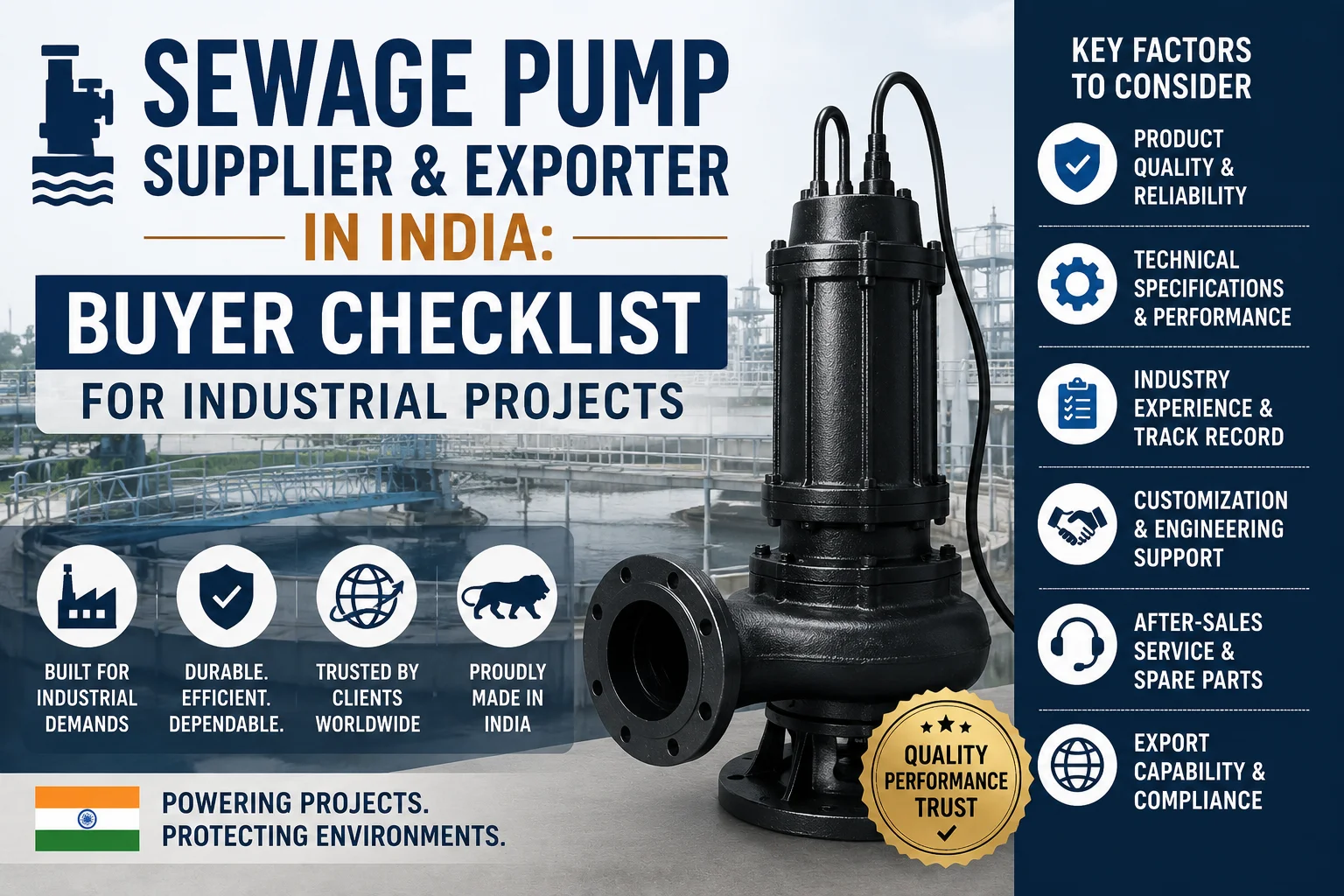
Compare sewage pump suppliers and exporters in India with this industrial buyer checklist. Review application fit, flow, head, solids, documents, support a
Industrial buyers should evaluate a sewage pump supplier or exporter in India by checking whether the supplier understands sewage and sludge duty, asks for flow and head data, reviews solids and clogging risk, explains pump selection clearly, provides proper documentation and avoids unsupported price, stock, capacity or export claims.
For Flow Chem, the main sewage product route to review is submersible sewage sludge pump. For broader manufacturer/supplier evaluation, the supporting authority page is submersible pump manufacturer in India. If fibrous solids are the main issue, buyers should also review submersible cutter pump.
Why supplier evaluation matters for sewage pumps
Sewage pumps operate in harsh, variable conditions. A supplier who only quotes by horsepower or discharge size may miss the actual site risk.
Poor supplier selection can lead to:
- Wrong pump type.
- Low flow at site.
- Repeated clogging.
- Motor overload.
- Poor documentation.
- Spare-parts confusion.
- Export documentation gaps.
- Unclear warranty or service terms.
- Procurement delays.
- Higher lifecycle cost.
A good supplier helps the buyer reduce technical and commercial risk before procurement.
Step 1: confirm application fit
The first question is whether the supplier understands the application.
Share:
- STP or ETP duty.
- Municipal sewage or industrial wastewater.
- Sewage transfer, lift station, wet well or sludge transfer.
- Raw sewage, screened sewage or treated wastewater.
- Solids and clogging history.
- Operating hours and duty cycle.
A supplier should not recommend the same pump for every wastewater duty. Sewage, sludge, cutter, effluent and dewatering applications need different review.
Step 2: check flow and head selection process
A reliable supplier should ask for flow rate and total dynamic head before recommending a sewage pump.
The buyer should prepare:
- Required flow rate.
- Static lift.
- Pipe length.
- Pipe diameter.
- Bends and valves.
- Discharge point.
- Peak-flow condition.
- Duty/standby requirement.
If the supplier quotes without this data, the recommendation may not match the site.
Step 3: review solids and clogging risk
Sewage pumps must handle solids. Clogging risk should be discussed clearly.
Ask the supplier:
- What solids profile is assumed?
- Is the pump suitable for sludge?
- Are rags, wipes, plastics or fibrous solids present?
- Is cutter action required?
- Is screening available upstream?
- What installation conditions reduce clogging?
For repeated fibrous clogging, compare the duty with submersible cutter pump selection.
Step 4: verify documentation quality
Documentation matters for both domestic and export procurement.
Review whether the supplier can provide relevant documents such as:
- Technical data sheet.
- Quotation with selection basis.
- Scope of supply.
- Motor and material details.
- Installation notes where available.
- Operation and maintenance guidance.
- Packing or dispatch details where applicable.
- Export documents only where approved and applicable.
Do not publish or claim specific certifications or export documents unless Flow Chem has approved them.
Step 5: evaluate manufacturer and supplier credibility
For industrial buyers, supplier credibility is not just about price. It includes application knowledge, manufacturing/supply capability, responsiveness and clarity.
Check:
- Whether the supplier asks technical questions.
- Whether product recommendations are application-specific.
- Whether claims are backed by documentation.
- Whether internal teams can answer engineering queries.
- Whether quote assumptions are visible.
- Whether product pages and company information are consistent.
Flow Chem’s broader manufacturer positioning should connect to submersible pump manufacturer in India where supplier/manufacturer evaluation is the main intent.
Step 6: check export-readiness carefully
Export-related claims must be handled carefully. A supplier may serve export buyers, but exact export markets, certifications, shipping timelines and documents should only be claimed if approved.
International buyers should ask about:
- Pump application and duty data.
- Product documentation.
- Packing details.
- Export paperwork requirement.
- Country-specific requirements.
- Payment and commercial terms.
- Warranty/support terms.
- Spare-parts planning.
SEO content should not invent export markets, ready stock, delivery timelines, certifications or global service coverage.
Step 7: compare lifecycle value, not only price
The lowest quote is not always the best option for sewage pumps. A cheaper pump may cost more if it clogs, trips, wears or fails to meet flow.
Compare:
- Application fit.
- Flow/head selection accuracy.
- Solids-handling suitability.
- Documentation quality.
- Material suitability.
- Service/spares clarity.
- Installation support information.
- Lifecycle risk.
Industrial sewage pumping is a reliability decision, not only a purchase-price decision.
Step 8: prepare a complete supplier enquiry
Before contacting a sewage pump supplier/exporter, prepare a technical enquiry.
Include:
- Application and industry.
- Country/location if export enquiry.
- Liquid type.
- Sewage/sludge/effluent condition.
- Flow rate.
- Total dynamic head.
- Pipe length and diameter.
- Solids size and clogging history.
- Operating hours.
- Duty/standby need.
- Power supply.
- Installation constraints.
- Documentation requirements.
For Flow Chem review, buyers can submit these details through the Flow Chem contact page.
Sewage pump supplier/exporter checklist
Use this checklist before shortlisting a supplier:
- Application fit is discussed.
- Flow and head data are requested.
- Solids and clogging risk are reviewed.
- Pump type is matched to duty.
- Documentation is clear.
- Quote assumptions are visible.
- Export claims are verified before use.
- Price is compared with lifecycle risk.
- Service/spares expectations are clarified.
- No unsupported capacity, stock, delivery or certification claims are used.
Common mistakes to avoid
Avoid these supplier-selection mistakes:
- Choosing only by lowest price.
- Asking only for horsepower.
- Ignoring total dynamic head.
- Ignoring solids and clogging risk.
- Assuming every supplier can handle export requirements.
- Publishing unapproved export-market claims.
- Publishing unapproved certification or warranty claims.
- Comparing quotes with different scope assumptions.
- Not sharing application data.
These mistakes create procurement and field-performance risk.
Frequently asked questions
How do I choose a sewage pump supplier in India?
Choose a supplier who asks for application data, flow rate, total dynamic head, solids profile, clogging history, duty cycle and installation conditions before recommending a pump. Compare documentation and lifecycle suitability, not only price.
What should I ask a sewage pump exporter in India?
Ask about application fit, technical documents, pump selection basis, packing details, export paperwork requirements, commercial terms, warranty/support terms and spare-parts planning. Verify all export claims before relying on them.
Is sewage pump price enough to compare suppliers?
No. Price should be compared with pump suitability, solids handling, flow/head match, materials, documentation, service clarity and lifecycle risk.
What details should I send for a sewage pump quote?
Send application, liquid type, flow rate, total dynamic head, pipe length, solids size, clogging history, operating hours, power supply, duty/standby requirement and documentation needs.
Should I choose a cutter pump supplier for sewage?
Choose or review a cutter pump supplier when the sewage contains rags, wipes, plastics or fibrous solids that cause repeated choking. If the duty is general sewage/sludge, a sewage sludge pump may be reviewed first.
Can Flow Chem publish export markets or certifications?
Export markets, certifications, stock, delivery timelines and global service claims should only be published if Flow Chem has approved them and supporting documentation is available.
Need help selecting the right pump?
Share your flow, head, liquid type, solids, site layout and duty cycle with Flow Chem Pumps. Our team can help you shortlist the right pump.