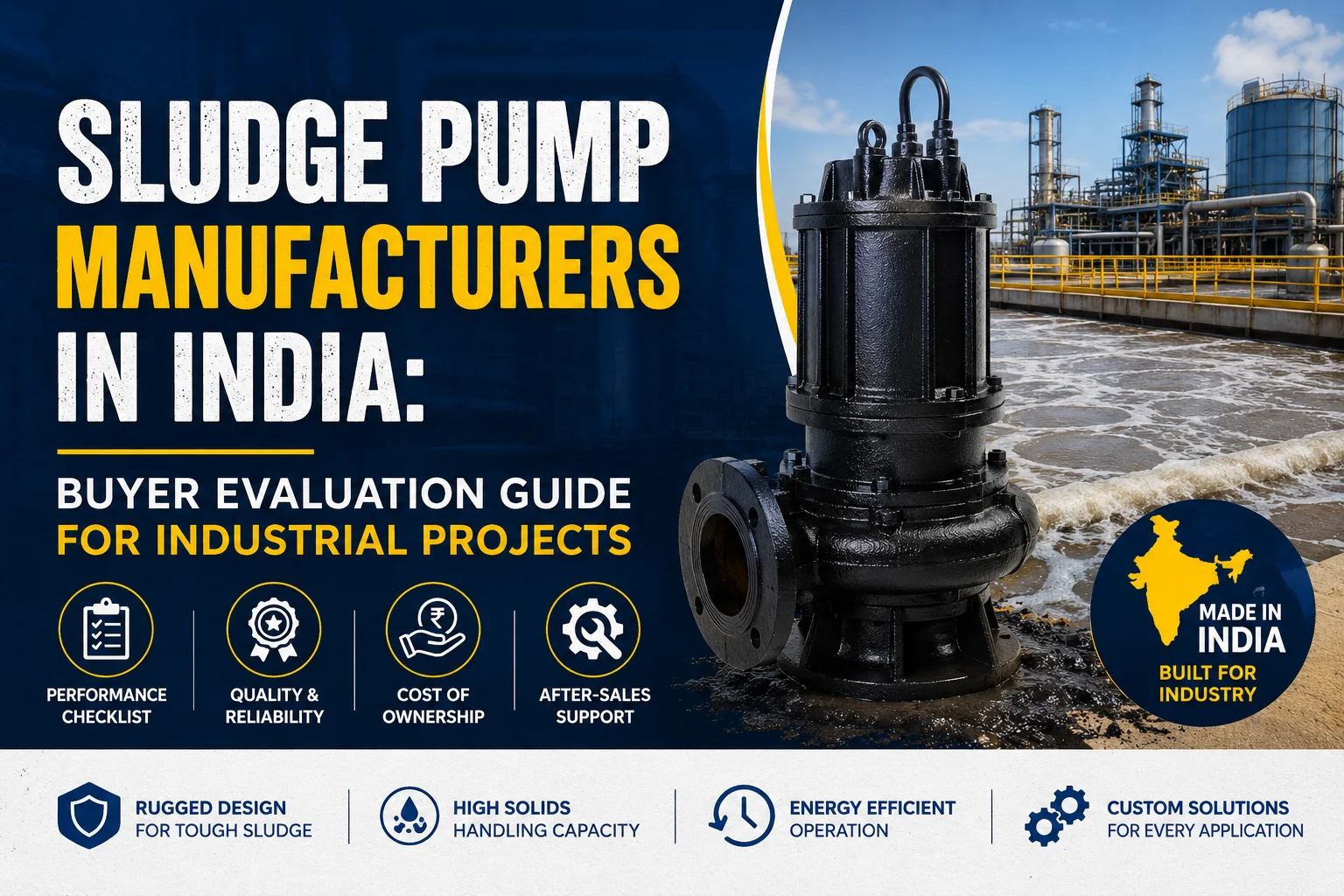
Evaluate sludge pump manufacturers in India with this industrial buyer guide. Compare sludge handling, flow, head, materials, service and lifecycle value b
Industrial buyers should evaluate sludge pump manufacturers by checking whether the manufacturer understands sludge duty, asks for flow rate and total dynamic head data, reviews sludge type and solids content, explains material selection for abrasive or corrosive conditions, provides proper technical documentation and avoids unsupported capacity, stock or price claims.
For Flow Chem, the primary sludge product route to review is submersible sewage sludge pump. For broader manufacturer evaluation, the supporting authority page is submersible pump manufacturer in India. For slurry applications with high abrasive content, also review submersible agitator slurry pump.
Why manufacturer evaluation matters for sludge pumps
Sludge pumps handle some of the most demanding conditions in wastewater treatment, industrial effluent plants, mining and process industries. Unlike clean-water pumps, sludge pumps must deal with thick, abrasive, variable-density liquids that can contain fibres, grit, chemicals and large solids.
Poor manufacturer selection can lead to:
- Frequent clogging and blockages
- Rapid impeller and wear-plate wear
- Motor overload and burnout
- Low actual flow at site conditions
- Shaft seal failure
- Premature pump replacement
- Spare-parts unavailability
- Unclear warranty terms
- Higher lifecycle cost
- Downtime in critical STP or ETP operations
A manufacturer who understands sludge duty can help the buyer reduce these risks through proper selection, material choice and configuration guidance.
Step 1: confirm the manufacturer understands sludge duty
The first question is whether the manufacturer differentiates sludge pumping from clean-water pumping. Sludge is not just dirty water — its viscosity, solids content, abrasiveness and flow behaviour are fundamentally different.
The manufacturer should ask about:
- Sludge type: primary, secondary, return, digested or industrial process sludge
- Solids content percentage
- Sludge density or specific gravity
- Abrasive content: sand, grit, fly ash or mineral particles
- Fibrous content: rags, plastics or organic fibres
- Chemical content: pH range, corrosive elements
- Temperature of the liquid
- Whether the sludge is settled, floating or mixed
A manufacturer who does not ask these questions may not understand the application.
Step 2: check flow and head selection methodology
A reliable sludge pump manufacturer should request duty data before recommending a pump. Sludge pump selection requires understanding that viscosity and solids affect pump performance significantly.
The manufacturer should request:
- Required flow rate at operating sludge density
- Static head or lift requirement
- Total dynamic head including pipe friction
- Pipe length, diameter and material
- Number of bends, valves and fittings
- Suction and discharge conditions
- Duty cycle and operating hours
- Number of pumps: duty, standby or alternating
If a manufacturer quotes a pump model without this data, the recommendation may be unreliable for sludge service.
Step 3: review material options for sludge conditions
Sludge can be highly abrasive and sometimes corrosive. The manufacturer should offer material options based on the actual sludge characteristics.
Review:
- Cast iron for general municipal sludge
- Stainless steel for corrosive or hygienic applications
- Hard-faced or wear-resistant impellers for abrasive sludge
- Coated volute casings for chemical resistance
- Mechanical seal type and material
- Shaft material and protection
- Bearing type and rating
The manufacturer should explain why a specific material is recommended for the stated sludge conditions rather than offering a one-size-fits-all solution.
Step 4: evaluate pump type and configuration knowledge
Different sludge applications need different pump configurations. A knowledgeable manufacturer should be able to discuss when each type is appropriate.
Ask about:
- Submersible sludge pump for wet-well and sump installations
- Cantilever or vertical pump for deep sumps
- Progressive cavity pump for thick, high-solids sludge
- Peristaltic pump for dosing and metering sludge
- Diaphragm pump for abrasive sludge with solids
- Cutter or chopper pump for fibrous sludge
For most STP and ETP applications, the submersible sewage sludge pump is the standard review route.
Step 5: check testing and quality processes
Manufacturers should have processes to verify pump performance before dispatch. Ask about:
- Hydraulic performance testing
- Motor testing and insulation checks
- Pressure testing of volute and seals
- Vibration and noise measurement
- Material certification availability
- Inspection documentation
- Factory acceptance test provisions
A manufacturer who cannot describe testing processes may not have consistent quality control.
Step 6: review documentation quality
Technical documentation is essential for industrial procurement, installation and maintenance. Review whether the manufacturer provides:
- Technical data sheet with performance curve
- Selection basis and duty point calculation
- Bill of materials with specifications
- Motor data sheet
- Installation drawing and dimensions
- Operating and maintenance manual
- Recommended spares list
- Warranty terms and conditions
Poor documentation creates problems during installation, commissioning and future maintenance.
Step 7: assess service and spares support
Sludge pumps are critical equipment in STP, ETP and industrial process plants. Downtime can shut down operations. Evaluate:
- Spares availability timeline
- Authorised service partner network
- Response time for field service
- Technical support accessibility
- Re-order identification system for spares
- Whether wear parts are standardised or custom
- Maintenance contract options
A manufacturer with poor spares support can extend downtime by weeks during a failure.
Step 8: compare lifecycle value, not only price
Sludge pump lifecycle cost includes energy consumption, spares replacement frequency, maintenance labour, downtime cost and eventual replacement. A cheaper pump can cost significantly more over its service life.
Compare:
- Energy efficiency at the operating duty point
- Expected wear-part replacement interval
- Spares cost as a percentage of pump cost
- Maintenance complexity
- Documented mean time between failures if available
- Warranty coverage and exclusions
- Installation support quality
- Application fit and sizing accuracy
Industrial sludge pumping is a reliability investment, not a commodity purchase.
Sludge pump manufacturer evaluation checklist
Use this checklist before shortlisting a manufacturer:
- Application knowledge is demonstrated through technical questions
- Flow and head data are requested before recommendation
- Sludge type, solids content and density are discussed
- Material options are explained based on sludge conditions
- Pump type is matched to installation and duty
- Testing processes are described
- Documentation is complete and professional
- Spares and service support is clear
- No unsupported capacity, stock or price claims
- Lifecycle value is discussed, not only purchase price
For Flow Chem application review, share your sludge duty details through the Flow Chem contact page.
Common mistakes to avoid
Avoid these manufacturer-selection mistakes:
- Choosing only by lowest quoted price
- Not sharing sludge type and solids content data
- Assuming all manufacturers understand sludge duty
- Ignoring material selection for abrasive or corrosive sludge
- Skipping wear-part cost and replacement interval discussion
- Not verifying spares availability before purchase
- Accepting quotes without duty-point selection basis
- Not comparing documentation quality
- Ignoring service and response-time support
- Assuming horsepower alone determines pump suitability
These mistakes create reliability, cost and operational risks for STP, ETP and industrial sludge management projects.
Frequently asked questions
How do I choose a sludge pump manufacturer in India?
Choose a manufacturer who asks for sludge type, solids content, flow rate, total dynamic head and installation conditions before recommending a pump. Compare material options, documentation, testing processes, spares support and lifecycle value.
What materials should a sludge pump have?
Material selection depends on the sludge. Cast iron suits general municipal sludge. Stainless steel or coated components are used for corrosive sludge. Hard-faced impellers are recommended for abrasive sludge containing grit or mineral particles.
Is sludge pump price enough to compare manufacturers?
No. Price should be compared with application fit, material suitability, wear-part replacement intervals, energy efficiency, documentation, spares support and expected service life.
What details should I send for a sludge pump enquiry?
Send sludge type, solids percentage, density, flow rate, total dynamic head, pipe size and length, installation type, operating hours, power supply and any chemical or temperature data.
What is the difference between a sludge pump and a dewatering pump?
A dewatering pump is designed for relatively clean water with low solids. A sludge pump is built for high-solids, viscous and abrasive liquids found in STP, ETP and industrial process applications.
Can a sludge pump handle fibrous solids?
It depends on the pump design. For sludge with rags, plastics or fibrous materials, a cutter or chopper pump variant may be needed. Review submersible cutter pump options for fibrous-duty applications.
Need help selecting the right pump?
Share your flow, head, liquid type, solids, site layout and duty cycle with Flow Chem Pumps. Our team can help you shortlist the right pump.