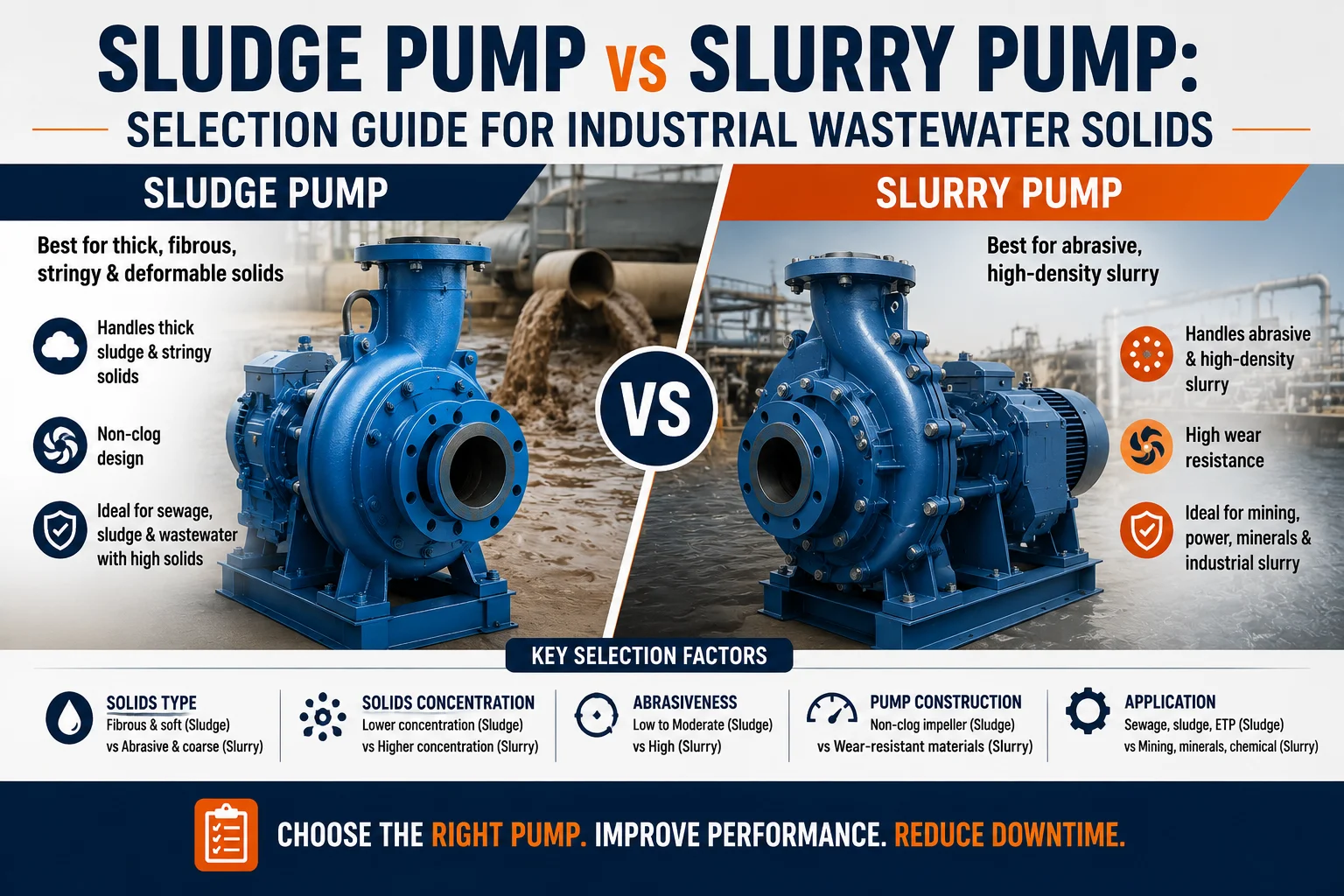
Compare sludge pumps and slurry pumps for industrial wastewater solids. Learn how solids type, abrasiveness, flow, head and material risk affect pump selec
A sludge pump is usually considered when the liquid contains wastewater sludge, sewage solids, settled organic solids or semi-solid material from STP, ETP or industrial wastewater processes. A slurry pump is usually considered when the liquid contains heavier or more abrasive solid particles such as grit, sand, mineral particles or industrial process solids suspended in liquid.
The difference is not just terminology. The right pump depends on the solids profile. Sludge may be soft, viscous, fibrous or semi-solid. Slurry may be more abrasive and may require different wear resistance, hydraulics and material review.
For Flow Chem, the current primary support page for sludge-related intent is submersible sewage sludge pump. If the buyer has high-clogging wastewater with fibrous solids, the submersible cutter pump route may also be relevant. For broader industrial wastewater duties, compare with the submersible waste water pump and effluent pumps where applicable.
Why this comparison matters in industrial wastewater projects
Sludge and slurry are often used loosely in procurement discussions. That can create pump selection errors. A buyer may ask for a sludge pump when the duty actually contains abrasive slurry, or ask for a slurry pump when the site mainly needs sewage sludge transfer.
Wrong selection can cause:
- Low discharge.
- Frequent clogging.
- Excessive wear.
- Seal problems.
- Motor overload.
- Poor solids movement.
- Higher maintenance cost.
- Shorter pump life.
- Procurement delays from unclear specifications.
The goal is to define the liquid-solid mixture before choosing the pump category.
Step 1: identify the solids type
Start by identifying what the pump will move. The solids profile is the main difference between sludge and slurry selection.
Sludge-type duties may include:
- Sewage sludge from STP processes.
- Settled organic solids.
- Thick wastewater residue.
- Semi-solid industrial wastewater.
- Soft suspended solids.
- Sludge from pits, tanks or sumps.
Slurry-type duties may include:
- Water mixed with grit or sand.
- Mineral or process solids.
- Abrasive particles.
- Dense solid-liquid mixtures.
- Industrial process residue.
- Applications where wear is a major risk.
If solids are fibrous, ragging or stringy, the buyer should also check whether a cutter pump is required.
Step 2: check abrasiveness and wear risk
Abrasiveness is one of the biggest differences between sludge and slurry pumping. Sludge can be difficult because it may be viscous or clogging. Slurry can be difficult because solids may be hard and abrasive.
Review:
- Are particles soft or hard?
- Is grit or sand present?
- Are the solids organic, mineral, chemical or mixed?
- Is the solid concentration low, medium or high?
- Will the pump run continuously with solids in the liquid?
- Does the site have a history of impeller or casing wear?
A sewage/sludge pump may be suitable for soft sludge but may wear quickly if the mixture contains abrasive solids. A slurry-duty pump may be required where abrasion is the main issue. Avoid assuming the same pump can handle every solids mixture.
Step 3: evaluate viscosity and settling behavior
Sludge can be thick, sticky or semi-solid. It may settle in tanks, sumps or pipelines if flow is low or if the system is not designed correctly. Slurry can also settle, especially if the solids are heavy.
Ask:
- Does the mixture settle quickly when flow stops?
- Is the sludge thick or watery?
- Are solids suspended evenly?
- Does the pump need to restart after solids have settled?
- Is agitation or mixing required before pumping?
- Is the pipeline designed to keep solids moving?
If solids settle heavily, the pump and piping system should be reviewed together. Pump selection alone may not solve a poorly designed solids-transfer system.
Step 4: calculate flow and total dynamic head
Flow and head still matter. Solids handling does not replace hydraulic selection.
Document:
- Required flow rate.
- Static lift.
- Pipe length and diameter.
- Number of bends, valves and fittings.
- Friction loss at expected flow.
- Discharge condition.
- Variation in tank or sump level.
- Operating hours and duty cycle.
A pump selected only by horsepower may fail to deliver the expected flow. For sludge and slurry duties, the pump curve and solids behavior should be reviewed together.
Step 5: select pump type based on failure mode
A practical way to choose between sludge and slurry options is to ask what failure mode the site is trying to avoid.
If the main risk is clogging from sewage solids, sludge or soft wastewater solids, review a submersible sewage sludge pump. If the main risk is fibrous waste, rags or stringy material, review a submersible cutter pump. If the main risk is abrasive wear from grit, sand or mineral solids, a slurry-duty solution may be more relevant and should be reviewed with the manufacturer.
Do not choose the pump only from the words “sludge” or “slurry”. Match the pump to the actual failure mode: clogging, wear, corrosion, low flow, settling or maintenance difficulty.
Step 6: review materials and corrosion risk
Industrial wastewater solids may come with chemical exposure. A pump may be hydraulically suitable but still fail if material compatibility is ignored.
Check:
- pH range.
- Chlorides or salts.
- Chemical content.
- Temperature.
- Abrasive particles.
- Coating requirements.
- Seal material suitability.
- Whether stainless steel or special construction needs review.
For wastewater material selection, buyers can also review Flow Chem’s industrial wastewater material guidance once this cluster is published. Material suitability should be confirmed from actual liquid data.
Step 7: check installation and maintenance access
Sludge and slurry pumps often work in difficult spaces: pits, sumps, tanks, wet wells and industrial wastewater areas. Maintenance access should be part of selection.
Review:
- Can the pump be removed safely?
- Is lifting access available?
- Is the sump deep or confined?
- Will solids settle around the pump?
- Is flushing or cleaning required?
- Are spare parts and wear components discussed?
- Is the site team trained to inspect clogging or wear?
A pump that is hard to service can create more downtime than expected. Serviceability should be part of the supplier discussion before procurement.
Step 8: prepare a clear enquiry for manufacturer review
Before asking for a quote, prepare a complete solids-handling brief. This helps the manufacturer recommend the right pump type.
Include:
- Application: STP, ETP, industrial pit, municipal sump, process wastewater or sludge tank.
- Liquid type: sludge, slurry, sewage, wastewater or mixed duty.
- Solids description: soft, fibrous, gritty, abrasive, settled or suspended.
- Flow rate and total dynamic head.
- Sump depth and pipe length.
- pH, temperature and chemical exposure.
- Operating hours and duty cycle.
- Clogging or wear history.
- Site photos or layout if available.
- Maintenance access limitations.
For Flow Chem selection support, buyers can submit these details through the Flow Chem contact page.
Sludge pump vs slurry pump comparison checklist
Use this checklist before finalizing the pump type:
- Is the solids mixture mainly soft sludge or abrasive slurry?
- Is the main risk clogging, wear, corrosion, settling or low flow?
- Are fibrous materials present?
- Is grit, sand or hard industrial residue present?
- What is the required flow and total dynamic head?
- Is the sludge thick or watery?
- Will solids settle in the sump or pipeline?
- Is material compatibility confirmed?
- Is maintenance access practical?
- Has the manufacturer reviewed the actual duty?
This checklist helps prevent selection based only on product names.
Frequently asked questions
What is the main difference between a sludge pump and a slurry pump?
A sludge pump is generally selected for wastewater sludge, sewage solids and semi-solid organic waste. A slurry pump is generally selected for liquid mixed with heavier or more abrasive solids such as grit, sand, mineral particles or industrial residue. Final selection depends on the actual solids profile.
Can a sludge pump handle slurry?
A sludge pump may handle some mixed wastewater solids if the duty matches its design, but it may not be suitable for abrasive slurry. If the liquid contains hard grit, sand or mineral solids, abrasion risk should be reviewed before selecting the pump.
Can a slurry pump handle sewage sludge?
A slurry pump may move some sludge-like mixtures, but sewage sludge can involve clogging, fibrous waste and semi-solid behavior. For sewage/STP sludge, a sewage sludge pump or cutter pump may be more suitable depending on the solids.
How do I choose between sludge and slurry pumps?
Check solids type, abrasiveness, viscosity, settling behavior, flow rate, total dynamic head, material compatibility, installation access and maintenance risk. Then ask the manufacturer to review the actual duty instead of choosing by product name alone.
Which pump is best for STP sludge transfer?
For many STP sludge transfer duties, a submersible sewage sludge pump is usually reviewed first. If the sludge contains fibrous waste or frequent ragging, a cutter pump may also need evaluation. Flow, head, solids and installation details should be checked before final selection.
What details should I send for a sludge or slurry pump quote?
Send liquid type, solids description, flow rate, total dynamic head, sump depth, pipe length, pH, temperature, chemical exposure, duty cycle, clogging or wear history and maintenance access details.
Need help selecting the right pump?
Share your flow, head, liquid type, solids, site layout and duty cycle with Flow Chem Pumps. Our team can help you shortlist the right pump.