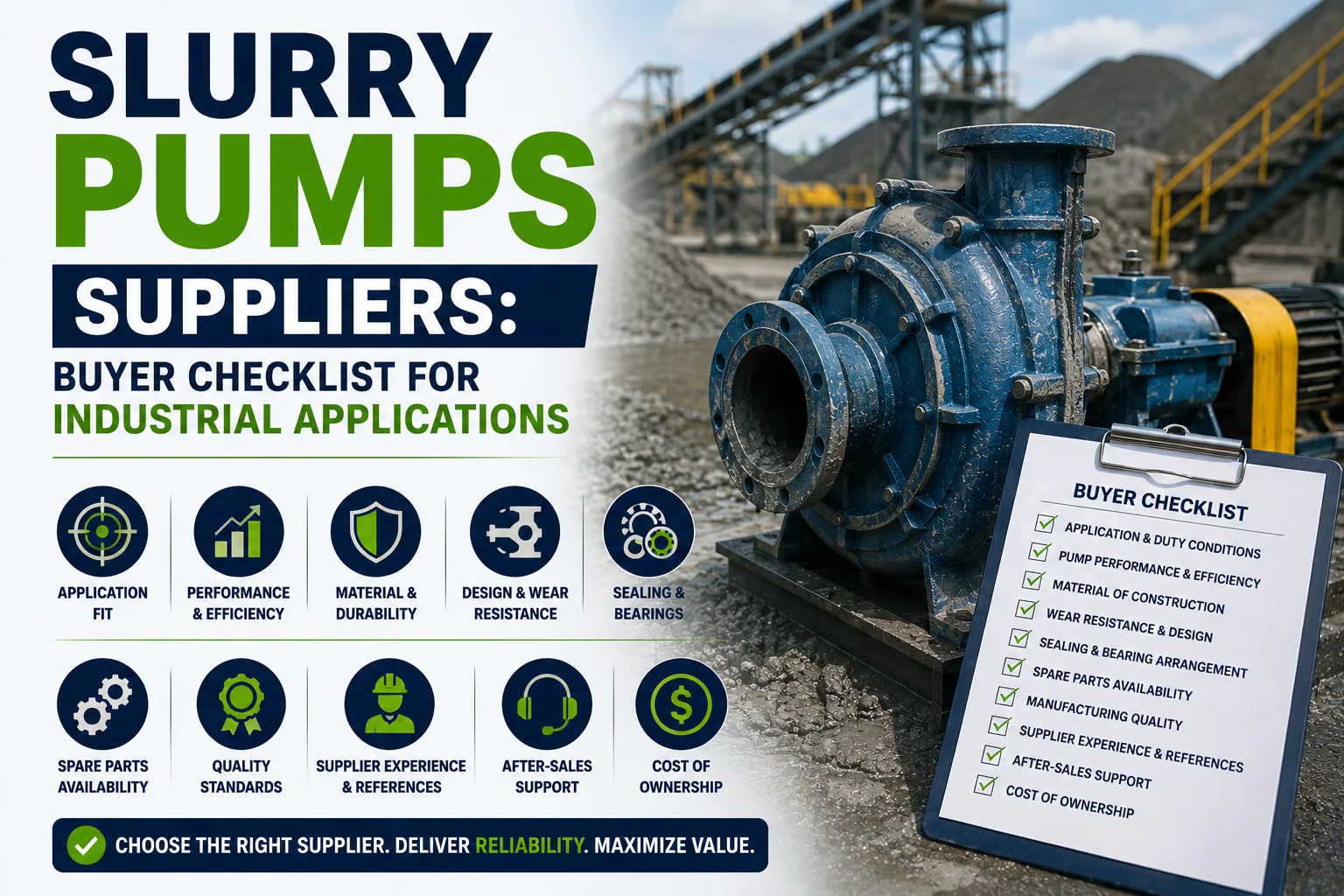
Use this buyer checklist to evaluate slurry pumps suppliers for industrial applications. Compare solids, abrasion, flow, head, materials, service and quote
Industrial buyers should evaluate slurry pumps suppliers by checking whether the supplier understands the actual solids mixture, abrasion risk, hydraulic duty and maintenance requirements. A good slurry pump supplier should ask about flow rate, total dynamic head, solids type, solids concentration, particle hardness, pH, temperature, installation layout and duty cycle before recommending a pump.
The buyer should also confirm whether the application truly needs a slurry-duty solution. Some sites use the word slurry for sludge, sewage solids or wastewater residue. If the duty is mainly sewage/STP sludge, Flow Chem’s submersible sewage sludge pump route may be more relevant. If fibrous waste causes clogging, the submersible cutter pump route should be reviewed. For broader wastewater handling, compare the duty with the submersible waste water pump.
Why supplier evaluation matters for slurry applications
Slurry applications can be difficult because the liquid carries solids that may be heavy, abrasive, settling or chemically aggressive. A pump that looks suitable by horsepower may fail quickly if the supplier does not review the actual mixture.
Wrong supplier selection can lead to:
- Premature wear.
- Impeller or casing damage.
- Poor discharge.
- Pipeline settling.
- Seal stress.
- Motor overload.
- High maintenance cost.
- Frequent downtime.
- Confusion between sludge, slurry and wastewater duties.
A supplier should help the buyer separate slurry-duty requirements from sludge and wastewater pumping requirements.
Step 1: confirm whether the application is slurry or sludge
Before asking for slurry pump quotes, define the material being pumped. Slurry usually means a liquid carrying solid particles, often with abrasion or settling risk. Sludge usually means wastewater residue, sewage solids, soft settled solids or semi-solid organic material.
Ask:
- Are the solids abrasive or soft?
- Is grit, sand, mineral material or industrial residue present?
- Is the mixture thick, watery or dense?
- Does it settle quickly?
- Is the main risk wear, clogging or corrosion?
- Are fibrous materials present?
- Is the duty STP/ETP sludge or process slurry?
If the main risk is sewage sludge, review sludge-pump selection. If the main risk is abrasive solids, slurry-duty review becomes more important.
Step 2: check solids concentration and particle behavior
Slurry pump selection depends heavily on solids concentration and particle behavior. The supplier should ask how much solid material is present and how it behaves in the liquid.
Review:
- Approximate solids percentage if available.
- Particle size.
- Particle hardness.
- Particle shape.
- Whether particles settle quickly.
- Whether the mixture is uniform or variable.
- Whether the pump must restart after settling.
If solids settle in the sump or pipeline, the full system should be reviewed. Pump selection alone may not solve settling or blockage in a poorly designed line.
Step 3: evaluate abrasion and material risk
Abrasive solids are a major concern in slurry pumping. The supplier should discuss wear and material suitability before quoting.
Ask the supplier:
- What parts are exposed to abrasive wear?
- Is the pump suitable for hard particles?
- What material or coating route is being assumed?
- What seal arrangement is suitable?
- What maintenance or wear-part inspection is expected?
- Is the application chemically aggressive as well as abrasive?
Do not assume material compatibility or wear resistance without verified application review. Avoid unsupported claims about chemical resistance or long wear life unless the supplier provides approved data.
Step 4: calculate flow rate and total dynamic head
Even in slurry applications, hydraulic selection remains critical. The supplier should not quote only by horsepower.
Document:
- Required flow rate.
- Static lift.
- Pipe length and diameter.
- Number of bends, valves and fittings.
- Friction loss.
- Discharge condition.
- Operating hours.
- Duty/standby requirement.
Slurry can create higher system resistance than clean water. If the supplier ignores solids behavior, expected flow may not be achieved.
Step 5: review installation conditions
Installation affects pump performance and serviceability. Industrial slurry or sludge pumps often work in sumps, pits, tanks or process areas where access may be limited.
Review:
- Sump depth and dimensions.
- Pump placement.
- Lifting/removal access.
- Cable routing and electrical safety.
- Pipeline layout.
- Whether agitation or mixing is needed.
- Cleaning and inspection access.
- Site safety constraints.
A supplier who understands installation risk can help reduce maintenance problems later.
Step 6: compare documentation and quote clarity
A useful slurry pump supplier should make the basis of selection clear. Vague quotes are risky for industrial applications.
A clear quote should include:
- Pump type and application assumption.
- Flow/head basis.
- Solids and abrasion assumptions.
- Material or construction assumptions.
- Motor and electrical assumptions.
- Scope of supply.
- Installation exclusions.
- Service/spares assumptions where approved.
- Data still needed from the buyer.
If the quote does not explain why the pump is suitable for the slurry or solids mixture, ask for clarification before procurement.
Step 7: evaluate service and spares support
Slurry and solids-handling applications can have higher wear and maintenance requirements. Supplier support matters.
Check:
- Whether spare parts are discussed.
- Whether wear inspection is explained.
- Whether maintenance access is practical.
- Whether troubleshooting support is available.
- Whether the supplier understands the failure risks.
- Whether support claims are verified and approved.
Avoid unsupported service-area, ready-stock, delivery or guarantee claims. Use practical service-evaluation language unless approved details are available.
Step 8: prepare a complete slurry pump enquiry
Before sending an enquiry, prepare a duty brief that helps the supplier review the application.
Include:
- Application and industry.
- Liquid type.
- Solid material type.
- Particle size and approximate concentration.
- Abrasiveness and hardness if known.
- Flow rate and total dynamic head.
- Sump depth and pipe length.
- pH, temperature and chemical exposure.
- Operating hours and duty cycle.
- Installation/access constraints.
- Current pump failure history if any.
For Flow Chem review, buyers can submit these details through the Flow Chem contact page.
Slurry pumps supplier checklist for industrial buyers
Use this checklist before shortlisting a supplier:
- The application is confirmed as slurry, sludge, wastewater or mixed duty.
- Solids type, particle size and abrasiveness are documented.
- Flow and total dynamic head are calculated.
- Material and corrosion risk are reviewed.
- Installation access is checked.
- Supplier explains the pump selection basis.
- Quote assumptions are clear.
- Service and spares support are discussed accurately.
- Unsupported product, price, stock or service claims are avoided.
- Manufacturer review is requested for uncertain duties.
Common mistakes to avoid
Avoid these mistakes when comparing slurry pumps suppliers:
- Asking for a slurry pump when the application is actually sludge duty.
- Choosing only by price.
- Choosing only by horsepower.
- Ignoring abrasive wear.
- Ignoring settling in the pipeline.
- Ignoring material compatibility.
- Accepting vague quote assumptions.
- Ignoring serviceability and spare planning.
- Making unsupported product-fit claims in SEO content.
These mistakes can create procurement confusion and field failures.
Frequently asked questions
What should I ask slurry pumps suppliers before buying?
Ask about solids type, particle size, abrasiveness, flow rate, total dynamic head, material suitability, duty cycle, installation conditions, service support, spares and quote assumptions. The supplier should review the actual slurry or solids mixture before recommending a pump.
What is the difference between a slurry pump supplier and a sludge pump supplier?
A slurry pump supplier focuses on liquid-solid mixtures that may include abrasive particles such as grit, sand, minerals or process solids. A sludge pump supplier focuses on wastewater sludge, sewage solids and semi-solid residue. Some suppliers may support both, but the duty should be reviewed separately.
Can a sludge pump be used for slurry?
Only if the solids, abrasion risk, flow, head and material conditions match the pump design. A sludge pump may not be suitable for abrasive slurry, especially where hard particles cause wear.
What details should I send for a slurry pump quote?
Send liquid type, solid material, particle size, solids concentration, abrasiveness, flow rate, total dynamic head, sump depth, pipe length, pH, temperature, chemical exposure, duty cycle and maintenance access details.
Should I choose the cheapest slurry pump supplier?
Lowest price can be risky if the pump is not suited for the abrasive solids, flow, head, material conditions or duty cycle. Compare lifecycle reliability, wear risk, serviceability and quote clarity along with price.
Does Flow Chem have a dedicated slurry pump page?
This article should not claim a dedicated slurry pump page unless one is approved and live. Until then, slurry-related enquiries should be reviewed based on actual duty and routed through Flow Chem’s relevant sewage/sludge, wastewater, cutter or manufacturer support paths.
Need help selecting the right pump?
Share your flow, head, liquid type, solids, site layout and duty cycle with Flow Chem Pumps. Our team can help you shortlist the right pump.