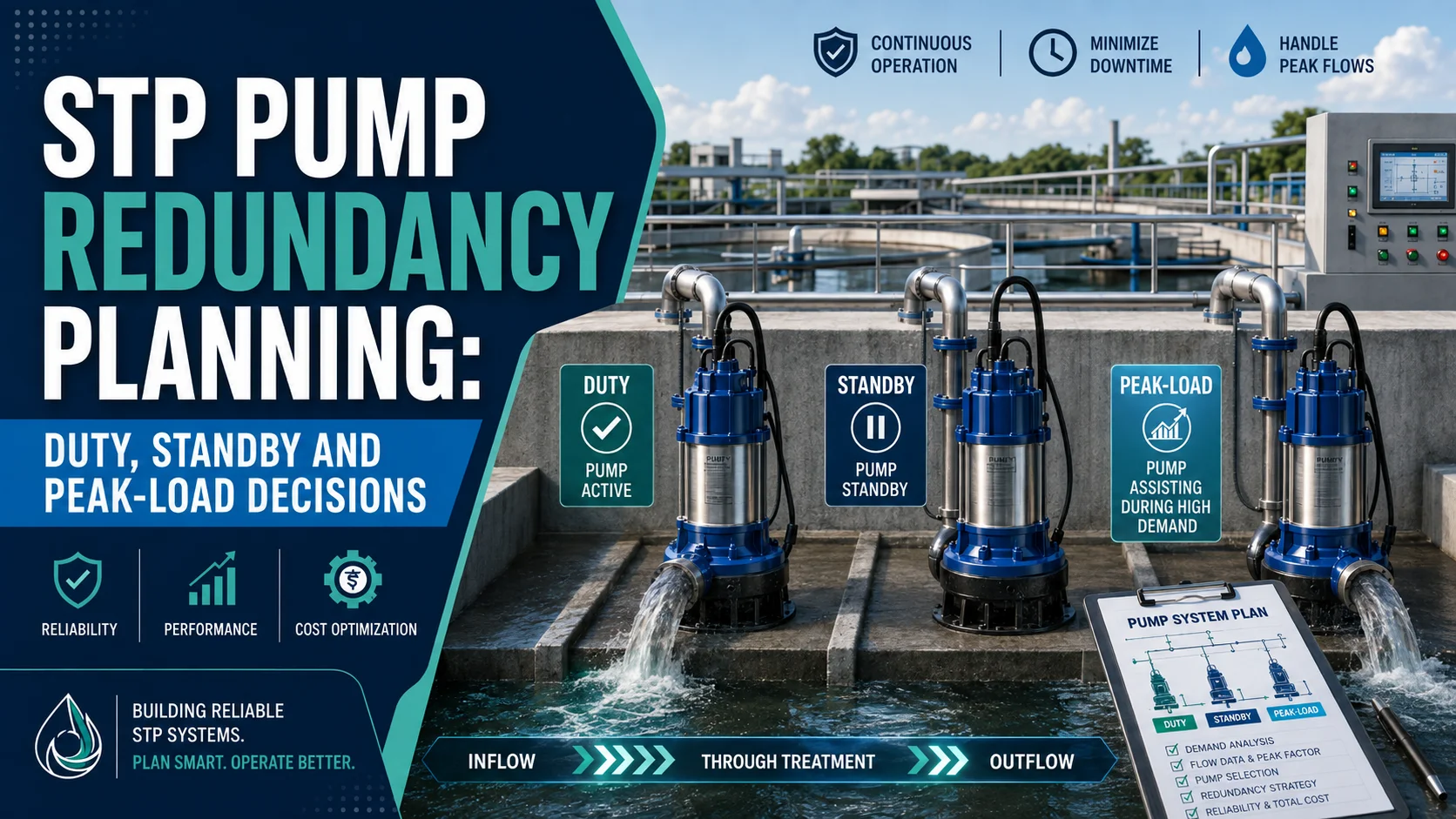
Plan STP pump redundancy with duty, standby and peak-load logic that fits process risk, maintenance windows and uptime needs. Avoid underbuilt or overbuilt
STP redundancy should be planned around process criticality, inflow variation, maintenance access and the consequences of a single pump failure. Duty-standby planning is not only about buying extra pumps; it is about creating a station that can survive maintenance, fault events and peak load without uncontrolled overflow or process instability.
Why redundancy planning matters in wastewater systems
In a treatment plant, a pump outage can affect equalisation, biological stability, sludge handling and overflow risk. That is why redundancy needs an engineering basis.
- A single failure may stop a critical transfer step.
- Maintenance isolation may be impossible without standby capacity.
- Peak inflow events can expose weak redundancy planning very quickly.
Start with process criticality, not a fixed rule of thumb
Some teams apply a blanket “one duty one standby” rule everywhere. That is simple, but not always correct.
- How critical is the pumping step to plant continuity?
- How much buffer volume exists upstream?
- How quickly can a failed pump be repaired or replaced?
- What happens during monsoon, peak occupancy or upset loading?
Critical sewage-transfer stages may justify more conservative standby philosophy than low-risk recirculation loops.
Common redundancy patterns
- 1 working + 1 standby for smaller or moderate-risk duties.
- 2 working + 1 standby where flow variation and uptime risk are higher.
- Parallel duty pumps for variable demand with automatic alternation.
- Peak-load assist pumps where normal flow is modest but storm or shift-related surges occur.
The right pattern depends on the inflow profile and the cost of downtime.
How pump type influences standby planning
Pump selection and redundancy planning should be reviewed together.
- A submersible sewage sludge pump station may allow compact duty-standby layouts.
- A submersible cutter pump may be justified if fibrous loads make unplanned clogging more likely.
- Submersible waste water pump duties may need different standby logic if the stream is lighter and less blockage-prone.
Controls, alternation and alarm logic
Redundancy fails in practice when the pumps exist but the control philosophy is weak.
- Duty/standby alternation should prevent one pump from aging alone.
- Level alarms must escalate before overflow risk becomes critical.
- Auto-start of standby should be verified under real conditions.
- Operators should know the sequence during manual override or panel fault.
Maintenance access and spare strategy
A standby pump helps only if the plant can isolate and service the failed unit properly.
- Isolation valves and guide arrangements should support safe intervention.
- Critical spares should match the station risk level.
- If vendor response is slow, the standby philosophy may need to be stronger.
How overbuilding can still be a mistake
Adding more pumps than the process needs can increase capital cost, panel complexity, maintenance burden and control confusion.
Redundancy should reduce risk in a measurable way. If the extra pump does not solve a credible failure or peak-load scenario, it may not justify the added complexity.
Redundancy planning checklist
- Identify critical pumping steps.
- Quantify upstream buffer time.
- Review peak inflow and upset conditions.
- Match standby philosophy to maintenance reality.
- Verify auto-start, alternation and alarm logic.
- Align spares strategy with service response time.
Frequently asked questions
Is one duty and one standby always enough for an STP?
Not always. Some systems need stronger redundancy because failure consequences, peak inflow variation or service delays make a simple 1+1 arrangement too risky.
Should standby pumps be identical to duty pumps?
Often yes, because it simplifies interchangeability and controls, but the final decision depends on the duty profile and whether peak-load assist or alternate operating modes are needed.
Can a standby pump stay unused for long periods?
It can, but that increases the need for periodic testing and alternation. A standby unit that is never exercised may fail when it is finally needed.
Does redundancy remove the need for spare parts planning?
No. Redundancy buys time, but the station still needs a realistic repair and spare strategy to restore full resilience after a failure.
How does clogging history affect redundancy decisions?
If the duty is prone to ragging or blockage, stronger standby planning and pump-type review may be justified because unplanned trips become more likely.
Can Flow Chem define redundancy without plant data?
No. Final standby philosophy should follow the duty, inflow pattern, buffer volume, failure consequence and service constraints of the site.
Need help selecting the right pump?
Share your flow, head, liquid type, solids, site layout and duty cycle with Flow Chem Pumps. Our team can help you shortlist the right pump.