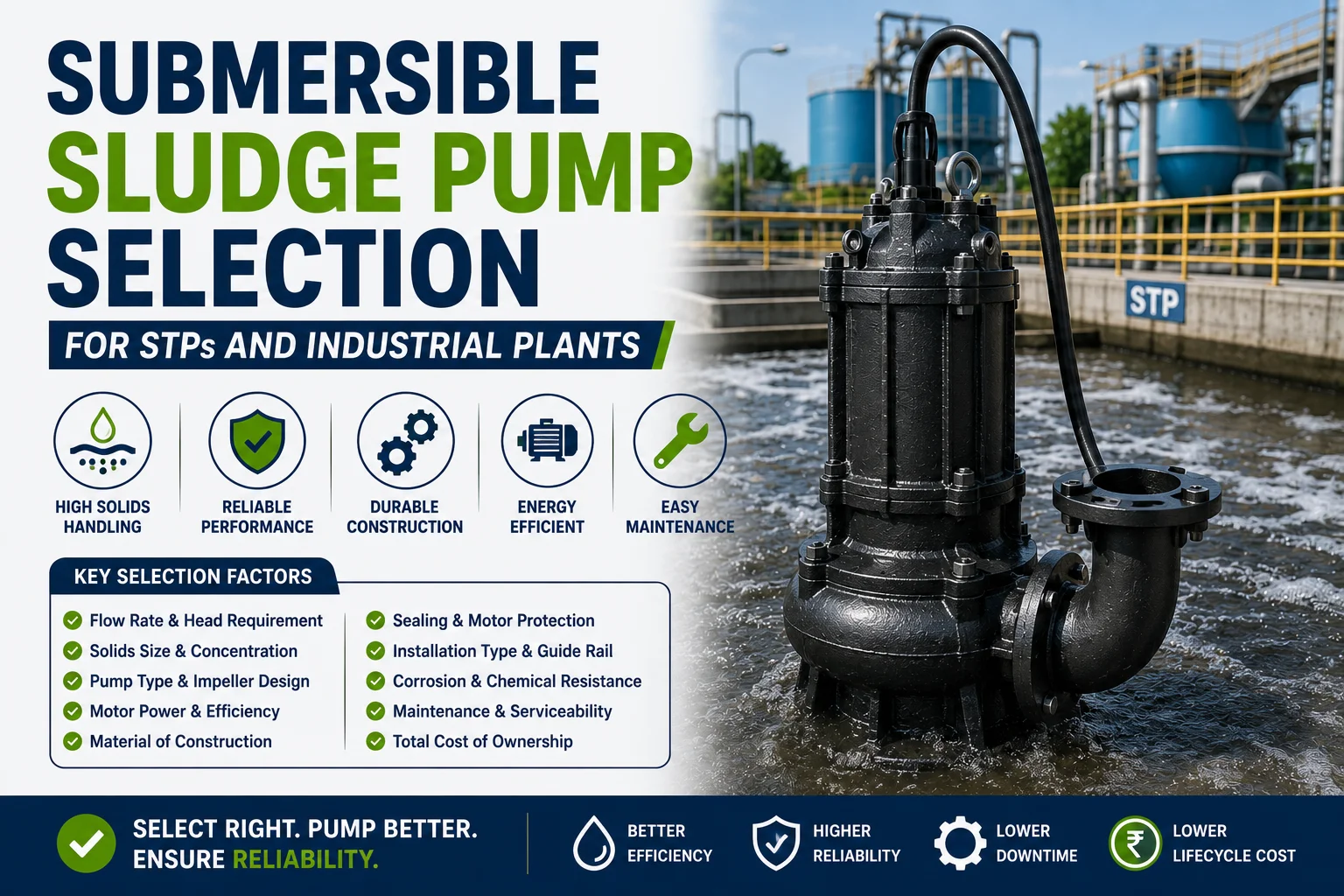
Learn how to select a submersible sludge pump for STPs and industrial plants. Compare flow, head, solids, clogging risk, materials, duty cycle and maintena
A submersible sludge pump is selected by matching the pump to the sludge duty. The buyer should document the sludge source, flow rate, total dynamic head, solids size, sludge thickness, clogging risk, material requirements, installation conditions and maintenance access before requesting a quote.
For STPs and many industrial wastewater plants, the first product route to review is Flow Chem’s submersible sewage sludge pump. If the sludge or wastewater contains rags, fibers, plastics or repeated choking risk, the submersible cutter pump route should also be evaluated. For treated or semi-treated industrial wastewater, compare the duty with the submersible waste water pump or effluent pumps where relevant.
The right selection is not based only on horsepower. It is based on duty point, sludge behavior and long-term serviceability.
Why sludge pump selection is different from normal water transfer
Sludge is not clean water. It can be thick, settled, semi-solid, fibrous, corrosive, abrasive or inconsistent depending on the process stage. A pump that works for drainage or clean-water transfer may fail quickly in sludge transfer.
Poor sludge pump selection can cause:
- Low discharge or no discharge.
- Pump choking.
- Motor overload.
- Seal stress.
- Excessive wear.
- Sludge settling around the pump.
- Frequent manual cleaning.
- Higher maintenance cost.
- Unplanned STP or plant downtime.
The selection process should therefore start from the sludge profile, not from a generic pump model.
Step 1: define the sludge source
Different sludge sources behave differently. The pump should be selected based on where the sludge comes from and what it contains.
Common sources include:
- STP sludge.
- ETP sludge.
- Municipal sewage sludge.
- Industrial wastewater sludge.
- Settled solids in pits or tanks.
- Sludge mixed with grit or process residue.
- Sludge from equalization tanks or sumps.
STP sludge may include organic solids and wastewater residue. Industrial sludge may include chemicals, oils, grit or process solids. Municipal sludge may include unpredictable solids or fibrous material. Each source changes the pump selection.
Step 2: measure flow rate and total dynamic head
A submersible sludge pump must deliver the required flow at the required head. Horsepower alone does not confirm this.
Document:
- Required flow rate in m³/hr or LPM.
- Static lift from sludge level to discharge point.
- Pipe length and diameter.
- Number of bends, valves and fittings.
- Friction loss at expected flow.
- Discharge condition.
- Operating hours per day.
- Whether the pump must empty a tank within a fixed time.
If head is underestimated, the pump may not deliver sludge properly. If head is overestimated, the pump may operate away from its efficient range.
Step 3: review solids and clogging risk
Sludge may contain soft solids, settled solids, fibers, grit, plastics or process waste. Solids-handling review is essential.
Ask:
- What is the expected solids size?
- Are solids soft, hard, gritty, fibrous or stringy?
- Does the sludge contain rags or plastics?
- Is screening available before the pump?
- Has the site faced repeated pump choking?
- Does sludge settle around the pump?
- Is cutting action required?
For sludge with fibrous waste or ragging, a cutter pump may be more suitable than a standard sludge pump. For sludge with abrasive grit or process solids, wear and material review become more important.
Step 4: check sludge thickness and settling behavior
Sludge thickness affects pump performance. Thin sludge may move more easily, while thick or settled sludge can increase load and reduce flow.
Review:
- Is the sludge watery, thick or semi-solid?
- Does it settle quickly?
- Does the sump need mixing or agitation before pumping?
- Does the pump restart after long idle periods?
- Is the suction area likely to get blocked by settled solids?
- Does pipeline velocity keep solids moving?
If sludge settles heavily, the system design may need review along with the pump. A pump alone may not solve settling inside tanks or pipelines.
Step 5: evaluate material and corrosion risk
Industrial sludge can be chemically aggressive. Material selection should be reviewed before procurement.
Check:
- pH range.
- Chemical content.
- Chlorides or salts.
- Oil or process residue.
- Temperature.
- Abrasive solids.
- Coating requirements.
- Seal and cable-entry suitability.
For general sewage sludge, standard sewage/sludge construction may be suitable depending on the duty. For aggressive industrial sludge, material compatibility should be confirmed from actual wastewater analysis. Do not assume chemical resistance without verification.
Step 6: review installation conditions
Submersible sludge pumps usually work in difficult environments. Installation conditions can affect both pump performance and maintenance.
Review:
- Sump or tank depth.
- Pump placement.
- Lifting and removal access.
- Cable routing.
- Guide rail or coupling requirement.
- Non-return valve and isolation valve arrangement.
- Ventilation and electrical safety.
- Cleaning and inspection access.
A technically correct pump can still create downtime if it cannot be removed, inspected or serviced easily.
Step 7: check duty cycle and reliability requirements
A sludge pump used for occasional tank emptying has different requirements from one used in continuous plant operation.
Review:
- Continuous or intermittent duty.
- Number of starts per day.
- Required working and standby pump arrangement.
- Peak sludge load.
- Operating hours.
- Maintenance window.
- Criticality of the pump to the process.
For critical STP and industrial plant duties, standby planning and serviceability should be discussed before procurement.
Step 8: prepare a complete enquiry for Flow Chem review
Before requesting a pump recommendation, prepare a selection brief.
Include:
- Application: STP, ETP, municipal, industrial plant or process sump.
- Sludge type and source.
- Flow rate.
- Total dynamic head.
- Sump depth and pipe length.
- Solids size and type.
- Whether fibers, rags or grit are present.
- pH, temperature and chemical exposure.
- Operating hours and duty cycle.
- Installation constraints.
- Clogging or wear history.
For selection support, send these details through the Flow Chem contact page. The more complete the duty data, the better the pump recommendation.
Submersible sludge pump selection checklist
Use this checklist before finalizing procurement:
- Sludge source is defined.
- Flow rate is known.
- Total dynamic head is calculated.
- Solids size and solids type are documented.
- Clogging risk is reviewed.
- Sludge thickness and settling behavior are understood.
- Material and corrosion risk are checked.
- Installation access is practical.
- Duty cycle and standby requirement are discussed.
- Manufacturer has reviewed the actual duty.
This checklist helps avoid selection by horsepower alone.
Common mistakes to avoid
Avoid these mistakes:
- Treating sludge pumping as clean-water transfer.
- Selecting only by HP.
- Ignoring solids and clogging risk.
- Ignoring sludge thickness.
- Ignoring settling in the sump or pipeline.
- Using a normal wastewater pump where a sludge pump is needed.
- Ignoring material compatibility.
- Not planning maintenance access.
- Not sharing full duty data with the manufacturer.
These mistakes often create repeated cleaning, poor discharge, short pump life and avoidable downtime.
Frequently asked questions
What is a submersible sludge pump used for?
A submersible sludge pump is used to move sludge, sewage solids, settled wastewater solids and semi-solid liquid from STPs, ETPs, municipal sumps, industrial pits and sludge tanks. The exact pump should be selected based on sludge characteristics and duty point.
How do I size a submersible sludge pump?
Size the pump by calculating required flow rate and total dynamic head, then reviewing solids size, sludge thickness, clogging risk, material compatibility, duty cycle and installation access. Do not size only by horsepower.
What is the difference between a sludge pump and a sewage pump?
A sewage pump handles sewage and wastewater solids. A sludge pump is selected when the liquid contains thicker sludge, settled solids or semi-solid wastewater residue. In many STP duties, sewage/sludge pump categories overlap, so the actual solids profile should guide selection.
When should I use a cutter pump instead of a sludge pump?
Use a cutter pump when the main risk is fibrous waste, rags, plastics or stringy material causing repeated choking. For general sludge or sewage solids, a sewage sludge pump may be reviewed first.
Can a submersible sludge pump handle industrial wastewater?
It may be suitable if the flow, head, solids, material and chemical conditions match the pump design. Industrial wastewater should be reviewed carefully for corrosion, abrasion and process-chemical exposure.
What details should I send for a sludge pump quote?
Send sludge source, flow rate, total dynamic head, sump depth, pipe length, solids size, solids type, pH, temperature, chemical exposure, duty cycle, installation constraints and any clogging or wear history.
Need help selecting the right pump?
Share your flow, head, liquid type, solids, site layout and duty cycle with Flow Chem Pumps. Our team can help you shortlist the right pump.