Learn how to select a 2 HP sewage pump for STP, municipal and industrial wastewater duties. Compare flow, head, solids handling, phase, material and duty cycle.
A 2 HP sewage pump can be suitable for sewage transfer, STP wastewater movement, small-to-medium sump duties, industrial wastewater pits and localized sewage water pumping when the required flow and head are within the pump’s performance curve. It should not be selected only because the motor is 2 HP. The pump must match the total dynamic head, solids profile, discharge line, duty cycle and wastewater condition.
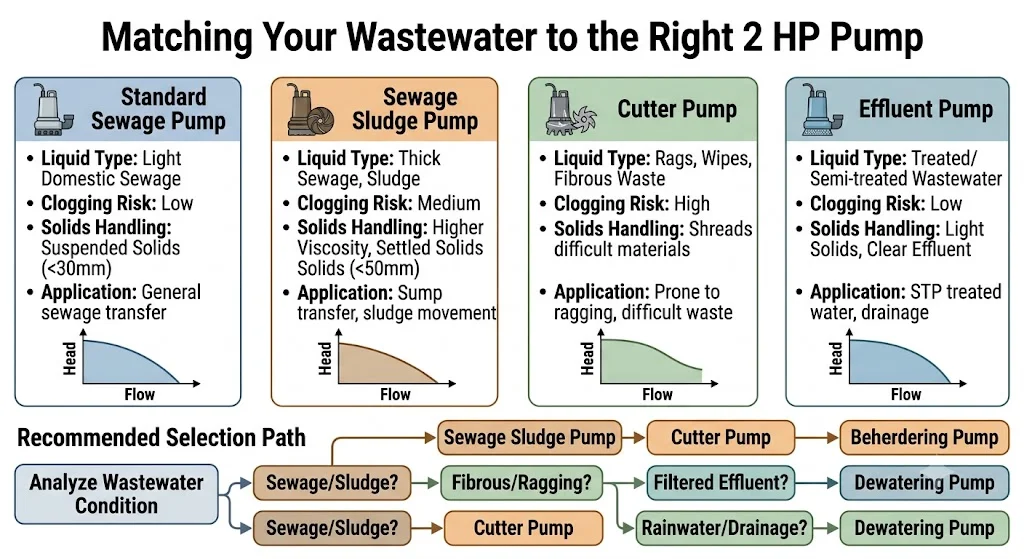
For Flow Chem, buyers should compare the requirement with the submersible sewage sludge pump range first. If the site has frequent clogging from rags, wipes or fibrous material, also compare a submersible cutter pump. If the duty is mainly rainwater or site drainage rather than sewage, a dewatering pump or submersible drainage pump may be more appropriate.
The correct question is not “Is 2 HP enough?” The correct question is “Does this 2 HP sewage pump deliver the required flow at my actual head while handling my wastewater solids safely?”
Why 2 HP sewage pump selection needs care
A 2 HP sewage pump is a common buyer query because it sounds specific and practical. Many purchase teams already have a motor rating in mind before speaking to a manufacturer. But in wastewater pumping, HP is only one part of the selection. Two pumps with the same HP can deliver different flow, head, solids passage and performance depending on hydraulic design, impeller type, motor efficiency and construction.
Wrong selection can cause:
- Low discharge flow even though the pump runs.
- Frequent choking from sewage solids.
- Motor overload or tripping.
- Premature seal or bearing failure.
- High maintenance calls.
- STP downtime or overflow risk.
- Poor performance during peak inflow or monsoon load.
A 2 HP sewage pump can be a good fit for the right application, but it can also be undersized for high-head, long-discharge, heavy-sludge or continuous-duty wastewater systems. The pump should be selected from site data, not from HP alone.
What is a 2 HP sewage pump?
A 2 HP sewage pump is a sewage or wastewater pump powered by a motor rated around two horsepower. In submersible form, the pump is installed directly in a sump, tank, pit or wastewater collection area and pumps sewage water or solids-laden wastewater to the required discharge point.
In buyer language, “2 HP sewage pump” may refer to different pump types:
- Submersible sewage pump.
- Submersible sewage sludge pump.
- Sewage water pump.
- Wastewater transfer pump.
- STP sump pump.
- Sewage motor or pump set.
This is why the product category must be clarified before quoting. A 2 HP motor rating alone does not define solids handling, free passage, flow, head, material or application suitability.
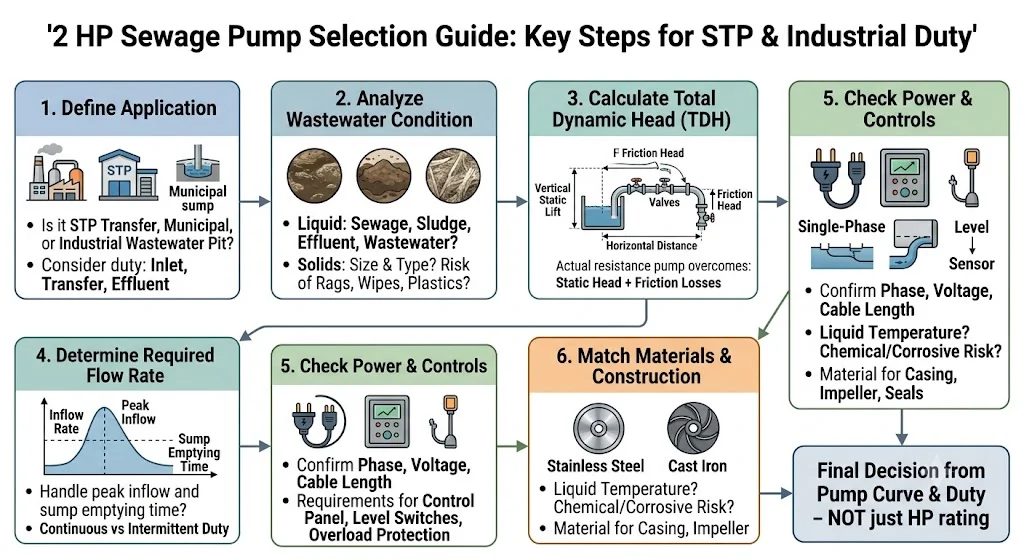
Step 1: define the application
Start with the actual duty. The same 2 HP sewage pump cannot be assumed suitable for every wastewater site.
Common applications include:
- STP sewage transfer.
- Treated or semi-treated wastewater transfer.
- Sewage collection sump pumping.
- Industrial wastewater pit pumping.
- Commercial building sewage sump duty.
- Municipal small sump or transfer duty.
- Sludge or settled-solids movement, if pump design allows.
The application decides whether the buyer needs a sewage sludge pump, cutter pump, wastewater pump or drainage/dewatering pump. For example, an STP transfer sump with suspended solids may suit a sewage sludge pump. A ragging-prone sewage inlet may need cutter-pump evaluation. A clean drainage pit may not need sewage-pump construction at all.
Step 2: identify the wastewater condition
Wastewater condition is one of the most important selection inputs. A pump that works for light sewage water may fail in thick sludge or fibrous waste.
Document:
- Is the liquid sewage, sludge, effluent, wastewater or drainage water?
- Are solids suspended, settled, fibrous or abrasive?
- What is the approximate solids size?
- Is there risk of rags, wipes, plastic or cloth?
- Is the liquid corrosive or chemically aggressive?
- Is there grit or sand?
- Is the liquid temperature normal or elevated?
For solids-laden wastewater, the pump must have suitable passage and construction. For fibrous wastewater, compare a submersible cutter pump. For sludge-heavy duty, review the submersible sewage sludge pump specification carefully.
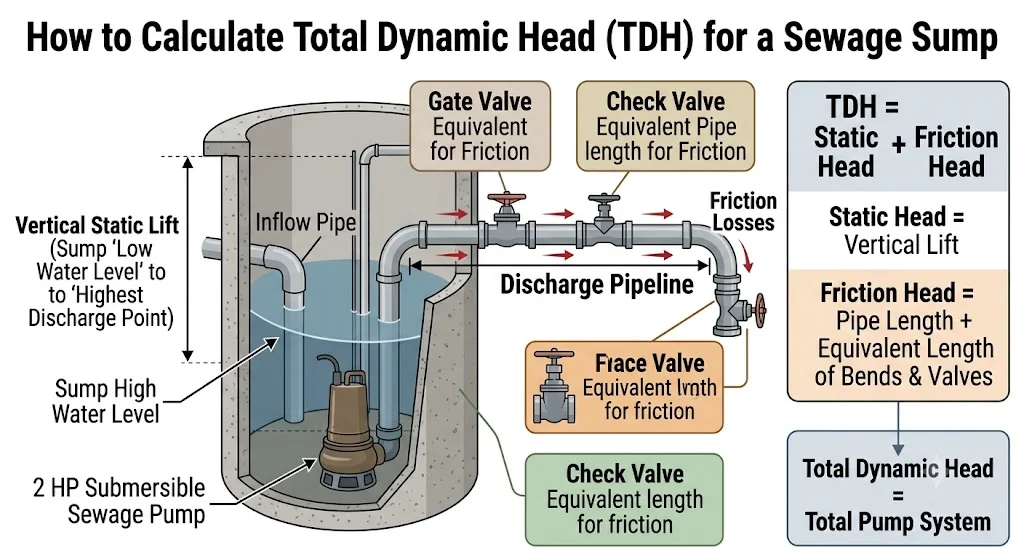
Step 3: calculate total dynamic head
Total dynamic head is the actual resistance the pump must overcome. A 2 HP sewage pump may perform well at one head but deliver much lower flow at a higher head. This is why site head calculation is essential before selection.
Include:
- Vertical lift from sump water level to discharge point.
- Pipe length and diameter.
- Horizontal discharge distance.
- Bends, valves and fittings.
- Friction losses.
- Discharge pressure or downstream tank level.
- Variation as sump water level changes.
If the discharge line is long or the vertical lift is high, the pump may need a different curve or higher rating. If head is underestimated, the installed pump may run but fail to move enough wastewater.
Step 4: define required flow rate
Flow rate decides how quickly the pump must empty or control the sump. For STP and wastewater systems, the pump should handle expected inflow plus safety margin. The required flow depends on sump size, incoming wastewater rate and acceptable emptying time.
Ask:
- What is the sump volume?
- What is the normal inflow rate?
- What is the peak inflow rate?
- How quickly must the pump empty the sump?
- Is the pump intermittent or continuous duty?
- Is there a standby pump?
- Are two pumps expected to alternate?
A 2 HP sewage pump may be suitable for smaller or moderate duties, but larger STP, municipal or industrial systems may need more capacity, multiple pumps or a duty/standby configuration.
Step 5: check phase, power and control panel requirements
Power availability affects selection. A 2 HP sewage pump may be supplied in different electrical configurations depending on manufacturer and model. The buyer should confirm site power before procurement.
Check:
- Single-phase or three-phase supply.
- Voltage and frequency.
- Cable length.
- Starter/control panel requirement.
- Float switch or level control requirement.
- Protection against overload and dry run.
- Earthing and installation safety.
For critical wastewater duties, do not treat the pump and control panel separately. Pump reliability depends on correct electrical protection and level-control logic.
Step 6: evaluate solids handling and clogging risk
A sewage pump must move wastewater without frequent blockage. The solids-handling requirement depends on the site.
Review:
- Free passage or solids passage requirement.
- Impeller design.
- Sump screening or upstream protection.
- Risk of fibrous material.
- Maintenance access for cleaning.
- Existing clogging history.
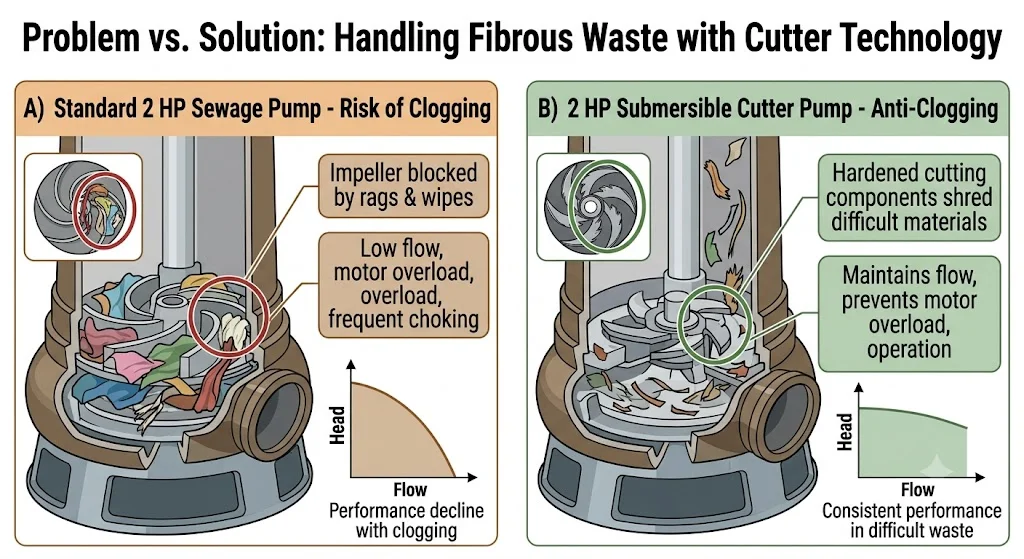
If the site has repeated clogging from rags and wipes, a cutter pump may be more suitable than a standard sewage pump. If the site has thick sludge or settled solids, the pump may need a sewage sludge configuration rather than a light wastewater pump.
Step 7: match material and construction to the liquid
Material selection depends on wastewater chemistry and abrasiveness. Domestic sewage, industrial wastewater, effluent and sludge can create different material risks.
Consider:
- Corrosion risk.
- Abrasive particles.
- Seal compatibility.
- Impeller material.
- Pump casing material.
- Cable and gasket compatibility.
- Expected operating life.
For industrial wastewater, material compatibility should be checked before selection. If the liquid includes chemicals, oil, acidic/alkaline discharge or abrasive particles, share those details before requesting a quote.
2 HP sewage pump vs higher HP pump
A higher HP pump is not always better, but under-sizing is also risky. The right rating depends on duty point.
| Selection situation | 2 HP sewage pump may be suitable | Higher HP or different pump may be needed | |---|---|---| | Sump size | Small-to-medium sump | Large collection pit or high inflow | | Head | Low-to-moderate head within curve | High vertical lift or long pipeline | | Liquid | Sewage water with manageable solids | Thick sludge, abrasive solids or severe ragging | | Operation | Intermittent or moderate duty | Continuous heavy-duty operation | | Risk level | Non-critical or standby available | Critical STP/municipal duty with overflow risk | | System | Short discharge line | Long discharge line with friction losses |
The final decision should be made from the pump curve and duty point, not from a general HP assumption.
2 HP sewage pump for STP duties
In STPs, a 2 HP sewage pump may be used in smaller transfer duties, sump pumping or support applications where the head and flow requirement are moderate. However, STP liquid conditions vary by stage. Inlet sewage, equalization tank wastewater, treated water, sludge and drain sumps may require different pump types.
Before selecting a 2 HP pump for STP use, confirm:
- Which stage of the STP the pump serves.
- Whether the liquid is raw sewage, treated wastewater or sludge.
- Whether solids are fibrous, settled or suspended.
- Whether the pump runs continuously or intermittently.
- Whether downtime can create overflow risk.
- Whether standby capacity is required.
For STP sewage and sludge duties, Flow Chem’s submersible sewage sludge pump page should be the primary reference. For clogging-prone duties, compare with submersible cutter pump.
2 HP sewage pump for industrial wastewater
Industrial wastewater requires more caution than normal domestic sewage because the liquid may contain chemicals, oil, grit, process residues, higher temperature or abrasive solids. A 2 HP pump can only be recommended after the wastewater condition is known.
For industrial wastewater, collect:
- Industry/application type.
- Liquid composition.
- Solids and grit details.
- pH or chemical compatibility requirement.
- Temperature.
- Operating hours.
- Discharge line details.
- Required flow and head.
If the liquid is treated or semi-treated effluent, compare with Flow Chem’s effluent pumps and submersible waste water pump pages. If it contains sludge or solids, continue with sewage sludge pump evaluation.
Buyer checklist before requesting a quote
Share these details with Flow Chem before asking for a 2 HP sewage pump quote:
- Application and site type.
- Liquid type: sewage, sludge, effluent, wastewater or drainage water.
- Required flow rate.
- Total dynamic head.
- Sump depth and installation type.
- Pipe size and pipe length.
- Solids type and solids size.
- Clogging history.
- Power supply: single-phase or three-phase.
- Required operating hours per day.
- Standby pump requirement.
- Material compatibility concerns.
- Existing pump details, if replacing a pump.
This information allows Flow Chem to confirm whether a 2 HP sewage pump is suitable or whether a different pump rating/type is safer.
Common mistakes to avoid
Mistake 1: selecting only by HP
HP does not define pump performance. Always check the pump curve, flow, head and solids-handling ability.
Mistake 2: using a sewage pump for every wastewater duty
Some duties are better suited to effluent pumps, wastewater pumps, drainage pumps or dewatering pumps. Match the pump to the liquid and application.
Mistake 3: ignoring solids and clogging history
If the existing pump frequently blocks, the issue may be solids type, not just motor rating. Review cutter-pump suitability if fibrous clogging is present.
Mistake 4: underestimating pipe friction
Long discharge lines and small pipe diameters can reduce actual flow. Include friction losses in total dynamic head.
Mistake 5: not planning for standby
Critical STP or municipal wastewater systems should consider duty/standby operation. A single pump may not be enough for continuous or high-risk sites.
Recommended Flow Chem selection path
Use this path when evaluating a 2 HP sewage pump:
1. If the liquid is sewage or sludge, start with the submersible sewage sludge pump page. 2. If clogging from fibrous solids is frequent, compare a submersible cutter pump. 3. If the liquid is treated/semi-treated industrial wastewater, compare effluent pumps and submersible waste water pumps. 4. If the duty is drainage or water removal, review dewatering pumps or submersible drainage pumps. 5. If the site requires a specific 2 HP rating, validate the pump curve against flow and head before finalizing.
Conclusion
A 2 HP sewage pump can be a practical option for STP, municipal and industrial wastewater duties when the pump curve, solids handling, flow, head, duty cycle and material compatibility match the site. But 2 HP should be treated as a starting point, not the full selection.
For reliable selection, define the wastewater condition, calculate total dynamic head, estimate flow, review solids and confirm power supply. Then compare the correct Flow Chem pump category before procurement.
For selection support, contact Flow Chem through the enquiry page and share your application details, flow/head requirement, sump depth and solids condition.
Frequently asked questions
Is a 2 HP sewage pump enough for STP use?
A 2 HP sewage pump may be enough for smaller or moderate STP duties if its flow and head match the site requirement. It may not be enough for high-head, large-flow, thick-sludge or continuous-duty applications.
Can I select a sewage pump only by HP?
No. A sewage pump should be selected by flow, total dynamic head, solids handling, liquid condition, duty cycle, material compatibility and power supply. HP alone is not enough.
What is the difference between a 2 HP sewage pump and a sewage sludge pump?
A 2 HP sewage pump describes motor rating. A sewage sludge pump describes application and solids-handling duty. A pump can be both, but the buyer must confirm the actual pump design and suitability.
When should I choose a cutter pump instead of a 2 HP sewage pump?
Choose or compare a cutter pump when the site has frequent clogging from rags, wipes, cloth, plastic or fibrous wastewater solids.
What details are needed for a 2 HP sewage pump quote?
You should provide application, liquid type, required flow, total head, sump depth, pipe length, solids details, power supply, operating hours and existing pump failure history.
Is a 2 HP sewage pump suitable for industrial wastewater?
It can be suitable only if the industrial wastewater condition, solids, chemistry, flow and head match the pump. If chemicals, grit, heat or abrasive particles are present, material and pump design must be reviewed.
Need help selecting the right pump?
Share your flow, head, liquid type, solids, site layout and duty cycle with Flow Chem Pumps. Our team can help you shortlist the right pump.