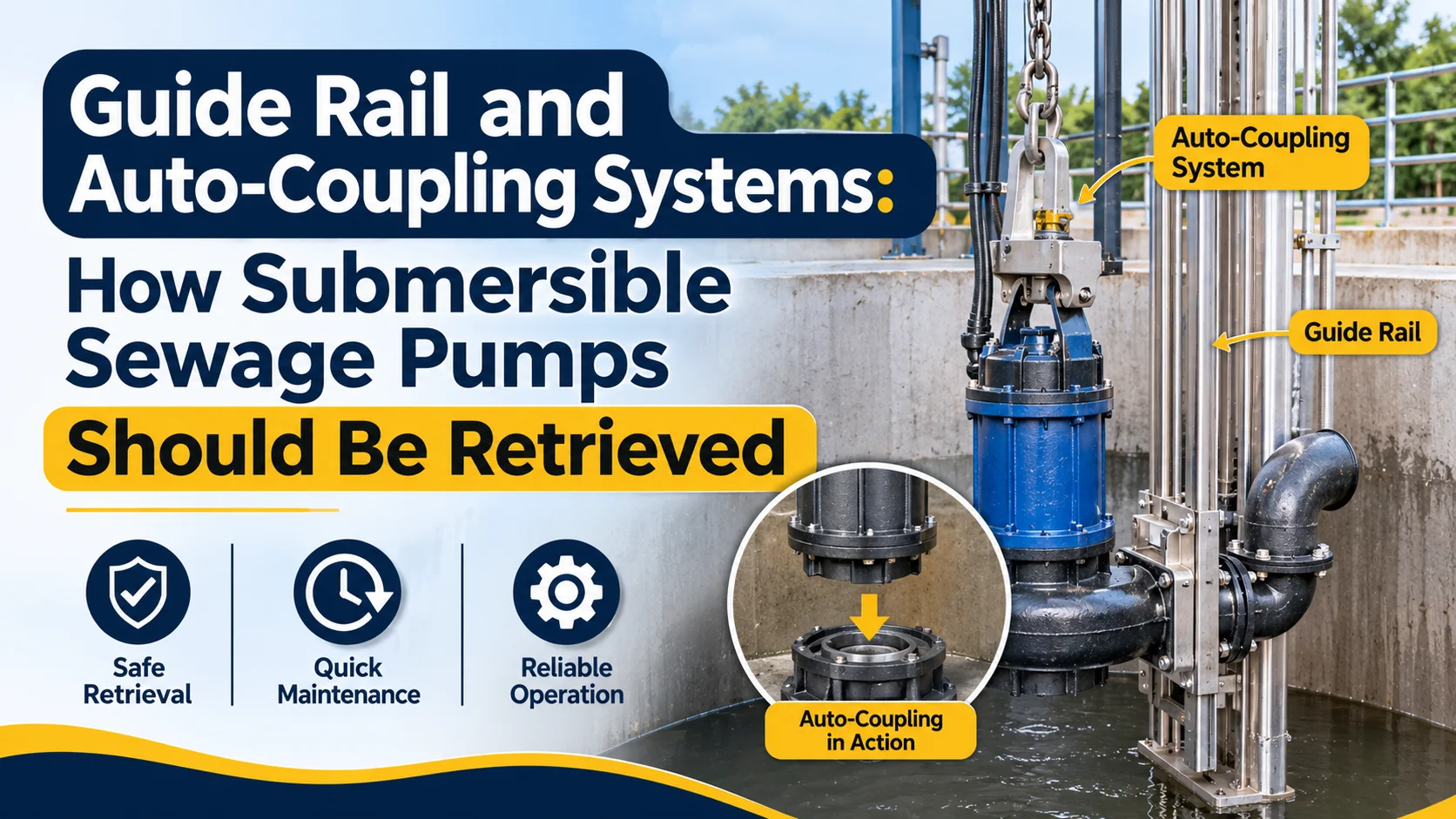
A guide rail auto-coupling system lets a submersible sewage pump be lifted for service without anyone entering the wet well: rails, pedestal, duckfoot bend
Lowering a submersible sewage pump into a wet well on a rope and hoping for the best is an installation method; a guide rail auto-coupling system is an engineering decision. Two vertical rails run from the access cover to a floor-mounted pedestal. The pump carries a duckfoot bend — a flanged elbow with rail guides — and is lowered on its lifting chain down the rails until the duckfoot seats on the pedestal, where the pump's own weight compresses the discharge seal and the connection is made. No diver, no dewatering, no bolts underwater. Lifting the chain reverses the operation, and the pump comes to the surface for seal inspection, impeller clearing or replacement.
The reason this matters is not elegance — it is maintenance reality. Wet wells are confined spaces, and in sewage service they are hazardous ones: atmosphere, biological risk, and the operational disruption of dewatering a live station to reach a pump. Stations whose pumps can be retrieved from the surface get serviced on schedule; stations whose pumps are bolted to flanges underwater get serviced when they fail. The specification decisions — rail material, chain rating, pedestal alignment, well geometry, access alignment — determine whether the system still works in year ten or seizes in year three. The installation-side discipline is covered in the submersible sewage pump installation guide, and the well itself is engineered per wet well design practice for sewage pump stations; this guide covers the coupling system that joins them.
Components of an auto-coupling system, and what each one must survive
Every part of the system lives in the hardest environment the station contains, and each has a specification role:
- Guide rails: structure and alignment in one part. Rails are typically stainless steel pipe or solid round, sized for the pump mass — light pumps on smaller diameter rails, heavy non-clog pumps on proportionally heavier sections, with rail supports bracketed to the well structure at intervals so the column cannot flex as the pump travels. The rail material decision is binary in practice: stainless, or replaced. Galvanised or carbon steel rails corrode in sewage atmosphere and immersion, and corrosion products seize the sliding interfaces the system depends on.
- Pedestal and duckfoot bend: the coupling itself. The floor pedestal receives the pump's duckfoot discharge bend, and the seat carries a gasket or sealing face that the pump's weight compresses. The pedestal must be anchored into the well floor dead level — a tilted pedestal seats the duckfoot at an angle, leaks past the seal and hammers the joint every start. The duckfoot and pedestal should come as a matched pair from the pump manufacturer; mixing a duckfoot from one source with a pedestal from another is a leak designed in advance.
- Lifting chain or rope: the retrieval lifeline. The chain must be rated for the pump's installed mass — including motor, cable guard and any accessories — with a recognised safety factor, in stainless or appropriately coated alloy for sewage immersion. The specification detail that gets skipped is the release method: the top end needs a secure anchor at the access deck, and the system should allow the chain to be connected and released from the surface. Chains are also inspection items — links wear at the anchor and at the pump bail, and a chain that fails during retrieval drops a pump into a full well.
- Rail guides and sliding interfaces: where systems live or die. The duckfoot's guide brackets and any upper guide sleeves are the sliding surfaces along which the pump travels. They must be stainless, debris-tolerant and generously toleranced — interfaces tightened "for a snug fit" at installation are the ones that jam when a film of grease and grit builds over seasons. The fit that travels well is slightly loose and permanently lubricated with a suitable compound, not precision-tight.
- Fasteners and anchors: the invisible specification. Every bolt in the system — pedestal anchors, rail brackets, duckfoot flange bolts — should be stainless of a grade compatible with the rails, with attention to avoiding mixed-metal pairs that accelerate galvanic attack. Fastener grade is a small line item at purchase and an underwater excavation later; stations have been dewatered to replace bolts that cost a fraction of the dewatering.
- Access cover and deck: the surface end of the system. The access opening must sit directly above the pump's rail line, sized for the pump to pass with its bail and chain, and rated for the loads of the service crew and their lifting equipment. Covers offset from the rails, or undersized for the pump's envelope, convert a ten-minute retrieval into a demolition exercise.
Wet well geometry: making the rails work means building the well around them
The coupling system succeeds or fails in the geometry of the well it lives in:
- Rails plumb, pedestal level, verified at installation. The duckfoot descends the rails under gravity; rails out of plumb drag it against one side, and the pump arrives at the pedestal skewed. A pedestal out of level seats the seal unevenly and wears it asymmetrically. These are survey checks with a plumb line and spirit level — thirty minutes at installation against a lifetime of jammed retrievals.
- Clearance envelope around the pump. The pump needs clearance from well walls for cable movement and to prevent solids packing against the motor body, floor clearance above the benched floor so the suction sits where flow reaches it, and cable routing that cannot foul the rails or the chain. Manufacturers publish minimum clearances per pump size; treating them as suggestions produces pumps that cannot be removed without unblocking the space around them first.
- Benched floors and anti-deposition geometry. A well floor benched at steep angles — commonly fifty to sixty degrees from horizontal — keeps solids from settling in dead zones beside the pedestal, so the duckfoot area stays clear and the seal face stays seated against sewage, not silt. Flat floors silt up to the pedestal, and the silt finds the coupling.
- Duplex and triplex arrangements: rails per pump, no shared games. Multi-pump wells give each pump its own rail pair and pedestal, spaced so pumps can be retrieved independently — one pump out for service never blocks another's rails. Duty-standby philosophy depends on this: a station where the standby pump cannot be lifted because the duty pump's retrieval occupies the access is a station without a standby, as the duty-standby planning guide makes clear.
- Access alignment and headroom. The hatch must be directly over the rail line with enough headroom above it for the pump to be lifted clear, laid down and moved to a service area. Headroom that requires a pump to be manhandled around steelwork at the deck is how backs, pumps and cables get damaged.
- Ventilation and atmosphere, because retrieval is frequent. A station designed for easy retrieval will be opened often; well ventilation that keeps the atmosphere predictable is part of the retrieval system, and the confined-space safeguards around sewage wet wells belong in the operating procedure from day one.
Specification, commissioning and the retrieval test everyone skips
The system is only as good as the paper and the proving behind it:
- Buy the coupling system from the pump manufacturer, as a system. Rails, pedestal, duckfoot, brackets and chain from one source match the pump's mass, flange and guide geometry, and carry one warranty and one set of instructions. Assembled systems from mixed sources fit poorly at best and fail the retrieval test at worst; the savings are microscopic and the failure mode is a pump that cannot be lifted.
- State the pump mass and service conditions explicitly. Rail diameter, bracket spacing, chain rating and pedestal anchoring all derive from the installed pump mass and the well's chemistry — sewage with industrial components attacks materials differently from domestic waste. The supplier specifying against a datasheet that omits mass and chemistry is guessing.
- Prove engagement and retrieval at commissioning. The commissioning test for an auto-coupling system is physical: lower the pump, verify it seats and seals — the discharge holds pressure and the seal does not weep — then lift it out completely and re-seat it, while the commissioning team watches it travel without binding. The number of stations commissioned on paper, never exercised, and discovered jammed at the first service, would fund a small research programme into why.
- Write the retrieval procedure and the corrosion inspection into the O&M documents. The station's operating manual should name the lifting equipment required, the chain inspection interval, the fastener and rail corrosion checks, and the lubrication points on the sliding interfaces. Retrieval systems decay silently between services; the inspection schedule is what keeps them silent and functional rather than silently seized.
- Match electrical disconnection to mechanical retrieval. A pump that lifts cleanly but whose power cable terminates in a junction box bolted inside the well defeats the system's purpose. Cable termination at the surface, with connectors sized and located for quick, dry disconnection, completes the retrieval design — a point the pump installation best practices guide covers from the electrical side.
- Include spare wear parts with the system, not after the failure. Duckfoot seals and gaskets, guide wear inserts and a spare set of stainless fasteners cost little at supply and decide whether a service visit is a retrieval or a fabrication exercise.
Common mistakes in guide rail installations
These recur across STP basements, industrial sumps and municipal lifting stations:
- Carbon steel rails or galvanised components in permanent immersion. The rails corrode, the corrosion welds the sliding interfaces together, and the first retrieval after two monsoons requires forces the chain was never rated for. Stainless rails and stainless fasteners are the entire point of a maintainable station.
- Pedestal anchored out of level. A one-degree tilt is invisible to the eye and obvious to the seal: uneven compression, a weeping joint, and hammering at every start that works the anchors loose. Level is checked with an instrument, not judged.
- Mixed-source duckfoot and pedestal. The geometry almost matches, seats almost squarely, and leaks on schedule. Matched pairs from the pump manufacturer cost little more and seat as designed.
- Underrated or unaudited lifting chains. Chains sized to the pump's dry catalogue mass with no safety factor, no corrosion allowance and no inspection history are dropped-pump scenarios. Rate the chain for the real installed mass with a proper factor, inspect it on a schedule, and anchor it for surface release.
- Access hatches offset from the rail line. The pump lifts partway and binds against the deck edge; the crew improvises with levers; something breaks. The hatch belongs directly above the rails, sized for the pump's true envelope — decided at civil design, impossible to fix later without concrete.
- Skipping the commissioning retrieval test. The station is handed over after a functional run, the coupling is never exercised, and the first service discovers the duckfoot binds at the last hundred millimetres. Lowering, lifting and re-seating at commissioning is a ten-minute test that protects twenty years of maintenance.
- Flat floors and dead zones beside the pedestal. Silt accumulates against the coupling, the duckfoot lands in sludge, the seal faces grind on grit. Bench the floor, keep the deposition zones away from the pedestal, and the coupling seals against sewage, not sediment.
Frequently asked questions
How does a guide rail auto-coupling system work?
Two vertical rails are fixed from the wet well access cover down to a discharge pedestal anchored on the floor. The submersible pump carries a flanged elbow — the duckfoot bend — with guides that engage the rails, and a lifting chain from the pump's bail to the surface. To install, the pump is lowered on the chain: the rail guides keep it aligned as it descends, and the duckfoot seats onto the pedestal, where the pump's own weight compresses the discharge seal and completes the pipe connection — no bolts, no tools, no entry. To service, the chain lifts the pump straight up the rails and out of the hatch. The connection is made and broken by gravity and alignment, which is why rail plumb, pedestal level and matched duckfoot-pedestal geometry are the entire engineering of the system: seat it squarely and it seals under weight for years; seat it skewed and it leaks, wears and jams.
Can any submersible sewage pump be installed on guide rails?
Most submersible sewage and dewatering pumps in the industrial and municipal size ranges are offered with factory auto-coupling arrangements, but "any pump on any rails" is where installations go wrong. The duckfoot must match the pump's discharge flange and guide geometry, the rails and brackets must be rated for the pump's installed mass, and the pedestal must match the floor flange and well layout — which is why the coupling system should be bought from the pump's manufacturer as a matched assembly. Very small sump pumps are often designed for free-standing hose connection and gain nothing from rails, and some large or unusual discharge configurations need custom engineered skids rather than catalogue rails. The selection question is not whether rails can be fabricated, but whether the pump is supported by a proven coupling arrangement for its mass and flange — if the manufacturer offers one, use it; if not, the installation deserves an engineered review rather than an improvised rail set.
What maintenance does a guide rail system need?
Three items on a schedule: the chain, the sliding interfaces and the fasteners, plus the seal. The lifting chain is inspected for wear at the links, the anchor and the pump bail — corrosion and link wear decide its retirement before they decide its failure. The rail guides and duckfoot sliding surfaces are cleaned and lubricated with an appropriate compound so they travel freely; interfaces that have gone dry and gritty are the ones that jam mid-retrieval. Fasteners and anchors are checked for corrosion and tightness — stainless does not make them immortal, only slow. The duckfoot seal or gasket is replaced whenever it has been disturbed or shows weeping, which makes a spare seal part of the station's critical spares rather than an emergency procurement. And once a year in a healthy station, a pump is lifted and re-seated as a live test: retrieval systems that are never exercised decay invisibly, and the annual lift discovers problems while the pump still works.
Is auto-coupling worth it for a small duplex lifting station, or is a free-standing install acceptable?
For any sewage pump that will ever need service — which is every sewage pump — auto-coupling is worth it from remarkably small station sizes upward. The economics are simple: a matched rail set is a modest fraction of the installed pump cost, while a single service that would have been a ten-minute surface retrieval becomes a confined-space entry with dewatering, atmosphere management and a station outage. Free-standing installations with hose or rigid pipework connections are acceptable where pumps are genuinely light, accessible and dry — a clear-water sump in a plant room, for example. In a sewage wet well, even a small duplex station serving an industrial estate or building basement collects exactly the solids, atmosphere and access constraints that make retrieval the design requirement. The duplex arrangement itself — each pump on its own rails under a shared or paired access — preserves the duty-standby logic; a free-standing pair in the same well usually cannot be serviced independently, which quietly deletes the redundancy the station was bought for. Specify rails from the start; retrofitting them into a finished well is many times the cost of installing them in the first place.
Need help selecting the right pump?
Share your flow, head, liquid type, solids, site layout and duty cycle with Flow Chem Pumps. Our team can help you shortlist the right pump.