Learn how to select the right sewage pump for STP and municipal wastewater projects. Compare flow, head, solids handling, materials and service factors bef
The right sewage pump for an STP or municipal wastewater project is selected by matching the pump to the actual duty, not only by motor HP or discharge size. Start with five inputs: wastewater characteristics, required flow rate, total dynamic head, solids/fibrous waste load and the installation environment. Then choose the pump type, construction material, seal protection and service arrangement that can handle that duty consistently.
For most STP and municipal sewage transfer applications, the first shortlist is a submersible sewage sludge pump. If the sewage contains rags, plastics, wipes or fibrous solids that can clog the impeller, evaluate a submersible cutter pump. If the duty is treated wastewater, industrial discharge or effluent transfer, compare the application with a submersible waste water pump or Flow Chem’s effluent pump range.
This guide explains the practical selection process for engineers, purchase teams, EPC contractors, plant operators and municipal buyers who need a reliable pump for STP, sewage sump, lift station and wastewater handling applications.
Why sewage pump selection matters in STP and municipal projects
Quick answer: To choose a solids handling wastewater pump for an STP (Sewage Treatment Plant), match the pump to the stage duty: raw municipal sewage transfer needs a non-clog submersible rated for 50–75 mm spheres; WAS pump (Waste Activated Sludge) and RAS duties in SBR and MBBR plants need a sludge pump; then verify flow, total dynamic head and materials.
A sewage pump in an STP is not a simple water-transfer pump. It works in a harsh environment where solids, sludge, grit, rags, fibrous waste, variable inflow and long running hours can all affect performance. If the pump is selected only by price or motor rating, the project can face repeated clogging, low discharge, motor overload, seal failure and unplanned shutdowns.
In municipal and industrial wastewater projects, the cost of failure is usually higher than the cost of selecting the correct pump. A blocked pump can stop transfer from a wet well, overload the upstream process, delay treatment and create emergency maintenance work. That is why a selection checklist is useful before procurement.
The goal is not to buy the largest pump. The goal is to select a pump that can deliver the required flow at the required head while handling the actual sewage characteristics with acceptable maintenance effort.
Step 1: define the wastewater profile
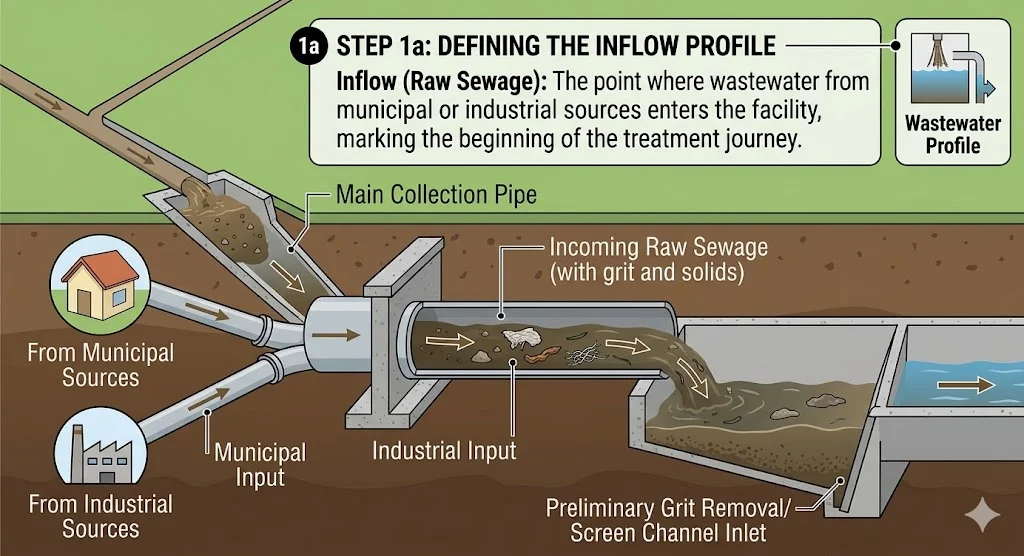
Before selecting a pump model, define what the pump will handle. Sewage in STP and municipal projects can vary widely depending on the source, screening quality and process stage.
Key questions to answer:
- Is the liquid raw sewage, screened sewage, sludge, treated wastewater, industrial effluent or mixed wastewater?
- What solids are expected: soft solids, grit, sludge, rags, plastics, fibrous waste or settled solids?
- Is the flow continuous, intermittent or peak-load driven?
- Is the pump installed in a wet well, sump, lift station, equalization tank or process transfer point?
- Is the wastewater corrosive, abrasive or chemically aggressive?
If the application is general sewage/sludge transfer, the selection may point toward a sewage/sludge pump. If the application has high clogging risk, a cutter pump may be a safer choice. If the liquid is more like treated wastewater or industrial discharge, material compatibility becomes more important.
Step 2: calculate flow rate and peak load
Flow rate decides how much wastewater the pump must move within a required time. In STP and municipal projects, the pump should be evaluated against average flow, peak flow and standby requirements.
Do not select only for the average flow if the site receives peak inflow during certain hours, monsoon periods or process discharge cycles. A pump that is correct for average flow but weak during peak load can cause wet well overflow, frequent starts and unstable operation.
For a practical selection brief, document:
- Required flow rate in m³/hr or LPM.
- Peak inflow condition.
- Number of working pumps and standby pumps.
- Operating hours per day.
- Whether the pump must empty a sump within a fixed time.
For larger STP or municipal duties, pump selection should also consider whether multiple pumps will run in duty/standby or duty/assist mode. That decision affects the flow rating of each pump.
Step 3: calculate total dynamic head
Total dynamic head is the resistance the pump must overcome. It includes static lift, pipe friction, bends, valves and discharge pressure requirement. A common selection mistake is to consider only vertical lift and ignore friction losses.
For sewage pumping systems, head calculation should include:
- Static head from liquid level to discharge point.
- Pipe length and diameter.
- Number of bends, valves and fittings.
- Friction loss at the expected flow rate.
- Required discharge pressure or terminal condition.
- Variation in wet well level.
If head is underestimated, the pump may not deliver the expected flow. If head is overestimated, the pump may run away from its efficient operating range. The selection should match the pump curve to the duty point and keep the operating point in a stable zone.
Step 4: evaluate solids handling and clogging risk
Solids handling is one of the most important differences between a regular wastewater transfer pump and a sewage-duty pump. STP and municipal sewage often includes suspended solids, sludge, fibrous waste and debris that can block narrow passages.
Selection factors include:
- Maximum expected solid size.
- Whether the waste is soft, fibrous, abrasive or stringy.
- Whether screening is available before the pump.
- Impeller design and free passage.
- Need for cutter mechanism.
- Site history of clogging or pump choking.
For general sewage and sludge handling, a submersible sewage sludge pump is usually evaluated first. For wastewater with rags, fibers or high clogging risk, a submersible cutter pump can help reduce blockage by cutting solids before pumping.
Step 5: select the right pump type
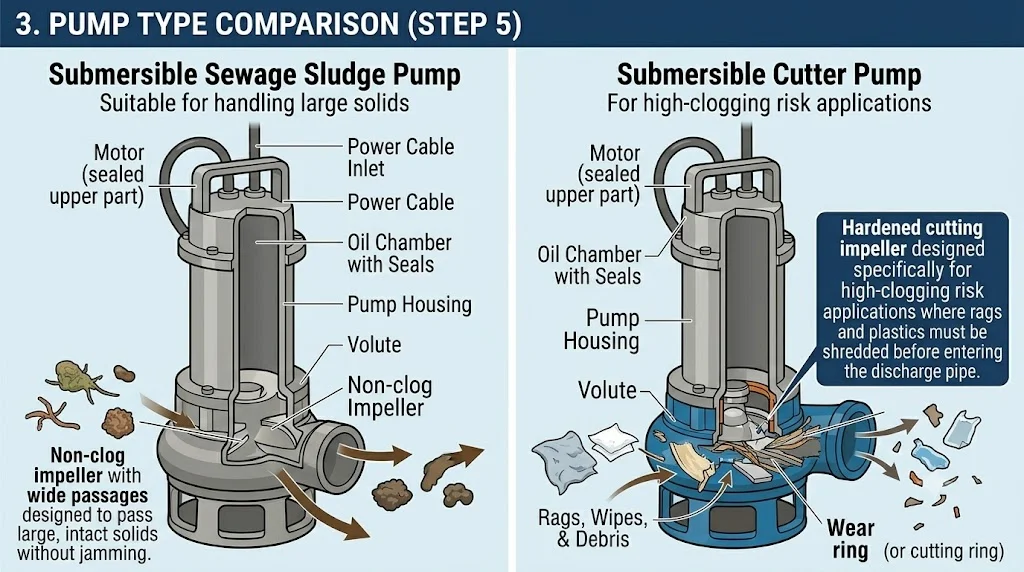
The pump type should follow the application. For STP and municipal wastewater projects, the most common options are sewage sludge pumps, cutter pumps and wastewater/effluent pumps.
Sewage sludge pump: best for sewage transfer, sludge handling, wet wells, sumps and general STP duties where solids are expected but cutting action is not the primary requirement. Review Flow Chem’s submersible sewage sludge pump when the application needs solids-handling submersible pumping.
Cutter pump: best when clogging risk is high due to fibrous waste, rags, plastics or stringy material. A submersible cutter pump is useful where the site has repeated choking or where screening is inconsistent.
Wastewater or effluent pump: best for treated wastewater, industrial discharge, process water, effluent transfer or applications where corrosion resistance and liquid characteristics are more important than raw sewage solids. For this intent, compare the duty with Flow Chem’s submersible waste water pump and effluent pump options.
If the application has mixed conditions, share the duty details with the manufacturer before procurement. Flow, head, solids and material requirements should be reviewed together, not separately.
Step 6: choose materials based on wastewater chemistry
Material selection affects pump life. In municipal sewage, cast iron construction may be suitable for many standard duties. In industrial wastewater or aggressive effluent, material compatibility becomes more important.
Check these inputs before selecting construction:
- pH range of wastewater.
- Chlorides, chemicals or corrosive content.
- Abrasive grit or suspended solids.
- Temperature.
- Required coating or stainless steel parts.
- Mechanical seal material and protection.
If wastewater has corrosive or aggressive characteristics, do not finalize the pump only from a generic sewage pump specification. Confirm material suitability with the manufacturer and document the expected liquid conditions.
Step 7: review installation and maintenance access
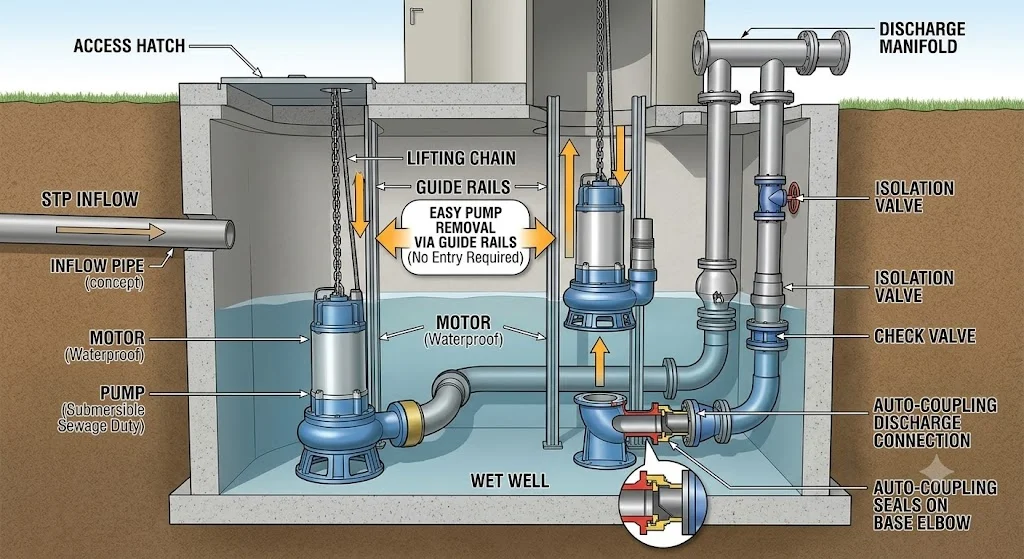
A good pump selection can still fail if the installation design is poor. STP pumps should be easy to install, remove, inspect and service. Maintenance access matters because sewage pumps often operate in difficult working conditions.
Review:
- Wet well dimensions and pump placement.
- Guide rail or coupling arrangement if applicable.
- Cable routing and lifting access.
- Non-return valve and isolation valve arrangement.
- Ventilation and electrical safety.
- Access for cleaning, inspection and pump removal.
- Availability of spare parts and service support.
For installation-led requirements, connect the selection process with the site execution team. Flow Chem also supports sewage pump installation-related requirements through its sewage pump installation services page.
Step 8: check reliability features before procurement
For STP and municipal buyers, reliability is not only about the pump body. Electrical protection, seal protection and serviceability matter over the life of the project.
Important reliability checks:
- Motor rating suitable for duty.
- Thermal protection where required.
- Seal arrangement suitable for sewage duty.
- Cable entry protection.
- Impeller suitable for solids.
- Stable pump curve for the expected duty point.
- Manufacturer support for spares and service.
A lower-priced pump without service support may cost more in downtime. For municipal and industrial wastewater systems, purchase teams should consider lifecycle cost, not only initial cost.
Common mistakes to avoid
Avoid these selection mistakes:
- Selecting only by HP without confirming flow and head.
- Ignoring solids size and fibrous waste.
- Using a wastewater pump where a cutter pump is needed.
- Underestimating pipe friction losses.
- Ignoring corrosion or chemical exposure.
- Not planning standby capacity.
- Choosing a pump without local service or spare support.
- Treating raw sewage and treated wastewater as the same duty.
These mistakes often lead to low flow, clogging, overheating, seal failure and frequent emergency maintenance.
Sewage pump selection checklist for STP projects
Use this checklist before sending a procurement enquiry:
- Application: STP, municipal sewage, lift station, sump, sludge transfer or wastewater transfer.
- Liquid type: raw sewage, sludge, screened sewage, treated wastewater or effluent.
- Flow rate: average and peak.
- Total dynamic head: static lift plus friction losses.
- Solids: size, type and clogging risk.
- Pump type: sewage sludge, cutter, wastewater or effluent pump.
- Construction: cast iron, stainless steel, coating or special material.
- Installation: wet well/sump dimensions and access.
- Operation: continuous or intermittent duty.
- Maintenance: lifting, inspection, spares and service support.
- Documentation: pump curve, motor details, material details and warranty/support terms.
When to ask Flow Chem for selection support
If the project has unclear duty data, variable wastewater conditions, high clogging risk or aggressive industrial discharge, it is safer to ask for manufacturer selection support before finalizing the pump. Flow Chem can review application details and recommend suitable pump options for sewage, sludge, cutter, effluent and wastewater pumping requirements.
For selection support, share the flow rate, head, sump depth, pipe length, liquid type, solids profile and installation details through the Flow Chem contact page. The more complete the duty data, the better the pump recommendation.
STP pump terms: WAS, RAS, non-clog and the stage-by-stage map
Municipal wastewater pumps are usually specified stage by stage, and most selection mistakes come from applying one pump term to every stage. The two abbreviations that confuse buyers most are WAS (Waste Activated Sludge) and RAS (Return Activated Sludge): in SBR (Sequential Batch Reactor) and MBBR (Moving Bed Biofilm Reactor) plants, the RAS pump returns settled sludge from the clarifier to the bioreactor, while the WAS pump bleeds surplus sludge out to thickening and dewatering.
| STP stage | Liquid handled | Pump term to specify |
|---|---|---|
| Raw sewage receiving & transfer | Screened sewage, rags, 50–75 mm solids | Non-clog submersible sewage pump |
| Aeration / bioreactor recirculation | Mixed liquor, thin biological sludge | RAS (Return Activated Sludge) pump |
| Surplus sludge withdrawal | 1–4% DS biological sludge | WAS (Waste Activated Sludge) pump |
| Sludge thickening & dewatering feed | Thickened sludge, polymer dosed | Sludge transfer pump |
| Treated effluent discharge | Clear, low-solids effluent | Effluent pump |
Once the stage map is clear, pair the selection with a wastewater pump maintenance schedule, review how dewatering pumps integrate into STPs, and compare candidates against the top sewage pumps for commercial and industrial use.
Frequently asked questions
Which pump is best for STP sewage transfer?
For general STP sewage and sludge transfer, a submersible sewage sludge pump is usually the first option to evaluate. If the sewage contains fibrous waste or repeated clogging risk, a cutter pump may be more suitable.
What is the difference between a sewage pump and a cutter pump?
A sewage pump is designed to move sewage and sludge with solids-handling capability. A cutter pump includes a cutting mechanism to reduce clogging from fibrous or stringy waste. Cutter pumps are useful in high-clogging sewage applications.
How do I size a sewage pump for an STP?
Size the pump by calculating required flow rate and total dynamic head, then matching the duty point to the pump curve. Also check solids handling, material compatibility, operating hours and standby requirements.
Can one pump handle sewage, sludge and wastewater?
One pump may handle overlapping duties if the flow, head, solids and material conditions match its design. However, raw sewage, sludge, cutter-duty wastewater and treated wastewater should be reviewed separately before final selection.
What details should I send for a sewage pump quote?
Send flow rate, total head, sump depth, pipe length, wastewater type, solids size, installation type, operating hours, material concerns and project location. These details help the manufacturer recommend a suitable pump.
What is the WAS pump in an STP?
The WAS pump in an STP is the Waste Activated Sludge pump. It transfers surplus biological sludge from the secondary clarifier or SBR/MBBR bioreactor to sludge thickening and dewatering. Its neighbour, the RAS (Return Activated Sludge) pump, returns settled sludge to the aeration tank to keep the mixed-liquor concentration stable.
What is the full form of STP pump?
STP stands for Sewage Treatment Plant, so an STP pump is any pump installed inside a sewage treatment plant: raw-sewage non-clog pumps, RAS and WAS recirculation pumps, sludge transfer pumps and treated-effluent discharge pumps, each specified for its own stage duty.
How do I choose a solids handling wastewater pump?
Match the sphere passage to the wastewater — 50–75 mm for raw municipal sewage — then verify flow at the required total dynamic head, choose a non-clog or cutter impeller for rags and fibrous waste, confirm materials against the wastewater chemistry, and size the motor for continuous or standby STP duty with a duty/standby pair.
Need help selecting the right pump?
Share your flow, head, liquid type, solids, site layout and duty cycle with Flow Chem Pumps. Our team can help you shortlist the right pump.