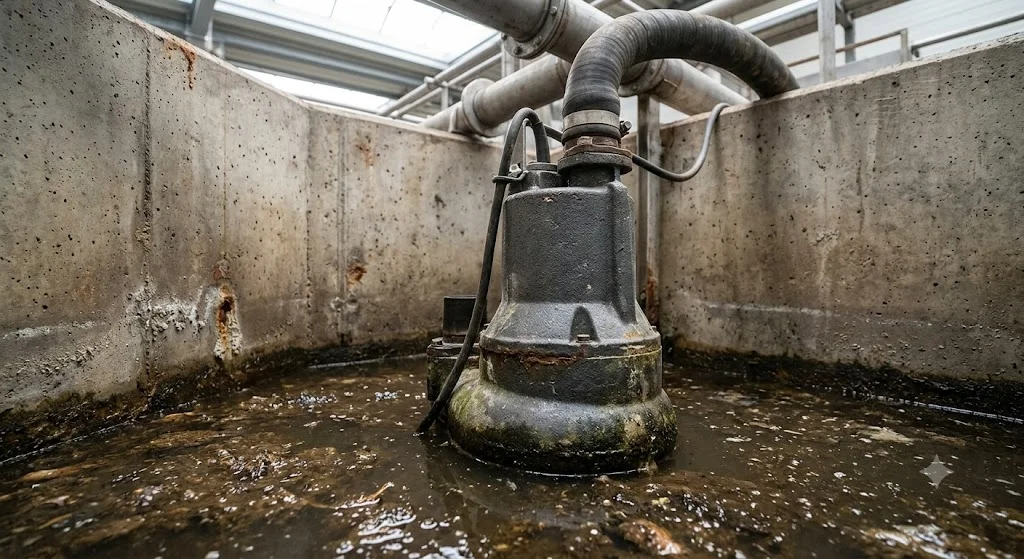
Compare cast iron, stainless steel and coating choices for industrial wastewater pumps. Learn how liquid chemistry, solids, corrosion and duty affect material selection.
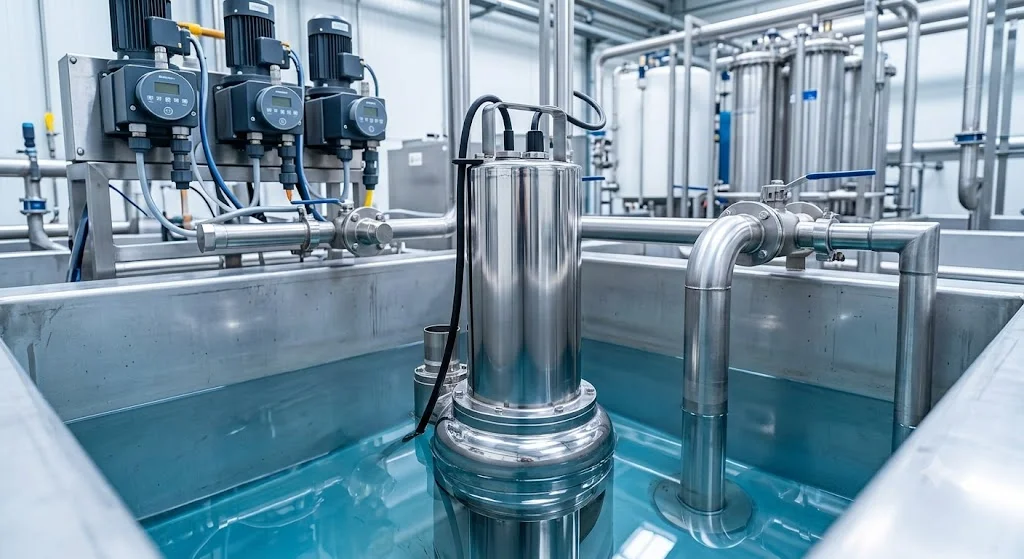
There is no single best material for every industrial wastewater pump. The right material depends on the liquid being pumped, solids content, corrosion risk, abrasion, temperature, operating hours and maintenance conditions.
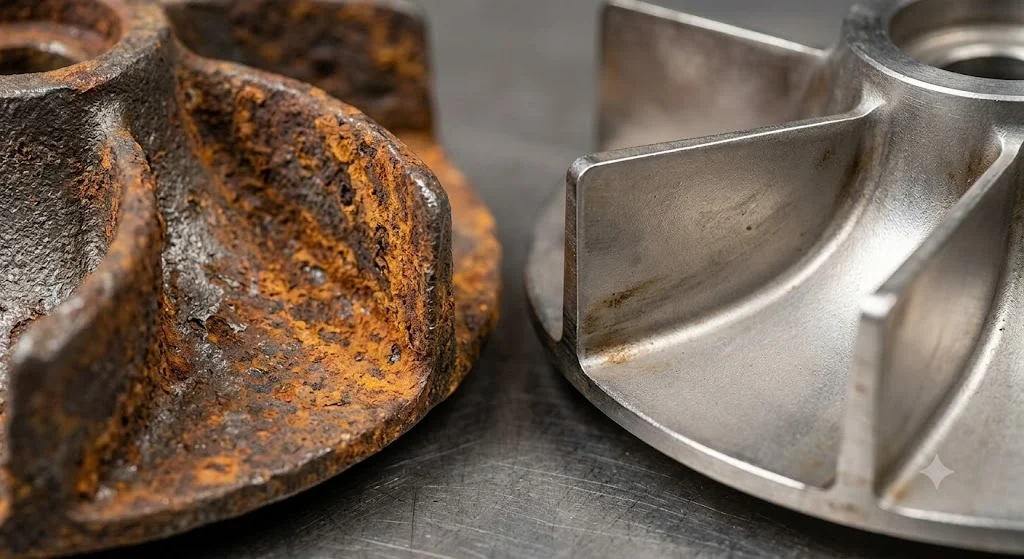
For many sewage and general wastewater duties, cast iron may be a practical base material when the liquid is not highly corrosive. For treated effluent, chemical wastewater or corrosion-sensitive applications, stainless steel or another corrosion-resistant route may be required. Coatings can help in selected cases, but coatings should not be treated as a universal fix for aggressive wastewater.
For Flow Chem, this article should route buyers toward the correct product pages:
- Submersible waste water pump for broader industrial wastewater duties.
- Effluent pumps for treated or semi-treated effluent transfer.
- Submersible sewage sludge pump for sewage, sludge and solids-laden wastewater.
- Submersible cutter pump when fibrous clogging/ragging is the main failure mode.
Why material selection matters in wastewater pumps
Industrial wastewater is not a standard liquid. It can contain sewage, sludge, process residue, chemicals, oil, grit, suspended solids, treated effluent, corrosive components or temperature variation. A pump that works in one wastewater plant may fail quickly in another if the material is not matched to the liquid.
Wrong material selection can lead to:
- Corrosion of the casing or components.
- Premature wear from abrasive solids.
- Seal problems.
- Leakage risk.
- Higher maintenance cost.
- Reduced pump life.
- Unplanned downtime.
- Wrong procurement comparison based only on upfront price.
Material selection should happen after the buyer understands the liquid. It should not be based only on generic phrases like “industrial wastewater” or “sewage pump”.
Step 1: identify the wastewater type
Before comparing cast iron, stainless steel and coatings, define the wastewater source.
Common sources include:
- STP sewage water.
- Municipal or commercial sewage.
- ETP treated or semi-treated effluent.
- Industrial process wastewater.
- Sludge transfer or settled solids.
- Drainage water from industrial pits.
- Wastewater mixed with chemicals, grit, oil or process residue.
Each source affects material risk. STP sewage may need solids handling and corrosion review. ETP effluent may need chemical compatibility review. Industrial process wastewater may need both corrosion and abrasion review.
No borewell, deep-well, domestic-water or residential pump angle should be used for this article. The target is industrial, municipal, STP and ETP wastewater selection.
Step 2: check corrosion risk
Corrosion risk depends on pH, chemical composition, dissolved gases, chloride content, temperature and exposure duration. In wastewater applications, corrosion can weaken components and increase maintenance frequency.
Ask:
- Is the wastewater acidic or alkaline?
- Are chlorides or salts present?
- Are chemicals from the process entering the wastewater?
- Is the temperature elevated?
- Does the liquid remain stagnant around the pump?
- Is the pump used continuously or intermittently?
If corrosion risk is low and the duty is general sewage/wastewater, cast iron may be considered. If corrosion risk is higher, stainless steel or another corrosion-resistant route should be reviewed. Do not assume coating alone will solve a chemically aggressive application.
Step 3: check abrasion and solids
Abrasion happens when grit, sand, hard solids or abrasive particles pass through the pump. Sewage and sludge may contain solids, but not all solids are equally abrasive. Fine grit and hard particles can wear pump components faster than softer organic solids.
Review:
- Solids size.
- Solids concentration.
- Whether solids are soft, hard, gritty or fibrous.
- Whether sludge is settled or suspended.
- Whether the application includes sand, grit or industrial residue.
- Whether the pump runs continuously with solids in the liquid.
For solids-heavy wastewater, material selection must be paired with pump-type selection. A submersible sewage sludge pump may be more relevant than a light effluent pump. If the solids are fibrous and cause ragging, review the submersible cutter pump route.
Cast iron wastewater pumps: when they make sense
Cast iron is commonly used in many pump applications because it can provide practical strength and durability for general wastewater, sewage and sludge duties when corrosion risk is manageable. It is often considered where the wastewater is not highly aggressive and where the selection priority is a robust pump body for sewage or solids-laden liquid.
Cast iron may be suitable when:
- The duty is general sewage or wastewater.
- Corrosion risk is not severe.
- The liquid does not have aggressive chemical content.
- Solids handling and pump design are more important than high corrosion resistance.
- The application needs practical durability and cost control.
Cast iron should be reviewed carefully when:
- Wastewater is acidic or chemically aggressive.
- Chloride or salt content is high.
- The pump remains exposed to stagnant corrosive liquid.
- The site has a history of casing corrosion.
- Material compatibility is uncertain.
For sewage and sludge duties, the product route should usually point to submersible sewage sludge pump and related sewage-selection content.
Stainless steel wastewater pumps: when they make sense
Stainless steel is considered where corrosion resistance, hygiene, cleaner effluent handling or chemical compatibility is more important. It may be used in treated effluent, process wastewater, chemical exposure or applications where cast iron would face faster corrosion.
Stainless steel may be suitable when:
- The wastewater is corrosive or chemically variable.
- Treated or semi-treated effluent requires better material resistance.
- The liquid contains components that may attack cast iron.
- The site needs a cleaner or more corrosion-resistant pump construction.
- Long-term corrosion cost is more important than lowest upfront price.
Stainless steel should still be selected carefully. Not every stainless steel grade is suitable for every chemical condition. The buyer should confirm the wastewater chemistry and grade suitability instead of assuming all stainless steel is equal.
For treated/semi-treated wastewater, route the buyer to effluent pumps or submersible waste water pump depending on the site duty.
Coatings: useful protection, not a universal fix
Coatings can improve surface protection in selected wastewater duties. They may help reduce corrosion or wear exposure when properly specified and maintained. But coatings do not replace correct base-material selection.
A coating may be considered when:
- The base material is suitable but needs added protection.
- The wastewater exposure is known and controlled.
- The pump can be inspected and maintained.
- The site understands coating wear and repair needs.
- The duty does not exceed coating limits.
Coatings should be reviewed carefully when:
- The wastewater is highly abrasive.
- The coating can be damaged by solids impact.
- The liquid is chemically aggressive beyond the coating’s suitability.
- Maintenance access is poor.
- The buyer expects coating to compensate for wrong material selection.
In procurement, a coated pump should not be compared only by coating name. Ask what the coating protects against, where it is applied, how it performs under abrasion and how it will be inspected over time.
Material comparison table
| Material route | Best fit | Main strength | Main caution | Typical Flow Chem page route | |---|---|---|---|---| | Cast iron | General sewage, sludge and wastewater where corrosion is manageable | Practical strength and durability | Not ideal for aggressive chemical/corrosive liquid | `/submersible-sewage-sludge-pump/` or `/submersible-waste-water-pump/` | | Stainless steel | Effluent, process wastewater or corrosion-sensitive duty | Better corrosion resistance depending on grade | Grade and chemical compatibility must be confirmed | `/effluent-pumps/` or `/submersible-waste-water-pump/` | | Coated construction | Selected duties needing added surface protection | Extra protection when properly specified | Coating damage/wear can expose base material | Use only after duty review | | Cutter route | Fibrous wastewater with rags/wipes/strings | Reduces ragging/clogging risk | Not selected only for corrosion | `/submersible-cutter-pump/` |
Step 4: match material with pump type
Material selection and pump type selection are connected. A corrosion-resistant material will not solve clogging if the pump type is wrong. A strong solids-handling pump may still fail if the liquid is chemically aggressive.
Use this route:
1. If the liquid is treated/semi-treated effluent with limited solids, review effluent pumps. 2. If the liquid is broad industrial wastewater, review submersible waste water pump. 3. If the liquid is sewage, sludge or solids-laden wastewater, review submersible sewage sludge pump. 4. If the liquid contains fibrous solids causing ragging, review submersible cutter pump. 5. If the duty is mostly water removal from pits or construction sites, review dewatering pumps or submersible drainage pump.
Step 5: check duty cycle and maintenance access
A material that performs acceptably in intermittent duty may not perform the same way in continuous operation. Exposure time matters.
Check:
- Operating hours per day.
- Whether the pump remains submerged when idle.
- Whether the sump contains stagnant wastewater.
- Maintenance interval.
- Whether the pump can be lifted and inspected easily.
- Availability of standby pump.
- Consequence of downtime.
For critical STP, ETP and industrial wastewater duties, the cheapest upfront material route may become expensive if it increases corrosion, downtime or maintenance frequency.
Step 6: avoid unsupported material claims
For SEO and sales accuracy, avoid absolute statements such as:
- “Cast iron is best for all wastewater.”
- “Stainless steel is always corrosion-proof.”
- “Coating makes any pump chemical-resistant.”
- “This material handles all industrial chemicals.”
- “One pump is suitable for every STP/ETP duty.”
The safe and correct position is: material selection depends on the actual wastewater analysis and duty point. Flow Chem can guide the buyer after reviewing liquid type, solids, flow, head, temperature, chemistry and operating conditions.
Industrial buyer checklist for material selection
Before requesting a wastewater pump quote, collect:
1. Application: STP, ETP, process wastewater, municipal sewage, industrial pit or drainage duty. 2. Liquid type: effluent, sewage, sludge, wastewater or mixed liquid. 3. pH range. 4. Chemical content or process source. 5. Temperature. 6. Solids type and size. 7. Abrasion or grit presence. 8. Corrosion history at the site. 9. Required flow. 10. Total dynamic head. 11. Operating hours per day. 12. Whether pump remains submerged when idle. 13. Material currently used and failure history. 14. Maintenance access. 15. Required documentation or compliance constraints.
This checklist helps avoid comparing pumps only on price or material name.
How this article should support Flow Chem rankings
This article should strengthen Flow Chem’s industrial wastewater authority and help Google understand product-page relationships.
Recommended internal linking actions after publishing:
- Link to `/submersible-waste-water-pump/` using anchors such as “industrial wastewater pump” and “submersible waste water pump”.
- Link to `/effluent-pumps/` using anchors such as “effluent pumps” and “effluent pump material selection”.
- Link to `/submersible-sewage-sludge-pump/` using anchors such as “sewage sludge pump” and “sewage pump material”.
- Link to `/submersible-cutter-pump/` only in the section about fibrous/ragging solids.
- Link to `/submersible-pump-manufacturer-india/` where manufacturer proof and material-selection support are discussed.
- Use root-level slug only: `/industrial-wastewater-pump-materials-cast-iron-stainless-steel-coatings`.
This is a P2 authority article. It should not compete with the main product pages. It should educate buyers and pass topical relevance to wastewater, effluent, sewage/sludge and manufacturer pages.
Frequently asked questions
What is the best material for an industrial wastewater pump?
The best material depends on wastewater chemistry, pH, temperature, solids, corrosion risk, abrasion and duty cycle. Cast iron may suit many general wastewater and sewage duties, while stainless steel may be needed for more corrosive or cleaner effluent applications.
Is cast iron suitable for sewage pumps?
Cast iron can be suitable for many sewage and sludge pump duties where corrosion risk is manageable. The buyer should still check wastewater chemistry, solids, operating hours and site corrosion history before final selection.
When should stainless steel be used for wastewater pumps?
Stainless steel should be considered when corrosion resistance, chemical compatibility or cleaner effluent handling is important. The exact stainless steel grade should be matched to the wastewater chemistry.
Do coatings make wastewater pumps corrosion-proof?
No. Coatings can provide added protection in selected duties, but they do not make a pump universally corrosion-proof. Coating suitability depends on chemical exposure, abrasion, maintenance and base-material selection.
What information is needed for wastewater pump material selection?
Provide liquid type, pH, chemical content, temperature, solids type, abrasion risk, flow, head, operating hours, installation condition and any previous corrosion or wear history.
Need help selecting the right pump?
Share your flow, head, liquid type, solids, site layout and duty cycle with Flow Chem Pumps. Our team can help you shortlist the right pump.