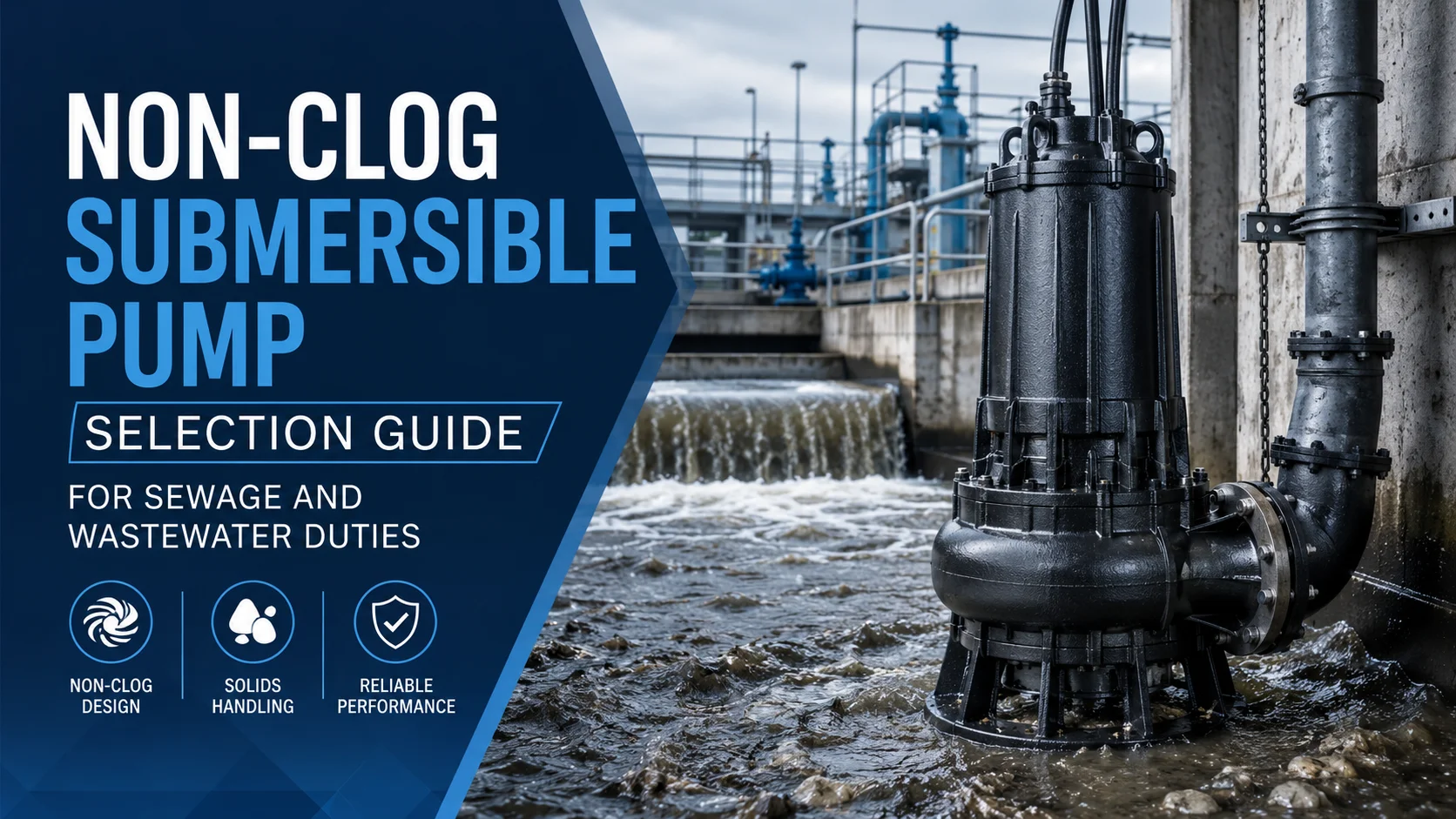
Learn how to select a non-clog submersible pump for sewage and wastewater duties. Compare solids handling, head, flow, duty cycle, cutter and sludge pump o
A non-clog submersible pump is used when the wastewater contains solids that would clog a normal pump path, but the duty still needs submersible installation and reliable continuous drainage or transfer. It is commonly considered for sewage sumps, wastewater pits, lift stations, STP transfer areas, industrial drains and municipal collection points where clogging risk is higher than with clean water.
The term “non-clog” is often used as a buyer shortcut, but it is not a guarantee that the pump will never clog. It means the pump is designed to handle solids better than a standard clear-water pump. The actual result still depends on the solids type, impeller design, free passage, discharge layout and how the site operates.
For Flow Chem buyers, the first shortlist is usually the submersible sewage sludge pump page. If the main problem is fibrous or ragging solids, review the submersible cutter pump route instead. If the duty is broader industrial wastewater rather than sewage-specific, compare with the submersible waste water pump page.
Why “non-clog” matters in real sites
In real sewage and wastewater systems, pumps rarely face a perfectly uniform liquid. One hour the pit may contain mostly water. The next hour it may contain grit, ragging solids, paper, fibers, sludge, hair-like material, food waste or mixed debris. That variation is what turns a normal pump into a maintenance problem.
A standard pump may still rotate, but it can lose flow, heat up, overload, trip the motor or need repeated cleaning if solids are not handled properly. For plant teams, the cost is not only the pump repair. The bigger cost is overflow risk, downtime, cleaning labour and unplanned service calls.
A non-clog submersible pump is relevant when the buyer wants:
- Better solids passage than a basic drainage pump.
- Lower clogging risk in sewage or wastewater duties.
- Submersible installation in pits, sumps or lift stations.
- Less frequent cleaning and lifting of the pump.
- More stable operation in variable wastewater.
It is important to be precise: non-clog capability helps most when the wastewater has manageable solids. If the material is fibrous and wraps around the impeller, a cutter pump may be needed. If the liquid is thick sludge or heavily solids-loaded, a sewage sludge pump may be the better route.
What is a non-clog submersible pump?
A non-clog submersible pump is a pump that operates while submerged in the liquid and is designed to pass solids more effectively than a clean-water pump. In industrial and municipal use, the phrase usually refers to sewage or wastewater pumps with a hydraulic design that reduces blockage risk.
The expression can include:
- Submersible sewage pump.
- Submersible sewage sludge pump.
- Wastewater pump with non-clog impeller design.
- Heavy-duty sump pump for dirty liquid.
- Industrial wastewater transfer pump.
The buyer should not assume that all of these are identical. Some pumps are built for sewage with solids. Some are better for sludge. Some are better for dirty drainage water. The selection depends on the actual liquid and the expected solids profile.
Non-clog pump vs sewage pump vs sludge pump vs cutter pump
These terms overlap in the market, but they solve different problems.
| Pump type | Best suited for | Main selection reason | Typical Flow Chem support page | |---|---|---|---| | Non-clog submersible pump | Sewage and wastewater with solids that should pass without frequent blockage | Reduce clogging in pits, lift stations and transfer sumps | `/submersible-sewage-sludge-pump/` | | Sewage pump | Sewage transfer, STP duties, municipal wastewater | Handle sewage with appropriate solids passage | `/submersible-sewage-sludge-pump/` | | Sludge pump | Thick sludge, settled solids, heavier wastewater | Move dense, solids-laden liquid reliably | `/submersible-sewage-sludge-pump/` | | Cutter pump | Fibrous, ragging-prone wastewater | Cut or reduce stringy material before blockage forms | `/submersible-cutter-pump/` | | Wastewater / drainage pump | Dirty water, effluent, pits, industrial drains | Move liquid where solids are manageable | `/submersible-waste-water-pump/`, `/effluent-pumps/` |
A non-clog pump is usually the general starting point. A cutter pump becomes relevant when the solids are not just present, but are wrapping and clogging. A sludge pump becomes relevant when the wastewater is thicker and heavier than normal sewage.
Step 1: identify the liquid category first
Start with the liquid, not with horsepower.
Ask what the pump is moving:
- Sewage.
- Treated or semi-treated wastewater.
- Industrial wastewater.
- Sludge.
- Dirty drainage water.
- Mixed wastewater with fibers or debris.
If the liquid is primarily dirty drainage or effluent, a non-clog pump may be unnecessary. If the liquid is sewage or sludge, the non-clog route becomes more relevant. If the liquid contains fibrous waste, the cutter route may be stronger.
For buyers working across treatment plants, a useful rule is:
- Clear water or light dirty water: drainage or dewatering pump.
- Sewage with manageable solids: non-clog sewage pump.
- Fibrous sewage: cutter pump.
- Thick sludge: sewage sludge pump.
Step 2: define the solids profile
The solids profile is the biggest determinant of whether a non-clog submersible pump is suitable.
Check:
- Are the solids soft or hard?
- Are they small, large or irregular?
- Are they fibrous or stringy?
- Do they wrap around rotating parts?
- Is there grit or abrasive material?
- Is the liquid mostly sewage, or sewage mixed with debris?
- Is screening weak upstream?
A non-clog pump is most useful when the solids are present but not aggressively ragging. If the solids are ragging-prone, a standard non-clog impeller may still struggle. In that case, cutter technology deserves a closer look.
Step 3: calculate flow and total dynamic head
Do not select a non-clog pump by solids handling alone. The pump still has to move the required flow against the actual head.
Measure:
- Required flow rate.
- Vertical lift.
- Horizontal discharge distance.
- Pipe diameter.
- Number of bends and fittings.
- Valve and pressure losses.
- Discharge elevation.
- Level variation as the sump empties.
If head is underestimated, the pump may technically be non-clog but still fail the duty. If the pipe run is long or narrow, the selected pump may deliver much less flow than expected.
A larger motor does not automatically solve the issue. The pump curve must match the actual duty point.
Step 4: check duty cycle and operating hours
A pump that runs occasionally is not the same as a pump that runs all day.
Confirm:
- Intermittent or continuous duty.
- Expected hours per day.
- Seasonal peak loading.
- Whether inflow continues while the pump is running.
- Whether standby capacity is needed.
- Whether automatic level control is required.
If the site is critical, a duty/standby arrangement may be safer than relying on one pump. In many sewage and wastewater sites, reliability matters as much as capacity.
Step 5: confirm impeller and free-passage requirement
For non-clog applications, the internal hydraulic design matters.
Buyers should ask for:
- Free passage size.
- Impeller type.
- Solids handling capability.
- Passage through volute and discharge path.
- Expected maintenance interval.
Free passage is not only a specification line. It affects whether the pump can keep operating when solids appear in the wastewater. A pump with poor passage may still look suitable on paper but may fail in the field.
Step 6: validate material and wear resistance
Sewage and wastewater can carry grit, sand and abrasive fines. These particles wear pump parts over time.
Check:
- Cast iron or other wetted-part material.
- Seal arrangement.
- Abrasion resistance.
- Corrosion exposure.
- Temperature of the liquid.
- Chemical compatibility if the liquid is not pure sewage.
If the pump will see abrasive solids, the selection must balance clog resistance with wear life. A unit that resists clogging but wears rapidly may still create downtime.
When a non-clog submersible pump is usually a good fit
A non-clog submersible pump is usually practical when:
- The liquid is sewage or wastewater with solids.
- The solids are manageable, not heavily fibrous.
- The site needs submerged installation.
- The discharge head is within the pump curve.
- The discharge line is not excessively restrictive.
- Maintenance access is limited and downtime must be reduced.
- The site has recurring blockage with a standard pump.
Typical use cases include:
- STP sewage transfer sumps.
- Municipal pumping stations.
- Lift stations.
- Industrial wastewater pits.
- Commercial building sewage pits.
- Plant drains with mixed solids.
- Flooded service pits where debris is moderate.
When a different pump type should be shortlisted instead
Choose another pump route when the main issue is not general clogging.
1. Use a cutter pump when solids are fibrous
If the wastewater contains wipes, cloth, rags, plastic strips or other wrapping solids, a submersible cutter pump is often the better shortlist.
Signs include:
- Repeated ragging around the impeller.
- Frequent removal for manual cleaning.
- Clogs caused by fibrous waste rather than sludge.
- Pump flow dropping even when the motor is running.
2. Use a sewage sludge pump when the liquid is thicker
If the duty is thicker, heavier or more solids-loaded than normal sewage, review the submersible sewage sludge pump route.
Signs include:
- Settled solids or sludge in the sump.
- Higher viscosity than normal wastewater.
- Slower flow acceptable, but reliable solids transfer required.
- Need to move sludge-like material rather than only sewage water.
3. Use a drainage or dewatering pump when the liquid is mostly water
If the liquid is mainly seepage, rainwater or construction water, a dewatering pump or submersible drainage pump may be more suitable.
A non-clog pump is not the right default for water-removal duties where solids are minimal.
Non-clog submersible pump for sewage applications
Sewage is the most common environment where the non-clog term appears.
For sewage duties, confirm:
- Is the liquid raw sewage or partially treated wastewater?
- Are there solids, paper or soft debris?
- Is the line short or long?
- Does the site experience peak inflow during certain hours?
- Is the pump part of an STP, municipal system or private building system?
A non-clog sewage pump can be a practical answer when the task is sewage transfer and the solids are present but not strongly ragging. If the site sees wipes, cloth or packaging material, the non-clog shortlist should be checked against a cutter pump.
Non-clog submersible pump for industrial wastewater
Industrial wastewater adds another layer: the liquid may include solids, chemicals, grease, temperature variation or process residue.
Before selecting, confirm:
- Whether the wastewater is compatible with the pump materials.
- Whether oil, grease or chemicals are present.
- Whether the solids are abrasive.
- Whether the pump must run continuously.
- Whether the pit is in a critical production area.
For broader industrial wastewater, compare the duty with submersible waste water pump and effluent pumps as needed. The right choice depends on the liquid quality, not just on the word wastewater.
Buyer checklist before asking for a quote
Before requesting a non-clog submersible pump quote, prepare:
- Application: sewage, wastewater, sludge, industrial drain or municipal pit.
- Liquid type: sewage, wastewater, effluent or sludge.
- Required flow rate.
- Total dynamic head.
- Vertical lift.
- Pipe or hose size and length.
- Solids profile and debris description.
- Duty cycle and operating hours.
- Power supply details.
- Need for automatic control or float switch.
- Need for standby pumping.
- Existing pump make/model, if replacing.
This information helps Flow Chem confirm whether a non-clog submersible pump is suitable or whether cutter, sludge or drainage options should be recommended instead.
Common mistakes to avoid
Mistake 1: treating non-clog as a universal fix
Non-clog does not mean impossible to clog. It means better solids handling than a normal pump. If the wastewater is fibrous or badly screened, the wrong pump type can still fail.
Mistake 2: selecting only by horsepower
Horsepower is only one part of the selection. Flow, head, solids and duty cycle matter more than motor rating alone.
Mistake 3: ignoring the solids type
A sewage pump, sludge pump and cutter pump are not interchangeable. The solids profile decides the best shortlist.
Mistake 4: ignoring pipe losses
A pump may look suitable until the discharge line is calculated properly. Long hoses, small pipe diameter and multiple bends reduce performance.
Mistake 5: not planning for maintenance access
If the site is hard to access, a pump that needs frequent cleaning creates more downtime. In those cases, a better solids-handling design is worth the upfront effort.
Conclusion
A non-clog submersible pump is the right conversation starter for many sewage and wastewater duties, but it should never be selected blindly. The buyer still has to confirm solids type, head, flow, duty cycle, discharge layout and maintenance access.
For Flow Chem, the safest approach is to treat “non-clog” as a functional requirement, then match the actual duty to the right product family. In many cases that will lead to the submersible sewage sludge pump. In fibrous duties it may lead to the submersible cutter pump. In light wastewater duties it may lead to submersible waste water pump or effluent pumps.
For selection support, contact Flow Chem through the enquiry page and share your application details, liquid type, flow/head requirement, solids description and operating hours.
Frequently asked questions
What does non-clog submersible pump mean?
It usually means a submersible pump designed to pass sewage or wastewater solids more effectively than a standard clear-water pump. It reduces clogging risk, but it is not clog-proof.
Is a non-clog pump the same as a sewage pump?
Not always. Many sewage pumps are non-clog in practice, but the correct selection depends on solids, head and the exact duty. Some sewage duties need a cutter pump or sludge pump instead.
When should I choose a cutter pump instead?
Choose a cutter pump when the wastewater contains rags, wipes, cloth, plastic strips or other fibrous solids that wrap and clog the pump.
Can a non-clog submersible pump handle sludge?
It may handle light sludge or mixed wastewater, but thick sludge usually needs a submersible sewage sludge pump matched to the duty.
What details are needed for a non-clog pump quote?
Provide liquid type, solids description, flow rate, total head, pipe size and length, duty cycle, power supply and whether standby pumping is required.
Can I choose a non-clog submersible pump only by horsepower?
No. Horsepower alone does not confirm suitability. The pump curve, solids handling and installation conditions matter more.
Need help selecting the right pump?
Share your flow, head, liquid type, solids, site layout and duty cycle with Flow Chem Pumps. Our team can help you shortlist the right pump.