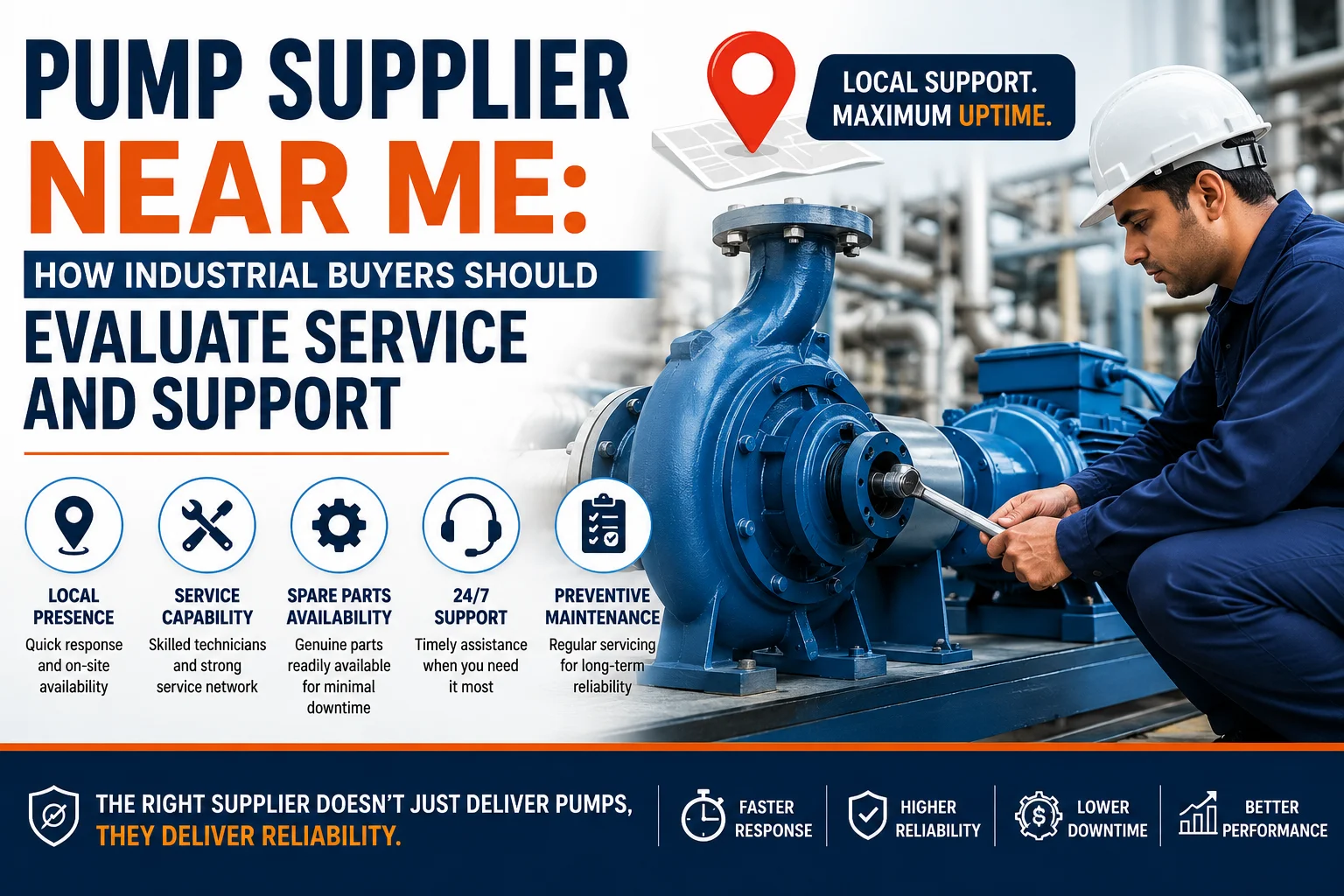
Searching for a pump supplier near me? Use this industrial buyer checklist to evaluate service support, spares, documentation, application fit and quote cl
Industrial buyers should check whether a nearby pump supplier can support the actual pumping duty, not just whether the supplier is geographically close. For sewage, wastewater, dewatering, sludge, cutter or drainage applications, the supplier should understand flow, total dynamic head, solids, material compatibility, installation and maintenance requirements.
A good pump supplier should help the buyer choose the right pump type, explain quote assumptions, provide documentation and discuss service or spares support clearly. If the project is industrial or municipal, a generic “water pump supplier near me” result may not be enough.
For Flow Chem, this article should support the main manufacturer/supplier money page: submersible pump manufacturer in India. It should also route buyers naturally to relevant application pages such as dewatering pumps, submersible sewage sludge pump, submersible cutter pump and submersible waste water pump.
Why “near me” is not enough for industrial pump buying
Nearness can matter when service, installation coordination or urgent communication is required. But for industrial pump buying, location alone should not decide the supplier.
A nearby supplier may still be a poor fit if they cannot support the application. A supplier located farther away may be a better fit if they can understand the duty, recommend the correct pump type, provide documentation and support future maintenance.
For industrial buyers, the real question is not only “Who is near me?” The better question is: “Which supplier can help us select and maintain the right pump for this duty?”
Step 1: define what type of pump supplier you need
Different applications need different supplier capability. Before shortlisting suppliers, define the duty.
Common industrial pump needs include:
- Sewage transfer in STP, municipal or commercial projects.
- Sludge transfer or solids-laden wastewater handling.
- Construction, mining or municipal dewatering.
- Industrial drainage and sump emptying.
- Treated or semi-treated effluent transfer.
- High-clogging wastewater with fibrous solids.
- Industrial wastewater with corrosion or material concerns.
A supplier for general water transfer may not be suitable for sewage or wastewater. For fibrous wastewater, a submersible cutter pump may be required. For sewage/sludge, a submersible sewage sludge pump may be more relevant. For site-water removal, the buyer may need dewatering pumps.
Step 2: check application-fit selection support
A reliable pump supplier should ask for duty data before recommending a pump.
Useful selection inputs include:
- Required flow rate.
- Total dynamic head.
- Static lift and pipe length.
- Number of bends, valves and fittings.
- Liquid type: sewage, sludge, wastewater, effluent, drainage water or process water.
- Solids size and clogging risk.
- pH, temperature and corrosion risk.
- Operating hours and duty cycle.
- Installation access and sump depth.
If the supplier quotes only by horsepower, price or discharge size, the buyer should ask for a proper duty-point review.
Step 3: evaluate service support realistically
Service support is one of the main reasons buyers search locally. But service support should be verified practically.
Ask:
- What service information is provided before purchase?
- What maintenance steps should the site team follow?
- What information is needed if the pump fails?
- Are spare parts and wear components discussed?
- Is pump removal and reinstallation access considered?
- Is troubleshooting guidance available?
- Are support timelines or areas approved and clearly stated?
Do not publish or rely on claims such as “same-day service”, “pan-India service” or “ready stock” unless those details are verified and approved.
Step 4: compare documentation quality
Documentation helps industrial teams avoid confusion between purchase, installation and maintenance.
A useful supplier should provide or explain:
- Pump type and application fit.
- Flow/head selection basis.
- Motor and electrical details.
- Material and construction assumptions.
- Solids-handling assumptions.
- Installation considerations.
- Quote inclusions and exclusions.
- Maintenance or service notes.
- Information still needed from the buyer.
For EPC and municipal projects, documentation can be as important as price because it reduces approval delays and miscommunication.
Step 5: check whether the supplier can support the right product category
A supplier may rank for “pump supplier near me” but still not have the right product route for industrial wastewater or sewage duty. Buyers should confirm product-category fit.
Typical product-category checks:
- Does the supplier understand dewatering duties for construction, mining or municipal sites?
- Does the supplier support sewage/sludge pumping applications?
- Can the supplier explain when cutter pumps are needed?
- Can the supplier support industrial wastewater or effluent transfer?
- Can the supplier discuss material suitability where wastewater is aggressive?
- Can the supplier guide the buyer toward a manufacturer-level recommendation if needed?
For Flow Chem, the article should reinforce that product selection must be connected to the correct money page and application.
Step 6: compare quote clarity
A nearby supplier with a vague quote can still create project risk. Quote clarity helps the buyer understand what is being supplied and whether it fits the duty.
A clear pump quote should explain:
- Pump type and intended application.
- Flow and head basis.
- Motor/phase assumptions.
- Material assumptions.
- Solids-handling assumptions.
- Scope of supply.
- Installation or control-panel exclusions.
- Service/support assumptions where approved.
- Pending information from the buyer.
If the quote does not explain why the pump is suitable, request clarification before procurement.
Step 7: evaluate supplier risk for industrial projects
Industrial pump failure can create downtime, overflow, site delays, maintenance hazards or process interruption. Supplier evaluation should therefore include risk control.
Risk questions include:
- What happens if the pump clogs?
- What happens if the pump does not deliver expected flow?
- What happens if the liquid is more corrosive than expected?
- Who reviews the duty if the site conditions change?
- Can the buyer access spares and service guidance?
- Is the maintenance team able to remove and inspect the pump safely?
A good supplier conversation should reduce uncertainty before the purchase order is released.
Common mistakes when searching for pump suppliers near me
Avoid these mistakes:
- Choosing only the closest supplier.
- Choosing only the lowest quote.
- Comparing only motor HP.
- Ignoring total dynamic head.
- Treating sewage, wastewater and clean-water transfer as the same duty.
- Ignoring solids, fibers and clogging risk.
- Ignoring material compatibility.
- Accepting vague service/support claims.
- Not asking for quote assumptions.
- Using local-search intent to create fake service-area claims.
The best supplier shortlist should be based on application fit, documentation, serviceability and lifecycle risk, not only location.
Pump supplier near me checklist for industrial buyers
Use this checklist before shortlisting a pump supplier:
- Application is defined: sewage, wastewater, dewatering, sludge, cutter, drainage or effluent.
- Flow and total dynamic head are documented.
- Liquid type and solids profile are clear.
- Corrosion/material concerns are reviewed.
- Supplier can explain pump selection logic.
- Supplier has access to the relevant pump category.
- Documentation is clear.
- Quote assumptions are visible.
- Service and spares support are discussed accurately.
- No unsupported local/service-area claims are used.
- Buyer knows what information to send for selection.
For Flow Chem, buyers can submit duty details through the Flow Chem contact page. Useful information includes flow, head, liquid type, solids profile, sump depth, pipe length, operating hours, material concerns and project location.
Frequently asked questions
How do I choose a pump supplier near me for an industrial project?
Choose a pump supplier by checking application fit, flow/head selection support, product-category suitability, documentation quality, service support, spares discussion and quote transparency. Do not choose only by distance or lowest price.
Is a nearby pump supplier always better?
Not always. A nearby supplier can be useful for communication and service coordination, but industrial buyers should still verify pump selection capability, documentation, service support and application fit. The best supplier is the one that reduces project risk.
What details should I send to a pump supplier for selection?
Send required flow rate, total dynamic head, liquid type, solids size, clogging history, pH or chemical exposure, sump depth, pipe length, duty cycle, electrical details and project location. Complete information helps the supplier recommend the correct pump.
Can a general water pump supplier handle sewage or wastewater applications?
Only if the supplier has the right product range and selection expertise. Sewage, sludge, high-solids wastewater and cutter duties need different selection logic from clean-water transfer.
Should I search for a pump supplier or a pump manufacturer?
If the project needs technical selection, documentation and application support, a manufacturer or manufacturer-backed supplier may be more suitable. For industrial duties, buyers should prioritize selection support and serviceability over generic supplier listings.
Can Flow Chem content claim local service areas or ready stock?
Only if those claims are verified and approved. For this article, avoid unsupported local service, ready stock, price, delivery, capacity or availability claims. Use application-fit and service-evaluation guidance instead.
Need help selecting the right pump?
Share your flow, head, liquid type, solids, site layout and duty cycle with Flow Chem Pumps. Our team can help you shortlist the right pump.