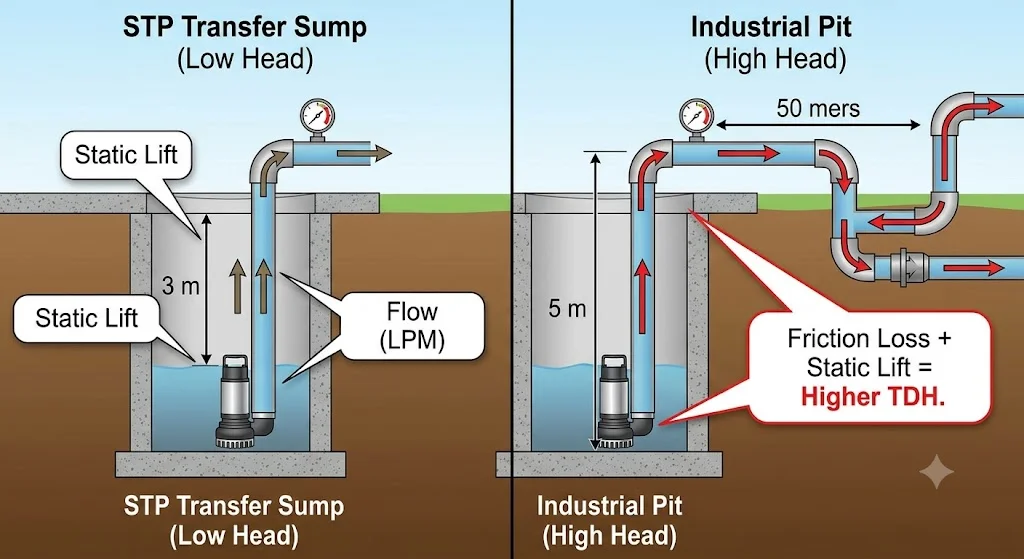
Learn how to select a sewage motor for STP, municipal and industrial wastewater duties based on HP, phase, head, flow, solids handling and duty cycle.
Select a sewage motor by starting with the duty point, not the motor horsepower. The duty point means the required flow and total dynamic head for the sewage or wastewater system. After that, check the solids profile, sump depth, pipe length, operating hours, phase availability and control-panel requirements.
For most STP, municipal and industrial wastewater sites, the correct question is not “Which HP sewage motor should I buy?” The correct question is: “What pump and motor combination will move this wastewater at the required flow and head without clogging, overloading or failing during actual site operation?”
For Flow Chem’s June SEO architecture, this article supports the submersible sewage sludge pump product page. That page should remain the main commercial ranking URL for sewage pump, submersible sewage pump, sewage water pump, 2 HP sewage pump and sewage motor intent.
Why HP alone is not enough
A common buyer mistake is to select a sewage motor only by HP. HP matters, but it does not describe the full site duty. A 2 HP sewage pump can perform very differently depending on head, flow, discharge line, impeller design, solids loading, sump condition, power supply and duty cycle.
Two sites can both ask for a 2 HP sewage motor, but their requirements may be completely different:
- One site may need moderate flow at low head for an STP transfer sump.
- Another site may need higher head because the discharge line is long or elevated.
- One site may handle mostly sewage water with manageable suspended solids.
- Another site may handle sludge, ragging-prone solids or heavy wastewater.
- One site may run intermittently; another may run for long hours every day.
If the selection is made only by HP, the pump may run but fail to deliver enough flow, trip frequently, clog, overheat or wear out early. Motor selection must be tied to hydraulic duty and solids-handling requirements.
What does “sewage motor” mean in buyer searches?
In Indian industrial and municipal search behavior, the term `sewage motor` is often used by buyers looking for a sewage pump or submersible sewage pump. The buyer may not be asking only for the electric motor as a separate component. They may be searching for the complete pump-motor unit used in sewage or wastewater pumping.
This is important for SEO and content structure. Flow Chem should answer the term naturally, but route the buyer to the correct product page:
- For sewage and sludge duties, link to submersible sewage sludge pump.
- For fibrous clogging duties, compare with submersible cutter pump.
- For construction or drainage water removal, compare with dewatering pumps or submersible drainage pump.
- For cleaner treated or semi-treated water, compare with effluent pumps or submersible waste water pumps.
The article should not create a separate “sewage motor” product claim unless Flow Chem wants a dedicated commercial page later. For now, the safest and strongest SEO route is to support the sewage/sludge pump money page.
Step 1: define the sewage or wastewater application
Before selecting HP or phase, define the application clearly. Sewage and wastewater applications vary widely.
Common B2B applications include:
- STP inlet, transfer or collection sumps.
- Municipal sewage pumping stations.
- Industrial wastewater pits.
- Commercial building sewage transfer systems.
- ETP or process wastewater transfer where solids may be present.
- Sludge recirculation or sludge transfer where suitable pump design is required.
- Emergency sewage or wastewater pumping duties.
Each application creates a different selection priority. A municipal sump may need better solids handling and reliable duty/standby operation. An industrial pit may need material compatibility. A sludge duty may require a different impeller and motor loading review than a general sewage water duty.
No borewell, deep-well, domestic-water or residential pump angle should be used for this article. The target audience is STP, municipal, commercial and industrial wastewater buyers.
Step 2: calculate flow requirement
Flow is the volume of wastewater the pump must move in a given time. It is usually expressed in LPM, m³/hr or similar units. The motor/pump combination must be selected to meet this flow at the actual site head.
Flow depends on:
- Inflow rate into the sump.
- Peak load during operating hours.
- Whether the system uses one pump or duty/standby pumps.
- Required emptying time for the sump.
- Process requirements at STP or industrial sites.
- Safety margin for peak sewage load or monsoon inflow.
A pump that is too small may not empty the sump fast enough. A pump that is too large may short-cycle, consume unnecessary power or operate away from the suitable part of its curve. Flow should be calculated before choosing HP.
Step 3: calculate total dynamic head
Head is the resistance the pump must overcome to move sewage from the sump to the discharge point. It is not only the vertical lift. Total dynamic head includes static lift, friction losses and discharge conditions.
For sewage motor selection, document:
- Vertical lift from the lowest water level to the discharge point.
- Horizontal pipe length.
- Pipe diameter.
- Number of bends, valves and fittings.
- Discharge pressure or receiving-line condition.
- Non-return valve and other restrictions.
- Whether the pipe may carry solids or sludge.
Higher head usually requires more motor power for the same flow. But the correct selection should still be based on the pump curve and duty point, not an HP guess.
Step 4: confirm solids-handling requirement
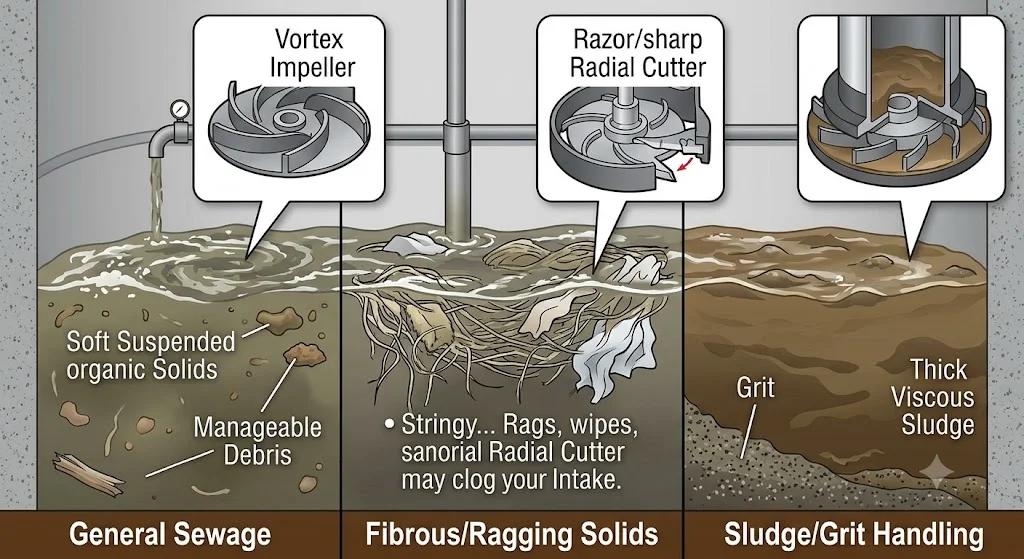
Sewage water is not clean water. It may include suspended solids, organic matter, sludge, grit, rags, wipes, plastics or fibrous material. The pump and motor must be selected based on the actual solids profile.
Ask these questions:
- Is the liquid mostly sewage water or thick sludge?
- Are solids soft, hard, fibrous or abrasive?
- Is ragging or clogging already happening?
- Does the site receive wipes, cloth, plastics or packaging material?
- Is the duty intermittent or continuous?
- Does the system need a non-clog, sewage sludge or cutter-pump route?
For normal sewage and sludge handling, Flow Chem’s submersible sewage sludge pump page should be the primary recommendation. If fibrous clogging is the main problem, compare with the submersible cutter pump page.
Step 5: select HP after flow and head are known
HP should be selected after flow, head and solids conditions are known. A buyer may ask for a 1 HP, 2 HP, 3 HP or higher HP sewage motor, but the correct rating depends on the duty.
General selection logic:
| Selection condition | What it means | Selection note | |---|---|---| | Low head + moderate flow | Short lift and manageable discharge line | Lower HP may be enough if solids are suitable | | Higher head + same flow | More resistance to overcome | Motor rating may need to increase | | Longer pipe + more bends | Higher friction loss | Check total dynamic head carefully | | Sludge or heavier wastewater | Higher load and wear risk | Check pump design and motor loading | | Fibrous solids | Clogging risk | Review cutter pump suitability | | Long operating hours | More heat and duty stress | Confirm duty rating and protection |
For SEO, this section supports related search demand around `2 hp sewage pump`, but the article should avoid publishing generic capacity claims such as “2 HP will pump X litres” unless Flow Chem has confirmed model-specific data.
Step 6: choose single phase or three phase
Phase selection depends on power availability, motor rating, site infrastructure and duty requirement.
Single-phase sewage motor
Single-phase supply may be used in some smaller commercial or facility-level duties where the required motor rating is lower and the electrical infrastructure is limited. It may be easier to source power, but it is not always suitable for larger or heavy-duty wastewater applications.
Three-phase sewage motor
Three-phase supply is commonly preferred for industrial, STP and municipal duties because it supports more stable operation for higher-power motors and demanding applications. For continuous or heavy wastewater duty, three-phase configuration is often more appropriate when site power is available.
Selection should consider:
- Available site power.
- Motor rating.
- Starting current.
- Control panel requirements.
- Duty cycle.
- Reliability requirements.
- Whether automatic level-based operation is needed.
Do not choose phase only by convenience. Choose it based on duty and electrical reliability.
Step 7: check control panel and protection requirements
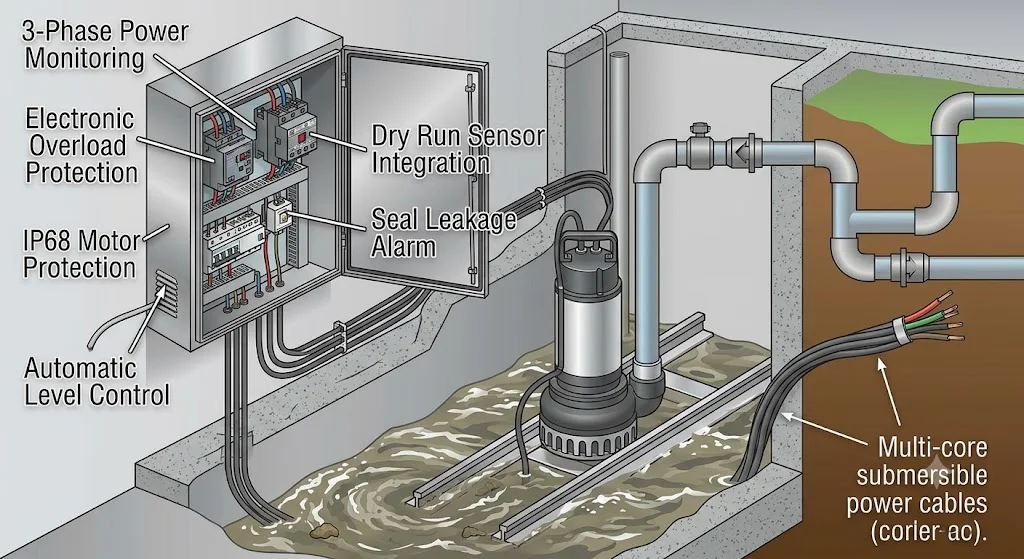
A sewage pump is often installed in a harsh operating environment. Electrical protection is not optional. The control system should protect the motor from overload, phase failure, voltage issues, dry run and abnormal operation where relevant.
Common protection considerations include:
- Starter type.
- Overload relay or motor protection.
- MCB/MCCB and panel safety.
- Phase failure protection for three-phase motors.
- Float switch or level sensor integration.
- Dry-run protection where applicable.
- Cable gland and cable protection.
- Earthing and site safety requirements.
Many sewage pump failures are blamed on the pump but caused by poor protection, wrong panel setting or unstable supply. For industrial and municipal buyers, motor protection should be part of the selection discussion.
Step 8: evaluate installation depth and cable requirements
For submersible sewage pumps, installation conditions affect the final selection. The pump may be installed in a sump where liquid level, cable routing and access conditions vary.
Check:
- Maximum and minimum liquid level.
- Sump depth.
- Whether the pump is fixed, portable or guide-rail mounted.
- Cable length required.
- Cable exposure and protection.
- Lifting chain or guide rail requirement.
- Accessibility for service.
If the pump is difficult to access, reliability and protection become more important. A low-cost selection that requires frequent lifting can become expensive over time.
Step 9: consider duty cycle and standby requirement
Sewage and wastewater systems often need operational reliability. A single pump may not be enough for critical sites.
Consider duty/standby arrangement when:
- The site cannot tolerate overflow.
- The sump receives unpredictable peak inflow.
- The application is municipal or compliance-sensitive.
- The pump runs for long hours.
- Maintenance access is difficult.
- The cost of downtime is high.
A duty/standby system improves reliability because one pump can operate while another remains available. For important STP and municipal applications, this should be reviewed during design, not after failure.
2 HP sewage motor: when is it relevant?
Searches around `2 hp sewage pump` and `sewage motor` often overlap. A 2 HP sewage motor may be relevant where the calculated flow and head match a 2 HP sewage pump model and the solids profile is suitable. But 2 HP should not be treated as a universal answer.
A 2 HP sewage pump selection should still confirm:
- Required flow.
- Required total dynamic head.
- Solids size and type.
- Sump depth.
- Pipe length and diameter.
- Single-phase or three-phase availability.
- Control panel and protection.
- Operating hours.
For buyers researching 2 HP sewage pumps, Flow Chem should use this article and the separate 2 HP sewage pump guide to route traffic to the submersible sewage sludge pump page, where the actual commercial inquiry can be handled.
Sewage motor selection checklist
Before requesting a quote, collect the following information:
1. Application: STP, municipal, commercial or industrial wastewater. 2. Liquid type: sewage water, sludge, effluent or mixed wastewater. 3. Solids type: suspended, settled, fibrous, abrasive or mixed. 4. Required flow rate. 5. Total dynamic head. 6. Sump depth and liquid level variation. 7. Pipe diameter and discharge length. 8. Number of bends and valves. 9. Available phase: single phase or three phase. 10. Required operating hours per day. 11. Whether duty/standby arrangement is needed. 12. Control panel and protection requirements. 13. Cable length requirement. 14. Existing pump failure history, if replacement is needed. 15. Any chemical, temperature or corrosion concern.
This information helps the technical team recommend a pump-motor combination instead of guessing from HP alone.
Common mistakes in sewage motor selection
Mistake 1: buying by HP only
HP does not define performance. Always match HP to the pump curve, flow, head and wastewater condition.
Mistake 2: ignoring solids
A sewage motor/pump that is suitable for sewage water may not be suitable for thick sludge or fibrous ragging. Solids profile must be checked.
Mistake 3: ignoring phase and protection
Wrong phase selection, unstable voltage or missing protection can damage the motor even if the hydraulic selection is correct.
Mistake 4: using a dewatering pump for sewage duty
A dewatering pump is designed for water removal. It may not be appropriate for sewage with solids, sludge or ragging risk. Use the correct product route.
Mistake 5: publishing unverified price or capacity claims
Avoid generic claims about price, capacity, model availability or exact discharge performance unless Flow Chem has confirmed model data. Use the article to educate and route qualified inquiries.
How this article should support Flow Chem rankings
This article should strengthen the sewage cluster, not create a competing ranking URL.
Recommended internal linking actions after publishing:
- Link to `/submersible-sewage-sludge-pump/` as the primary money page using anchors such as “sewage motor”, “submersible sewage pump”, “sewage pump motor” and “sewage sludge pump”.
- Link to the 2 HP sewage pump guide using anchor text such as “2 HP sewage pump selection”.
- Link to the STP sewage pump selection article using anchor text such as “sewage pump for STP”.
- Link to `/submersible-cutter-pump/` where the article discusses fibrous solids and ragging.
- Link to `/dewatering-pumps/` and `/submersible-drainage-pump/` only to clarify non-sewage water-removal duties.
- Add a reciprocal link from `/submersible-sewage-sludge-pump/` to this article under a section like “Sewage Motor Selection Guide”.
- Use root-level slug only: `/sewage-motor-selection-hp-phase-head-solids`.
For June 2026, this article supports the `sewage motor` keyword and reinforces the broader sewage cluster: sewage pump, submersible sewage pump, sewage water pump and 2 HP sewage pump.
Frequently asked questions
What is a sewage motor?
A sewage motor usually refers to the motor or pump-motor unit used in a sewage pump system. In buyer searches, the term often means a submersible sewage pump used for STP, municipal, commercial or industrial wastewater duties.
How do I select the correct HP for a sewage motor?
Select HP after calculating the required flow and total dynamic head and checking the solids profile. HP alone is not enough because pipe length, lift, bends, sludge, ragging and duty cycle all affect the final motor/pump selection.
Is a 2 HP sewage pump enough for STP use?
A 2 HP sewage pump may be enough only if the required flow, head, solids profile and operating hours match that pump’s duty. It should not be selected only because 2 HP sounds sufficient. The site duty must be calculated first.
Which is better for sewage pumps: single phase or three phase?
Single phase may suit smaller duties where site power and motor rating allow it. Three phase is generally preferred for heavier STP, municipal and industrial wastewater duties because it supports more stable operation for higher-power motors.
What causes sewage pump motor overload?
Common causes include clogging, wrong pump selection, high head, blocked discharge, thick sludge, fibrous solids, voltage problems, incorrect overload settings or long operating hours beyond the suitable duty.
Need help selecting the right pump?
Share your flow, head, liquid type, solids, site layout and duty cycle with Flow Chem Pumps. Our team can help you shortlist the right pump.