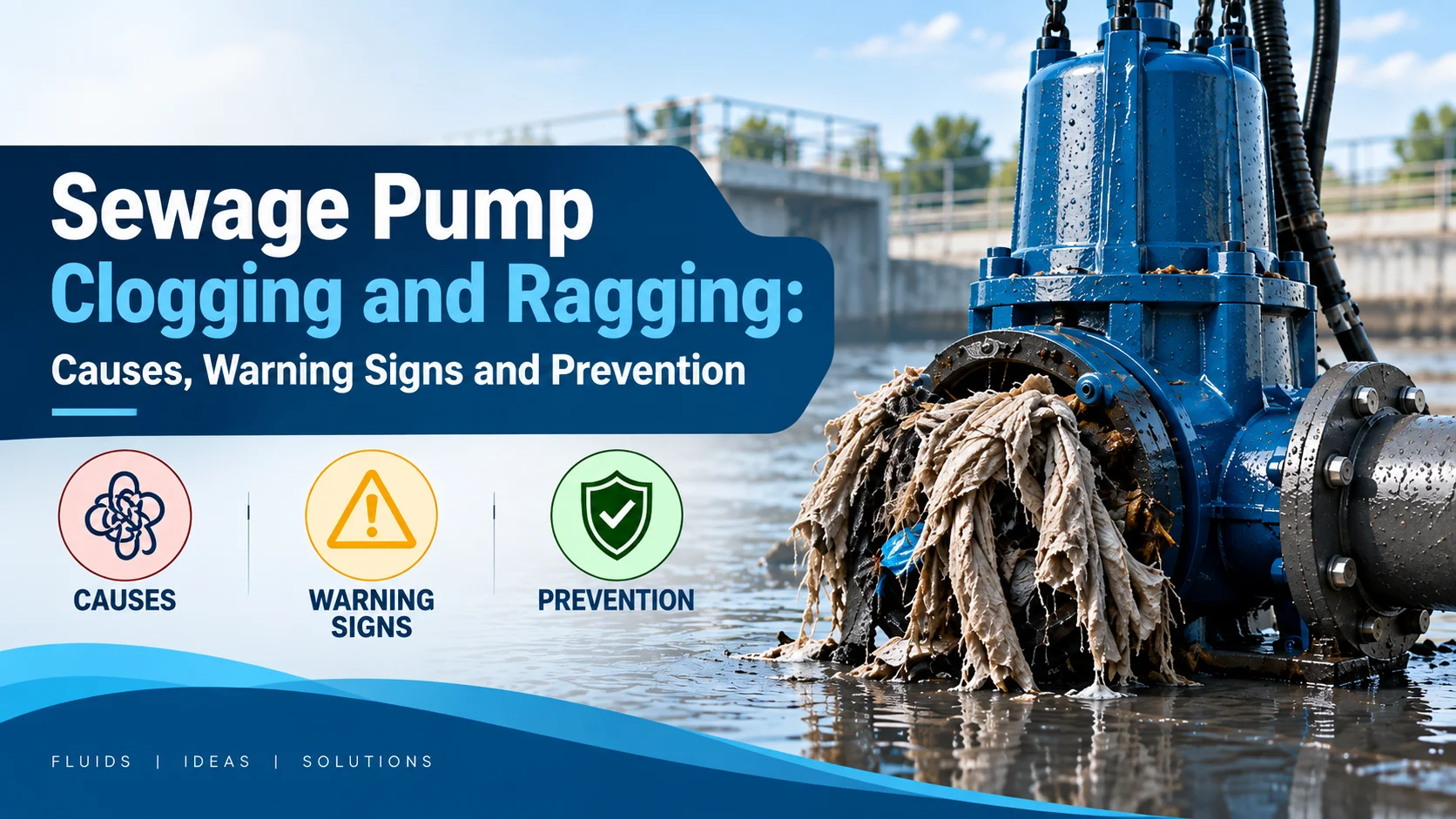
Sewage pump clogging occurs when solids or fibrous materials obstruct the pump inlet, impeller or discharge path.
Ragging is a common form of clogging where materials wrap around rotating components.
Typical problem materials include:
- Wet wipes
- Cloth
- Sanitary waste
- Hair
- Plastic strips
- Fibres
- Rope-like waste
- Food packaging
Signs include:
- Reduced flow
- High wet-well level
- Higher motor current
- Overload trips
- Vibration
- Longer pump runtime
- Frequent manual cleaning
If clogging happens repeatedly, the solution should not be limited to cleaning the same pump again and again. Review the wastewater, screening, wet-well condition, impeller type and pump selection.
Why Sewage Pump Clogging Is So Common
Wastewater entering an STP or sewage pumping station is rarely controlled perfectly.
Even when screens are installed, operators may still find:
- Rags
- Wipes
- Plastic
- Fibres
- Stringy material
inside the wet well.
These materials behave differently from hard solids.
A stone may pass through a sufficiently large hydraulic passage or become trapped immediately.
A long flexible wipe can wrap around the impeller repeatedly and form a dense rope-like mass.
This makes fibrous waste one of the most difficult solids-handling problems in sewage pumping.
What Is Ragging?
Ragging occurs when flexible material winds around:
- Impeller vanes
- Shaft
- Cutter components
- Pump inlet
The material can combine with grease, hair and other waste to form a compact mass.
As ragging develops:
- Hydraulic passages become smaller.
- Flow falls.
- Pump runtime increases.
- Motor load may change.
- Vibration may increase.
- The pump may eventually trip or stop moving wastewater.
1. Wet Wipes and Sanitary Products
Products that appear flushable can behave very differently from normal toilet paper inside a pumping station.
Many remain strong and fibrous after entering wastewater.
They can combine into long strands and wrap around the impeller.
Sites with high wipe loading include:
- Hotels
- Hospitals
- Shopping malls
- Residential complexes
- Public facilities
Where this is a known repeated problem, the pump type should be selected specifically for fibrous waste.
2. Cloth and Laundry Fibres
Hotels, hospitals, laundries and textile-related facilities can introduce:
- Cloth pieces
- Threads
- Mop fibres
- Cotton waste
These materials can create severe ragging.
A pump that performs well in municipal sewage with mostly soft organic solids may require a different hydraulic or cutting arrangement in these applications.
3. Grease Makes Ragging Worse
Grease and fats can coat fibrous material and help it stick together.
The resulting mass can become difficult to pass through:
- Impeller passages
- Check valves
- Bends
- Small discharge pipes
Kitchen wastewater entering hotel or food-service sewage systems can therefore increase clogging risk.
Source control and grease management may be as important as pump selection.
4. Wrong Impeller Type
Different impeller designs provide different trade-offs between:
- Efficiency
- Solids passage
- Clogging resistance
- Head capability
A narrow-passage impeller may be efficient in relatively clean water but unsuitable for raw sewage containing fibres.
For sewage duties, engineers may consider designs such as:
- Vortex
- Non-clog
- Channel
- Cutter arrangements
The correct choice depends on the actual waste stream.
Flow Chem's Pump Impeller Selection for Sewage, Sludge and Wastewater Solids provides a broader comparison.
5. Pump Intake Is Too Close to Settled Debris
Wet wells accumulate material over time.
If the pump inlet sits in an area where solids collect, the pump may repeatedly draw concentrated debris.
Review:
- Sump floor shape
- Inlet location
- Pump position
- Cleaning frequency
- Dead zones
Good wet-well design directs solids toward the pump without creating large stagnant deposits.
6. Low Flow Velocity Allows Solids to Accumulate
The pump may pass a material successfully, but the discharge pipe must also carry it away.
If velocity is too low, solids can settle inside the pipeline.
Deposits can then narrow the pipe and trap additional fibres.
This can create a blockage downstream even when the pump itself remains clear.
Discharge pipe sizing should therefore consider both friction loss and solids transport.
7. Check Valve Can Become a Ragging Point
Fibrous material may become trapped around a check-valve disc or internal mechanism.
This can cause:
- Partial blockage
- Low flow
- Backflow
- Valve not closing fully
When a pump repeatedly clogs, inspect the complete discharge route rather than only the impeller.
8. Pump Starts After Long Settling Periods
In some industrial or intermittent-duty sumps, the pump may remain idle for hours.
During this time:
- Sludge settles
- Fibres collect
- Grease accumulates
The next start can expose the pump to a concentrated mass rather than evenly mixed wastewater.
Wet-well cleaning, mixing or operating strategy may need review depending on the application.
Signs of Developing Clogging
A pump does not always go from normal to fully blocked instantly.
Early signs include:
- Pump-down time becomes longer
- Motor current changes from baseline
- Wet-well high-level alarm occurs more often
- Pump sounds different
- Vibration increases
- Duty pump runs more hours than before
- Standby pump starts more frequently
Tracking these indicators helps operators clean or inspect the pump before complete failure.
Standard Sewage Pump vs Cutter Pump
A cutter pump is not automatically better for every wastewater application.
Standard Sewage/Sludge Pump
Often appropriate for:
- General sewage
- Soft solids
- Sludge
- Mixed wastewater
- Larger passable solids where fibres are not dominant
Cutter Pump
Often considered when the main recurring problem is:
- Rags
- Wipes
- Fibres
- Cloth
- Stringy waste
The cutting mechanism reduces fibrous material before it passes through the pump.
For rag-heavy applications, explore Flow Chem's Submersible Cutter Pump range.
For general sewage and sludge transfer, review the Submersible Sewage and Sludge Pump range.
Cutter Pumps Are Not for Every Hard Solid
A cutting mechanism is intended primarily for fibrous and soft material.
Do not assume it is designed to process:
- Large stones
- Metal pieces
- Heavy construction debris
If the wastewater contains hard abrasive solids, the application requires a different solids and wear review.
Screening Can Reduce Pump Problems
Pump selection should not be used to compensate for every upstream waste-management problem.
Appropriate screening can remove large material before it reaches the wet well.
Benefits can include:
- Fewer pump blockages
- Less valve ragging
- Reduced pipeline blockage
- Lower maintenance exposure
However, screen design also requires maintenance. A blocked screen can create upstream overflow problems.
Wet-Well Housekeeping Matters
Routine inspection should look for:
- Floating rags
- Grease crust
- Settled sludge
- Plastic accumulation
- Material around floats
Keeping the wet well clean reduces both pump clogging and level-control problems.
How to Diagnose a Clogging Problem
Step 1: Compare Flow
Has pump-down time increased?
Step 2: Check Motor Current
Compare with normal baseline.
Step 3: Inspect Wet-Well Level
Is the pump running but the level not falling normally?
Step 4: Check Valve and Discharge
Confirm the restriction is not downstream of the pump.
Step 5: Remove and Inspect the Pump if Required
Use the approved lifting and isolation procedure.
Step 6: Record What Was Found
Was the blockage mainly:
- Wipes?
- Cloth?
- Plastic?
- Hard solids?
- Grease?
This determines the long-term corrective action.
Repeated Clogging Is a Selection Signal
If a site removes the same type of rag mass every week, maintenance is telling you something important about the duty.
The long-term options may include:
- Better screening
- Different impeller
- Cutter pump
- Wet-well changes
- Source control
- Pipe changes
Do not accept frequent manual unclogging as an unavoidable part of sewage pumping without reviewing the system.
Clogging Troubleshooting Table
| Symptom | Possible Cause | What to Check |
|---|---|---|
| Flow suddenly falls | Impeller blockage | Pump hydraulic section |
| Pump trips on overload | Severe ragging | Impeller and shaft |
| Pump vibrates | Uneven rag buildup | Impeller condition |
| Check valve leaks | Debris trapped in valve | Valve inspection |
| High level after long idle | Settled solids | Wet-well condition |
| Repeated cloth/wipe blockage | Wrong pump type | Cutter pump suitability |
| Pipeline blocks downstream | Low velocity or buildup | Pipe sizing and cleaning |
| Floats malfunction too | Rags in wet well | Housekeeping and float clearance |
Common Mistakes
1. Cleaning the Pump Without Recording the Debris
The blockage material identifies the real process problem.
2. Choosing a Cutter Pump for Hard Abrasive Debris
Cutter pumps are mainly intended for fibrous waste.
3. Ignoring the Check Valve
The valve can also trap rags.
4. Ignoring Wet-Well Accumulation
The pump may repeatedly draw from the same debris pile.
5. Using a Smaller Pipe Without Checking Solids Transport
Pipe sizing must balance friction and solids movement.
Preventing Sewage Pump Clogging
A practical prevention plan can include:
- Identify the actual waste stream
- Improve screening where appropriate
- Select the correct impeller type
- Use cutter pumps for recurring fibrous waste where suitable
- Maintain wet-well cleanliness
- Maintain appropriate discharge velocity
- Inspect check valves
- Monitor motor current
- Track pump-down time
- Alternate duty/standby pumps
- Record every blockage event
Frequently Asked Questions
Why does my sewage pump keep clogging?
The pump may be receiving rags, wipes, fibres, grease or solids that do not match its hydraulic design. Wet-well accumulation and low pipeline velocity can also contribute.
What is sewage pump ragging?
Ragging is the wrapping of fibrous materials such as wipes, cloth and hair around the impeller or shaft.
Will a cutter pump stop all sewage blockages?
No. Cutter pumps are useful where soft fibrous waste is the main problem, but hard debris, grit and poor system design can still create failures.
Can grease clog a sewage pump?
Grease can combine with fibres and solids to create dense deposits in pumps, valves and pipelines.
How do I know if the impeller is clogged?
Typical signs include reduced flow, high wet-well level, abnormal current, vibration and overload trips.
Can a check valve clog?
Yes. Rags and debris can prevent a check valve from opening or closing correctly.
Should I use a cutter pump for a hotel?
Hotels can generate significant wipes, cloth fibres and sanitary waste. A cutter pump may be worth evaluating if the site has a history of fibrous clogging.
Need Help Solving Repeated Sewage Pump Clogging?
Share:
- Wastewater source
- Type of blockage material
- Flow
- Head
- Pipe size
- Existing pump type
- Frequency of clogging
- Wet-well photos or layout
- Screening details
with Flow Chem Pumps.
The goal is to match the pump and system to the actual solids instead of repeatedly clearing the same blockage.