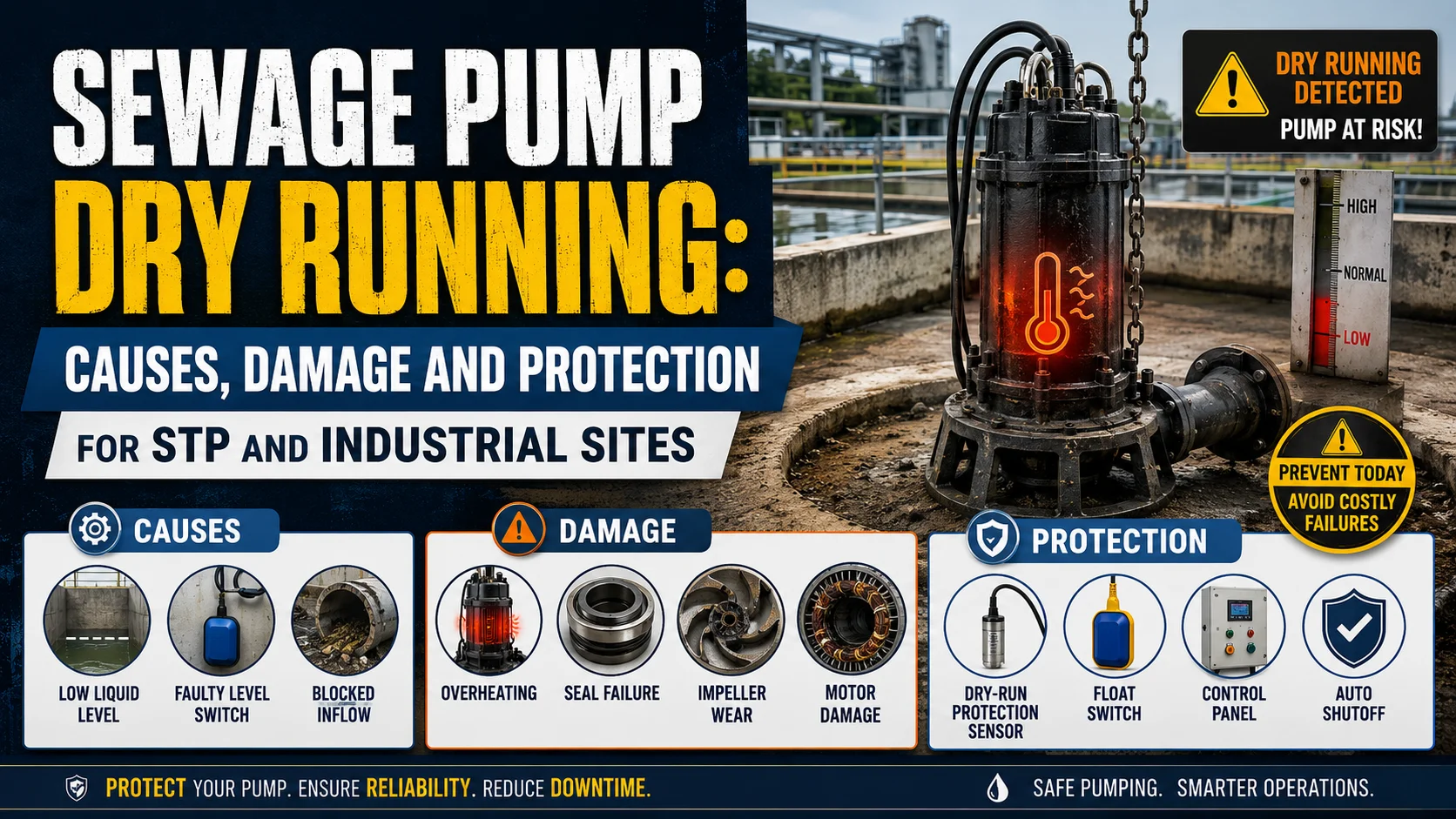
A sewage pump is dry running when it continues operating without enough wastewater around or through the pump to provide the cooling and hydraulic conditions required for normal operation.
Depending on the pump design, prolonged dry running can cause:
- Mechanical seal damage
- Seal-face overheating
- Motor overheating
- Bearing damage
- Impeller wear
- Loss of lubrication or cooling around critical components
- Thermal overload trips
- Premature pump failure
- Motor winding damage
Common causes include:
- Pump OFF level set too low
- Failed float switch
- Faulty level sensor
- Control-panel fault
- Manual mode left ON
- Blocked inlet
- Low wastewater inflow
- Incorrect wet-well design
- Pump installed at the wrong elevation
Dry-running protection should therefore be considered during the pump, wet-well, level-control and control-panel design, rather than only after a pump has failed.
What Does Dry Running Mean in a Sewage Pump?
A submersible sewage pump normally operates while immersed in wastewater.
The liquid serves several important purposes depending on the pump design.
It provides the medium being pumped and can also help remove heat from the motor and hydraulic components.
If the wet-well level falls below the safe operating level while the motor continues running, the pump may begin operating with insufficient liquid.
This condition is commonly called dry running.
A short accidental exposure may not necessarily destroy every pump immediately.
However, repeated or prolonged dry running can significantly reduce service life.
The acceptable condition depends on:
- Pump design
- Motor construction
- Cooling arrangement
- Mechanical seal design
- Installation configuration
- Manufacturer requirements
Operators should therefore never assume that a submersible sewage pump can safely run indefinitely without adequate liquid.
Why Submersible Sewage Pumps Need Adequate Liquid Level
A sewage pump is designed around specific operating conditions.
Correct liquid level helps maintain:
- Stable hydraulic operation
- Motor cooling
- Mechanical seal conditions
- Proper pump loading
- Reliable solids movement
When the level becomes too low, the pump may begin drawing:
- Air
- Air-water mixtures
- Vortices
- Foam
Instead of a stable liquid flow.
The pump may continue spinning even though very little wastewater is actually being transferred.
This creates unnecessary mechanical and thermal stress.
What Happens When a Sewage Pump Runs Dry?
The exact failure sequence varies by pump design, but several components can be affected.
1. Mechanical Seal Temperature Can Increase
Mechanical seals help prevent wastewater from entering the motor area.
Seal faces operate with extremely small clearances.
They depend on the intended lubrication and cooling conditions.
If the pump operates without adequate liquid, seal-face temperature can increase.
Repeated overheating can contribute to:
- Seal-face damage
- Cracking
- Distortion
- Loss of sealing performance
- Water ingress
A damaged seal can eventually allow wastewater into areas where it should not be present.
2. Motor Temperature Can Rise
Submersible pump motors must dissipate the heat generated during operation.
In many installations, surrounding wastewater contributes to cooling.
If the pump continues running after the liquid level drops too far, cooling performance can deteriorate.
Possible consequences include:
- Higher winding temperature
- Thermal protection activation
- Insulation degradation
- Repeated motor trips
- Reduced motor life
A thermal trip should be treated as a warning, not simply reset repeatedly without identifying the cause.
3. Bearings Can Experience Additional Stress
Abnormal temperature and unstable hydraulic operation can also affect bearings.
Over time, repeated dry-running events may contribute to:
- Lubricant deterioration
- Increased bearing temperature
- Noise
- Vibration
- Premature bearing wear
Bearing failure may appear later, making the original dry-running event easy to overlook.
4. The Pump May Draw Air
When the liquid level becomes too low, vortices may develop around the pump intake.
Air can then enter the hydraulic section.
Possible symptoms include:
- Fluctuating discharge flow
- Unstable pressure
- Noise
- Vibration
- Reduced pumping capacity
If air continues entering the pump, the unit may remain electrically ON while accomplishing very little useful pumping.
Common Causes of Sewage Pump Dry Running
Understanding the cause is more useful than repeatedly resetting an overload or replacing damaged components.
1. Pump OFF Level Is Set Too Low
One of the most common causes is incorrect level-control setup.
A typical sewage wet well may have:
- Pump OFF level
- Duty pump ON level
- Lag pump ON level
- High-level alarm
The OFF level tells the control system when the pump should stop.
If this level is positioned too low, the pump may continue operating after the wet well has already been substantially emptied.
This can expose the pump to low-liquid conditions.
Why Operators Sometimes Lower the Stop Level
Operators may lower the OFF level because they want to:
- Empty the wet well completely
- Reduce residual sewage
- Increase storage before the next cycle
- Prevent odour
- Reduce pump starts
But lowering the level excessively can create a new problem.
The pump must still maintain the minimum operating submergence required for its installation.
Level settings should therefore be engineered rather than adjusted only by observation.
2. Float Switch Is Stuck
Float switches are commonly used to start and stop sewage pumps.
A float should move freely with the liquid level.
If the wet well empties but the float remains in the ON position, the pump may continue running.
Common causes include:
- Rags wrapped around the float
- Grease buildup
- Float cable trapped around pipework
- Float touching a guide rail
- Float caught against the wet-well wall
- Damaged float mechanism
- Incorrect cable length
A simple mechanical obstruction can therefore create a serious pump problem.
Flowchem already has a dedicated Sewage Pump Float Switch and Level Control Guide covering level-control arrangements in more detail.
3. Faulty Level Sensor
Larger wastewater pumping stations may use electronic level measurement instead of simple floats.
Systems may include:
- Ultrasonic sensors
- Hydrostatic sensors
- Pressure transmitters
- Conductivity probes
- PLC-based control
If a sensor reports a higher level than actually exists, the controller may keep the pump running.
Possible causes include:
- Incorrect calibration
- Sensor contamination
- Grease buildup
- Electrical fault
- Damaged cable
- Incorrect scaling
- PLC programming error
The displayed level should therefore be compared periodically with the actual wet-well condition.
4. Pump Is Left in Manual Mode
Many control panels have operating modes such as:
- AUTO
- OFF
- MANUAL
In AUTO mode, level controls normally determine when the pump starts and stops.
In MANUAL mode, the operator may bypass part of the automatic level logic.
This is useful during:
- Maintenance
- Testing
- Commissioning
- Emergency operation
But it creates risk if the pump is left running after the sump has emptied.
Operators should never assume the normal low-level stop protection remains active in every manual-mode control philosophy.
The actual panel logic must be understood.
5. Control Panel Fault
The pump itself may be mechanically healthy while the electrical control system keeps it running incorrectly.
Possible problems include:
- Contactor stuck closed
- Relay fault
- Incorrect wiring
- PLC logic error
- Failed sensor input
- Bypassed interlock
- Incorrect selector-switch position
The control panel should therefore be included whenever dry-running problems are investigated.
Flowchem's Sewage Pump Control Panel Selection Guide explains protection, alarms and level-control logic in greater detail.
6. Wastewater Inflow Suddenly Stops
Some industrial pumping systems operate continuously during production.
If the process stops unexpectedly, the sump may no longer receive enough liquid.
Possible situations include:
- Production shutdown
- Upstream valve closed
- Tank emptied
- Batch process completed
- Upstream pump stopped
- Cleaning operation finished
If the downstream sewage pump continues running, the wet well can be emptied.
The control system should therefore respond to the actual liquid level rather than relying only on a fixed time schedule.
7. Pump Is Oversized
An oversized sewage pump can empty a wet well extremely quickly.
Suppose:
Incoming wastewater flow: 20 m³/hr
Actual pump flow: 100 m³/hr
The pump may remove wastewater far faster than it enters the sump.
If the control system does not stop the pump at the correct level, dry-running risk increases.
Oversizing can also create:
- Short cycling
- High discharge velocity
- Water hammer
- Higher energy demand
- Unstable operation
Pump capacity should therefore match the real flow and total dynamic head.
8. Wet-Well Design Is Incorrect
A poorly designed sump can contribute to low-level problems.
Examples include:
- Pump installed above the intended lowest operating level
- Incorrect sump floor elevation
- Insufficient operating volume
- Poor inlet arrangement
- Excessive turbulence
- Air vortex formation
- Level sensors located in unstable zones
The wet well, pump and level controls should be designed as one system.
9. Pump Intake Is Blocked
Sometimes the wet well contains sufficient wastewater, but the pump cannot receive it properly.
The intake may be blocked by:
- Rags
- Plastic
- Fibres
- Sludge
- Grease
- Foreign objects
- Accumulated debris
The pump may then behave as though it is starved of liquid.
Possible symptoms include:
- Reduced flow
- Noise
- Vibration
- High temperature
- Increased motor current
- Poor wet-well drawdown
This should not be confused with a genuinely empty sump.
10. Air Vortex Forms at Low Level
When the wastewater surface approaches the pump intake, a vortex may form.
Think of the swirling funnel sometimes seen when a tank drains.
The vortex can pull air into the pump.
Possible consequences include:
- Unstable discharge
- Noise
- Vibration
- Reduced flow
- Loss of hydraulic performance
Correct minimum submergence and wet-well geometry help reduce this risk.
Dry Running vs Pump Blockage
These two problems can produce similar symptoms.
Dry Running
Typical signs:
- Wet well almost empty
- Pump still operating
- Air entering intake
- Reduced or zero discharge
- Pump temperature rising
Blockage
Typical signs:
- Wet well still contains wastewater
- Pump is running
- Flow is reduced or absent
- High-level condition may develop
- Pump current may change
Always inspect the wet-well level before assuming the cause.
Dry Running vs Cavitation
Dry running and cavitation are also different conditions.
Dry Running
The pump does not have enough liquid available.
Cavitation
The pump contains liquid, but local pressure falls low enough for vapour bubbles to form and collapse inside the hydraulic system.
Cavitation can produce:
- Crackling noise
- Vibration
- Impeller pitting
- Reduced performance
Both conditions can damage pumps, but their causes and corrective actions are different.
Signs a Sewage Pump May Have Run Dry
Operators should look for:
- Thermal overload trip
- Hot motor housing
- Burnt smell
- Mechanical seal leakage
- Reduced insulation resistance
- New vibration
- Bearing noise
- Unusual pump sound
- Reduced discharge flow
- Repeated automatic shutdown
- Pump running while wet well is empty
- Pump operating longer than expected
After a significant dry-running event, do not simply refill the sump and restart repeatedly.
The pump should be inspected if abnormal behaviour remains.
How Float Switches Prevent Dry Running
A simple automatic system may use at least two important levels:
ON Level
When wastewater reaches this level, the pump starts.
OFF Level
When wastewater falls to this level, the pump stops.
The OFF level should be positioned so the pump stops before the liquid reaches an unsafe operating condition.
Additional floats may be used for:
- Lag pump start
- High-level alarm
- Emergency low-level protection
The exact configuration depends on the station design.
Add a Dedicated Low-Level Protection Signal
Critical pumping stations may benefit from a dedicated low-level interlock.
The logic may be:
Low-level condition detected → Pump stop command → Dry-run alarm
This adds another protection layer if the normal operating-level system fails.
Whether this is required depends on:
- Pump criticality
- Control system
- Site supervision
- Consequence of failure
- Level sensor reliability
Thermal Protection Is Not the Same as Dry-Run Prevention
A pump may include thermal protection.
This is valuable because the motor can shut down if winding temperature rises excessively.
However:
Thermal protection reacts to overheating.
Dry-run protection tries to prevent the overheating condition from occurring.
Both can be useful.
Relying only on a thermal trip means the pump may already have experienced abnormal temperature before protection activates.
Moisture Sensors Provide Another Layer of Protection
Some sewage pump designs can use moisture or leakage detection.
These sensors can help identify water ingress before severe motor failure occurs.
Depending on pump construction, the protection system may monitor:
- Seal chamber
- Motor housing
- Leakage compartment
An alarm can then warn operators that the sealing system requires attention.
Moisture detection does not directly prevent dry running, but it can help identify seal damage that may result from abnormal operating conditions.
Use Control Panel Alarms
A sewage pumping station should not depend only on the pump stopping automatically.
Useful alarms can include:
- Low-level alarm
- High-level alarm
- Pump trip
- Thermal overload
- Seal leakage
- Motor overload
- Phase failure
- Sensor fault
At unmanned stations, remote alarms may also be valuable.
The objective is to tell operators why the pump stopped, not simply that something went wrong.
Dry-Running Protection in Duty/Standby Systems
A duplex sewage pumping station may contain:
- Pump A
- Pump B
- Duty alternation
- Lag start
- High-level alarm
- Low-level stop
Both pumps should follow a control philosophy that prevents operation below the approved minimum liquid level.
Consider this scenario:
- Wet-well level rises.
- Pump A starts.
- Inflow increases.
- Pump B also starts.
- Both pumps rapidly empty the wet well.
- Level reaches OFF point.
- Both pumps should stop according to the designed sequence.
If lag-pump logic is incorrect, one pump may continue running after the sump has been emptied.
Control sequencing should therefore be verified during commissioning.
Why Dry Running Can Occur After Maintenance
Dry-running events often occur immediately after service work because operators intentionally use manual controls.
Typical sequence:
- Pump is serviced.
- Pump is returned to sump.
- Operator selects MANUAL.
- Pump is started for checking.
- Wet well empties.
- Pump remains ON.
Maintenance procedures should include a clear check that the selector is returned to the correct operating mode before handover.
Commissioning Checks for Dry-Run Protection
During commissioning, verify:
- Pump start level
- Pump stop level
- Minimum submergence
- High-level alarm
- Low-level protection
- Float movement
- Sensor calibration
- Automatic operation
- Manual operation
- Duty/standby sequence
- Lag pump start
- Thermal protection
- Fault indication
- Alarm operation
Do not only check whether the pump starts.
Confirm that it stops correctly under low-level conditions.
Why Repeatedly Resetting a Thermal Trip Is Dangerous
Suppose the pump trips on temperature.
An operator resets it.
Five minutes later it trips again.
Resetting repeatedly without diagnosis can allow a developing problem to become serious damage.
Investigate:
- Wet-well level
- Pump submergence
- Float operation
- Blockage
- Voltage
- Motor current
- Cooling
- Pump operating point
- Bearing condition
Protection devices are warning systems.
They should not be treated as inconveniences that simply need resetting.
What to Check After a Pump Has Run Dry
If a sewage pump has accidentally operated without sufficient liquid, inspect the system before normal operation resumes.
Check:
- Mechanical seal condition
- Oil chamber condition where applicable
- Insulation resistance
- Motor current
- Bearing noise
- Pump vibration
- Impeller condition
- Thermal sensor
- Float switch
- Level sensor
- Control-panel logic
- Discharge flow
If the pump experienced prolonged overheating, professional inspection may be required.
Dry-Running Troubleshooting Table
| Symptom | Possible Cause | What to Check |
|---|---|---|
| Pump running in empty sump | OFF float failure | Float movement and wiring |
| Pump does not stop in AUTO | Level sensor fault | Sensor signal and calibration |
| Pump runs continuously in MANUAL | Manual override | Selector position and operator procedure |
| Thermal trip at low level | Insufficient cooling | Minimum pump submergence |
| Flow suddenly disappears | Intake exposed or blocked | Wet-well level and intake |
| Pump repeatedly overheats | Dry running or overload | Level control, current and hydraulic duty |
| Air in discharge | Low liquid level or vortex | Pump submergence |
| Seal fails soon after overheating | Dry-running damage | Seal faces and oil chamber |
Common Dry-Running Prevention Mistakes
1. Using Only One Float for Everything
Critical installations benefit from clearly defined start, stop and alarm logic rather than depending on a single control point.
2. Installing Floats Too Close to the Pump
Pump turbulence can make floats unstable.
The float should operate in a location where it can respond reliably to actual wet-well level.
3. Setting the Stop Level Too Low
Trying to empty every last litre from the sump can reduce pump submergence below the safe operating condition.
4. Assuming Thermal Protection Solves Everything
Thermal protection is an important backup, but the level-control system should prevent abnormal operation before overheating occurs.
5. Leaving the Pump in Manual Mode
Manual mode requires operator supervision.
It should not become the normal operating method for an automatic sewage pumping station.
6. Ignoring Repeated Trips
A repeating thermal or overload trip indicates a problem requiring investigation.
7. Adjusting Level Settings Without Reviewing Wet-Well Design
Changing one float can affect:
- Pump cycle time
- Overflow margin
- Minimum submergence
- Lag-pump operation
- High-level alarm
Review the entire level sequence.
Dry-Run Protection Checklist
Before commissioning or troubleshooting a sewage pump, confirm:
- Pump minimum operating level
- Required minimum submergence
- Pump OFF level
- Pump ON level
- Lag-pump level
- High-level alarm
- Low-level protection
- Float switch movement
- Sensor calibration
- Sensor cable condition
- Control-panel wiring
- AUTO mode operation
- MANUAL mode behaviour
- Thermal overload protection
- Motor current
- Pump operating point
- Wet-well dimensions
- Inlet position
- Pump installation height
- Duty/standby sequencing
- Alarm operation
- Remote alarm requirement
How to Reduce the Risk of Sewage Pump Dry Running
Depending on the installation, useful measures may include:
- Correctly positioning the pump OFF float
- Maintaining adequate minimum submergence
- Installing low-level protection
- Cleaning floats regularly
- Calibrating electronic level sensors
- Using suitable control-panel interlocks
- Providing thermal motor protection
- Training operators on MANUAL mode
- Inspecting the wet well routinely
- Matching pump capacity to actual inflow
- Reviewing duty/standby sequencing
- Recording repeated alarms and trips
Dry-running prevention is usually inexpensive compared with repairing a damaged submersible motor.
Frequently Asked Questions
Can a sewage pump run dry?
Some pump designs may tolerate brief abnormal conditions better than others, but a submersible sewage pump should generally operate according to the manufacturer's required liquid-level and cooling conditions. Prolonged dry running can damage seals, motors and other components.
What happens if a submersible sewage pump runs without water?
The pump may lose adequate cooling and lubrication conditions, causing increased seal and motor temperature. Prolonged operation can lead to thermal trips or component damage.
How can I stop a sewage pump from running dry?
Correctly configured float switches or level sensors should stop the pump before the liquid falls below its safe operating level. Critical systems may also use dedicated low-level interlocks.
Can a float switch cause dry running?
Yes. A stuck, obstructed, incorrectly positioned or electrically faulty float can keep the pump running after the wet well has emptied.
Does thermal protection prevent dry running?
Not directly. Thermal protection shuts the motor down when excessive temperature is detected. Proper level control should prevent the low-liquid condition before overheating develops.
Can an oversized pump cause dry-running problems?
Yes. An oversized pump may empty the wet well very quickly, increasing the importance of correct stop-level control.
Why does my sewage pump keep running when the sump is empty?
Possible causes include a stuck float, failed level sensor, control-panel fault, manual mode or incorrectly configured stop level.
Should the pump completely empty the sewage sump?
Not necessarily. The pump normally stops at a designed minimum operating level. Attempting to empty the wet well completely may expose the pump intake or reduce required submergence.
Why does my submersible pump trip after the water level becomes low?
The motor may be overheating because cooling conditions have deteriorated. Check level controls, minimum submergence, blockage and electrical load before repeatedly resetting the pump.
Can dry running damage the mechanical seal?
Yes. Depending on the pump and seal arrangement, inadequate cooling and lubrication can overheat seal faces and contribute to premature failure.
Need Help Selecting a Sewage Pump and Level-Control System?
Reliable sewage pumping requires more than selecting a pump based on horsepower.
The system should consider:
- Required flow
- Total dynamic head
- Wet-well dimensions
- Minimum liquid level
- Solids profile
- Pump operating point
- Float or level-sensor arrangement
- Control-panel protection
- Duty/standby logic
For STPs, ETPs, sewage pumping stations and industrial wastewater applications, share these operating details with Flow Chem Pumps for application-based pump selection support.
Explore Flow Chem's Submersible Sewage and Sludge Pump range for sewage, sludge and wastewater pumping applications.