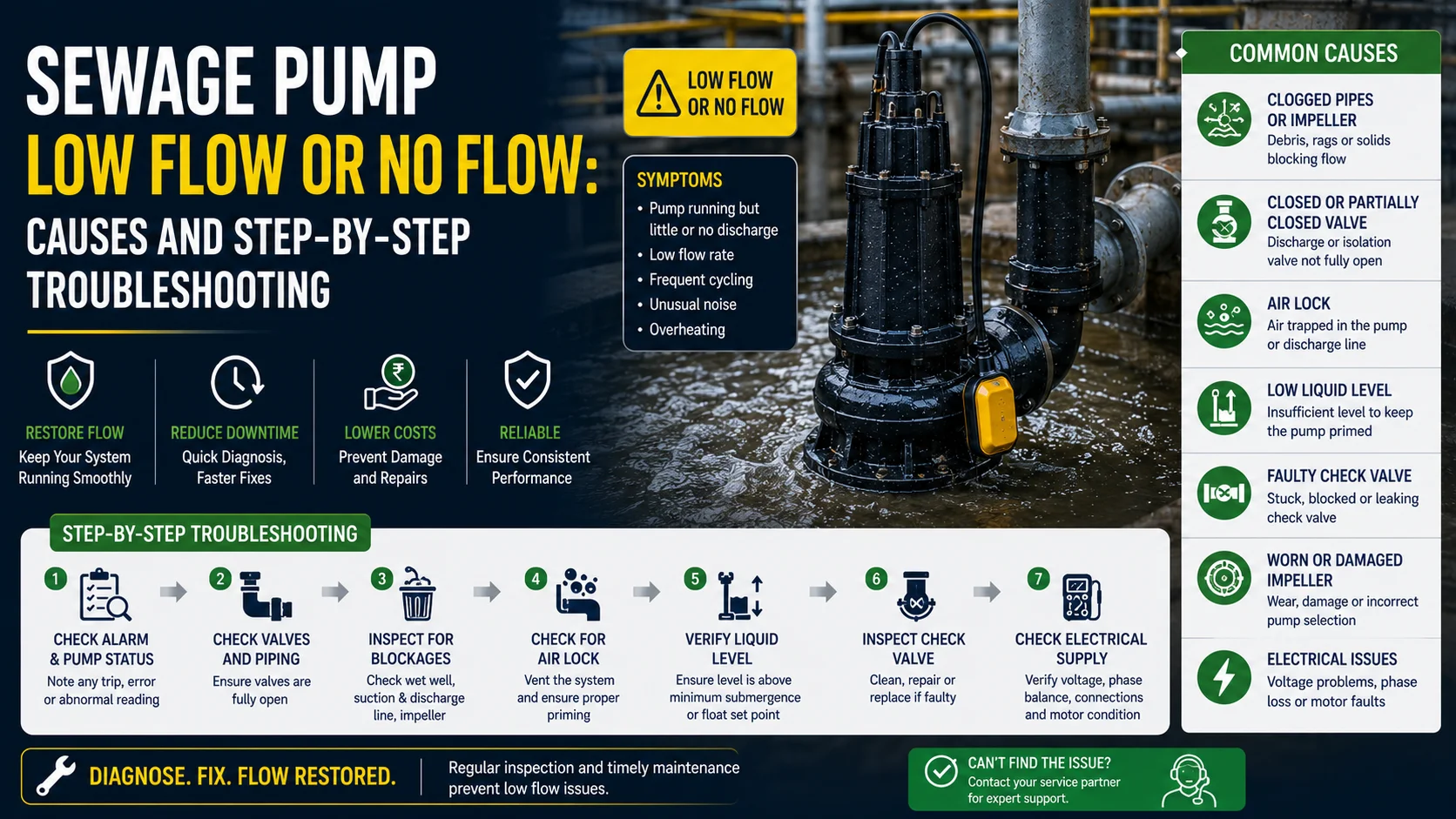
If a sewage pump is running but delivering little or no wastewater, the problem may be in the pump, wet well, discharge piping, valves, rotation or hydraulic selection.
Common causes include:
- Impeller blockage
- Rags or fibres around the impeller
- Pump rotating in the wrong direction
- Check valve stuck or partially closed
- Isolation valve not fully open
- Discharge pipe blockage
- Air vortex or inadequate submergence
- Worn impeller
- Excessive actual system head
- VFD operating at too low a speed
- Incorrect pump selection
- Sludge or solids thicker than expected
The first step is to determine whether the problem is no hydraulic output at all or simply less flow than the original design.
Why a Running Pump Can Still Deliver Poor Flow
A motor running only proves that electrical power is reaching the pump.
It does not prove that the pump is moving the required wastewater.
A sewage pump must simultaneously have:
- Clear hydraulic passages
- Correct impeller rotation
- Sufficient liquid at the inlet
- A workable discharge path
- Enough developed head for the system
- Suitable solids-handling capability
A fault in any of these areas can reduce discharge.
Start with the Original Baseline
Before troubleshooting, ask what "low flow" means for this site.
Compare current performance with:
- Commissioning flow
- Pump curve
- Tank emptying time
- Normal discharge pressure
- Motor current
- Historical operating data
If the pump has always delivered less than expected, the issue may be selection or system design.
If performance was previously normal and has recently fallen, blockage, wear or a changed system condition becomes more likely.
1. Impeller Blockage
This is one of the most common causes in raw sewage.
The impeller may collect:
- Rags
- Wipes
- Cloth
- Fibres
- Hair
- Plastic
- Organic solids
A partially blocked impeller can continue rotating while moving much less liquid.
Typical Signs
- Lower discharge flow
- Longer wet-well pump-down time
- Higher or unstable motor current
- Vibration
- Repeated high-level alarms
If fibrous waste is a recurring site condition, compare the duty with a Submersible Cutter Pump.
2. Intake Is Blocked
Wastewater must reach the pump inlet freely.
Debris can collect around:
- Pump intake
- Suction opening
- Sump floor
- Protective screen
Sludge can also accumulate around the pump after long idle periods.
The result is starvation at the inlet even though the wet well contains wastewater.
Inspect the wet-well condition and pump intake area safely.
3. Reverse Rotation
A three-phase sewage pump can rotate in the wrong direction if the phase sequence is incorrect.
The motor still runs, but the impeller does not develop the intended hydraulic performance.
Possible symptoms include:
- Low flow
- Low head
- Unusual sound
- Poor wet-well drawdown
- Different motor current from expected
Rotation should always be verified during commissioning and after electrical rewiring.
Correction should be performed by qualified electrical personnel using the pump manufacturer's procedure.
4. Check Valve Is Not Opening Fully
A check valve prevents discharge water from flowing backward after the pump stops.
If the valve becomes:
- Jammed
- Fouled with rags
- Corroded
- Mechanically damaged
it may not open fully during pump operation.
This creates additional resistance and reduces flow.
A faulty valve can sometimes produce both:
- Low flow while the pump runs
- Backflow after the pump stops
Valve inspection should therefore be included in the troubleshooting sequence.
5. Isolation Valve Is Partially Closed
After maintenance, an isolation valve may be left partially closed.
This can create unexpected discharge resistance.
Before removing the pump, verify the intended position of all discharge valves.
Do not force a valve that is mechanically jammed. The valve itself may require maintenance.
6. Discharge Pipe Is Blocked
Sewage pipelines can accumulate:
- Grease
- Sludge
- Grit
- Rags
- Scale
- Process residue
A partial blockage increases system resistance.
The pump then moves to a lower-flow operating point on its curve.
Possible signs include:
- Reduced flow
- Longer runtime
- Higher discharge pressure upstream of the blockage, where measured
- Repeated high-level alarms
If the pipe blockage is progressive, the problem may become worse over weeks rather than failing suddenly.
7. Actual System Head Is Higher Than the Pump Can Handle
The pump must overcome the complete total dynamic head.
This includes:
- Static lift
- Pipe friction
- Bends
- Valves
- Fittings
- Downstream pressure
If the actual TDH is higher than assumed during selection, the pump may deliver less flow than required.
Common reasons include:
- Longer pipe installed than designed
- Smaller pipe diameter
- Additional bends
- Additional valves
- Higher final discharge elevation
- Changed downstream process pressure
Use the actual installed system when checking the pump curve.
Flow Chem's Sewage Pump Sizing Guide can help structure the hydraulic review.
8. Air Vortex or Low Submergence
If the liquid level falls too close to the pump intake, air can be drawn into the pump.
This can create:
- Sputtering discharge
- Unstable flow
- Noise
- Vibration
- Reduced pumping capacity
Review:
- Pump OFF level
- Minimum submergence
- Wet-well geometry
- Inlet turbulence
The problem may be level-control related rather than a damaged pump.
9. Worn Impeller
A sewage pump impeller gradually wears in abrasive service.
Wear can be accelerated by:
- Grit
- Sand
- Industrial particles
- Cavitation
- Corrosion
As the impeller loses its original profile or clearances increase, the pump may produce less head and flow.
A common pattern is:
Normal performance at commissioning → gradual flow reduction over months or years
This is different from the sudden performance loss normally associated with a blockage.
10. Pump Is Running at the Wrong VFD Speed
If the pump is controlled by a Variable Frequency Drive, check the actual frequency and speed command.
Possible problems include:
- Incorrect setpoint
- Manual low-speed mode
- Faulty level-control command
- Maximum frequency limited too low
- Wrong control scaling
Reducing speed reduces pump flow and head.
The VFD may be operating exactly as programmed while the process requires a different operating point.
11. Wastewater Has Changed
The liquid may no longer match the conditions used for pump selection.
Examples include:
- Higher sludge concentration
- More solids
- More fibrous material
- Higher viscosity
- Additional industrial residue
A pump selected for relatively thin wastewater may struggle when the process starts sending thicker sludge into the same sump.
Review process changes whenever low-flow complaints begin unexpectedly.
12. Pump Is Undersized for the Duty
Sometimes nothing is mechanically wrong.
The selected pump simply cannot deliver the required flow at the actual head.
This often happens when selection is based on:
- HP
- Outlet size
- Maximum flow
- Maximum head
instead of the true duty point.
For example:
A catalogue may show:
Maximum Flow: 80 m³/hr
Maximum Head: 20 m
That does not mean the pump delivers 80 m³/hr at 20 metres head.
The required flow and head must be checked at the same point on the pump curve.
Pressure and Current Can Help Narrow the Cause
Where instruments are available, compare:
- Discharge pressure
- Motor current
- Flow
Different combinations can provide clues.
Low Flow + High Discharge Pressure
Possible discharge restriction or higher-than-expected system head.
Low Flow + Low Discharge Pressure
Possible worn impeller, wrong rotation, intake problem or pump damage.
Low Flow + High Current
Possible blockage, mechanical friction or heavy solids.
Low Flow + Low Current
Possible wrong rotation, low VFD speed or low hydraulic load depending on the pump.
These are diagnostic clues, not universal rules. Always compare with the specific pump curve and normal site data.
Step-by-Step Troubleshooting Sequence
Step 1: Confirm the Pump Is Actually Running
Check motor current, panel status and vibration.
Step 2: Observe Wet-Well Drawdown
Measure how quickly the liquid level falls.
Step 3: Check Valve Positions
Confirm discharge isolation valves are correctly positioned.
Step 4: Check for Backflow
Observe whether the wet-well level rises immediately after shutdown.
Step 5: Check Rotation
For three-phase pumps, verify correct direction using the manufacturer's commissioning procedure.
Step 6: Inspect Intake and Impeller
If safe and necessary, remove the pump for mechanical inspection.
Step 7: Check Discharge Restriction
Review pressure, pipe condition and valve condition.
Step 8: Recalculate Actual TDH
Use the installed pipe length, diameter, elevation and fittings.
Step 9: Compare with the Pump Curve
Confirm the selected pump can meet the actual duty.
Low-Flow Troubleshooting Table
| Symptom | Possible Cause | What to Check |
|---|---|---|
| Motor runs, almost no flow | Blocked impeller | Pump hydraulic section |
| Low flow after rewiring | Reverse rotation | Phase sequence |
| Low flow with high pressure | Discharge restriction | Valves and piping |
| Low flow with low pressure | Wear or wrong rotation | Impeller and direction |
| Flow pulses with air | Low submergence | Wet-well level |
| Flow gradually falls over months | Wear or buildup | Impeller and pipeline |
| Low flow only on VFD | Speed too low | Frequency and controls |
| Pump cannot keep up at peak | Pump undersized | Duty point and inflow |
Common Mistakes
1. Replacing the Pump Before Checking the Valves
A partially closed or blocked valve can create the problem.
2. Assuming Maximum Catalogue Flow Is Site Flow
Actual flow depends on system head.
3. Ignoring Rotation After Electrical Work
A three-phase pump can run in reverse after phase changes.
4. Increasing Motor HP Without Recalculating the System
The hydraulic cause may remain unchanged.
5. Ignoring Pipe Changes
Even a correct original design can perform differently after modifications.
Frequently Asked Questions
Why is my sewage pump running but not pumping?
Possible causes include impeller blockage, reverse rotation, a closed or stuck valve, discharge blockage, inadequate liquid at the inlet or a pump that cannot overcome the system head.
Can a sewage pump run with a blocked impeller?
A partially blocked pump may continue running with reduced flow. A severe blockage may cause high current or an overload trip.
Can reverse rotation reduce flow?
Yes. A three-phase centrifugal pump rotating in the wrong direction can produce substantially lower flow and head.
Can a check valve reduce pump flow?
Yes. A check valve that is jammed or only partially opening adds resistance to the discharge line.
Why did pump flow decrease gradually?
Gradual decline can indicate impeller wear, abrasion, corrosion, pipe buildup or progressively increasing blockage.
Does pipe diameter affect sewage pump flow?
Yes. Smaller discharge piping normally increases friction loss and can reduce the actual operating flow.
Can a VFD cause low flow?
A VFD operating the pump below the intended speed will reduce flow and head.
Need Help Diagnosing a Sewage Pump That Cannot Meet Flow?
For an application review, share:
- Pump model
- Required flow
- Actual flow if measured
- Total head
- Pipe diameter
- Pipe length
- Valve arrangement
- Wastewater type
- Solids profile
- Motor current
- VFD frequency if used
with Flow Chem Pumps.
For general STP, sewage and sludge applications, explore the Submersible Sewage and Sludge Pump range.