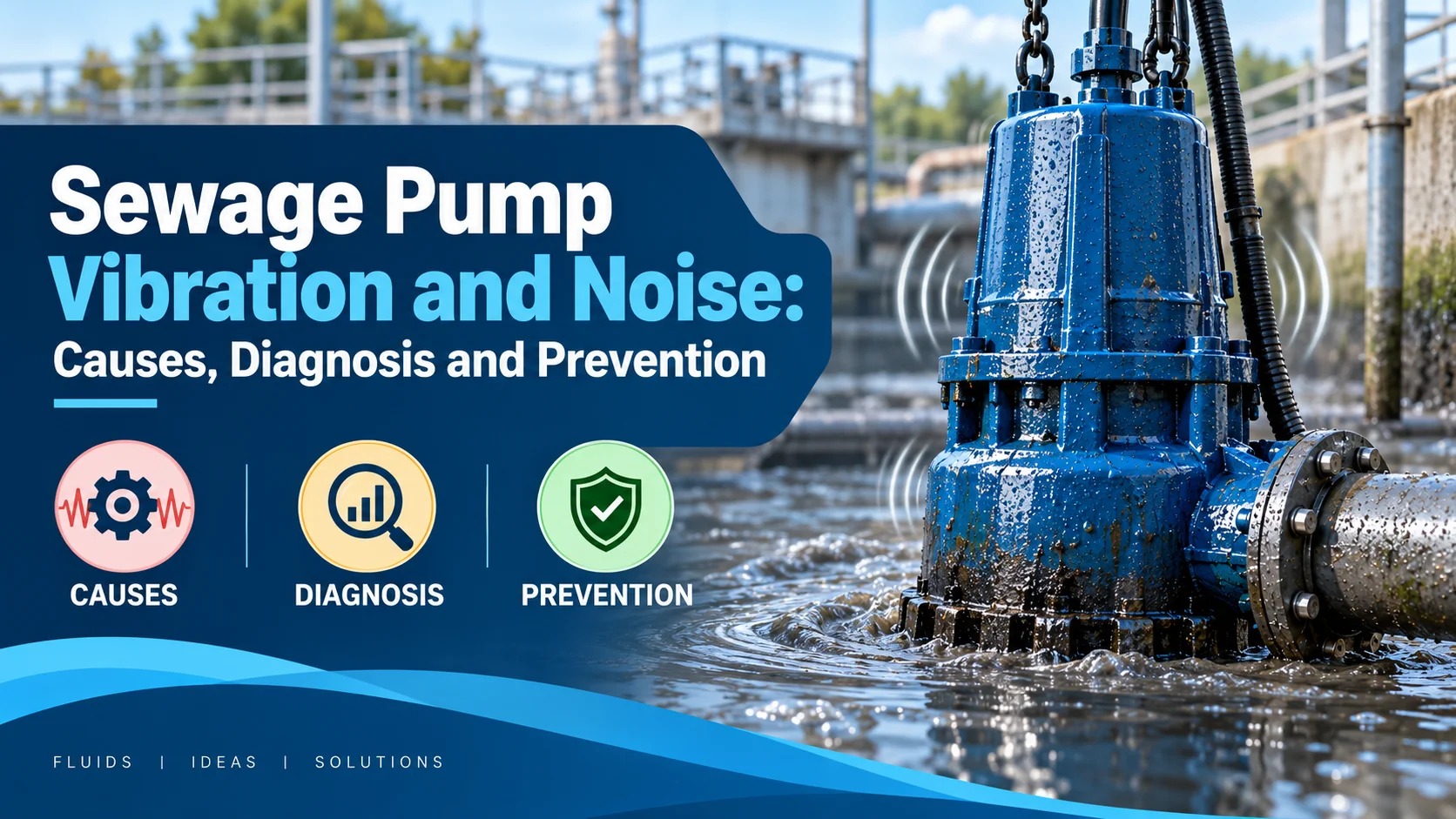
A sewage pump that suddenly becomes louder or vibrates more than normal should be inspected.
Common causes include:
- Impeller blockage
- Uneven ragging
- Cavitation
- Air vortex at low liquid level
- Worn bearings
- Damaged impeller
- Shaft problems
- Pump not seated correctly on the coupling
- Loose pipe supports
- Operation too far from the intended pump-curve region
- Mechanical contact inside the pump
Noise and vibration are often early warning signs. Investigating them before the pump fails can prevent damage to bearings, mechanical seals, cables and discharge piping.
Why Baseline Sound Matters
Every pump produces some normal operating noise and vibration.
The useful question is not:
"Is the pump completely silent?"
It is:
"Has the sound or vibration changed from the normal baseline?"
During commissioning, operators should become familiar with:
- Normal motor sound
- Normal pipe vibration
- Normal start and stop behaviour
- Normal current
- Normal pump-down time
A change from this baseline is often more valuable than a one-time observation.
1. Impeller Blockage Creates Imbalance
When rags or solids collect unevenly around the impeller, the rotating assembly becomes unbalanced.
This can create:
- Vibration
- Pulsating flow
- Higher bearing load
- Seal stress
The pump may still deliver wastewater, so the problem can continue unnoticed.
If vibration begins at the same time as reduced flow or higher current, inspect for blockage.
2. Damaged Impeller
An impeller can be damaged by:
- Hard foreign objects
- Severe abrasion
- Corrosion
- Cavitation
Loss of material changes the balance of the rotating component.
A damaged impeller may produce:
- Vibration
- Low flow
- Low head
- Repeating noise
Replacing bearings alone will not solve vibration caused by an unbalanced impeller.
3. Cavitation
Cavitation occurs when local pressure becomes low enough for vapour bubbles to form and then collapse in higher-pressure regions.
The collapsing bubbles create small shock events.
Operators often describe cavitation noise as:
- Crackling
- Gravel-like sound
- Popping
Possible causes depend on the pump and installation, including unsuitable hydraulic conditions or inlet restrictions.
Flow Chem's NPSH for Wastewater Pumps guide explains the suction-side concept in more detail.
4. Air Vortex at Low Wet-Well Level
A vortex can form when the wastewater level falls too close to the pump inlet.
Air is pulled into the pump and creates unstable hydraulic operation.
Signs may include:
- Gurgling
- Intermittent flow
- Vibration
- Visible vortex on the liquid surface
Review:
- Pump OFF level
- Minimum submergence
- Inlet arrangement
- Wet-well geometry
Do not simply lower the stop float to empty the wet well further.
5. Worn Bearings
Bearing wear is a major mechanical cause of pump vibration.
As clearances increase, the shaft may move more than intended.
Possible symptoms include:
- Rumbling
- Grinding
- Rising temperature
- Increased vibration
- Mechanical seal problems
Bearing wear can eventually allow the impeller to contact stationary components.
A pump with increasing vibration and bearing noise should be removed from service for inspection before secondary damage occurs.
6. Shaft Damage or Misalignment
A bent or damaged shaft creates a repeating vibration pattern as it rotates.
Possible causes include:
- Severe blockage
- Hard-object impact
- Bearing failure
- Improper repair
Shaft condition should be checked during workshop overhaul when unexplained vibration continues after impeller cleaning.
7. Pump Not Seated Correctly on Auto-Coupling
Submersible pumps installed on guide rails normally lower onto an automatic discharge coupling or base arrangement.
If the pump does not seat correctly, operators may experience:
- Leakage at the discharge connection
- Movement
- Vibration
- Reduced flow
Possible causes include:
- Debris on the coupling face
- Damaged guide rail
- Pump not lowered fully
- Misalignment
The pump should sit securely in the intended operating position.
8. Discharge Pipe Supports Are Loose
Not every vibration originates inside the pump.
Flow pulsations and pump forces can excite poorly supported piping.
Check:
- Pipe clamps
- Supports
- Flexible connections
- Valve chamber supports
- Flange alignment
Loose pipes can amplify a small hydraulic vibration into a large audible problem.
9. Check Valve Slam
A loud bang occurring mainly when the pump stops can indicate check-valve slam or hydraulic surge.
This is different from continuous running vibration.
Review:
- Check valve type
- Valve closing behaviour
- Pipeline length
- Flow velocity
- Static head
Repeated water hammer can damage valves, supports and pipe joints.
10. Pump Operating Far from Its Intended Duty Point
A centrifugal pump has a preferred operating region on its performance curve.
Operating too far away can increase hydraulic instability.
Possible causes include:
- Wrong pump selection
- Discharge valve position
- Incorrect pipe sizing
- Changed system head
- VFD operating at inappropriate speed
If vibration exists with no obvious mechanical fault, compare the actual operating point with the pump curve.
11. Excessive Solids or Thick Sludge
The pump may have been selected for relatively thin wastewater but later receive thick or uneven solids.
The impeller experiences changing hydraulic loads as solids pass through.
Industrial plants should review whether a process change introduced:
- Higher solids concentration
- Grit
- Fibres
- Sludge
Vibration may be a symptom of a pump-duty mismatch.
Different Sounds Can Suggest Different Problems
Crackling or Gravel Sound
Possible cavitation.
Rumbling
Possible bearing wear.
Scraping
Possible rotating component contact.
Gurgling
Possible air entry or low submergence.
Bang at Shutdown
Possible check-valve slam or water hammer.
Repetitive Knock
Possible rotating imbalance or mechanical looseness.
Sound alone is not enough for diagnosis, but it helps focus the inspection.
Monitor Vibration Trends
For critical pumps, vibration measurements can be recorded periodically.
The value of condition monitoring comes from trends.
A gradual increase may indicate:
- Bearing deterioration
- Impeller wear
- Buildup
A sudden increase may indicate:
- Blockage
- Hard-object damage
- Loose mounting
Combine vibration data with current, flow and temperature.
Vibration Troubleshooting Sequence
Step 1: Identify When the Noise Occurs
Is it during start, continuous running or shutdown?
Step 2: Check Flow and Current
Look for simultaneous performance changes.
Step 3: Check Wet-Well Level
Look for low submergence or vortex formation.
Step 4: Inspect Pipe Supports and Valves
Determine whether the noise is external to the pump.
Step 5: Remove the Pump if Required
Inspect impeller, bearings and shaft.
Step 6: Check the Operating Point
Compare actual flow/head with the pump curve.
Vibration and Noise Troubleshooting Table
| Symptom | Possible Cause | What to Check |
|---|---|---|
| Crackling noise | Cavitation | Inlet and hydraulic conditions |
| Gurgling at low level | Air vortex | Submergence and stop level |
| Rumbling | Bearing wear | Bearings and temperature |
| Scraping | Internal contact | Impeller and shaft |
| High vibration + low flow | Blockage | Impeller and intake |
| Bang at pump stop | Valve slam | Check valve and surge |
| Pump body moves | Coupling/mount issue | Seating and guide rails |
| Pipe shakes | Poor supports | Pipe clamps and alignment |
Common Mistakes
1. Ignoring New Noise Because the Pump Still Runs
A pump can continue running while damage develops.
2. Replacing Bearings Without Checking the Impeller
An unbalanced impeller can damage the replacement bearings.
3. Treating Every Noise as Cavitation
Bearing, blockage and pipe problems can sound different.
4. Ignoring Shutdown Noise
Valve slam can cause serious pipeline stress.
5. Lowering the Wet-Well Stop Level
This may increase vortex and air-entry risk.
Preventing Excessive Vibration
Use these practices:
- Keep impellers free of rags and debris
- Maintain correct minimum submergence
- Inspect bearings during planned maintenance
- Verify pump seating on guide rails
- Support discharge piping correctly
- Maintain check valves
- Select pumps around the actual duty point
- Record current, vibration and temperature baselines
- Investigate sudden changes promptly
Frequently Asked Questions
Why is my sewage pump vibrating?
Common causes include impeller blockage, cavitation, bearing wear, air entry, damaged impeller, poor pump seating or operation outside the intended hydraulic range.
Why does my sewage pump sound like gravel?
A crackling or gravel-like sound can indicate cavitation, although other mechanical issues should also be ruled out.
Why does the pipe bang when the pump stops?
Check-valve slam or water hammer may be causing the shutdown impact.
Can rags cause vibration?
Yes. Uneven ragging around the impeller can create rotational imbalance.
Can worn bearings damage the mechanical seal?
Yes. Excessive shaft movement can disturb seal alignment and shorten seal life.
Why does vibration occur only when the wet well is almost empty?
Low liquid level may be allowing an air vortex to form near the pump intake.
Should vibration be measured?
For critical industrial pumping stations, trending vibration alongside current and temperature can help identify developing faults.
Need Help Reviewing an Abnormally Noisy Sewage Pump?
Share:
- Pump model
- Flow and head
- Wastewater type
- When the noise occurs
- Motor current
- Wet-well levels
- Pipe arrangement
- Recent maintenance history
with Flow Chem Pumps.
For general sewage and sludge applications, explore the Submersible Sewage and Sludge Pump range.