Compare submersible cutter pumps and sewage sludge pumps for STP, municipal and industrial wastewater duties. Learn when to use each pump type.
Choose a submersible cutter pump when the main problem is clogging from fibrous wastewater solids. Cutter pumps are used where rags, wipes, thin plastic, cloth-like debris, food-processing fibers or similar materials may enter the wastewater stream and block standard pumps.
Choose a submersible sewage sludge pump when the main problem is heavier sewage, sludge, settled solids or thick wastewater that needs reliable solids passage. Sewage sludge pumps are used in STPs, municipal wastewater, industrial wastewater, drainage sumps and sludge-transfer duties where the pump must move wastewater with suspended or settled solids.
The decision should not be made only from the pump name. A cutter pump is not automatically the best choice for every sewage duty, and a sewage sludge pump is not always enough when the waste stream contains fibrous clogging material. The correct selection depends on the actual solids profile, flow, head, duty cycle and site conditions.
Why this comparison matters
Wastewater pump failure usually happens for one of three reasons: clogging, incorrect sizing or wrong pump construction for the liquid. In sewage and sludge applications, clogging is one of the most common operational problems. A pump may have enough horsepower and enough flow capacity, but if the impeller or inlet cannot handle the solids entering the sump, the system will still fail.
This is why buyers often compare cutter pumps with sewage or sludge pumps. Both are used in wastewater environments, but they solve different problems. A cutter pump focuses on cutting or reducing fibrous material before it causes a blockage. A sewage sludge pump focuses on moving sewage, sludge and solids-laden wastewater through the pump with stable operation.
For Flow Chem, this comparison article supports two money pages:
- Submersible cutter pump for cutter-pump commercial intent.
- Submersible sewage sludge pump for sewage, sewage water pump, submersible sewage pump and sludge-handling intent.
What is a submersible cutter pump?
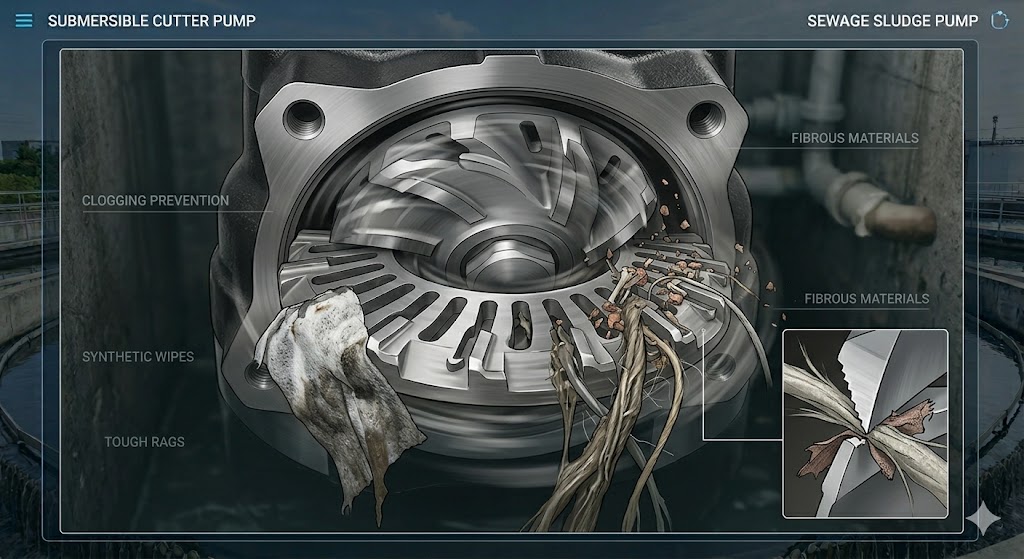
A submersible cutter pump is a wastewater pump designed to reduce clogging from fibrous or stringy solids. The pump is installed in the wastewater sump or pit, and the cutter mechanism helps break down materials before they can wrap around the impeller or block the pump passage.
Typical use cases include:
- Municipal sewage sumps with ragging risk.
- STP inlet or transfer areas with fibrous waste.
- Commercial wastewater where wipes, cloth or plastic may enter the stream.
- Industrial wastewater with process fibers or stringy material.
- Pumping stations where frequent clogging has already been observed.
The cutter function is useful where the problem is not only the size of solids, but the nature of the solids. Long, flexible and fibrous material can wrap around a pump even when the solid pieces are not very large. In such conditions, a cutter pump can reduce downtime and maintenance interventions.
What is a sewage sludge pump?
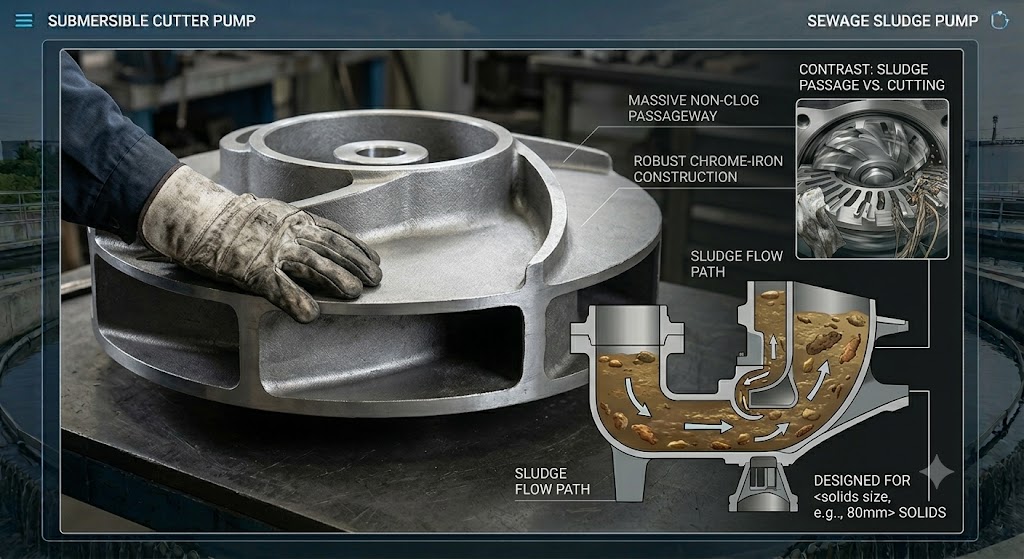
A sewage sludge pump is designed to handle sewage, sludge and wastewater containing solids. In many STP, ETP and municipal applications, the pump must move liquid that is not clean water. It may contain suspended solids, settled sludge, organic material, grit, semi-solid matter and wastewater residue.
Typical use cases include:
- STP sludge-transfer duties.
- Sewage collection and transfer sumps.
- Municipal wastewater pumping.
- Industrial wastewater pits.
- Sludge recirculation or transfer where the pump is matched to duty.
- High-solids wastewater where free passage and non-clog design are important.
A sewage sludge pump is often selected when the wastewater is heavier, thicker or more solids-loaded than normal drainage water. The key requirement is reliable solids handling at the required flow and head.
Main difference between cutter pump and sewage sludge pump
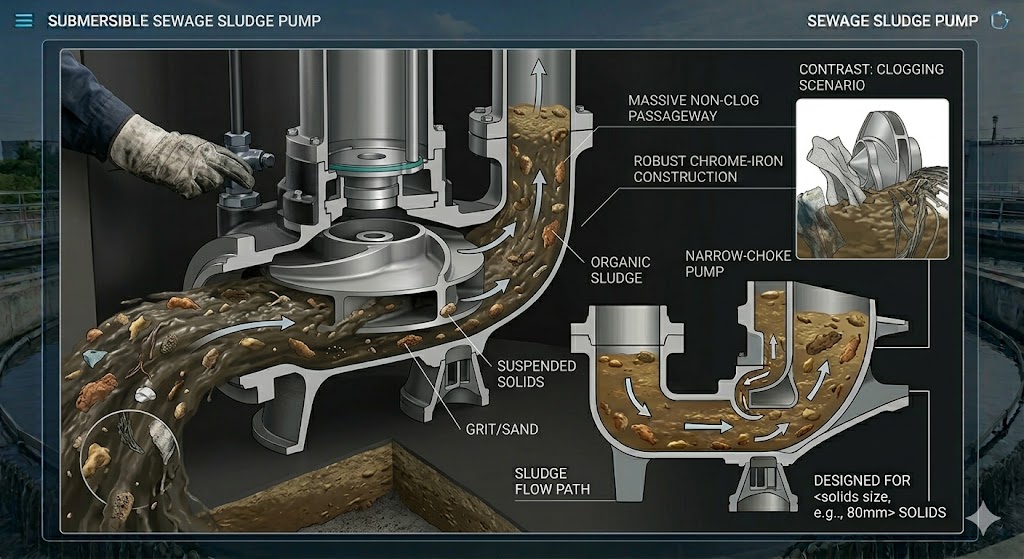
The main difference is the primary failure mode each pump is designed to solve.
A cutter pump is selected when fibrous clogging is the main risk. Its value is in cutting, shredding or reducing stringy material before that material can block the pump. This is useful in ragging-prone sewage applications.
A sewage sludge pump is selected when solids handling, sludge movement and wastewater transfer are the main risks. Its value is in moving thicker or solids-laden liquid reliably without depending on a cutting mechanism for every application.
In simple terms:
| Selection factor | Cutter pump | Sewage sludge pump | |---|---|---| | Best for | Fibrous, stringy, ragging-prone sewage | Sludge, sewage, solids-laden wastewater | | Main function | Reduce clogging by cutting fibrous solids | Move sewage/sludge with suitable passage and duty | | Common issue solved | Rags, wipes, cloth-like debris, stringy material | Thick sludge, settled solids, suspended solids | | Typical sites | Sewage lift stations, STP inlet areas, municipal sumps | STPs, ETPs, municipal wastewater, sludge transfer | | Selection priority | Cutter design, clog resistance, access for service | Solids passage, flow/head, wear resistance, viscosity | | Money page | `/submersible-cutter-pump/` | `/submersible-sewage-sludge-pump/` |
Step 1: identify the solids type
The first selection step is to understand what is actually entering the sump. Do not select based only on the word “sewage”. Different sewage and wastewater sites have different solid profiles.
Ask these questions:
- Are the solids fibrous or stringy?
- Are rags, wipes, cloth or plastic frequently found in the sump?
- Are the solids soft, hard, abrasive or organic?
- Is the wastewater mostly liquid with occasional debris?
- Is the duty closer to thick sludge transfer?
- Is the pump failing because of clogging or because it cannot move the required volume?
If the answer points to fibrous clogging, shortlist a cutter pump. If the answer points to heavy sludge and solids loading, shortlist a sewage sludge pump. If the site has both, the final choice should be made after reviewing flow, head, solids concentration and maintenance history.
Step 2: check flow and head requirements
After identifying solids type, calculate the required flow and total dynamic head. Pump type alone does not guarantee performance. A cutter pump that cannot meet the duty point will not solve the system problem. A sewage sludge pump that is not sized for the head can also underperform.
Document:
- Required flow rate.
- Static lift from sump to discharge point.
- Pipe or hose length.
- Pipe diameter.
- Bends, valves and fittings.
- Discharge pressure or downstream condition.
- Operating hours per day.
- Whether the site needs duty/standby pumps.
For sewage and sludge systems, conservative sizing matters because actual conditions can vary during the day. Peak inflow, monsoon load, plant upset conditions or higher solids can all increase stress on the pump.
Step 3: match the pump to the site application
Different applications create different selection priorities.
STP and municipal sewage pumping
For STPs and municipal sewage systems, the pump often needs to handle mixed sewage with uncertain solids. If ragging is frequent, a cutter pump may reduce clogging. If the duty is sludge transfer, settled solids or heavier wastewater movement, a sewage sludge pump may be more suitable.
For general sewage and sludge duties, review Flow Chem’s submersible sewage sludge pump. If the site has repeated ragging, compare with the submersible cutter pump page.
Industrial wastewater
Industrial wastewater varies widely. Some industries create fibrous waste, some create sludge, and some create chemical or abrasive wastewater. The pump must be selected based on the actual process liquid.
If the duty includes treated or semi-treated effluent, review an effluent pump or submersible waste water pump as part of the comparison. If solids or sludge are present, avoid assuming a basic wastewater pump is enough.
Drainage and dewatering areas
Not every dirty-water duty requires a cutter or sewage sludge pump. If the site is mainly moving rainwater, construction water or drainage water with manageable solids, a dewatering pump or submersible drainage pump may be more appropriate.
This matters because over-selecting the wrong pump type can increase cost and maintenance complexity. The pump should match the duty, not just the worst-case label.
Step 4: review viscosity and solids concentration
Sludge is different from normal wastewater. As solids concentration increases, the pump needs more careful selection. Thick sludge may affect pump curve performance, motor loading and wear. A cutter mechanism does not automatically make a pump suitable for thick sludge movement.
For sludge-heavy applications, check:
- Approximate solids concentration.
- Whether the sludge is settled, floating, fibrous or mixed.
- Viscosity or thickness.
- Presence of grit or abrasive particles.
- Temperature and chemical compatibility.
- Whether the duty is continuous or intermittent.
If the wastewater is thick or sludge-heavy, prioritize sewage sludge pump suitability, impeller type, motor rating, material and maintenance access. If the wastewater is mostly liquid but contains rags and fibrous debris, prioritize cutter-pump suitability.
Step 5: check clogging history and maintenance access
Maintenance history is a strong selection signal. If an existing pump is frequently removed because cloth, rags or wipes are wrapped around the impeller, the application may need a cutter pump. If the existing pump is wearing quickly, struggling with sludge movement or losing performance due to solids load, the application may need a better sewage/sludge-handling pump.
Ask the site team:
- How often does clogging happen?
- What material is found during cleaning?
- Does the pump trip due to overload?
- Is the issue at the pump inlet, impeller, discharge pipe or panel?
- How difficult is it to remove and service the pump?
- Is there a screen, grinder, bar screen or upstream protection?
A pump selection that ignores service access can create long-term downtime. For STP and municipal sites, easy lifting, inspection, spares availability and service support matter as much as the pump specification.
When to choose a submersible cutter pump
Choose a cutter pump when the application has:
- Repeated clogging from rags, wipes or stringy solids.
- Sewage or wastewater with fibrous debris.
- A lift station or sump where maintenance access is difficult.
- Frequent pump removal due to wrapping around the impeller.
- Commercial or municipal sewage with unpredictable incoming solids.
- A need to reduce blockage-related downtime.
A cutter pump is especially useful when the wastewater is not extremely thick but contains troublesome fibrous material. The goal is to reduce blockage risk and keep the pump operating longer between cleaning cycles.
When to choose a sewage sludge pump
Choose a sewage sludge pump when the application has:
- Sewage or wastewater with suspended solids.
- STP sludge-transfer or sludge-removal duties.
- Thicker liquid or settled solids.
- Municipal wastewater pumping.
- Industrial wastewater pits with solids.
- Duties where solids passage and stable hydraulic performance matter more than cutting.
For many STP and industrial wastewater duties, a properly selected sewage sludge pump is the core solution. The buyer should only move to a cutter pump when the site’s clogging pattern proves that cutting action is needed.
Common selection mistakes
Mistake 1: assuming every sewage application needs a cutter pump
Cutter pumps are valuable, but they are not automatically required for every sewage duty. If the wastewater contains normal suspended solids but limited fibrous material, a sewage sludge pump may be the more suitable and simpler option.
Mistake 2: selecting by HP only
HP is not enough. The pump must match flow, head, solids, viscosity and duty cycle. A higher HP pump can still fail if the impeller or hydraulic design is wrong for the solids.
Mistake 3: ignoring upstream screening
Sometimes the pump is blamed for a system problem. If large debris is entering the sump, upstream screening or site housekeeping may also be required. Pump selection and system design should work together.
Mistake 4: using a drainage pump for sewage sludge duty
A drainage pump may work for rainwater or light dirty water, but sewage sludge duty can be much heavier. If sludge, fibrous matter or high solids are present, evaluate sewage sludge or cutter options instead.
Mistake 5: not planning standby capacity
STP and municipal sites often need continuous operation. If one pump fails, the site may still need pumping. Duty/standby configuration should be reviewed for critical applications.
Buyer checklist before requesting a quote
Before requesting a quote from Flow Chem, prepare the following information:
- Application: STP, municipal, industrial, commercial, drainage or sludge transfer.
- Liquid type: sewage, sludge, wastewater, effluent or drainage water.
- Solids type: fibrous, abrasive, settled, suspended or mixed.
- Expected flow rate.
- Total dynamic head.
- Sump depth and installation condition.
- Pipe size and discharge length.
- Operating hours per day.
- Power supply and panel requirement.
- Material or chemical compatibility needs.
- Existing pump failure history, if any.
With this information, Flow Chem can help shortlist whether the application should use a cutter pump, sewage sludge pump, wastewater pump or dewatering/drainage pump.
Recommended Flow Chem selection path
Use this practical decision path:
1. If the liquid is mostly rainwater, site water or drainage water, start with a dewatering pump or submersible drainage pump. 2. If the liquid is sewage or wastewater with solids, start with a submersible sewage sludge pump. 3. If the sewage contains fibrous material and clogging is frequent, compare a submersible cutter pump. 4. If the application is treated or semi-treated industrial wastewater, compare an effluent pump or submersible waste water pump. 5. If the duty involves slurry or abrasive industrial solids, confirm whether a slurry-specific pump is required before selection.
Conclusion
A cutter pump and a sewage sludge pump are both wastewater pump options, but they are not interchangeable. A cutter pump is the stronger choice when fibrous clogging is the recurring problem. A sewage sludge pump is the stronger choice when the application involves sewage, sludge and solids-laden wastewater that needs reliable transfer.
For STP, municipal and industrial sites, the best selection comes from understanding the liquid, solids, flow, head, duty cycle and maintenance history. If you are not sure which option is suitable, share your site details with Flow Chem’s technical team and compare the correct pump type before procurement.
For product selection support, contact Flow Chem through the enquiry page or review the relevant product pages for submersible cutter pumps and submersible sewage sludge pumps.
Frequently asked questions
Is a cutter pump the same as a sewage pump?
No. A cutter pump is a type of wastewater pump designed to reduce clogging from fibrous or stringy solids. A sewage pump or sewage sludge pump is designed to move sewage, sludge and solids-laden wastewater. Some applications need cutter action; others only need proper sewage/sludge handling.
When should I use a submersible cutter pump?
Use a submersible cutter pump when sewage or wastewater contains rags, wipes, cloth-like debris, plastic or fibrous solids that repeatedly clog standard pumps.
When should I use a sewage sludge pump?
Use a sewage sludge pump when the application involves sewage, sludge, settled solids or solids-laden wastewater where reliable passage and duty-point performance are required.
Can a cutter pump handle sludge?
A cutter pump may handle some wastewater with solids, but it is not automatically suitable for thick sludge or high-solids sludge transfer. For sludge-heavy applications, confirm solids concentration, viscosity, head, flow and pump construction before selection.
Which pump is better for STP applications?
It depends on the STP duty. For general sewage and sludge transfer, a sewage sludge pump may be suitable. For ragging-prone inlet or sump areas, a cutter pump may be better. The final selection should be based on solids type and clogging history.
What information is needed to select between cutter and sludge pumps?
You should provide the application, liquid type, solids type, flow rate, total head, sump depth, pipe length, operating hours, power supply and existing clogging or failure history.
Need help selecting the right pump?
Share your flow, head, liquid type, solids, site layout and duty cycle with Flow Chem Pumps. Our team can help you shortlist the right pump.