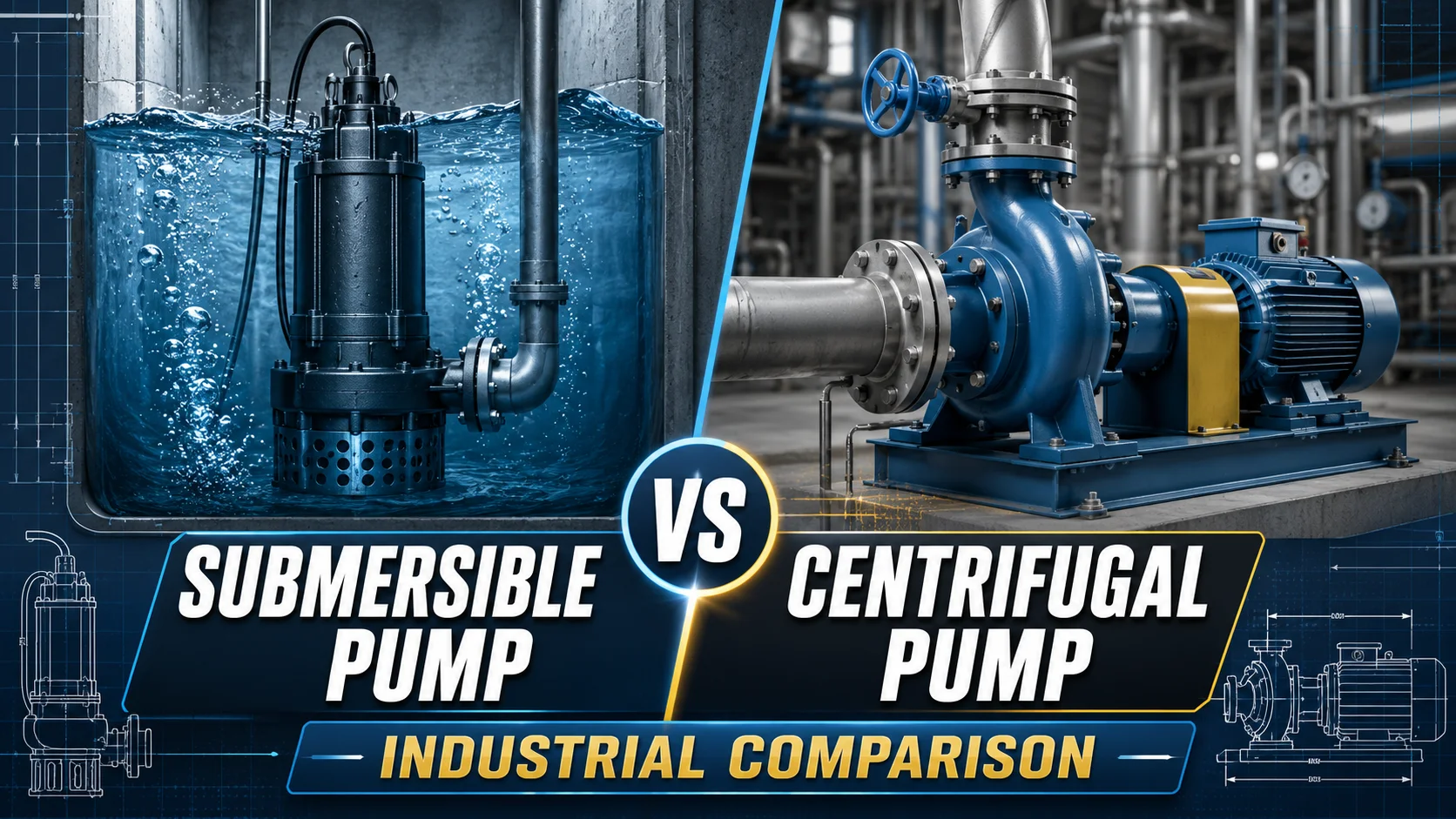
Compare submersible pumps and centrifugal pumps for industrial water, wastewater and slurry duties. Learn the real differences in installation, priming, ma
Not always. In industrial pump selection, “submersible” describes how the pump is installed, while “centrifugal” describes how the pump moves liquid. Many submersible pumps are centrifugal pumps with the motor sealed for underwater operation.
Choose a submersible pump when the pump must sit in a sump, pit, tank or wet well and you want to avoid suction-lift and priming issues. This is common in drainage, sewage, wastewater, stormwater, dewatering and pit transfer duties.
Choose a surface-mounted centrifugal pump when the installation allows easy access above the liquid level, the suction arrangement is stable, and the site prefers straightforward maintenance, piping access and serviceability. In industrial use, centrifugal pumps are common for water transfer, process circulation and clean-liquid duties.
If the liquid contains sewage, sludge, fibrous solids or clogging risk, compare the duty with Flow Chem’s submersible sewage sludge pump, submersible waste water pump or submersible cutter pump instead of treating the choice as a simple pump-family preference.
Why this comparison matters for industrial buyers
Many buyers hear both terms in the same conversation and assume they are competing technologies. That is only partly true. In practice:
- A centrifugal pump can be surface-mounted.
- A centrifugal pump can also be submersible.
- A submersible pump may use centrifugal hydraulics.
- The actual decision often concerns installation location, priming, maintenance and duty conditions.
That is why the wrong comparison can cause procurement mistakes. A buyer may reject a submersible pump because they think “centrifugal” is a separate alternative, or they may specify a surface centrifugal pump for a pit where suction conditions are poor.
Wrong selection can create:
- Priming problems.
- Cavitation risk.
- Frequent air binding.
- Poor discharge under changing liquid levels.
- Hard-to-service installations.
- Energy inefficiency.
- Seal failures or motor stress.
- Downtime in STP, ETP, drainage or process systems.
For Flow Chem, this article should clarify the difference and route the buyer to the right duty-specific page rather than forcing every liquid-transfer duty into one generic pump label.
What is a submersible pump?
A submersible pump is installed below the liquid surface inside a sump, tank, pit or wet well. Because it operates while submerged, the pump does not need to lift liquid up to itself in the same way a surface pump does.
Typical submersible pump uses include:
- Sewage sumps and lift stations.
- STP and ETP pits.
- Drainage and stormwater removal.
- Construction and dewatering applications.
- Wastewater transfer from wet wells or collection tanks.
- Industrial sumps where flooded suction is available.
A submersible pump is often selected for difficult access or flooded intake conditions because it removes the priming problem common to many surface-mounted arrangements. However, submersible pumps still need correct sizing, solids review, material compatibility and maintenance planning.
What is a centrifugal pump?
A centrifugal pump is a pump that uses an impeller to add velocity to the liquid and convert that velocity into discharge pressure. In industrial settings, the term usually refers to a surface-mounted pump, but the hydraulic principle also appears in many submersible designs.
Typical centrifugal pump uses include:
- Clean-water and process-water transfer.
- Cooling-water circulation.
- Boiler-feed or utility systems where the design is appropriate.
- General industrial water movement.
- Some wastewater duties when suction conditions and solids profile are suitable.
A centrifugal pump works well when the suction side is properly designed, priming is controlled, and the liquid is compatible with the pump construction. But if the suction lift is too high, the system is air-bound, or the liquid contains solids that stress the impeller and seals, the pump can perform poorly.
Main difference between submersible and centrifugal pumps
The main difference is not simply the pumping mechanism. The important distinction is installation and duty context.
A submersible pump is defined by where it operates: inside the liquid. A centrifugal pump is defined by how it moves liquid: through an impeller and centrifugal force.
In simple terms:
| Selection factor | Submersible pump | Surface-mounted centrifugal pump | |---|---|---| | Installation | Installed in the liquid | Installed above the liquid | | Priming need | Usually no priming issue | Priming may be required depending on suction layout | | Suction lift | Not the main issue | Can be a major issue | | Maintenance access | May require lifting equipment | Often easier to access from above | | Flooded intake | Strong fit | May or may not be suitable | | Solids handling | Good in wastewater versions | Depends on impeller and pump design | | Common industrial use | Sewage, drainage, dewatering, pit transfer | Water transfer, process circulation, utility duties | | Related Flow Chem route | `/submersible-pump-manufacturer-india/` and duty-specific wastewater pages | Usually no dedicated money page; review the duty and contact Flow Chem |
Do not treat these as mutually exclusive categories. A submersible wastewater pump can be centrifugal in design, while a centrifugal pump can still be installed in a way that makes it unsuitable for a particular pit or sump.
Step 1: identify whether the real issue is installation or hydraulics
Start by separating the installation question from the hydraulic question.
Ask:
- Is the pump going into a pit, tank, sump or wet well?
- Is the liquid level below the pump, above the pump, or variable through the day?
- Does the site need to avoid suction lift?
- Is the suction line short, stable and flooded?
- Is priming a recurring issue today?
- Is maintenance easier from above or from a submerged installation?
If the main challenge is the pump location and the need to run below liquid level, a submersible route is usually worth reviewing first. If the main challenge is a controlled surface installation with convenient service access, a centrifugal route may be better.
Step 2: review the liquid type and solids profile
The liquid often decides the final pump family more than the installation label does.
For submersible duties, check:
- Sewage.
- Drainage water.
- Stormwater.
- Industrial wastewater.
- Sludge or settled solids.
- Fibrous or clogging debris.
- Abrasive grit or sand.
For centrifugal duties, check:
- Clean water.
- Process water.
- Light dirty water.
- Temperature.
- Corrosion risk.
- Solids size and concentration.
- NPSH margin and suction conditions.
If the liquid contains sewage solids, sludge or fibrous waste, compare submersible sewage sludge pump and submersible cutter pump options before assuming a standard centrifugal pump will work.
Step 3: check priming, NPSH and suction conditions
This is one of the biggest practical differences for industrial buyers.
A surface-mounted centrifugal pump usually depends on a sound suction arrangement. If the suction line is poorly designed, air enters the system, the pump loses prime, or cavitation becomes a risk, performance can drop quickly.
Review:
- Suction lift.
- Flooded suction availability.
- Suction pipe length.
- Suction pipe diameter.
- Number of bends and restrictions.
- Air leaks.
- NPSH margin.
- Start-stop frequency.
A submersible installation reduces or eliminates several suction-side problems because the pump is already in the liquid. That is why submersibles are often preferred in pits, wet wells and wastewater sumps.
Step 4: review maintenance access and downtime tolerance
A centrifugal pump mounted above grade is usually easier to inspect, align and service. A submersible pump may require lifting gear, guide rails or confined-space procedures depending on the installation.
Review:
- Can the pump be removed easily?
- Is there guide-rail or lifting provision?
- Is the area safe for service teams?
- How often does the pump need cleaning?
- Is spare-pump changeover required?
- Can the site tolerate downtime during removal?
If the site expects frequent maintenance, easy access may favor a surface centrifugal arrangement. If the site expects difficult suction conditions or a flooded pit, submersible operation may outweigh the service-access advantage.
Step 5: match the pump to the application
STP and sewage duty
For STP transfer and sewage collection, submersible pumps are often considered because they sit in wet wells and handle variable liquid levels well. If the sewage contains solids, sludge or ragging risk, Flow Chem’s submersible sewage sludge pump is the more relevant route.
If the sewage stream contains fibrous material such as wipes, cloth or stringy waste, compare the submersible cutter pump rather than relying on a general centrifugal assumption.
ETP and industrial wastewater
Industrial wastewater can range from relatively clear effluent to solids-laden or chemically aggressive liquid. If the liquid is treated or semi-treated, compare effluent pumps or submersible waste water pumps depending on the installation.
If the liquid is more like sludge, settled solids or high-solids wastewater, a duty-specific wastewater pump is a better starting point than a generic centrifugal pump label.
Drainage and dewatering duty
For construction pits, basement seepage, rainwater, stormwater and temporary water removal, a submersible route is often practical because suction conditions can change fast.
Review Flow Chem’s dewatering pumps and submersible drainage pump pages when the duty is water removal rather than process circulation.
Clean process water duty
For clean process-water transfer, cooling loops and utility systems, a surface-mounted centrifugal pump may be the simpler and more service-friendly choice if suction conditions are stable and the layout supports it.
When to choose a submersible pump
Choose a submersible pump when the site has one or more of these conditions:
- The pump must work inside a sump, pit or wet well.
- Flooded intake is available or preferred.
- Priming issues are a concern.
- Suction lift is undesirable.
- The liquid level changes frequently.
- The duty involves sewage, drainage, wastewater or dewatering.
- The installation benefits from compact placement below grade.
A submersible pump is especially useful when the operational environment makes a surface pump awkward or unreliable.
When to choose a centrifugal pump
Choose a centrifugal pump when the site has one or more of these conditions:
- The installation is above the liquid level and suction is stable.
- Maintenance access from the top is important.
- The liquid is clean or lightly contaminated.
- Priming and NPSH can be controlled.
- The duty is process water or utility transfer.
- The system layout is better served by a surface-mounted arrangement.
A centrifugal pump is often the better fit where simple inspection, alignment and serviceability matter more than submerged installation.
Common selection mistakes
Mistake 1: treating submersible and centrifugal as the same decision
They are related, but not identical. The installation method and duty conditions matter as much as the hydraulic principle.
Mistake 2: choosing a surface centrifugal pump where suction is poor
If the suction side is unstable, the pump may cavitate, lose prime or underperform.
Mistake 3: choosing a submersible pump only because the pit exists
A pit alone does not justify a submersible choice. The liquid, solids, maintenance plan and electrical installation still need review.
Mistake 4: ignoring solids and clogging risk
If the wastewater contains sludge or fibrous waste, compare the duty against submersible sewage sludge pump and submersible cutter pump.
Mistake 5: selecting by horsepower only
HP does not tell you enough. Flow, head, suction, solids and duty cycle all matter.
Mistake 6: assuming “centrifugal” always means clean water
Many centrifugal pumps are used in wastewater and process duty, but only if the construction and hydraulic design fit the liquid.
Buyer checklist before requesting a quote
Before requesting a pump recommendation, collect:
1. Application: STP, ETP, sewage, drainage, dewatering, process water or utility transfer. 2. Liquid type: clean water, wastewater, sewage, sludge, effluent or mixed liquid. 3. Solids type: none, suspended, gritty, fibrous, settled or abrasive. 4. Flow rate requirement. 5. Total dynamic head. 6. Suction condition: flooded, suction lift or submerged. 7. Sump, pit or tank depth. 8. Pipe diameter and discharge length. 9. Number of bends, valves and restrictions. 10. Operating hours per day. 11. Start-stop frequency. 12. Power supply and phase. 13. Material compatibility concerns. 14. Maintenance access and downtime tolerance. 15. Any clogging, priming, cavitation or seal-failure history.
This information helps Flow Chem recommend the correct route instead of forcing every duty into a generic pump category.
Conclusion
Submersible pump vs centrifugal pump is not a simple either-or choice. In many industrial systems, the more important question is whether the pump should operate submerged in the liquid or mounted above it.
A submersible pump is often the better fit when priming, suction lift or wet-well installation is the problem. A centrifugal pump is often the better fit when the system is clean, accessible and designed for stable surface-mounted service. In wastewater, sewage and drainage applications, the final choice should always be driven by liquid type, solids profile, head, flow, installation conditions and maintenance access.
If the duty is unclear, share the site details with Flow Chem’s technical team before procurement so the pump family is matched to the real application.
Frequently asked questions
Is a submersible pump a centrifugal pump?
Often yes, at the hydraulic level. Many submersible pumps use centrifugal impellers, but the key difference is that the motor and pump operate underwater rather than above the liquid.
Which is better, submersible pump or centrifugal pump?
Neither is always better. Submersible pumps are often better for pits, wet wells and suction-lift problems. Centrifugal pumps are often better for accessible surface installations with stable suction and easier maintenance.
Can a centrifugal pump be used for wastewater?
Yes, if the pump construction and suction arrangement suit the liquid. For sewage, sludge or fibrous solids, a duty-specific wastewater or sewage pump is usually a better comparison than a generic clean-water centrifugal assumption.
Why do submersible pumps avoid priming problems?
Because they sit in the liquid, they do not usually need to lift liquid up to the pump housing before starting. That reduces priming and air-binding issues common in some surface-mounted systems.
When should I avoid a surface-mounted centrifugal pump?
Avoid it when suction lift is excessive, air ingress is likely, the wet well level varies too much, or the installation would create priming and cavitation risks.
What information do I need to choose between submersible and centrifugal?
Provide the liquid type, solids profile, flow rate, total dynamic head, suction condition, installation depth, duty cycle, power supply and maintenance constraints.
Need help selecting the right pump?
Share your flow, head, liquid type, solids, site layout and duty cycle with Flow Chem Pumps. Our team can help you shortlist the right pump.