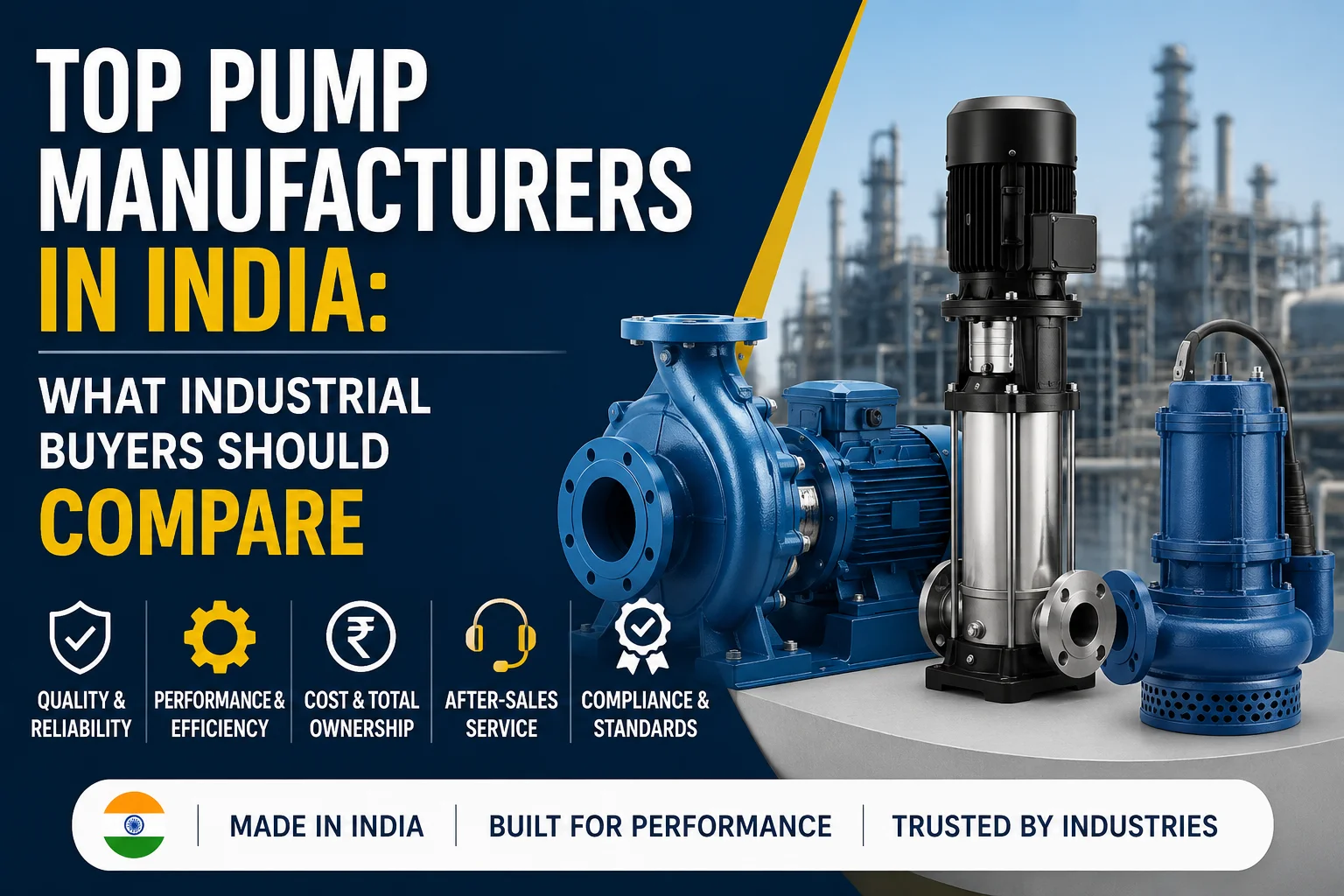
Compare top pump manufacturers in India using industrial buyer criteria: application fit, documentation, materials, service support, spares, quote clarity
Industrial buyers should compare pump manufacturers in India by evaluating how well each manufacturer fits the actual application. A strong pump manufacturer shortlist should include companies that can support duty-point selection, industrial liquid handling, documentation, materials, service support and clear quotation assumptions.
For industrial projects, the “top” manufacturer is not always the largest brand or the lowest-cost supplier. The right manufacturer is the one that can help the buyer select a pump that works for the actual liquid, flow rate, total dynamic head, solids profile, corrosion risk, installation condition and duty cycle.
Flow Chem’s primary manufacturer authority page for this cluster should remain the main ranking URL: submersible pump manufacturer in India. This article supports that money page by answering commercial comparison questions and routing buyers toward application-specific product pages such as dewatering pumps, submersible sewage sludge pump, submersible cutter pump and submersible waste water pump.
Why “top pump manufacturer” searches need buyer criteria
Searches like “top pump manufacturers in India” and “pump manufacturers in India” usually come from buyers who are trying to reduce supplier risk. They may already know they need a pump, but they are still deciding which manufacturer or supplier deserves an enquiry.
The risk is that many comparison searches become too generic. A buyer may compare company names without checking whether the manufacturer is actually suitable for the application. That can lead to wrong pump selection, weak documentation, unclear quote assumptions and service problems after installation.
For Flow Chem, the manufacturer/supplier content should therefore be proof-led and application-led. It should not claim “top” status without third-party proof. Instead, it should explain how industrial buyers should evaluate top manufacturers before procurement.
Step 1: compare manufacturers by application fit
The first filter is application fit. Pumps that look similar in a catalogue can perform differently in sewage, wastewater, sludge, dewatering, cutter or drainage duties.
Before shortlisting a manufacturer, define the application:
- Sewage or sludge transfer.
- STP, ETP or municipal wastewater duty.
- Construction, mining or industrial dewatering.
- Drainage or stormwater removal.
- High-solids wastewater with clogging risk.
- Treated or semi-treated effluent transfer.
- Industrial wastewater with chemical or material concerns.
A manufacturer that is strong for one application may not be the best fit for another. For example, a general water pump comparison is not enough when the real duty is fibrous sewage or high-solids wastewater. In that case, the buyer may need to review a submersible cutter pump or sewage/sludge pump route instead of a generic water pump.
Step 2: compare selection support, not only product range
A useful manufacturer does more than display product names. Industrial buyers should check whether the manufacturer can help with practical pump selection.
Good selection support should include:
- Asking for required flow rate.
- Asking for total dynamic head, not only vertical lift.
- Checking pipe length, bends, valves and discharge condition.
- Reviewing solids size and clogging risk.
- Understanding whether the liquid is sewage, effluent, sludge, drainage water or industrial wastewater.
- Considering pH, temperature, corrosion risk and material compatibility.
- Checking duty cycle and operating hours.
- Explaining why a specific pump type is recommended.
If a quote is given only on horsepower or discharge size, the buyer should ask for more selection detail. For sewage and wastewater applications, HP alone is not a reliable selection method.
Step 3: compare documentation quality
Documentation is a trust signal. It helps consultants, EPC teams, procurement managers and maintenance teams understand what is being supplied and why it fits the duty.
Useful documentation may include:
- Pump type and application explanation.
- Flow/head suitability or pump curve guidance.
- Motor and phase details.
- Construction and material information.
- Solids-handling details where relevant.
- Installation notes.
- Maintenance guidance.
- Quote assumptions and exclusions.
- Warranty or support terms where available.
For SEO and conversion, manufacturer pages should also communicate this clearly. A thin manufacturer page that only says “best pump manufacturer” is weaker than a page that shows application coverage, documentation, FAQs, service guidance and internal links to the right pump categories.
Step 4: compare material and construction suitability
Industrial pumping duties can involve corrosion, abrasion, grit, chemicals, temperature changes and solids. Material suitability should be reviewed before final procurement.
Buyers should ask:
- Is the liquid corrosive or chemically aggressive?
- Is the wastewater acidic or alkaline?
- Are chlorides, oils or industrial chemicals present?
- Are solids abrasive, fibrous, soft or gritty?
- Is cast iron suitable, or is another material route required?
- Is a coating required, and is it appropriate for the duty?
- Are seals and cable entry suitable for the application?
Material claims should be treated carefully. Do not assume a pump is suitable for aggressive wastewater just because a generic material name appears in a catalogue. The manufacturer should review the actual liquid and duty conditions.
Step 5: compare service and spares support
For industrial pump buyers, serviceability is part of the buying decision. A pump working in a sewage pit, wet well, dewatering sump or industrial wastewater area may be difficult to access after installation. If service and spares are not considered early, downtime risk increases.
Evaluate:
- Whether service support is clearly discussed.
- Whether spare parts availability is addressed.
- Whether installation access is understood.
- Whether the manufacturer can explain maintenance needs.
- Whether troubleshooting support is available.
- Whether the buyer knows what information to provide when a pump fails.
The goal is not only to buy a pump. The goal is to reduce lifecycle risk.
Step 6: compare quote transparency
A clear quote helps the buyer understand what is included and what assumptions were used. A vague quote may look cheaper but create confusion later.
A strong quote should clarify:
- Pump category and intended application.
- Flow/head basis.
- Motor and electrical assumptions.
- Construction/material assumptions.
- Solids-handling assumptions.
- Scope of supply.
- Any installation or control-panel exclusions.
- Delivery, service or support terms where available.
- Information still needed from the buyer.
If the buyer cannot see how the manufacturer selected the pump, the quote should be clarified before approval.
Step 7: compare manufacturer proof without relying on unsupported claims
For manufacturer/supplier SEO, proof matters. But proof must be accurate. Content should avoid unsupported statements like “number one manufacturer”, “largest manufacturer”, “certified for every industry”, “pan-India service”, “ready stock” or “lowest price” unless those claims are verified and approved.
Better proof signals include:
- Clear application pages.
- Practical product-category coverage.
- Technical explanations.
- Selection guidance.
- Documentation quality.
- Customer enquiry process.
- Industries served where approved.
- Manufacturing or testing details where approved.
- Service and maintenance guidance.
For Flow Chem, this article should support manufacturer-authority building without overstating claims.
Step 8: compare against the actual project risk
The final comparison should connect manufacturer choice to project risk. Different projects have different failure costs.
For a simple drainage application, the buyer may focus on flow, head, installation and maintenance. For a sewage or wastewater application, solids and clogging risk become more important. For industrial effluent, material compatibility may become the deciding factor. For municipal or EPC projects, documentation and support may matter as much as the pump itself.
This is why a “top manufacturers” comparison should not be a generic brand list. It should be a structured buying framework.
Manufacturer comparison checklist for industrial buyers
Use this checklist before shortlisting pump manufacturers in India:
- Application is clearly defined.
- Pump type is matched to duty: sewage, wastewater, dewatering, cutter, sludge or drainage.
- Flow rate and total dynamic head are documented.
- Solids, fibers and clogging risk are reviewed.
- Material and corrosion risk are reviewed.
- Manufacturer can explain selection logic.
- Documentation is clear enough for consultant and procurement review.
- Quote assumptions are visible.
- Service and spares support are discussed.
- Unsupported claims are avoided.
- Internal team understands why the manufacturer is being shortlisted.
For Flow Chem enquiries, buyers can share their duty data through the Flow Chem contact page. Useful details include flow, head, liquid type, solids size, sump depth, pipe length, duty cycle and material concerns.
Frequently asked questions
Who are the top pump manufacturers in India for industrial buyers?
Industrial buyers should define “top” by application fit, selection support, documentation, material suitability, service support and quote clarity. The best manufacturer shortlist depends on the buyer’s actual duty, such as sewage, wastewater, dewatering, sludge, cutter or industrial drainage applications.
How should I compare pump manufacturers in India?
Compare manufacturers by checking pump range, application experience, flow/head selection support, solids-handling capability, material options, documentation quality, service/spares support and quote transparency. Do not compare only by price or horsepower.
Is a water pump manufacturer the same as an industrial wastewater pump manufacturer?
Not always. A general water pump manufacturer may not be suitable for sewage, wastewater, sludge, high-solids or chemically exposed duties. Industrial buyers should check whether the manufacturer has relevant application-fit pump options and selection support.
What information should I send before asking for a pump quote?
Send flow rate, total dynamic head, liquid type, solids profile, clogging history, pH or chemical exposure, sump depth, pipe length, installation type, duty cycle, electrical details and project location. Complete data improves pump selection accuracy.
Should I choose the lowest-cost pump manufacturer?
Lowest upfront cost is not always the best decision. If the pump is incorrectly selected, the buyer may face clogging, low discharge, motor overload, corrosion, downtime and maintenance cost. Compare lifecycle reliability and application fit along with price.
Can one manufacturer support sewage, dewatering and wastewater projects?
A manufacturer may support multiple industrial pumping applications if it has the right product range and selection expertise. Buyers should still evaluate each duty separately because sewage, dewatering, cutter, sludge and wastewater applications have different technical requirements.
Need help selecting the right pump?
Share your flow, head, liquid type, solids, site layout and duty cycle with Flow Chem Pumps. Our team can help you shortlist the right pump.