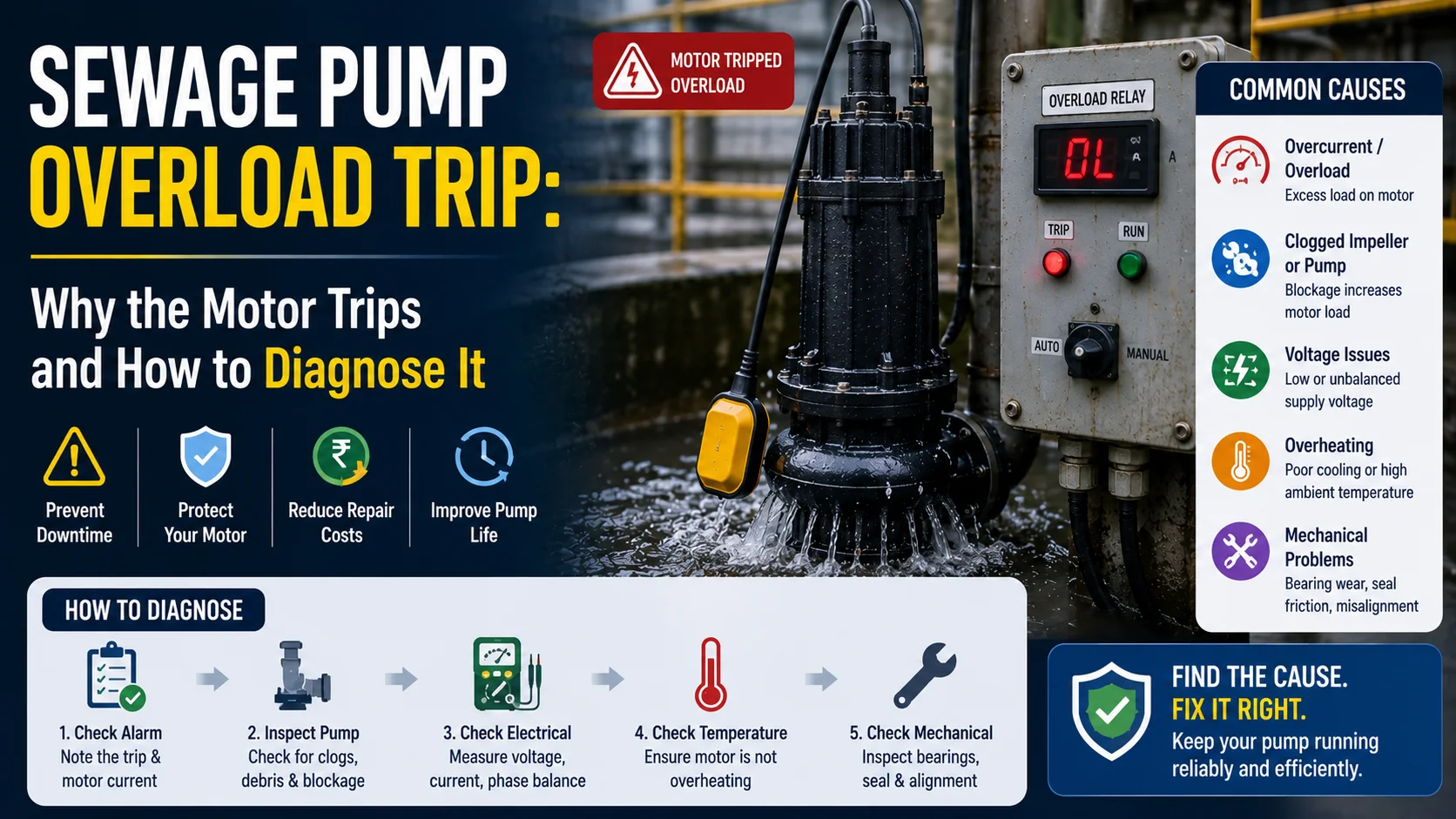
A sewage pump overload trip means the motor protection system has detected an operating condition that may damage the motor if it continues.
Common causes include:
- Impeller blockage or ragging
- Foreign material jamming the pump
- Worn or damaged bearings
- High mechanical friction
- Voltage imbalance or phase problems
- Incorrect overload relay setting
- Pump operating at an unsuitable high-flow point
- Wastewater that is denser or more difficult to pump than expected
- Excessive starts per hour
- Motor or winding deterioration
- Cable or connection problems
Do not keep resetting an overload relay without finding the cause. A trip is a protection event. Repeatedly restarting the pump can convert a manageable blockage or electrical problem into a burnt motor, damaged cable or major pump overhaul.
What Does an Overload Trip Mean?
A sewage pump motor converts electrical energy into shaft power that turns the impeller.
During normal operation, the motor draws current within an expected range. The control panel monitors this condition using devices such as:
- Motor protection relay
- Thermal overload relay
- Electronic motor protection unit
- VFD protection
- Built-in motor thermal sensor
If the motor draws excessive current for too long, or if another configured protection condition occurs, the system stops the pump.
This is commonly described by operators as:
"The sewage pump is tripping on overload."
The important question is not how to reset the trip. The important question is why the motor load has changed.
First Check: Is It Really an Overload Trip?
Before dismantling the pump, confirm which protection device actually operated.
A pump may stop because of:
- Overload
- Short circuit
- Earth leakage
- Phase failure
- Phase imbalance
- Thermal sensor trip
- Low level
- High motor temperature
- VFD fault
- Control circuit failure
These faults require different troubleshooting methods.
Check the panel indication, relay code or VFD fault history before assuming that every shutdown is an overload.
Compare Motor Current with the Normal Baseline
One of the most useful diagnostic measurements is motor current.
Record the current on each phase during normal operation and compare it with:
- Motor nameplate current
- Commissioning readings
- Previous maintenance records
- Protection relay settings
A sudden increase in current can indicate a developing mechanical or hydraulic problem.
For a three-phase pump, compare all three phase currents rather than recording only one value.
Large current imbalance can point toward an electrical supply, cable, connection or winding issue.
Electrical testing should be performed by qualified personnel using appropriate isolation and safety procedures.
1. Impeller Blockage or Ragging
Raw sewage often contains:
- Wipes
- Cloth
- Plastic
- Hair
- Fibres
- Sanitary waste
- Packaging material
- Organic solids
These materials can wrap around the impeller or become trapped between rotating and stationary parts.
The motor then needs more torque to keep the shaft turning.
Current rises and the overload protection may trip.
Signs of Impeller Blockage
Look for:
- Sudden increase in motor current
- Reduced discharge flow
- Pump hums but does not accelerate normally
- Repeated overload after restart
- Increased vibration
- Wet-well level continues rising
If the pump repeatedly blocks because of fibrous waste, the site may need better screening or a pump designed for rag-heavy wastewater.
For these applications, compare the duty with Flow Chem's Submersible Cutter Pump range.
2. Hard Object Jamming the Impeller
Not every blockage is soft sewage material.
Wet wells can receive:
- Stones
- Metal pieces
- Construction debris
- Broken plastic parts
- Wood
- Other foreign objects
A hard object can physically prevent the impeller from rotating.
The motor may draw very high current and trip almost immediately.
Do not repeatedly attempt to start a mechanically locked pump.
The pump should be safely isolated, removed and inspected according to the site's maintenance procedure.
3. Worn Bearings Increase Mechanical Load
Bearings allow the pump shaft to rotate with controlled friction and alignment.
As bearings wear, they can develop:
- Roughness
- Excessive clearance
- Heat
- Radial movement
- Axial movement
The motor must then overcome additional mechanical resistance.
Possible symptoms include:
- Gradually increasing current
- Bearing noise
- Higher pump temperature
- Vibration
- Seal problems
A pump that trips after running for some time, rather than immediately at start-up, may have a developing bearing or temperature-related problem.
4. Pump Operating Too Far Toward High Flow
A centrifugal sewage pump does not consume the same power at every point on its curve.
If system resistance is much lower than expected, the pump can operate farther to the high-flow side of the curve.
Depending on the pump design, the required shaft power may increase enough to overload the selected motor.
Possible causes include:
- Incorrect pump selection
- Different pipe arrangement from the design
- Lower actual head than assumed
- Bypass left open
- Pump running at an unintended VFD speed
This is why the pump curve should be checked against the actual system operating point.
Do not use maximum flow and maximum head as though they occur at the same operating point.
5. Wastewater Is Heavier or More Difficult Than Expected
Pump selection is often based on a particular liquid condition.
Industrial wastewater can change with production.
The pump may later receive:
- Higher solids concentration
- Thick sludge
- More viscous material
- Grit
- Process residue
A liquid with substantially different density or viscosity can change pump and motor loading.
If overload problems began after a process change, review the wastewater itself instead of assuming the pump has developed an electrical fault.
6. Voltage Imbalance or Phase Problems
Three-phase motors depend on a healthy and reasonably balanced power supply.
Problems can include:
- Low voltage
- Unequal phase voltages
- Loose terminal connection
- Damaged cable
- Phase loss
- Poor contactor connection
These conditions can increase motor temperature and create abnormal current.
Measure and compare the electrical supply under operating load.
If voltage or current imbalance is significant, the electrical system should be corrected before the pump returns to continuous service.
7. Incorrect Overload Relay Setting
Sometimes the pump is healthy but the protection is incorrectly configured.
The overload relay may have been:
- Set below the appropriate motor value
- Replaced with the wrong range
- Adjusted during maintenance
- Configured incorrectly in a VFD or motor protection relay
Protection should not simply be increased because the pump trips.
First confirm:
- Motor nameplate data
- Actual operating current
- Pump operating point
- Manufacturer requirements
- Starter configuration
Increasing the trip setting without understanding the load can remove protection from a genuinely overloaded motor.
8. Excessive Starts Per Hour
Every motor start creates additional thermal stress.
If a sewage pump starts and stops too frequently, the motor may not have enough time to cool between starts.
This can lead to thermal trips even when the running current appears normal.
Possible causes include:
- Start and stop floats too close together
- Small wet well
- Oversized pump
- Leaking check valve
- Incorrect control logic
Check cycle time as well as running current.
9. Mechanical Seal or Internal Friction
A damaged mechanical component can increase shaft resistance.
Possible issues include:
- Mechanical seal damage
- Shaft rubbing
- Bearing seizure
- Impeller contacting the casing
- Internal corrosion
If the pump is difficult to rotate during an approved workshop inspection, there may be excessive mechanical drag.
Repeated overload after a mechanical repair should trigger inspection of shaft alignment, bearings, seal installation and impeller clearances.
10. Cable or Terminal Problems
Submersible pump cables operate in wet, abrasive environments.
Damage can occur from:
- Pulling the pump by its cable
- Cable rubbing against concrete
- Poor cable support
- Damaged gland
- Loose terminal
- Water ingress
Electrical resistance and heating at a poor connection can create unstable motor operation and trips.
Cable condition should therefore be part of overload troubleshooting.
Overload Trip Troubleshooting Sequence
Use a structured process instead of resetting the pump repeatedly.
Step 1: Read the Fault
Identify exactly which relay or protection function operated.
Step 2: Record Current
Measure phase current during an approved test run if safe to do so.
Step 3: Check Wet-Well Condition
Look for abnormal solids, rags or debris.
Step 4: Check Flow and Pressure
Compare with normal system performance.
Step 5: Inspect the Discharge System
Confirm valves are in their intended operating positions and there is no abnormal restriction.
Step 6: Check Electrical Supply
Review voltage, current balance, contactors, cable and terminals.
Step 7: Inspect the Pump Mechanically
If required, safely remove the unit and inspect impeller, shaft and bearings.
Step 8: Compare with the Pump Curve
Confirm the actual system duty matches the selected pump and motor.
Sewage Pump Overload Troubleshooting Table
| Symptom | Possible Cause | What to Check |
|---|---|---|
| Trips immediately at start | Locked impeller | Debris or hard object |
| Trips after several minutes | Heating or mechanical drag | Bearings, current, cooling |
| High current on all phases | Hydraulic/mechanical overload | Impeller, duty point, solids |
| One phase current abnormal | Electrical imbalance | Supply, cable, terminals |
| High current with low flow | Blockage or mechanical problem | Impeller and discharge |
| Current increased gradually | Wear or buildup | Bearings, impeller, ragging |
| Trips after many starts | Excessive cycling | Float levels and wet well |
| Trips after process change | Different wastewater load | Solids, density, viscosity |
Common Mistakes
1. Resetting the Relay Repeatedly
A repeated trip is evidence of a fault condition.
2. Increasing the Overload Setting Immediately
This can expose the motor to damage.
3. Replacing the Motor Before Checking the Impeller
A simple blockage can create a high-current condition.
4. Checking Only One Phase
Three-phase systems should be evaluated phase by phase.
5. Ignoring Pump Cycling
Too many starts can create thermal stress without a dramatic running-current problem.
6. Selecting Pumps Only by HP
Motor horsepower does not confirm that the hydraulic duty is correct.
Preventing Future Overload Trips
Useful preventive measures include:
- Select the pump from actual flow and total dynamic head
- Match the impeller to the wastewater solids
- Maintain correct level-control settings
- Inspect wet-well debris and ragging
- Record motor current regularly
- Maintain the control panel
- Inspect cables and glands
- Monitor vibration and bearing noise
- Keep discharge valves in known operating positions
- Review wastewater changes with plant operations
For general sewage and sludge duty, explore Flow Chem's Submersible Sewage and Sludge Pump range.
Frequently Asked Questions
Why does my sewage pump keep tripping on overload?
Common causes include impeller blockage, high mechanical friction, bearing damage, power-supply problems, incorrect protection settings, excessive starts or a pump operating outside its intended duty range.
Can a clogged impeller cause an overload trip?
Yes. Rags, fibres or hard debris can increase the torque required to turn the impeller and raise motor current.
Should I increase the overload relay setting?
Not until the cause of the trip has been identified and the correct setting has been verified from the motor and protection-system requirements.
Why does the pump trip only after running for ten minutes?
A delayed trip can indicate temperature buildup, bearing friction, overload, poor cooling or an electrical problem that becomes worse as components heat up.
Can low voltage cause a pump to trip?
Electrical supply problems, including low or unbalanced voltage, can increase motor heating and contribute to trips.
Can an oversized pump cause overload?
An incorrectly selected pump can operate at an unsuitable point on its curve. Depending on the hydraulic and motor characteristics, this may increase power demand or create other reliability problems.
What should I record when troubleshooting?
Record fault code, phase currents, voltages, wet-well level, flow, discharge pressure if available, run time, starts per hour and recent changes to the process.